Loading...
Afonso de Albuquerque vs Huang Xing
Afonso de Albuquerque leads by 22.1 pts · 2 figures compared
…
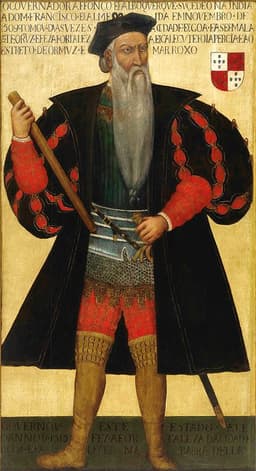
Afonso de Albuquerque
General · Medieval
79.6Total
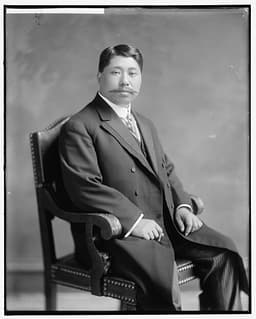
Huang Xing
General · Modern
57.5Total
Basic Information
Born
1453
1874
Died
1515
1916
Era
Medieval
Modern
Nationality
Portugal
China
Occupation
General
General
Civilization
Western
Eastern
Score Comparison
Military (10%)
77.5
46.7
Political (20%)
88.0
53.8
Influence (20%)
80.0
62.0
Legacy (20%)
75.0
56.0
Leadership (15%)
78.0
62.0
Strategy (15%)
82.0
60.0
TOTAL
79.6
57.5
Afonso de Albuquerque — Complete Timeline
1503 AD
First voyage to IndiaWar◆ Major
Afonso de Albuquerque led a fleet to India, establishing the first Portuguese fort at Cochin. This voyage laid the foundation for Portuguese control of the Indian Ocean trade.
ExplorationColonialismIndia
Impact: global
1510 AD
Conquest of GoaWar◆ Major
Albuquerque captured Goa from the Sultan of Bijapur. He made Goa the capital of Portuguese India, a position it held for over 400 years.
ConquestColonialismIndia
Impact: regional
1511 AD
Conquest of MalaccaWar◆ Major
Albuquerque led a Portuguese fleet to capture the strategic port of Malacca. This gave Portugal control of the spice trade route between the Indian Ocean and the Pacific.
ConquestSpice TradeSoutheast Asia
Impact: global
1513 AD
Siege of AdenWar
Albuquerque attempted to capture Aden in Yemen but failed. This failure prevented Portugal from controlling the entrance to the Red Sea and limited their influence in the region.
SiegeFailureRed Sea
Impact: regional
1515 AD
Death at seaOther◆ Major
Afonso de Albuquerque died at sea off the coast of Goa, possibly from illness or poison. His death left the Portuguese Empire in the Indian Ocean without its most capable leader.
DeathLeadershipEmpire
Impact: regionaltragic
Huang Xing — Complete Timeline
1905 AD
Co-founded the TongmenghuiPolitical Action◆ Major
Huang Xing co-founded the Tongmenghui (Revolutionary Alliance) in Tokyo with Sun Yat-sen. He became its military leader, organizing armed uprisings against the Qing dynasty.
TongmenghuiRevolutionMilitary
Impact: nationalconstructive
1911 AD
Led the Wuchang UprisingWar
Huang Xing led the Wuchang Uprising, which sparked the Xinhai Revolution. He commanded revolutionary forces against Qing troops, securing initial victories that led to the dynasty's collapse.
Xinhai RevolutionUprisingMilitary
Impact: nationalconstructive
1912 AD
Served as Minister of War in the RepublicPolitical Action◆ Major
Huang Xing served as Minister of War in the provisional government of the Republic of China. He worked to organize a national army and defend the republic against counter-revolutionary forces.
GovernmentMilitaryRepublic
Impact: nationalconstructive
1913 AD
Led the Second Revolution Against Yuan ShikaiWar◆ Major
Huang Xing led the Second Revolution, an armed uprising against President Yuan Shikai's authoritarian rule. The rebellion failed due to lack of coordination and military inferiority, forcing Huang into exile.
Second RevolutionYuan ShikaiExile
Impact: nationaltragic
1916 AD
Died in Exile in ShanghaiPolitical Action
Huang Xing died in Shanghai after returning from exile in Japan and the United States. His death marked the loss of a key military leader of the Chinese revolution, though his legacy endured.
DeathExileRevolution
Impact: nationaltragic
Expert Analysis
Afonso de Albuquerque vs Huang Xing
# Two Architects of Empire, Two Tragedies of Fate
On a winter morning in 1515, a Portuguese fleet lay anchored off the coast of Goa. Inside the flagship, Afonso de Albuquerque lay dying—perhaps from illness, perhaps from poison, the historical record is unclear. As the man who had carved out an oceanic empire from nothing took his last breath, half a world away and four centuries later, another general was being born into a crumbling empire of a different kind. Huang Xing came into the world in 1874, in the twilight of the Qing Dynasty, a child who would grow up to help tear down the oldest monarchy on earth. One man built an empire; the other destroyed one. Yet both were consumed by the same relentless tide of history.
Origins
Albuquerque was born into the hard, sun-baked nobility of 15th-century Portugal, a kingdom poised on the edge of Europe and the edge of the known world. His father was a lord, his mother a lady of the court, and young Afonso grew up breathing the salt air of Lisbon’s harbor, where caravels returned from Africa laden with gold and slaves. The Portuguese had already begun their great maritime push—Prince Henry the Navigator had died just thirteen years before Albuquerque’s birth—and the young nobleman absorbed the ethos of crusade and commerce that defined his era. He learned mathematics, navigation, and the art of war, but more importantly, he learned that the world was there for the taking.
Huang Xing’s origins could not have been more different. Born in a rural village in Hunan province, he grew up in a China that had been humiliated by foreign powers—the Opium Wars, the unequal treaties, the Taiping Rebellion. His father was a scholar-official, but the family had fallen on hard times. Young Huang studied the Confucian classics, but he also read Western books smuggled in from Japan. He saw his civilization in decline and felt the shame of it in his bones. Where Albuquerque saw an open sea, Huang Xing saw a closed door that needed to be kicked down.
Rise to Power
Albuquerque’s rise was the product of patronage and timing. In 1503, at age fifty, he led his first fleet to India, establishing a fort at Cochin. This was not a glorious arrival—he was one of many Portuguese captains jostling for favor with King Manuel I. But Albuquerque was methodical, patient, and ruthless. He understood that the Indian Ocean was not a frontier but a network of trade routes controlled by Muslim merchants and Hindu kings. To break into that network, he needed not just ships but fortresses, alliances, and terror.
Huang Xing’s rise was far more precarious. In 1905, at age thirty-one, he co-founded the Tongmenghui in Tokyo with Sun Yat-sen. While Sun was the visionary and the orator, Huang was the organizer and the warrior. He recruited soldiers, smuggled weapons, and planned uprisings that failed again and again. His path to power was not through royal favor but through secret societies, exiled revolutionaries, and the desperate hope of a generation that had run out of patience.
Leadership & Governance
Albuquerque governed like a Roman proconsul. After conquering Goa in 1510—a brutal siege that left the city in flames—he made it the capital of Portuguese India, immediately implementing a policy of racial intermarriage and religious conversion. He encouraged Portuguese men to marry local women, creating a mixed-race class loyal to Lisbon. He built hospitals, churches, and a naval arsenal. But he also burned mosques, massacred prisoners, and crucified rebels. His genius was strategic: he understood that controlling the choke points of the Indian Ocean—Malacca in 1511, Hormuz in 1515—was worth more than conquering vast territories. The spice trade flowed through his hands, and he squeezed it dry.
Huang Xing’s governance was the opposite. He served as Minister of War in the provisional republic of 1912, but he was a revolutionary, not an administrator. His task was not to build an empire but to dismantle one—and then to build a nation from the rubble. He failed. The republic was weak, the generals were ambitious, and Sun Yat-sen’s idealism clashed with Yuan Shikai’s authoritarianism. Huang tried to lead a Second Revolution in 1913 against Yuan, but the rebellion collapsed. He fled into exile, a general without an army, a builder without materials.
Triumph & Tragedy
Albuquerque’s greatest triumph was the conquest of Malacca in 1511. He led a fleet of eighteen ships against a fortified city defended by tens of thousands. The battle was fierce, but Albuquerque’s discipline and artillery prevailed. When the city fell, he wrote to the king: “I have taken Malacca, and with it the key to all the East.” It was not an exaggeration. For a century, Portugal would dominate the spice trade from this single port.
His greatest tragedy was the failed siege of Aden in 1513. He had planned to capture the city and seal off the Red Sea, cutting off the Muslim spice route to the Mediterranean. But the walls were too high, the defenders too numerous, and his ships too few. He withdrew, and the failure haunted him. On his deathbed, he reportedly said, “I have done nothing worthy of a man.”
Huang Xing’s triumph was the Wuchang Uprising of 1911, which he led personally. It was a desperate gamble—a small force of revolutionaries against the Qing army—but it sparked a wildfire that consumed the empire. Within months, the dynasty fell, and the Republic of China was born. Huang was hailed as a hero.
His tragedy came soon after. The republic he helped found was stolen by Yuan Shikai, who declared himself emperor in 1915. Huang led another rebellion, but it failed. He died in Shanghai in 1916, at age forty-two, a broken man who had seen his life’s work crumble. His last words, it is said, were: “The revolution is not yet finished.”
Character & Destiny
Albuquerque was a man of iron will and cold calculation. He trusted no one, forgave nothing, and drove himself and his men to the edge of madness. His letters to the king are filled with complaints about rivals at court, mutinous captains, and the loneliness of command. Yet he never wavered. His destiny was to build, and he built with blood and stone.
Huang Xing was a man of passion and principle. He was brave—in battle, he led from the front—but he was not a politician. He believed in democracy, but he did not know how to make it work in a country of four hundred million people. His destiny was to tear down, but he could not build. The difference between them is the difference between an age of empire and an age of revolution.
Legacy
Albuquerque is remembered as the founder of the Portuguese Empire in the East. His statue stands in Lisbon, and his name is carved into the history of Asia. But his empire was fragile, and within a century, the Dutch and the English would strip it away. Today, his legacy is contested: a hero of exploration or a pioneer of colonialism.
Huang Xing is remembered as a co-founder of the Chinese republic, but his name is overshadowed by Sun Yat-sen’s. In mainland China, he is a footnote; in Taiwan, a minor hero. His tragedy is that he succeeded in destroying the old order but failed to create a new one.
Conclusion
Both men were architects of worlds that did not survive them. Albuquerque built an empire that crumbled; Huang Xing tore down an empire that was replaced by something worse. Their stories remind us that the arc of history is not always upward—it bends, breaks, and sometimes leaves only ruins behind. The question they leave us is not whether we can build or destroy, but whether we can build something that lasts.
Rankings
🥇
Afonso de AlbuquerqueLeader
Mil: 77.5Pol: 88.0Inf: 80.0
79.6
🥈
Huang Xing
Mil: 46.7Pol: 53.8Inf: 62.0
57.5
+22.1 behind
How This Comparison Works
Algorithm
Each figure is scored on 6 dimensions (0—100 scale) based on structured historical data: Military (10%), Political (20%), Influence (20%), Legacy (20%), Leadership (15%), Strategy (15%). The weighted total produces the final ranking.
Data Sources
Scores are computed from structured sub-indicators in the database. Scale factors adjust for era (Ancient ×0.85, Modern ×1.0) and civilization size (Eastern ×1.05, Other ×0.80) to account for differences in population and military scale.
Maximum 3 Figures
Comparisons are limited to 2—3 figures to ensure readability and statistical meaningfulness.
Error Margins
±5 points per dimension — Sub-scores are derived from historical records with inherent uncertainty. Two figures within 5 points on a dimension should be considered roughly equivalent in that area.
Total Score Accuracy
±3 points overall — The weighted combination of 6 dimensions produces a total score with approximately ±3 points of uncertainty. Differences of less than 3 points are not statistically significant— the figures are effectively tied.
Known Limitations
- Historical records are incomplete and uneven across civilizations
- Figures from oral-tradition societies may be underrepresented
- Occupation labels can misclassify multi-role figures
- Scores measure capability and impact, not moral character
- Quantitative scoring is a comparison tool, not absolute truth
Capability Radar
Military (10%) — Battles & Warfare
Battles
85
35
Win Rate
80
30
Expansion
95
20
Political (20%) — Governance & Reform
Reform
80
60
Diplomacy
85
55
Economy
80
30
Influence (20%) — Cultural & Global Reach
Cultural
70
40
Global
85
40
Legacy (20%) — Historical Impact
Historical
85
55
Longevity
80
45
Leadership (15%) — Power & Stability
Tenure
70
40
Stability
65
25
Strategy (15%) — Tactics & Innovation
Strategy
95
45
Tactics
90
40
Reform
75
50
Similar Comparisons
Comments & Discussion
GoaButcher6/16/2026
Albuquerque was a strategic genius, but he died believing he'd failed. Think about it: he conquered Goa, Malacca, Hormuz—the three keys to Indian Ocean trade—yet was recalled in disgrace by a paranoid king. Huang Xing at least saw the Republic he fought for. The Portuguese admiral created an empire from a rowboat, true, but his last letters reek of bitterness. History remembers him as "the Great," but I'd call him the Great Failure who won anyway.
晚清铁拳6/16/2026
黄兴才是真正干实事的人,不是孙中山那种只会喊口号的空想家。仔细看看数据:1911年武昌起义,是他亲自率敢死队冲锋陷阵,而不是躲在海外发传单。他领导的黄花岗起义虽然失败,但72烈士的鲜血直接点燃了全国革命热情。相比之下,阿尔布开克不过是葡萄牙殖民主义的刽子手,靠屠杀手无寸铁的印度平民建立"功业",这种血腥之路有什么值得尊敬的?
DromonDoubt6/16/2026
"Two architects of empire"? That's romanticizing colonial violence. Albuquerque's fleet bombarded Malacca's wooden defenses with iron cannonballs, yes, but he also burned the port's entire Muslim quarter—merchants, women, children. Huang Xing's revolutionaries targeted symbols of oppression, not civilian populations. There's a moral chasm here that no clever comparison can bridge. One man built on ashes, the other on ideals.
地理侦探6/16/2026
哎,拿海洋帝国和大陆革命家比较,根本是风马牛不相及。阿尔布开克的战略核心是控制三个海峡:霍尔木兹、马六甲、巴布·厄尔·曼德,靠的是季风规律和战舰机动性。黄兴呢?他在日本学军事,回国后组织的是山地游击战和城市暴动——完全不同的战争逻辑。这就好比拿鲨鱼和老虎比较谁更凶猛,输了赢了都说明不了什么本质问题。
SoulOfEmpire6/16/2026
What strikes me isn't their tactics but their shared loneliness. Albuquerque wrote wistfully of being forgotten by Lisbon's courtiers who never left the Tagus River. Huang Xing lived long enough to see his revolution co-opted by military strongmen. Empire-builders and empire-destroyers both end up as footnotes to forces larger than themselves. The Goan fortresses still stand; the Chinese Republic's early promise crumbled. That's the real tragedy neither man could outrun.