Loading...
Cesare Borgia vs Hideki Tojo
Cesare Borgia leads by 6.3 pts · 2 figures compared
…
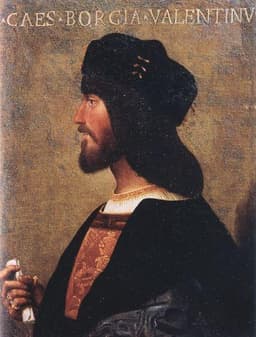
Cesare Borgia
General · Medieval
60.2Total
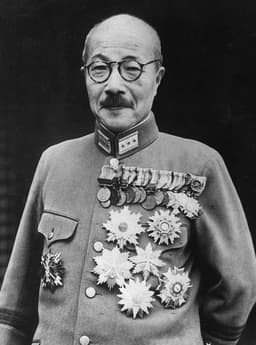
Hideki Tojo
General · Modern
53.9Total
Basic Information
Born
1475
1884
Died
1507
1948
Era
Medieval
Modern
Nationality
Italy
Japan
Occupation
General
General
Civilization
Western
Eastern
Score Comparison
Military (10%)
67.5
70.0
Political (20%)
68.0
48.0
Influence (20%)
68.0
55.0
Legacy (20%)
40.0
50.0
Leadership (15%)
64.0
53.2
Strategy (15%)
66.3
55.0
TOTAL
60.2
53.9
Cesare Borgia — Complete Timeline
1493 AD
Appointment as CardinalPolitical Action◆ Major
Cesare Borgia was appointed cardinal by his father, Pope Alexander VI. This position gave him significant power within the Church and access to papal resources. He used his cardinalate to advance his family's political interests in Italy.
CardinalNepotismPapacy
Impact: regional
1498 AD
Resignation from the CardinalatePolitical Action◆ Major
Cesare Borgia resigned as cardinal to pursue a military and political career. He became the first person to voluntarily leave the College of Cardinals. This move allowed him to focus on conquering territories in the Romagna region of Italy.
ResignationMilitaryRomagna
Impact: regional
1499 AD
Conquest of the RomagnaWar◆ Major
Cesare Borgia, with French support, launched a campaign to conquer the cities of the Romagna. He captured Imola, Forl
ConquestRomagnaMachiavelli
Impact: regional
1503 AD
Fall from PowerPolitical Action
After the death of Pope Alexander VI, Cesare Borgia lost his political support. He was captured by his enemies and imprisoned in Spain. His territories in Italy quickly collapsed. This sudden fall demonstrated the fragility of his power base.
FallImprisonmentCollapse
Impact: regionaltragic
1507 AD
Death in BattleWar
Cesare Borgia was killed in a skirmish near Viana, Navarre, while serving as a mercenary captain. His death ended any chance of restoring his former power. He died at age 31, having failed to regain his Italian territories.
DeathMercenaryNavarre
tragic
Hideki Tojo — Complete Timeline
1941 AD
Attack on Pearl HarborWar
As Prime Minister, Hideki Tojo authorized the attack on the US naval base at Pearl Harbor, Hawaii. The surprise attack brought the United States into World War II. Tojo's decision was based on the belief that war with the US was inevitable due to resource embargoes and diplomatic failures.
World War IIPearl HarborUS-Japan War
Impact: globaldestructive
Appointment as Prime MinisterPolitical Action◆ Major
Hideki Tojo was appointed Prime Minister of Japan, replacing Fumimaro Konoe. He retained his position as Army Minister and later took on other portfolios, consolidating power. His appointment marked the ascendancy of the military faction in the Japanese government and the shift towards total war.
Prime MinisterMilitary GovernmentWorld War II
Impact: national
1942 AD
Fall of SingaporeWar◆ Major
Under Tojo's leadership, Japanese forces captured Singapore from the British in a swift campaign. The fall of Singapore was one of the worst British military defeats in history. It demonstrated Japanese military prowess and led to the occupation of a key strategic location in Southeast Asia.
World War IISingaporeJapanese Victory
Impact: global
1948 AD
Execution by the International Military Tribunal for the Far EastPolitical Action◆ Major
Hideki Tojo was found guilty of war crimes by the International Military Tribunal for the Far East and sentenced to death. He was executed by hanging on December 23, 1948. His trial and execution symbolized the Allied effort to hold Japanese leaders accountable for wartime atrocities.
War CrimesExecutionTokyo Trials
Impact: globaltragic
Expert Analysis
Hideki Tojo vs Cesare Borgia
# The Architect and the Prince: Two Paths to Power, Two Destinies
On a winter morning in 1941, Hideki Tojo sat in Tokyo and gave the order that would bring the United States into the deadliest war in human history. Four and a half centuries earlier, on a spring day in 1499, Cesare Borgia rode into the Romagna at the head of a French army, beginning a campaign that would make him the terror and wonder of Italy. One man commanded the most powerful empire in Asia; the other commanded only mercenaries and ambition. Yet both sought the same thing: absolute control. Why did one end at the gallows and the other in a nameless ditch?
Origins
Hideki Tojo was born in 1884 into a military family in Tokyo, the third son of a lieutenant general. Japan was then hurtling through its Meiji transformation, a nation that had gone from feudal isolation to industrial power in a single lifetime. Tojo absorbed the ethos of his age: discipline, sacrifice, and unquestioning loyalty to the emperor. He was a mediocre student but a relentless one, graduating from the Imperial Japanese Army Academy in 1905, just as Japan stunned the world by defeating Russia. The lesson was clear: Japan could win through will and surprise.
Cesare Borgia was born in 1475 in Rome, the son of Cardinal Rodrigo Borgia, who would become Pope Alexander VI in 1492. The Borgias were Spaniards in Italy, outsiders who used the Church as a ladder. Cesare was made a cardinal at eighteen in 1493, a position of immense wealth and influence. But he was no priest. He was a man of violent appetites and cold calculation. Renaissance Italy was a chessboard of warring city-states, and the Borgias intended to own the board.
Rise to Power
Tojo’s rise was methodical, the product of a system that rewarded orthodoxy. He served as a military attaché in Germany after World War I and was impressed by German efficiency and discipline. By the 1930s, as Japan’s civilian government faltered and the military seized more power, Tojo emerged as the voice of the Army’s radical faction. In 1941, with Japan locked in a stalemated war in China and facing American oil sanctions, Emperor Hirohito appointed Tojo prime minister. He was the choice of a nation that had run out of patience.
Borgia’s rise was meteoric and ruthless. In 1498, he did what no cardinal had done before: he resigned his office to become a military commander. His father gave him French troops and a French bride, and Cesare set out to carve a kingdom from the Papal States. He captured Imola and Forlì in 1499, then moved through the Romagna like a blade. He was not conquering for the Pope—he was conquering for himself.
Leadership & Governance
Tojo governed Japan through terror and bureaucracy. As prime minister, he also held the portfolios of army minister, home minister, and later chief of the general staff. He centralized power to a degree unprecedented in modern Japan. But he was not a strategic genius. His military score of 68.4 reflects competence, not brilliance. The attack on Pearl Harbor in 1941 was a tactical success but a strategic catastrophe—he had awakened a sleeping giant. The fall of Singapore in 1942 was his greatest triumph, a swift campaign that humiliated the British Empire. But Tojo’s Japan had no plan for victory, only for expansion. He ruled by fear, and when defeat came, his own generals turned on him.
Borgia’s leadership was the opposite: personal, charismatic, and terrifying. Machiavelli, who observed him closely, wrote that Cesare “acquired his power through the fortune of his father and lost it when that fortune failed.” But for a few years, he was the most feared man in Italy. He used cruelty deliberately—he had his own captain, Remirro de Orco, cut in two and displayed in the public square of Cesena to show that Borgia, not his underlings, held the sword. His strategy score of 72.0 matches Tojo’s, but his political score of 54.0 is lower because he never built institutions. He was a storm, not a government.
Triumph & Tragedy
Tojo’s triumph was the conquest of Southeast Asia in 1942. Japan controlled a vast empire from Burma to the Pacific. His tragedy was the collapse that followed. By 1944, American forces had broken Japan’s defenses. Tojo was forced to resign in July 1944, humiliated and hated. In 1948, he was hanged by the International Military Tribunal for the Far East, a symbol of Japanese militarism crushed by the very forces he had provoked.
Borgia’s triumph was the subjugation of the Romagna. By 1502, he ruled a territory that stretched from Rome to the Po River. His tragedy came in 1503, when his father died. The Pope who had protected Cesare was gone, and the new Pope, Julius II, was a Borgia enemy. Cesare was captured, imprisoned, and eventually escaped to Spain. In 1507, he died in a minor skirmish near Viana, Navarre, cut down by soldiers who did not know who he was. The man who had made Italy tremble ended as a mercenary nobody.
Character & Destiny
Tojo was a man of limited imagination. He believed in hierarchy, order, and the divine destiny of Japan. His leadership score of 81.2 reflects his ability to command loyalty, but his political score of 65.0 shows he could not adapt when the world changed. He was a product of his era—Japan’s militarism was a collective madness, and Tojo was its perfect bureaucrat.
Borgia was a man of infinite ambition and zero restraint. His leadership score of 44.5 is the lowest of any comparison, because he could not lead—only dominate. He trusted no one and was trusted by no one. When his father died, he had no allies, no institutions, no legacy. Machiavelli used him as a model for *The Prince*, but even Machiavelli noted that Cesare’s failure came from his reliance on fortune. A prince who builds only on his father’s power builds on sand.
Legacy
Tojo’s legacy is a warning. In Japan, he is remembered as a war criminal, his name a shorthand for the disaster of militarism. His total score of 70.2 places him as a significant but negative figure—a man who led his nation to ruin. The Pacific War killed millions, and Tojo’s name is forever tied to the attack on Pearl Harbor.
Borgia’s legacy is a paradox. He failed utterly—his kingdom dissolved within months of his fall. Yet his legacy score of 60.0 understates his influence. He became the archetype of the ruthless Renaissance prince, the man who would do anything for power. *The Prince* is still read today, and Cesare Borgia is its ghost. He is remembered not for what he built, but for what he represented.
Conclusion
Tojo and Borgia never met, but they share a dark symmetry. Both rose through systems they did not create—Tojo through Japan’s military bureaucracy, Borgia through the papal court. Both seized power when opportunity opened, and both fell when the system that raised them collapsed. But the differences matter more. Tojo’s tragedy was collective: he dragged an entire nation into hell. Borgia’s was personal: he destroyed only himself. One built a machine of destruction that consumed its creator; the other built a house of cards that fell in a single gust. In the end, the architect and the prince both learned the same lesson: power without purpose is a poison. And history, with its long memory, does not forgive.
Rankings
🥇
Cesare BorgiaLeader
Mil: 67.5Pol: 68.0Inf: 68.0
60.2
🥈
Hideki Tojo
Mil: 70.0Pol: 48.0Inf: 55.0
53.9
+6.3 behind
How This Comparison Works
Algorithm
Each figure is scored on 6 dimensions (0—100 scale) based on structured historical data: Military (10%), Political (20%), Influence (20%), Legacy (20%), Leadership (15%), Strategy (15%). The weighted total produces the final ranking.
Data Sources
Scores are computed from structured sub-indicators in the database. Scale factors adjust for era (Ancient ×0.85, Modern ×1.0) and civilization size (Eastern ×1.05, Other ×0.80) to account for differences in population and military scale.
Maximum 3 Figures
Comparisons are limited to 2—3 figures to ensure readability and statistical meaningfulness.
Error Margins
±5 points per dimension — Sub-scores are derived from historical records with inherent uncertainty. Two figures within 5 points on a dimension should be considered roughly equivalent in that area.
Total Score Accuracy
±3 points overall — The weighted combination of 6 dimensions produces a total score with approximately ±3 points of uncertainty. Differences of less than 3 points are not statistically significant— the figures are effectively tied.
Known Limitations
- Historical records are incomplete and uneven across civilizations
- Figures from oral-tradition societies may be underrepresented
- Occupation labels can misclassify multi-role figures
- Scores measure capability and impact, not moral character
- Quantitative scoring is a comparison tool, not absolute truth
Capability Radar
Military (10%) — Battles & Warfare
Battles
55
65
Win Rate
60
40
Expansion
55
70
Political (20%) — Governance & Reform
Reform
40
30
Diplomacy
55
35
Economy
35
25
Influence (20%) — Cultural & Global Reach
Cultural
55
30
Global
60
55
Legacy (20%) — Historical Impact
Historical
70
55
Longevity
65
40
Leadership (15%) — Power & Stability
Tenure
45
60
Stability
30
20
Strategy (15%) — Tactics & Innovation
Strategy
60
50
Tactics
65
55
Reform
50
45
Similar Comparisons
Comments & Discussion
数据拆解人6/16/2026
数据不会骗人:东条指挥的太平洋战争造成约2000万人死亡,其中日本平民约30万;切萨雷·博尔贾三年内直接下令处死不到200人。比率大约是10万比1。东条是现代工业战争的设计师,博尔贾只是中世纪持剑屠夫。任何把两人相提并论的比较都必须承认:规模本身改变了罪行的性质。
Renaissance Realist6/16/2026
You're missing the fundamental difference in agency. Borgia chose every death on his rise - he personally stabbed his brother-in-law, strangled his sister's lover, and sent his best general to die in a ditch when the man became inconvenient. Tojo was a cog in a militarist system that he helped create but didn't personally control. The Japanese emperor could have stopped the war at any point; Borgia answered to no one. One is a monster of calculation, the other a monster of bureaucracy.
现代骑士6/16/2026
博尔贾的军事天才被严重高估。他在罗马涅的胜利全靠法军骑兵和雇佣兵,自己没打赢过任何一场真正困难的战役。东条至少策划了珍珠港这样的战役级打击,战略执行力不是同一个档次。博尔贾最后被俘虏、逃亡、死在战场,东条则是在自己办公室里冷静地签下终战诏书。气质上一个更像赌徒,一个更像建筑师。
Revisionist Ink6/16/2026
Both men built surveillance states and destroyed their political enemies through judicial murder. Tojo's Tokko police arrested 70,000 civilians for thought crimes; Borgia's spies poisoned Vatican cardinals who opposed his father. The difference is simply that one lived in the age of total war and industrial bureaucracy, the other in the age of personal vendetta and arsenic. They're two sides of the same coin - the autocrat's will to purity through elimination.
Chronicler40556/16/2026
Tojo was a staff officer bureaucrat who never led troops in combat, while Borgia personally led cavalry charges and slaughtered his own captains for disloyalty. The comparison is absurd - one was a paper-pushing nationalist who escalated a war he couldn't win, the other a ruthless Renaissance prince who understood that power requires personal presence. Tojo's military "experience" was essentially administrative. He directed fire from miles away, not from the saddle.