Loading...
Cesare Borgia vs Fuad Chehab
Cesare Borgia leads by 10.3 pts · 2 figures compared
…
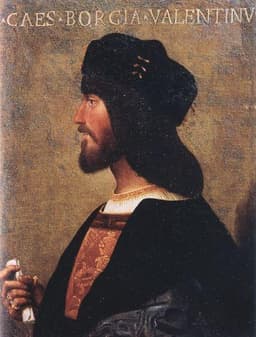
Cesare Borgia
General · Medieval
60.2Total
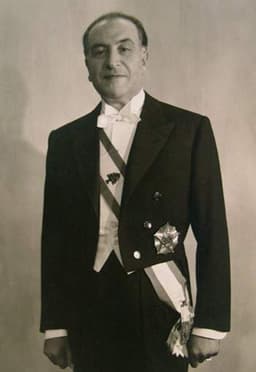
Fuad Chehab
General · Modern
49.9Total
Basic Information
Born
1475
1902
Died
1507
1973
Era
Medieval
Modern
Nationality
Italy
Lebanon
Occupation
General
General
Civilization
Western
Middle Eastern
Score Comparison
Military (10%)
67.5
10.2
Political (20%)
68.0
70.0
Influence (20%)
68.0
54.1
Legacy (20%)
40.0
44.2
Leadership (15%)
64.0
72.0
Strategy (15%)
66.3
30.3
TOTAL
60.2
49.9
Cesare Borgia — Complete Timeline
1493 AD
Appointment as CardinalPolitical Action◆ Major
Cesare Borgia was appointed cardinal by his father, Pope Alexander VI. This position gave him significant power within the Church and access to papal resources. He used his cardinalate to advance his family's political interests in Italy.
CardinalNepotismPapacy
Impact: regional
1498 AD
Resignation from the CardinalatePolitical Action◆ Major
Cesare Borgia resigned as cardinal to pursue a military and political career. He became the first person to voluntarily leave the College of Cardinals. This move allowed him to focus on conquering territories in the Romagna region of Italy.
ResignationMilitaryRomagna
Impact: regional
1499 AD
Conquest of the RomagnaWar◆ Major
Cesare Borgia, with French support, launched a campaign to conquer the cities of the Romagna. He captured Imola, Forl
ConquestRomagnaMachiavelli
Impact: regional
1503 AD
Fall from PowerPolitical Action
After the death of Pope Alexander VI, Cesare Borgia lost his political support. He was captured by his enemies and imprisoned in Spain. His territories in Italy quickly collapsed. This sudden fall demonstrated the fragility of his power base.
FallImprisonmentCollapse
Impact: regionaltragic
1507 AD
Death in BattleWar
Cesare Borgia was killed in a skirmish near Viana, Navarre, while serving as a mercenary captain. His death ended any chance of restoring his former power. He died at age 31, having failed to regain his Italian territories.
DeathMercenaryNavarre
tragic
Fuad Chehab — Complete Timeline
1958 AD
Launched Chehabist reforms and modernizationReform◆ Major
President Chehab implemented a series of reforms known as Chehabism, including administrative modernization, economic planning, and strengthening state institutions. He established the Central Bank of Lebanon and the Civil Service Board.
ReformModernizationState Building
Impact: nationalconstructive
Elected President of LebanonPolitical Action◆ Major
Fuad Chehab was elected President of Lebanon on September 23, 1958, succeeding Camille Chamoun. His election ended the 1958 crisis and was supported by both Christian and Muslim factions seeking stability.
PresidencyElectionStabilization
Impact: nationalconstructive
Created the Deuxième Bureau intelligence agencyPolitical Action
Chehab expanded the role of the Deuxi
IntelligenceSecurityAuthoritarianism
Impact: national
1960 AD
Presided over the 1960s economic boomOther
Under Chehab's presidency, Lebanon experienced a period of economic growth and stability, with Beirut becoming a major financial and tourism hub. His policies attracted foreign investment and expanded the middle class.
Economic GrowthBeirutProsperity
Impact: nationalconstructive
1964 AD
Refused to amend constitution for a second termPolitical Action
Chehab declined to seek a second term as president, respecting the constitutional limit. He retired from politics in 1964, setting a precedent for peaceful transitions of power in Lebanon.
ConstitutionTerm LimitRetirement
Impact: nationalconstructive
Expert Analysis
Fuad Chehab vs Cesare Borgia
# The Prince and the Peacemaker
In the autumn of 1503, Cesare Borgia lay sick in Rome, burning with fever as his father Pope Alexander VI died in the next room. Within weeks, the man who had carved a kingdom from the heart of Italy would be a prisoner, stripped of everything. Four and a half centuries later, in the summer of 1958, Fuad Chehab stood at the head of a Lebanese army that refused to take sides in a civil war, watching as a divided nation turned to him for salvation. One man sought to conquer through terror; the other sought to unite through restraint. Both were generals. Both shaped the destiny of their lands. Yet their paths could not have diverged more sharply.
Origins
Cesare Borgia was born in 1475 into the most notorious family of Renaissance Italy. His father, Rodrigo Borgia, would become Pope Alexander VI, and Cesare grew up immersed in the cynical politics of the Vatican, where poison and piety coexisted. At nineteen, he was made a cardinal—a position of immense power, but one that chafed against his ambitions. He was the son of a pope in an age when the Church was a battlefield, and his destiny seemed written in blood before he could speak.
Fuad Chehab entered the world in 1902 in Beirut, then part of the Ottoman Empire. His family belonged to the Maronite Christian elite, but his father died when he was young, and he was raised in a household that valued duty over dynasty. Lebanon was a mosaic of sects—Christians, Muslims, Druze—held together by fragile compromise. Chehab grew up in a world where survival meant balance, not conquest.
The difference in their eras is crucial. Borgia lived in a time when power was personal, territorial, and absolute—a prince could seize a city with a sword and call it justice. Chehab lived in a century of nation-states, constitutions, and Cold War pressures, where power required negotiation, not annihilation.
Rise to Power
Cesare Borgia’s rise was spectacular and brutal. In 1498, he did what no cardinal had done before: he resigned his ecclesiastical rank to become a military commander. His father granted him French troops, a title, and a bride from the French royal house. Within a year, he launched his campaign to conquer the Romagna, a patchwork of petty lordships. He captured Imola and Forlì, then moved against the cities of Urbino and Camerino. His method was simple: offer terms, then destroy those who resisted. In 1502, he lured his rebellious captains to the town of Senigallia and had them strangled. Machiavelli, who observed him closely, would later write that Borgia understood that “it is much safer to be feared than loved.”
Fuad Chehab rose through ranks of a different kind. He joined the French military academy at Saint-Cyr, then returned to serve in the Lebanese army under the French Mandate. When Lebanon gained independence in 1943, he became commander of the army. During the 1958 crisis—a sectarian civil war between pro-Western Christians and Arab nationalist Muslims—Chehab refused to order his soldiers to fire on civilians. The army stayed in its barracks, preserving its neutrality. When President Camille Chamoun stepped down, the parliament elected Chehab as a compromise candidate. He did not seize power; power was thrust upon him.
Leadership & Governance
Cesare Borgia governed through fear and calculation. In the Romagna, he appointed a brutal governor to pacify the province, then had the governor executed to win back the people’s affection—a move Machiavelli admired as a masterstroke of statecraft. Borgia’s military strategy was aggressive, decisive, and utterly dependent on his father’s papal support. He built a centralized state through conquest, but he never built institutions. His power was personal, and therefore fragile.
Fuad Chehab governed through reform and institution-building. His philosophy, known as Chehabism, sought to modernize Lebanon’s administration, create a civil service, and reduce sectarian tensions through economic development. He established the Central Bank, launched a planning council, and expanded the Deuxième Bureau intelligence agency to monitor political opponents. Unlike Borgia, Chehab understood that power must be shared. He presided over Lebanon’s economic boom in the early 1960s, when Beirut became the banking capital of the Middle East. But his reliance on intelligence surveillance also planted seeds of distrust that would later haunt the country.
Triumph & Tragedy
Cesare Borgia’s greatest moment came in 1502, when he seemed unstoppable—the Duke of Romagna, master of central Italy, poised to create a Borgia kingdom. His tragedy followed swiftly. When Pope Alexander VI died in 1503, Borgia’s enemies closed in. He was imprisoned by Pope Julius II, escaped, and fled to Navarre, where he died in 1507 in a meaningless skirmish, cut down by a spear. His kingdom evaporated within months.
Fuad Chehab’s triumph was his presidency itself—a quiet, constitutional revolution that averted civil war. His tragedy was that his reforms could not outlast him. After he refused to amend the constitution for a second term in 1964 and retired, Lebanon’s sectarian tensions resurfaced. The fragile balance he maintained collapsed into civil war a decade later.
Character & Destiny
Cesare Borgia was ruthless, brilliant, and utterly unconstrained by morality. He believed that a prince must be both lion and fox—strong enough to terrify, cunning enough to deceive. His destiny was shaped by his father’s rise and fall; he was a shooting star, burning bright but brief.
Fuad Chehab was cautious, principled, and deeply aware of limits. He believed that Lebanon could survive only if no one sect dominated. His destiny was shaped by his refusal to overreach. He chose stability over glory, and for that, history remembers him as a father figure—but also as a man who could not save his country from itself.
Legacy
Cesare Borgia’s legacy is paradoxical. He failed utterly in his own time, yet he became the model for Machiavelli’s *The Prince*, a manual for realpolitik that has influenced leaders from Napoleon to modern autocrats. He is remembered as the archetype of the Renaissance prince—amoral, ambitious, and doomed.
Fuad Chehab left a quieter legacy. He is remembered in Lebanon as a symbol of national unity, a general who refused to kill his own people. His reforms shaped Lebanese governance for decades, even if they could not prevent the war to come. In the Middle East, where strongmen often rule through force, Chehab stands as an alternative: a leader who chose restraint.
Conclusion
Two generals, two worlds. Cesare Borgia tried to build a kingdom through fear and failed. Fuad Chehab tried to build a nation through trust and partly succeeded. One died in a ditch; the other died in his bed. Yet both understood the deepest truth of power: it is never held alone. Borgia learned this too late, Chehab just in time. In the end, the prince who inspired Machiavelli and the president who inspired a generation both remind us that leadership is not about how high you rise, but how you fall—and what you leave behind.
Rankings
🥇
Cesare BorgiaLeader
Mil: 67.5Pol: 68.0Inf: 68.0
60.2
🥈
Fuad Chehab
Mil: 10.2Pol: 70.0Inf: 54.1
49.9
+10.3 behind
How This Comparison Works
Algorithm
Each figure is scored on 6 dimensions (0—100 scale) based on structured historical data: Military (10%), Political (20%), Influence (20%), Legacy (20%), Leadership (15%), Strategy (15%). The weighted total produces the final ranking.
Data Sources
Scores are computed from structured sub-indicators in the database. Scale factors adjust for era (Ancient ×0.85, Modern ×1.0) and civilization size (Eastern ×1.05, Other ×0.80) to account for differences in population and military scale.
Maximum 3 Figures
Comparisons are limited to 2—3 figures to ensure readability and statistical meaningfulness.
Error Margins
±5 points per dimension — Sub-scores are derived from historical records with inherent uncertainty. Two figures within 5 points on a dimension should be considered roughly equivalent in that area.
Total Score Accuracy
±3 points overall — The weighted combination of 6 dimensions produces a total score with approximately ±3 points of uncertainty. Differences of less than 3 points are not statistically significant— the figures are effectively tied.
Known Limitations
- Historical records are incomplete and uneven across civilizations
- Figures from oral-tradition societies may be underrepresented
- Occupation labels can misclassify multi-role figures
- Scores measure capability and impact, not moral character
- Quantitative scoring is a comparison tool, not absolute truth
Capability Radar
Military (10%) — Battles & Warfare
Battles
55
5
Win Rate
60
5
Expansion
55
5
Political (20%) — Governance & Reform
Reform
40
65
Diplomacy
55
60
Economy
35
50
Influence (20%) — Cultural & Global Reach
Cultural
55
30
Global
60
25
Legacy (20%) — Historical Impact
Historical
70
35
Longevity
65
30
Leadership (15%) — Power & Stability
Tenure
45
55
Stability
30
45
Strategy (15%) — Tactics & Innovation
Strategy
60
10
Tactics
65
10
Reform
50
20
Similar Comparisons
Comments & Discussion
No comments yet. Be the first to share your thoughts!