Loading...
Afonso de Albuquerque vs Francisco Morazan
Afonso de Albuquerque leads by 21.6 pts · 2 figures compared
…
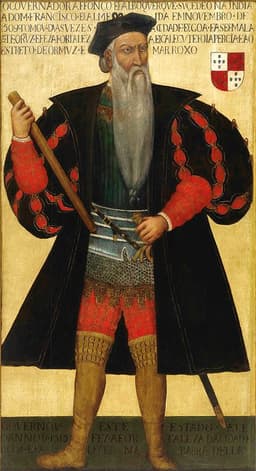
Afonso de Albuquerque
General · Medieval
79.6Total
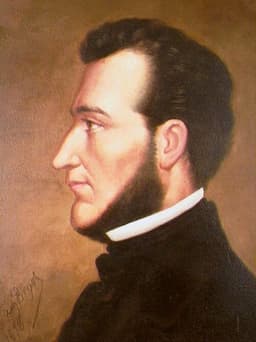
Francisco Morazan
General · Modern
58.0Total
Basic Information
Born
1453
1792
Died
1515
1842
Era
Medieval
Modern
Nationality
Portugal
Honduras
Occupation
General
General
Civilization
Western
Western
Score Comparison
Military (10%)
77.5
52.5
Political (20%)
88.0
60.0
Influence (20%)
80.0
62.0
Legacy (20%)
75.0
50.0
Leadership (15%)
78.0
68.0
Strategy (15%)
82.0
55.0
TOTAL
79.6
58.0
Afonso de Albuquerque — Complete Timeline
1503 AD
First voyage to IndiaWar◆ Major
Afonso de Albuquerque led a fleet to India, establishing the first Portuguese fort at Cochin. This voyage laid the foundation for Portuguese control of the Indian Ocean trade.
ExplorationColonialismIndia
Impact: global
1510 AD
Conquest of GoaWar◆ Major
Albuquerque captured Goa from the Sultan of Bijapur. He made Goa the capital of Portuguese India, a position it held for over 400 years.
ConquestColonialismIndia
Impact: regional
1511 AD
Conquest of MalaccaWar◆ Major
Albuquerque led a Portuguese fleet to capture the strategic port of Malacca. This gave Portugal control of the spice trade route between the Indian Ocean and the Pacific.
ConquestSpice TradeSoutheast Asia
Impact: global
1513 AD
Siege of AdenWar
Albuquerque attempted to capture Aden in Yemen but failed. This failure prevented Portugal from controlling the entrance to the Red Sea and limited their influence in the region.
SiegeFailureRed Sea
Impact: regional
1515 AD
Death at seaOther◆ Major
Afonso de Albuquerque died at sea off the coast of Goa, possibly from illness or poison. His death left the Portuguese Empire in the Indian Ocean without its most capable leader.
DeathLeadershipEmpire
Impact: regionaltragic
Francisco Morazan — Complete Timeline
1824 AD
Abolition of slavery in Central AmericaReform◆ Major
As a key leader in the liberal movement, Moraz
AbolitionSlaveryLiberal Reform
Impact: regionalprogressive
1827 AD
Battle of La TrinidadWar◆ Major
Morazán led a liberal army to victory against conservative forces at La Trinidad, Honduras. This battle was a key turning point in the Central American civil war, allowing Morazán to consolidate power and eventually become president of the federation.
BattleLiberal VictoryCivil War
Impact: regional
1830 AD
Presidency of the Federal Republic of Central AmericaPolitical Action
Morazán was elected president of the Federal Republic of Central America, a union of Guatemala, El Salvador, Honduras, Nicaragua, and Costa Rica. He pursued liberal reforms including separation of church and state, free trade, and land reform, facing opposition from conservatives.
Federal RepublicLiberal ReformsCentral America
Impact: regionalconstructive
1842 AD
Execution by firing squadPolitical Action
After a failed attempt to restore the Federal Republic, Moraz
ExecutionEnd of FederationLiberal Defeat
Impact: regionaltragic
Expert Analysis
Afonso de Albuquerque vs Francisco Morazan
# The Conqueror and the Dreamer
On a sweltering afternoon in September 1842, Francisco Morazán stood before a firing squad in San José, Costa Rica. His last words were not pleas for mercy but a defiant prophecy: “I die, but the union of Central America will live.” Twenty-seven years earlier, in December 1515, Afonso de Albuquerque had died aboard a ship off the coast of Goa, his body wracked by illness and his heart broken by royal disfavor. One man had built an empire that spanned oceans; the other had tried to forge a nation out of fractious republics. Both died far from home, victims of forces they could not control. But why did one succeed in laying foundations that lasted centuries, while the other saw his life’s work crumble within a decade? The answer lies not merely in their eras, but in the very nature of their ambitions.
Origins
Albuquerque was born into the Portuguese nobility in 1453, the year Constantinople fell to the Ottomans. He grew up in a kingdom obsessed with crusade and commerce, a small nation on the edge of Europe that had learned to look outward. His father was a courtier; his education was military and maritime. The world he inherited was one of expanding horizons—Portuguese ships were already probing the coast of Africa, seeking a sea route to the spices of the East. Albuquerque absorbed the ethos of his time: God, gold, and glory were not separate goals but a single mission.
Morazán entered the world in 1792, in Tegucigalpa, then part of the Spanish Empire’s Captaincy General of Guatemala. His family was creole, educated, and comfortable—but they lived under colonial rule. The winds of revolution were blowing from North America and France, and by the time Morazán reached adulthood, the Spanish Empire was collapsing. He was shaped not by the certainties of a crusading monarchy but by the chaos of liberal ideals clashing with conservative traditions. Where Albuquerque had a king and a clear enemy, Morazán had only principles and a fractured homeland.
Rise to Power
Albuquerque’s path was that of a professional soldier in an expanding empire. He first sailed to India in 1503, at age fifty, commanding a fleet that established the first Portuguese fort at Cochin. This was not a youthful adventure but a calculated mission: the Portuguese king, Manuel I, wanted to break the Muslim monopoly on the spice trade. Albuquerque proved himself a ruthless and methodical commander, winning the trust of a monarch who saw him as an instrument of national destiny.
Morazán’s rise was more turbulent. He was a provincial lawyer and soldier who entered politics during the chaotic years after Central America’s independence from Spain in 1821. The Federal Republic of Central America was a fragile union of five states, torn between liberals who wanted reform and conservatives who defended the old order. Morazán emerged as the champion of the liberals. His victory at the Battle of La Trinidad in 1827, when he was thirty-five, turned him from a regional rebel into a national leader. By 1830, he was president of the republic. Unlike Albuquerque, who served a king, Morazán had to build his own authority from the battlefield up.
Leadership & Governance
Albuquerque governed as a viceroy with near-absolute power, but he used it with strategic brilliance. After capturing Goa from the Sultan of Bijapur in 1510, he did not simply plunder and leave. He made Goa the capital of Portuguese India, encouraging intermarriage, building churches, and establishing a mixed-race administration. He understood that empire required roots, not just raids. His conquest of Malacca in 1511 gave Portugal control of the spice trade routes to the East Indies. He was a builder, not just a destroyer.
Morazán governed as a reformer in a democracy that was always on the verge of collapse. He abolished slavery in 1824, promoted education, separated church and state, and tried to create a unified legal system. But his vision of a liberal republic ran headlong into the power of the Catholic Church, conservative landowners, and regional caudillos who preferred local control. Where Albuquerque could impose his will through a fleet and a fortress, Morazán had to persuade, compromise, and fight—often simultaneously.
Triumph & Tragedy
Albuquerque’s greatest triumph was the conquest of Malacca, a feat that required audacity, naval skill, and diplomatic cunning. He held the city with a tiny force against overwhelming odds, turning it into the linchpin of Portuguese power in Asia. His greatest failure was the Siege of Aden in 1513, where he tried to block the Red Sea and failed. This failure left the route to Mecca open, preventing Portugal from strangling the Muslim trade network entirely. Yet even this was a setback, not a catastrophe.
Morazán’s triumph was the Federal Republic itself—a bold experiment in unity that, for a few years, seemed possible. He was reelected in 1835 and tried to move the capital to San Salvador, hoping to build a new center of power. But the republic was unraveling. Conservative revolts, led by figures like Rafael Carrera in Guatemala, tore the union apart. By 1839, the Federal Republic had effectively dissolved. Morazán’s final tragedy was his desperate attempt to restore it. He invaded Costa Rica in 1842, was betrayed, captured, and executed. His dream died with him.
Character & Destiny
Albuquerque was a man of iron will and cold calculation. He could be merciful to surrendered enemies and brutal to those who resisted. He wrote to his king with the confidence of a man who believed he was executing divine will. But he was also a victim of his own success: his rivals at court poisoned the king’s mind against him, and he died believing he had been abandoned. His character—proud, decisive, and unyielding—built an empire but also made enemies.
Morazán was a man of ideals and eloquence. He believed in progress, education, and the possibility of a united Central America. But his idealism was also his weakness. He underestimated the power of tradition and the depth of regional loyalties. He was a better general than a politician, and a better dreamer than a diplomat. His character—generous, principled, and stubborn—inspired devotion but could not hold a republic together.
Legacy
Albuquerque’s legacy is written in stone and saltwater. Goa remained Portuguese until 1961, nearly 450 years after his death. The Portuguese Empire in Asia, which he founded, lasted for centuries and reshaped global trade. His name is carved into the history of empire, for better and worse. He is remembered as a conqueror, an administrator, and the architect of Portuguese power in the East.
Morazán’s legacy is more fragile but no less profound. He is honored as a hero in Honduras, El Salvador, and Costa Rica—but each nation remembers him differently. The Federal Republic he died for never revived. Yet his vision of unity, of liberal reform, of a Central America free from foreign domination and internal tyranny, has never entirely died. Every generation of Central Americans who dreams of union walks in his shadow.
Conclusion
Albuquerque and Morazán represent two kinds of historical ambition: one that builds empires, and one that builds nations. The Portuguese general succeeded because he served a unified kingdom with clear goals and unlimited patience for violence. The Honduran reformer failed because he tried to create unity where none existed, with only the power of his ideas and the loyalty of his followers. Yet both men died believing they had served a larger purpose. Albuquerque’s empire outlasted him; Morazán’s republic did not. But in the long arc of history, it is not always clear which legacy is more enduring. The stones of Goa still stand, but so does the memory of a man who stood before a firing squad and refused to surrender his dream.
Rankings
🥇
Afonso de AlbuquerqueLeader
Mil: 77.5Pol: 88.0Inf: 80.0
79.6
🥈
Francisco Morazan
Mil: 52.5Pol: 60.0Inf: 62.0
58.0
+21.6 behind
How This Comparison Works
Algorithm
Each figure is scored on 6 dimensions (0—100 scale) based on structured historical data: Military (10%), Political (20%), Influence (20%), Legacy (20%), Leadership (15%), Strategy (15%). The weighted total produces the final ranking.
Data Sources
Scores are computed from structured sub-indicators in the database. Scale factors adjust for era (Ancient ×0.85, Modern ×1.0) and civilization size (Eastern ×1.05, Other ×0.80) to account for differences in population and military scale.
Maximum 3 Figures
Comparisons are limited to 2—3 figures to ensure readability and statistical meaningfulness.
Error Margins
±5 points per dimension — Sub-scores are derived from historical records with inherent uncertainty. Two figures within 5 points on a dimension should be considered roughly equivalent in that area.
Total Score Accuracy
±3 points overall — The weighted combination of 6 dimensions produces a total score with approximately ±3 points of uncertainty. Differences of less than 3 points are not statistically significant— the figures are effectively tied.
Known Limitations
- Historical records are incomplete and uneven across civilizations
- Figures from oral-tradition societies may be underrepresented
- Occupation labels can misclassify multi-role figures
- Scores measure capability and impact, not moral character
- Quantitative scoring is a comparison tool, not absolute truth
Capability Radar
Military (10%) — Battles & Warfare
Battles
85
55
Win Rate
80
60
Expansion
95
40
Political (20%) — Governance & Reform
Reform
80
70
Diplomacy
85
45
Economy
80
50
Influence (20%) — Cultural & Global Reach
Cultural
70
45
Global
85
35
Legacy (20%) — Historical Impact
Historical
85
50
Longevity
80
40
Leadership (15%) — Power & Stability
Tenure
70
55
Stability
65
30
Strategy (15%) — Tactics & Innovation
Strategy
95
55
Tactics
90
50
Reform
75
45
Similar Comparisons
Comments & Discussion
数据拆穿者6/16/2026
别跟我扯什么“梦想家与征服者”的鸡汤。数据最诚实:阿尔布开克控制了55个贸易据点,从霍尔木兹到马六甲,年贸易额超过150万克鲁扎多(相当于当时葡萄牙王室年收入的四倍)。莫拉桑呢?他领导的联邦在1838年解体时,内部贸易额比十年前还低12%。一个将军把军事资源转化为经济杠杆,另一个只会写空洞的联邦法令。谁更成功?看GDP,别听煽情故事。
Stoa Scribe6/16/2026
As a classics scholar, I'm struck by the irony: both men died betrayed by their own patrons. Albuquerque was recalled in disgrace by a king who feared his power—sound familiar? Morazán was executed by his former allies. Yet their fates differed because Albuquerque's empire was built on concrete institutions: the Estado da India had a council, a treasury, and a legal code that outlasted any single governor. Morazán's union rested entirely on his personal charisma and a paper constitution. The Rom
咖啡与甘蔗6/16/2026
我是洪都拉斯人,听够了外国学者对莫拉桑的廉价同情。他根本不是“中美洲的拿破仑”——他输在不懂经济只懂打仗。1829年他攻占危地马拉城时,军队靠的是哥斯达黎加咖啡农的血汗钱,打完仗却连个像样的港口都没修。阿尔布开克至少知道要把果阿变成商业枢纽,强迫商人纳税、建船厂、种香料。莫拉桑呢?他分封土地给战友,把联邦财政搞得破产。梦想家?他就是一个有理想的军阀,不如阿尔布开克这种务实殖民者十分之一。
铁血账本6/16/2026
好吧,我算半个修正派。阿尔布开克确实建立了持久帝国,但代价是什么?果阿宗教裁判所1520年成立,把印度教徒和穆斯林活活烧死,这种野蛮的“成功”值得吹嘘?莫拉桑至少尝试
Historian9416/16/2026
Military historians love to romanticize the "conqueror vs. dreamer" dichotomy, but that misses the real story. Albuquerque succeeded because he built a naval infrastructure that outlasted him—forts, shipyards, and a brutal rotation system that kept Portuguese caravels patrolling the Indian Ocean for decades. Morazán failed because he tried to weld together five fractious states with sheer will and a few hundred loyal troops. The Portuguese admiral understood that power flows from logistics and p