Loading...
Cesare Borgia vs Deodoro da Fonseca
Cesare Borgia leads by 11.4 pts · 2 figures compared
…
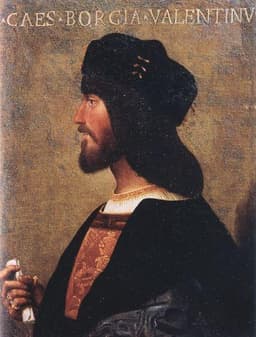
Cesare Borgia
General · Medieval
60.2Total
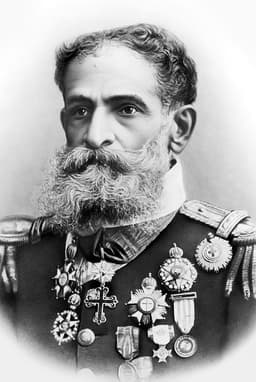
Deodoro da Fonseca
General · Modern
48.8Total
Basic Information
Born
1475
1827
Died
1507
1892
Era
Medieval
Modern
Nationality
Italy
Brazil
Occupation
General
General
Civilization
Western
Western
Score Comparison
Military (10%)
67.5
50.0
Political (20%)
68.0
45.1
Influence (20%)
68.0
54.1
Legacy (20%)
40.0
44.2
Leadership (15%)
64.0
57.6
Strategy (15%)
66.3
38.6
TOTAL
60.2
48.8
Cesare Borgia — Complete Timeline
1493 AD
Appointment as CardinalPolitical Action◆ Major
Cesare Borgia was appointed cardinal by his father, Pope Alexander VI. This position gave him significant power within the Church and access to papal resources. He used his cardinalate to advance his family's political interests in Italy.
CardinalNepotismPapacy
Impact: regional
1498 AD
Resignation from the CardinalatePolitical Action◆ Major
Cesare Borgia resigned as cardinal to pursue a military and political career. He became the first person to voluntarily leave the College of Cardinals. This move allowed him to focus on conquering territories in the Romagna region of Italy.
ResignationMilitaryRomagna
Impact: regional
1499 AD
Conquest of the RomagnaWar◆ Major
Cesare Borgia, with French support, launched a campaign to conquer the cities of the Romagna. He captured Imola, Forl
ConquestRomagnaMachiavelli
Impact: regional
1503 AD
Fall from PowerPolitical Action
After the death of Pope Alexander VI, Cesare Borgia lost his political support. He was captured by his enemies and imprisoned in Spain. His territories in Italy quickly collapsed. This sudden fall demonstrated the fragility of his power base.
FallImprisonmentCollapse
Impact: regionaltragic
1507 AD
Death in BattleWar
Cesare Borgia was killed in a skirmish near Viana, Navarre, while serving as a mercenary captain. His death ended any chance of restoring his former power. He died at age 31, having failed to regain his Italian territories.
DeathMercenaryNavarre
tragic
Deodoro da Fonseca — Complete Timeline
1889 AD
Proclamation of the Brazilian RepublicPolitical Action
Deodoro da Fonseca led a military coup that overthrew Emperor Pedro II on November 15, 1889. He proclaimed the Republic of the United States of Brazil, ending 67 years of imperial rule.
CoupRepublic
Impact: globalprogressive
1891 AD
Election as First President of BrazilPolitical Action◆ Major
Deodoro da Fonseca was elected the first President of Brazil by the Constituent Congress on February 25, 1891. He took office under the new republican constitution, but his rule was brief and authoritarian.
ElectionPresidency
Impact: national
Dissolution of the National CongressPolitical Action◆ Major
Facing political opposition, Deodoro da Fonseca dissolved the National Congress on November 3, 1891, and declared a state of siege. This authoritarian act triggered a naval revolt and his eventual resignation.
AuthoritarianismPolitical Crisis
Impact: nationaldestructive
Resignation from the PresidencyPolitical Action◆ Major
Deodoro da Fonseca resigned the presidency on November 23, 1891, after a naval rebellion threatened his government. He handed power to Vice President Floriano Peixoto, ending his 9-month rule.
ResignationPolitical Crisis
Impact: nationaltragic
Expert Analysis
Deodoro da Fonseca vs Cesare Borgia
# The Prince and the President: Cesare Borgia and Deodoro da Fonseca
On a cold November morning in 1503, Cesare Borgia stood in the Vatican, watching his world crumble. His father, Pope Alexander VI, had just died, and with him vanished the political scaffolding that had elevated Borgia to near-royal power in Italy. Four centuries later and an ocean away, another general, Deodoro da Fonseca, faced his own November reckoning: in 1891, after dissolving Brazil’s National Congress and declaring a state of siege, he watched a naval rebellion force his resignation. Both men rose through violence and fell through miscalculation. But their paths could not have been more different—one a cardinal turned conqueror, the other a monarchist turned republican. What drove these two soldiers to seize power, and why did their legacies diverge so sharply?
Origins
Cesare Borgia was born in 1475 into the most notorious family of Renaissance Italy. His father, Rodrigo Borgia, became Pope Alexander VI in 1492, and Cesare grew up in a world where the church was a political weapon, poison a diplomatic tool, and loyalty a fleeting commodity. He was made a cardinal at eighteen in 1493, a position that gave him immense wealth and influence before he had even tasted battle. But Cesare chafed at the cassock. In 1498, he did what no cardinal had done before: he resigned his sacred office to become a general. This was not a crisis of faith—it was a calculated move to trade spiritual power for temporal dominion.
Deodoro da Fonseca entered the world in 1827, in Alagoas, Brazil, a young empire ruled by Emperor Pedro II. Born into a military family, he grew up in a stable, constitutional monarchy—the opposite of Borgia’s chaotic Italy. Deodoro’s Brazil was a land of coffee plantations, slavery, and cautious progress. He joined the army, fought in the Paraguayan War (1864–1870), and rose through the ranks as a loyal servant of the empire. His world was ordered, hierarchical, and slow to change. Where Borgia learned to scheme in papal corridors, Deodoro learned to obey orders in dusty barracks.
Rise to Power
Borgia’s ascent was meteoric and bloody. After resigning the cardinalate in 1498, he secured French support through marriage to Charlotte d’Albret and launched his campaign to conquer the Romagna in 1499. With a mix of French troops and mercenaries, he swept through Imola, Forlì, and other cities, crushing local lords who had long defied papal authority. His military score of 66.9 and strategy of 72.0 reflect genuine tactical skill, but his true genius lay in political ruthlessness. He lured his enemies to peace talks, then had them strangled. He appointed brutal but effective governors, then executed them when they became too powerful. Machiavelli, who observed Borgia firsthand, immortalized him in *The Prince* as the model of a ruler who must be both lion and fox.
Deodoro’s rise was slower and more reluctant. By the 1880s, Brazil’s empire faced growing republican sentiment, fueled by abolitionist movements and military discontent. Deodoro, a respected general, became a figurehead for officers who wanted change. On November 15, 1889, he led a bloodless coup that deposed Emperor Pedro II. It was less a conquest than a procession: Deodoro marched troops into Rio de Janeiro, and the emperor, unwilling to spill blood, simply abdicated. Deodoro’s political score of 77.9 reflects his skill in navigating this transition—he did not seize power; power was thrust upon him.
Leadership & Governance
Borgia ruled as a Renaissance warlord. His conquest of the Romagna was a masterpiece of speed and terror. He centralized administration, imposed order on lawless territories, and built a loyal army. But his governance was a one-man show. He trusted no one, delegated little, and relied entirely on his father’s papal authority. When Alexander VI died in 1503, Borgia’s entire edifice collapsed. His leadership score of 44.5 reveals a fatal flaw: he could conquer but not build institutions. He was a brilliant tactician, a terrible statesman.
Deodoro, by contrast, governed as a reluctant president. Elected by the Constituent Congress on February 25, 1891, he inherited a fragile republic. His leadership score of 70.0 suggests a man who could command armies but not parliaments. He faced immediate opposition from civilian politicians who wanted a stronger congress. Instead of compromise, Deodoro dissolved the National Congress on November 3, 1891, and declared martial law. It was the act of a general who mistook democracy for insubordination. The navy rebelled, and within weeks, on November 23, 1891, he resigned. His fall was not violent—it was political suicide.
Triumph & Tragedy
Borgia’s greatest moment was the conquest of the Romagna. At his peak in 1502, he controlled a swath of central Italy and dreamed of unifying the peninsula. His tragedy came swiftly: the death of his father, the election of his enemy Pope Julius II, and his capture in 1503. He escaped, fled to Navarre, and died in a pointless skirmish near Viana in 1507—not as a prince, but as a mercenary for hire. His total score of 60.4 reflects a career of brilliant failure.
Deodoro’s triumph was the proclamation of the republic on November 15, 1889. He ended a monarchy that had ruled Brazil for 67 years, and for a moment, he was a national hero. His tragedy was his presidency. He could not transition from coup leader to democratic statesman. His resignation in 1891 spared Brazil a civil war, but it exposed the fragility of its new republic. His total score of 62.8 is slightly higher than Borgia’s, but his legacy is more ambiguous: a founder who nearly destroyed what he built.
Character & Destiny
Cesare Borgia was driven by ambition without restraint. Machiavelli wrote that Borgia’s cruelty was “well used” because it secured order, but his character was his undoing. He trusted only himself, and when his father died, he had no allies, no party, no popular support. His destiny was to be a cautionary tale: the prince who could not found a dynasty because he never learned to rule beyond the sword.
Deodoro da Fonseca was a man of duty, not vision. He overthrew an emperor because he believed the army represented the nation’s will, but he never articulated what that will should be. His character was conservative, cautious, and ultimately indecisive. His destiny was to be a bridge between empire and republic—a necessary figure who could not cross that bridge himself.
Legacy
Cesare Borgia lives on as Machiavelli’s archetype. His name evokes poison, betrayal, and the dark arts of power. But his legacy is also intellectual: he inspired a book that shaped modern political thought. His influence score of 67.0 reflects this strange immortality—a failure in life, a teacher in death.
Deodoro da Fonseca is remembered as the first president of Brazil, but his statue in Rio stands as a reminder of how republics are born in chaos. His legacy score of 60.6 is modest, partly because Brazil’s republic eventually matured under more capable leaders. He is a footnote in a larger story—a general who did not want power, did not know how to use it, and let it slip away.
Conclusion
Two soldiers, two centuries, two worlds. Cesare Borgia tried to build a kingdom through terror and died forgotten. Deodoro da Fonseca tried to build a republic through duty and resigned in disgrace. Their differences are not just of time and place, but of ambition and imagination. Borgia wanted everything; Deodoro wanted nothing beyond order. One was a predator in a world of prey; the other was a caretaker in a world of change. In the end, both discovered that power is not a sword to wield or a chair to occupy—it is a trust that must be earned, shared, and renewed. And when that trust fails, even princes and presidents fall.
Rankings
🥇
Cesare BorgiaLeader
Mil: 67.5Pol: 68.0Inf: 68.0
60.2
🥈
Deodoro da Fonseca
Mil: 50.0Pol: 45.1Inf: 54.1
48.8
+11.4 behind
How This Comparison Works
Algorithm
Each figure is scored on 6 dimensions (0—100 scale) based on structured historical data: Military (10%), Political (20%), Influence (20%), Legacy (20%), Leadership (15%), Strategy (15%). The weighted total produces the final ranking.
Data Sources
Scores are computed from structured sub-indicators in the database. Scale factors adjust for era (Ancient ×0.85, Modern ×1.0) and civilization size (Eastern ×1.05, Other ×0.80) to account for differences in population and military scale.
Maximum 3 Figures
Comparisons are limited to 2—3 figures to ensure readability and statistical meaningfulness.
Error Margins
±5 points per dimension — Sub-scores are derived from historical records with inherent uncertainty. Two figures within 5 points on a dimension should be considered roughly equivalent in that area.
Total Score Accuracy
±3 points overall — The weighted combination of 6 dimensions produces a total score with approximately ±3 points of uncertainty. Differences of less than 3 points are not statistically significant— the figures are effectively tied.
Known Limitations
- Historical records are incomplete and uneven across civilizations
- Figures from oral-tradition societies may be underrepresented
- Occupation labels can misclassify multi-role figures
- Scores measure capability and impact, not moral character
- Quantitative scoring is a comparison tool, not absolute truth
Capability Radar
Military (10%) — Battles & Warfare
Battles
55
20
Win Rate
60
25
Expansion
55
10
Political (20%) — Governance & Reform
Reform
40
40
Diplomacy
55
25
Economy
35
15
Influence (20%) — Cultural & Global Reach
Cultural
55
20
Global
60
15
Legacy (20%) — Historical Impact
Historical
70
35
Longevity
65
20
Leadership (15%) — Power & Stability
Tenure
45
30
Stability
30
10
Strategy (15%) — Tactics & Innovation
Strategy
60
25
Tactics
65
20
Reform
50
15
Similar Comparisons
Comments & Discussion
ILLUSION BREAKER6/16/2026
Comparing Deodoro da Fonseca to Cesare Borgia is ahistorical fluff. Fonseca was a hesitant general who accidentally stumbled into a republic, not a Machiavellian prince. He dissolved Congress out of panic, not strategy, and resigned within months. Borgia methodically carved a state from scratch, using murder and diplomacy with surgical precision. One was a reluctant republican; the other, a prince who never got his throne. Different leagues entirely.
海军吐槽客6/16/2026
拿德奥多罗和切萨雷比简直侮辱了后者。切萨雷18岁当红衣主教,毒死哥哥夺权,靠教皇老爸和法国军队打天下,是个精密的阴谋机器。德奥多罗呢?一个得过且过的军人,搞政变都搞不干净,1869年还同情君主制。一个是有系统的暴君,一个是无脑的政变者,非要沾边,不如说德奥多罗是低配版的佩德罗二世护卫兵。别再硬套了。
CLASSICS CROSS-REFERENCER6/16/2026
Both men suffered November downfalls: Borgia in 1503 when Alexander VI died, Fonseca in 1891 when a naval revolt forced him out. But Borgia’s fall was cosmic—he lost a papacy-backed empire; Fonseca’s was a tempest in a teapot. Borgia had Niccolò Machiavelli immortalize him as a prince ruined by bad luck; Fonseca has a bridge and a few mediocre portraits. Their only real parallel is that both were soldiers who overreached. But Borgia aimed at unifying Italy; Fonseca aimed at staying in charge. No
数据打假员6/16/2026
分析里说两人都“靠暴力崛起”,但数据完全不匹配。切萨雷在1500-1503年间打下了罗马涅地区,控制约5万平方公里的土地,军队超过1万人。德奥多罗呢?1889年政变只用了一个团加一两艘军舰,控制巴西全境但根本没打仗,纯粹是佩德罗二世主动退位。暴力程度差了两个数量级。拿“十一月危机”做类比更是胡扯,1503年的欧洲政治和1891年的巴西共和国能一样吗?
REVISIONIST'S PROWLER6/16/2026
This comparison whitewashes Borgia's brutality while pretending Fonseca was a failed tyrant. Borgia literally ordered the assassination of his own brother Giovanni in 1497 and had Cardinal Orsini strangled in 1503. Fonseca’s worst crime was disbanding a corrupt parliament that had no popular mandate. The real story here is that a Machiavellian murderer gets called a "prince," while a clumsy republican general gets labeled a despot. The analysis buys into Renaissance propaganda