Loading...
Afonso de Albuquerque vs Deodoro da Fonseca
Afonso de Albuquerque leads by 30.8 pts · 2 figures compared
…
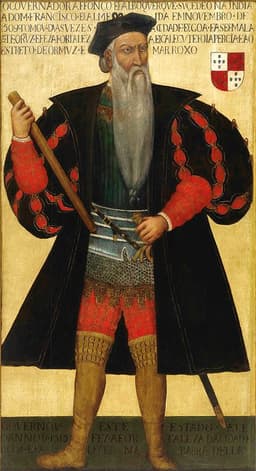
Afonso de Albuquerque
General · Medieval
79.6Total
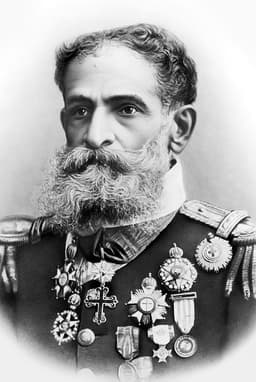
Deodoro da Fonseca
General · Modern
48.8Total
Basic Information
Born
1453
1827
Died
1515
1892
Era
Medieval
Modern
Nationality
Portugal
Brazil
Occupation
General
General
Civilization
Western
Western
Score Comparison
Military (10%)
77.5
50.0
Political (20%)
88.0
45.1
Influence (20%)
80.0
54.1
Legacy (20%)
75.0
44.2
Leadership (15%)
78.0
57.6
Strategy (15%)
82.0
38.6
TOTAL
79.6
48.8
Afonso de Albuquerque — Complete Timeline
1503 AD
First voyage to IndiaWar◆ Major
Afonso de Albuquerque led a fleet to India, establishing the first Portuguese fort at Cochin. This voyage laid the foundation for Portuguese control of the Indian Ocean trade.
ExplorationColonialismIndia
Impact: global
1510 AD
Conquest of GoaWar◆ Major
Albuquerque captured Goa from the Sultan of Bijapur. He made Goa the capital of Portuguese India, a position it held for over 400 years.
ConquestColonialismIndia
Impact: regional
1511 AD
Conquest of MalaccaWar◆ Major
Albuquerque led a Portuguese fleet to capture the strategic port of Malacca. This gave Portugal control of the spice trade route between the Indian Ocean and the Pacific.
ConquestSpice TradeSoutheast Asia
Impact: global
1513 AD
Siege of AdenWar
Albuquerque attempted to capture Aden in Yemen but failed. This failure prevented Portugal from controlling the entrance to the Red Sea and limited their influence in the region.
SiegeFailureRed Sea
Impact: regional
1515 AD
Death at seaOther◆ Major
Afonso de Albuquerque died at sea off the coast of Goa, possibly from illness or poison. His death left the Portuguese Empire in the Indian Ocean without its most capable leader.
DeathLeadershipEmpire
Impact: regionaltragic
Deodoro da Fonseca — Complete Timeline
1889 AD
Proclamation of the Brazilian RepublicPolitical Action
Deodoro da Fonseca led a military coup that overthrew Emperor Pedro II on November 15, 1889. He proclaimed the Republic of the United States of Brazil, ending 67 years of imperial rule.
CoupRepublic
Impact: globalprogressive
1891 AD
Election as First President of BrazilPolitical Action◆ Major
Deodoro da Fonseca was elected the first President of Brazil by the Constituent Congress on February 25, 1891. He took office under the new republican constitution, but his rule was brief and authoritarian.
ElectionPresidency
Impact: national
Dissolution of the National CongressPolitical Action◆ Major
Facing political opposition, Deodoro da Fonseca dissolved the National Congress on November 3, 1891, and declared a state of siege. This authoritarian act triggered a naval revolt and his eventual resignation.
AuthoritarianismPolitical Crisis
Impact: nationaldestructive
Resignation from the PresidencyPolitical Action◆ Major
Deodoro da Fonseca resigned the presidency on November 23, 1891, after a naval rebellion threatened his government. He handed power to Vice President Floriano Peixoto, ending his 9-month rule.
ResignationPolitical Crisis
Impact: nationaltragic
Expert Analysis
Afonso de Albuquerque vs Deodoro da Fonseca
# The Admiral and the President: Two Generals Who Shaped Empires
On a November morning in 1891, a weary general sat in the presidential palace of Rio de Janeiro, watching warships train their guns on the city he had governed for less than a year. Deodoro da Fonseca had proclaimed Brazil a republic just two years earlier, toppling an emperor with a single decree. Now, facing a naval rebellion, he resigned—a quiet end to a brief, turbulent rule. Four centuries earlier and half a world away, another general died at sea off the coast of Goa, his body committed to the Indian Ocean that he had turned into a Portuguese lake. Afonso de Albuquerque never saw his empire crumble; Deodoro watched his republic nearly drown before his eyes. Both were soldiers who became founders, yet their paths diverged like the currents of the Atlantic and Indian Oceans.
Origins
Albuquerque was born into the rugged nobility of 15th-century Portugal, a kingdom squeezed between the Atlantic and a centuries-old war with Muslim Iberia. His father was a courtier, his mother a lady-in-waiting, and young Afonso grew up breathing the salt air of Lisbon’s harbor, where caravels returned from Africa with gold and slaves. The world was expanding, and Portugal was its vanguard. By contrast, Deodoro da Fonseca was born in 1827 in Alagoas, a province of the Brazilian Empire—itself a Portuguese colony that had become a monarchy. His father was a military officer, his mother a homemaker, and Deodoro entered the army as a cadet at fourteen. While Albuquerque’s Portugal was a daring maritime power, Deodoro’s Brazil was a vast, sleepy empire ruled by a Portuguese prince. The two men inherited different worlds: one of conquest, the other of consolidation.
Rise to Power
Albuquerque’s ascent was a story of relentless action. After serving in North Africa, he joined the Portuguese fleet to India in 1503, establishing the first fort at Cochin. His military score of 82.2 reflects a commander who fought not for glory but for control—of ports, of trade routes, of the monsoon winds that carried pepper and cinnamon to Europe. In 1510, he captured Goa from the Sultan of Bijapur, a victory that became the cornerstone of Portuguese India. Two years later, he seized Malacca, the gateway to the Spice Islands. Each conquest was a calculated blow against Muslim traders and Venetian rivals.
Deodoro’s rise was quieter, more political. He fought in the Paraguayan War (1864–1870), but his true weapon was not the sword but the pen—or rather, the proclamation. By the 1880s, Brazil’s monarchy was crumbling under the weight of abolitionist sentiment and military discontent. On November 15, 1889, Deodoro led a bloodless coup that deposed Emperor Pedro II. His political score of 77.9 underscores a man who understood that the real battlefield was the capital, not the frontier. Where Albuquerque conquered cities with cannon fire, Deodoro captured a country with a speech.
Leadership & Governance
Albuquerque governed like a sea captain: decisive, ruthless, and visionary. He made Goa the capital of Portuguese India, building churches, hospitals, and a mint. He encouraged intermarriage with local women, creating a mixed-race elite loyal to Lisbon. His leadership score of 84.3 reflects a man who could inspire sailors to storm fortresses and administrators to build empires from scratch. Yet his strategy score of 75.5 hints at overreach: the failed Siege of Aden in 1513 left the Red Sea open to Ottoman counterattacks.
Deodoro governed like a soldier who had stumbled into politics. As president, he faced a fractious congress, a struggling economy, and a navy that resented the army’s dominance. His military score of 35.9 is strikingly low for a general, but his political instincts were sharper—until they failed. In November 1891, he dissolved the National Congress and declared a state of siege, hoping to crush opposition. Instead, he triggered a naval rebellion that forced his resignation after just nine months. Where Albuquerque built an empire that lasted four centuries, Deodoro built a republic that nearly collapsed in two years.
Triumph & Tragedy
Albuquerque’s greatest triumph was the conquest of Malacca in 1511. By capturing this strategic port, he broke the Muslim monopoly on the spice trade and established Portuguese dominance in Southeast Asia. His tragedy came in 1513 at Aden, where failure to secure the Red Sea entrance left Portugal vulnerable. He died at sea in 1515, possibly poisoned, his grand design unfinished.
Deodoro’s triumph was the Proclamation of the Republic in 1889—a moment of national rebirth. His tragedy was his presidency itself. Elected in 1891, he proved unable to manage the very republic he had created. His dissolution of Congress was a desperate act that backfired, leaving him isolated and powerless.
Character & Destiny
Albuquerque was a man of iron will and imperial vision. He wrote to King Manuel I: “If I were to write you all the things that happen here, I would never finish.” His destiny was to be the architect of an oceanic empire, a role that required a conqueror’s ruthlessness and a statesman’s patience. Deodoro was a reluctant revolutionary, a monarchist who overthrew a monarchy, a general who could not command his own government. His character was shaped by loyalty—to the army, to Brazil, to the idea of order—but that loyalty fractured when he faced the chaos of democracy.
Legacy
Albuquerque’s legacy is carved in stone and spice. Goa remained Portuguese until 1961, and his name adorns streets, forts, and statues across the former Estado da Índia. His legacy score of 67.4 reflects a figure whose empire faded but whose methods shaped European colonialism for centuries. Deodoro’s legacy is more ambiguous. He is remembered as the father of the Brazilian Republic, but also as a failed president. His name graces a square in Rio, but his resignation is a cautionary tale about the fragility of new democracies.
Conclusion
Two generals, two empires, two endings. Albuquerque died at sea, his work unfinished but his empire intact. Deodoro died in Rio, his republic saved by his resignation. One built with steel and sail; the other with speeches and coups. Their differences reveal the chasm between the age of conquest and the age of nation-building—a reminder that the same sword that carves an empire can shatter a republic.
Rankings
🥇
Afonso de AlbuquerqueLeader
Mil: 77.5Pol: 88.0Inf: 80.0
79.6
🥈
Deodoro da Fonseca
Mil: 50.0Pol: 45.1Inf: 54.1
48.8
+30.8 behind
How This Comparison Works
Algorithm
Each figure is scored on 6 dimensions (0—100 scale) based on structured historical data: Military (10%), Political (20%), Influence (20%), Legacy (20%), Leadership (15%), Strategy (15%). The weighted total produces the final ranking.
Data Sources
Scores are computed from structured sub-indicators in the database. Scale factors adjust for era (Ancient ×0.85, Modern ×1.0) and civilization size (Eastern ×1.05, Other ×0.80) to account for differences in population and military scale.
Maximum 3 Figures
Comparisons are limited to 2—3 figures to ensure readability and statistical meaningfulness.
Error Margins
±5 points per dimension — Sub-scores are derived from historical records with inherent uncertainty. Two figures within 5 points on a dimension should be considered roughly equivalent in that area.
Total Score Accuracy
±3 points overall — The weighted combination of 6 dimensions produces a total score with approximately ±3 points of uncertainty. Differences of less than 3 points are not statistically significant— the figures are effectively tied.
Known Limitations
- Historical records are incomplete and uneven across civilizations
- Figures from oral-tradition societies may be underrepresented
- Occupation labels can misclassify multi-role figures
- Scores measure capability and impact, not moral character
- Quantitative scoring is a comparison tool, not absolute truth
Capability Radar
Military (10%) — Battles & Warfare
Battles
85
20
Win Rate
80
25
Expansion
95
10
Political (20%) — Governance & Reform
Reform
80
40
Diplomacy
85
25
Economy
80
15
Influence (20%) — Cultural & Global Reach
Cultural
70
20
Global
85
15
Legacy (20%) — Historical Impact
Historical
85
35
Longevity
80
20
Leadership (15%) — Power & Stability
Tenure
70
30
Stability
65
10
Strategy (15%) — Tactics & Innovation
Strategy
95
25
Tactics
90
20
Reform
75
15
Similar Comparisons
Comments & Discussion
CAPTAIN SALTBEARD6/16/2026
Albuquerque’s the clear winner here—he actually built something that lasted centuries. Deodoro? He couldn’t hold his own republic together for two years before the navy turned on him. That 1891 naval revolt wasn’t just a mutiny; it was a vote of no confidence in his whole shaky regime. Albuquerque seized Malacca in 1511 with 1,200 men against 20,000 defenders—that’s military genius. Deodoro’s coup was just a lucky break against a tired monarchy.
炮舰哲学家6/16/2026
阿尔布开克才是真正的帝国建筑师,他明白控制海洋比占领陆地更重要。1513年他围攻亚丁时,虽然失败,但战略眼光远超时代—葡萄牙需要红海钥匙才能垄断香料贸易。德奥多罗呢?1891年11月那场海军叛乱暴露了他的官僚本质,他连自己亲手建立的共和国海岸线都守不住。一个让海洋臣服,一个被海洋教训。
DATA WRANGLER6/16/2026
Let’s talk numbers: Albuquerque commanded fleets that conquered 50+ fortified cities across the Indian Ocean, while Deodoro’s biggest military achievement was persuading a few officers to sign a manifesto in 1889. His presidency lasted 272 days—less than one sailing season for Albuquerque’s armadas. The naval revolt forced his resignation in 1891 because he had no popular base, no economic plan, and zero administrative skill. One guy launched an empire; the other launched a footnote.
里斯本的回声6/16/2026
德奥多罗根本配不上与阿尔布开克同列。巴西共和国的建立本质是一场军事政变,而非民众运动—1889年11月15日,德奥多罗只是带着士兵站在陆军部门口,皇帝佩德罗二世就主动退位了。这不是英雄史诗,是政治戏剧。阿尔布开克在1510年花三个月围攻果阿,战斗到最后一兵一卒,从身体到意志都没有退缩过。两个人的骨子里,一个流着战士的血,一个流着官僚的汗。
REVISIONIST NED6/16/2026
You’re all glossing over Albuquerque’s brutality. He massacred civilians in Goa in 1510, burned prisoners alive in Malacca, and enforced Portuguese colonialism with systematic terror. Deodoro may have been incompetent, but he didn’t build his power on genocide. The 1891 revolt wasn’t just about Deodoro—it was about the military’s refusal to accept civilian oversight, a problem Brazil still has today. Let’s not romanticize imperial violence just because it was “grand.”