Loading...
This comparison has not been analyzed yet.
One-time AI generation (~1 minute). Scores and timeline are already available below.
Bob Denard vs Olusegun Obasanjo
Olusegun Obasanjo leads by 16.6 pts · 2 figures compared
…

Bob Denard
General · Modern
43.6Total
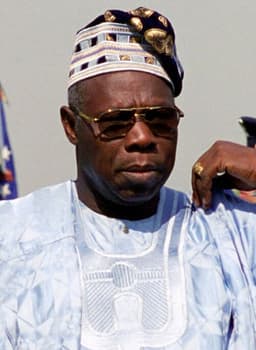
Olusegun Obasanjo
General · Modern
60.2Total
Basic Information
Born
1929
1937
Died
—
—
Era
Modern
Modern
Nationality
France
Nigeria
Occupation
General
General
Civilization
Western
Other
Score Comparison
Military (10%)
40.0
45.0
Political (20%)
32.2
72.0
Influence (20%)
54.1
55.0
Legacy (20%)
40.8
54.0
Leadership (15%)
43.8
78.0
Strategy (15%)
45.0
60.0
TOTAL
43.6
60.2
Bob Denard — Complete Timeline
1975 AD
Led a coup in the Comoros against President Ahmed AbdallahPolitical Action◆ Major
Denard led a group of mercenaries in overthrowing President Ahmed Abdallah of the Comoros. The coup installed a new government, but Denard remained a power broker behind the scenes, marking the start of his influence in the islands.
Comoros CoupMercenary
Impact: nationaldestructive
1978 AD
Overthrew the Comorian government again and installed a regimePolitical Action◆ Major
Denard orchestrated a second coup in the Comoros, overthrowing the leftist government of Ali Soilih. He restored Ahmed Abdallah to power and became the de facto ruler of the country, commanding the presidential guard.
Comoros CoupMercenary
Impact: nationaldestructive
Became commander of the Comorian Presidential GuardPolitical Action◆ Major
After the 1978 coup, Denard was appointed commander of the Presidential Guard. He effectively controlled the Comoros' security apparatus, using his position to enrich himself and maintain power through violence and intimidation.
Presidential GuardComoros
Impact: nationaldestructive
1995 AD
Attempted a coup in the Comoros that failedPolitical Action◆ Major
Denard attempted another coup in the Comoros, but this time French forces intervened. He was arrested and deported to France, where he was tried and imprisoned for his role in the 1995 coup attempt.
Failed CoupFrench Intervention
Impact: nationaltragic
Olusegun Obasanjo — Complete Timeline
1976 AD
Military coup that brought Obasanjo to powerPolitical Action
Following the assassination of General Murtala Mohammed in a failed coup, Obasanjo, as Chief of Staff, Supreme Headquarters, succeeded him as head of state. He oversaw the continuation of the transition to civilian rule.
CoupSuccessionMilitary Rule
Impact: national
1979 AD
Handover of power to civilian governmentPolitical Action
Obasanjo voluntarily handed over power to the elected civilian government of Shehu Shagari, marking the first peaceful transfer of power from military to civilian rule in Nigeria. This act established a precedent for democratic transition.
DemocracyTransitionCivilian Rule
Impact: nationalconstructive
1999 AD
Election as President of NigeriaPolitical Action
Obasanjo won the 1999 Nigerian presidential election as the candidate of the People's Democratic Party (PDP). His victory ended 16 years of military rule and began the Fourth Nigerian Republic.
ElectionDemocracyFourth Republic
Impact: nationalprogressive
2005 AD
Debt relief from Paris ClubPolitical Action◆ Major
Obasanjo's government negotiated a debt relief agreement with the Paris Club, resulting in the cancellation of $18 billion of Nigeria's external debt. This freed up resources for domestic spending and was a major economic achievement.
Debt ReliefEconomyNegotiation
Impact: nationalconstructive
2006 AD
Third term bid failurePolitical Action◆ Major
Obasanjo attempted to amend the Nigerian constitution to allow him to run for a third term. The bid was rejected by the National Assembly, marking a significant political defeat and reinforcing term limits.
Third TermConstitutionDefeat
Impact: national
This comparison has not been analyzed yet.
One-time AI generation (~1 minute). Scores and timeline are already available below.
Rankings
🥇
Olusegun ObasanjoLeader
Mil: 45.0Pol: 72.0Inf: 55.0
60.2
🥈
Bob Denard
Mil: 40.0Pol: 32.2Inf: 54.1
43.6
+16.6 behind
How This Comparison Works
Algorithm
Each figure is scored on 6 dimensions (0—100 scale) based on structured historical data: Military (10%), Political (20%), Influence (20%), Legacy (20%), Leadership (15%), Strategy (15%). The weighted total produces the final ranking.
Data Sources
Scores are computed from structured sub-indicators in the database. Scale factors adjust for era (Ancient ×0.85, Modern ×1.0) and civilization size (Eastern ×1.05, Other ×0.80) to account for differences in population and military scale.
Maximum 3 Figures
Comparisons are limited to 2—3 figures to ensure readability and statistical meaningfulness.
Error Margins
±5 points per dimension — Sub-scores are derived from historical records with inherent uncertainty. Two figures within 5 points on a dimension should be considered roughly equivalent in that area.
Total Score Accuracy
±3 points overall — The weighted combination of 6 dimensions produces a total score with approximately ±3 points of uncertainty. Differences of less than 3 points are not statistically significant— the figures are effectively tied.
Known Limitations
- Historical records are incomplete and uneven across civilizations
- Figures from oral-tradition societies may be underrepresented
- Occupation labels can misclassify multi-role figures
- Scores measure capability and impact, not moral character
- Quantitative scoring is a comparison tool, not absolute truth
Capability Radar
Military (10%) — Battles & Warfare
Battles
35
25
Win Rate
40
30
Expansion
25
20
Political (20%) — Governance & Reform
Reform
10
65
Diplomacy
25
75
Economy
15
55
Influence (20%) — Cultural & Global Reach
Cultural
15
45
Global
20
60
Legacy (20%) — Historical Impact
Historical
20
55
Longevity
15
50
Leadership (15%) — Power & Stability
Tenure
30
70
Stability
10
60
Strategy (15%) — Tactics & Innovation
Strategy
30
40
Tactics
45
35
Reform
10
50
Similar Comparisons
Comments & Discussion
No comments yet. Be the first to share your thoughts!