Loading...
Afonso de Albuquerque vs Olusegun Obasanjo
Afonso de Albuquerque leads by 19.4 pts · 2 figures compared
…
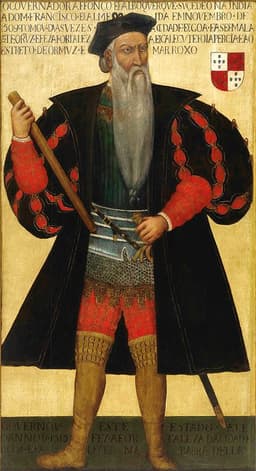
Afonso de Albuquerque
General · Medieval
79.6Total
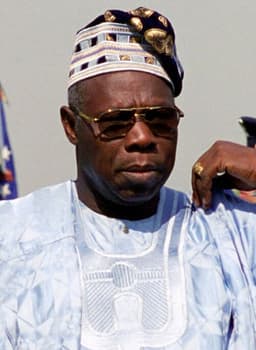
Olusegun Obasanjo
General · Modern
60.2Total
Basic Information
Born
1453
1937
Died
1515
—
Era
Medieval
Modern
Nationality
Portugal
Nigeria
Occupation
General
General
Civilization
Western
Other
Score Comparison
Military (10%)
77.5
45.0
Political (20%)
88.0
72.0
Influence (20%)
80.0
55.0
Legacy (20%)
75.0
54.0
Leadership (15%)
78.0
78.0
Strategy (15%)
82.0
60.0
TOTAL
79.6
60.2
Afonso de Albuquerque — Complete Timeline
1503 AD
First voyage to IndiaWar◆ Major
Afonso de Albuquerque led a fleet to India, establishing the first Portuguese fort at Cochin. This voyage laid the foundation for Portuguese control of the Indian Ocean trade.
ExplorationColonialismIndia
Impact: global
1510 AD
Conquest of GoaWar◆ Major
Albuquerque captured Goa from the Sultan of Bijapur. He made Goa the capital of Portuguese India, a position it held for over 400 years.
ConquestColonialismIndia
Impact: regional
1511 AD
Conquest of MalaccaWar◆ Major
Albuquerque led a Portuguese fleet to capture the strategic port of Malacca. This gave Portugal control of the spice trade route between the Indian Ocean and the Pacific.
ConquestSpice TradeSoutheast Asia
Impact: global
1513 AD
Siege of AdenWar
Albuquerque attempted to capture Aden in Yemen but failed. This failure prevented Portugal from controlling the entrance to the Red Sea and limited their influence in the region.
SiegeFailureRed Sea
Impact: regional
1515 AD
Death at seaOther◆ Major
Afonso de Albuquerque died at sea off the coast of Goa, possibly from illness or poison. His death left the Portuguese Empire in the Indian Ocean without its most capable leader.
DeathLeadershipEmpire
Impact: regionaltragic
Olusegun Obasanjo — Complete Timeline
1976 AD
Military coup that brought Obasanjo to powerPolitical Action
Following the assassination of General Murtala Mohammed in a failed coup, Obasanjo, as Chief of Staff, Supreme Headquarters, succeeded him as head of state. He oversaw the continuation of the transition to civilian rule.
CoupSuccessionMilitary Rule
Impact: national
1979 AD
Handover of power to civilian governmentPolitical Action
Obasanjo voluntarily handed over power to the elected civilian government of Shehu Shagari, marking the first peaceful transfer of power from military to civilian rule in Nigeria. This act established a precedent for democratic transition.
DemocracyTransitionCivilian Rule
Impact: nationalconstructive
1999 AD
Election as President of NigeriaPolitical Action
Obasanjo won the 1999 Nigerian presidential election as the candidate of the People's Democratic Party (PDP). His victory ended 16 years of military rule and began the Fourth Nigerian Republic.
ElectionDemocracyFourth Republic
Impact: nationalprogressive
2005 AD
Debt relief from Paris ClubPolitical Action◆ Major
Obasanjo's government negotiated a debt relief agreement with the Paris Club, resulting in the cancellation of $18 billion of Nigeria's external debt. This freed up resources for domestic spending and was a major economic achievement.
Debt ReliefEconomyNegotiation
Impact: nationalconstructive
2006 AD
Third term bid failurePolitical Action◆ Major
Obasanjo attempted to amend the Nigerian constitution to allow him to run for a third term. The bid was rejected by the National Assembly, marking a significant political defeat and reinforcing term limits.
Third TermConstitutionDefeat
Impact: national
Expert Analysis
Afonso de Albuquerque vs Olusegun Obasanjo
The Conqueror and the Conciliator
History rarely offers two men more different in time, place, and purpose than Afonso de Albuquerque and Olusegun Obasanjo. One sailed the Indian Ocean in the age of caravels and cannons, building an empire with blood and iron. The other navigated the treacherous currents of post-colonial Africa, stitching a fractured nation back together. Yet both were generals who became founders—one of an overseas dominion that would last centuries, the other of a democratic experiment that continues to this day. What drove these two men, born nearly five centuries apart, to such divergent paths? The answer lies not in their uniforms, but in the worlds they sought to shape.
Origins
Afonso de Albuquerque was born in 1453, the same year Constantinople fell to the Ottomans—a coincidence that foretold a life spent at the crossroads of civilizations. He came from Portugal’s minor nobility, a class bred for war and service to the crown. The sea was his inheritance; the crusading spirit of the Reconquista, his creed. By contrast, Olusegun Obasanjo was born in 1937 in the village of Ibogun-Olaogun, Nigeria, to a farming family of the Egba people. His world was one of colonial rule, missionary schools, and the slow awakening of African nationalism. Where Albuquerque saw a world to be conquered, Obasanjo saw one to be liberated and rebuilt.
Their eras shaped them profoundly. Albuquerque lived in an age when European powers believed they had a divine right to dominate—and the technology to do so. Obasanjo came of age when empires were crumbling, and the question was not whether Africa would rule itself, but how.
Rise to Power
Albuquerque’s rise was forged in battle. In 1503, he led his first fleet to India, establishing a fort at Cochin—a toehold on a vast continent. The Portuguese crown, hungry for spices and souls, saw in him a ruthless instrument. He was not a politician but a soldier, and his path to power ran through blood and saltwater.
Obasanjo’s ascent was more circuitous. A young officer in the Nigerian army, he rose through the ranks during the Biafran War (1967–1970), earning a reputation for competence and loyalty. In 1976, after a failed coup killed General Murtala Mohammed, Obasanjo, then Chief of Staff, found himself thrust into power. He did not seize it; it fell to him like a burden. His first act was not conquest, but consolidation—and a promise.
Leadership & Governance
Here the two men diverge most sharply. Albuquerque governed as a conqueror. In 1510, he captured Goa from the Sultan of Bijapur, then made it the capital of Portuguese India—a decision that would shape the region for 450 years. He was a builder: forts, churches, and a mixed-race administration that married Portuguese soldiers to local women. But he was also a destroyer. In 1511, he took Malacca, the jewel of the spice trade, by force, massacring those who resisted. His strategy was simple: control the choke points of the Indian Ocean—Goa, Malacca, Hormuz—and let trade flow through Portuguese hands.
Obasanjo governed as a conciliator. His first term (1976–1979) was defined by a singular act: in 1979, he voluntarily handed power to an elected civilian government—the first peaceful transition in Nigeria’s history. It was a move Albuquerque would have found incomprehensible. But Obasanjo understood that Nigeria’s unity was fragile, and that a general’s duty was not to rule forever, but to build institutions. When he returned to power in 1999, after years of military dictatorship, he faced a nation in ruins. His approach was pragmatic: he negotiated $18 billion in debt relief in 2005, stabilized the economy, and held elections. Yet he was no saint. His failed bid to amend the constitution for a third term in 2006 revealed a politician’s hunger for power—a reminder that even conciliators can be tempted.
Triumph & Tragedy
Albuquerque’s greatest triumph was the conquest of Malacca in 1511, which gave Portugal control of the spice routes to Europe. His greatest tragedy was the failure at Aden in 1513, where he could not seize the gateway to the Red Sea. That failure left the door open for Ottoman and Egyptian rivals, and it haunted him. He died at sea in 1515, possibly poisoned, his empire still unsecured. His last words, it is said, were to the king: “I leave you the keys of the Orient.”
Obasanjo’s triumph was the 1979 handover—a moment that proved military rulers could step aside. His tragedy was the third-term bid, which stained his legacy. Yet even that failure was a kind of victory: the Nigerian Senate rejected the amendment, proving that democracy, however flawed, had taken root.
Character & Destiny
Albuquerque was a man of iron will and cold calculation. He wrote to his king: “From a bad peace, we gain nothing; from a good war, we lose nothing.” His character was his destiny: a relentless drive to build an empire, tempered by a fatal inability to compromise. He died believing he had failed, but his empire endured for centuries.
Obasanjo was more adaptable—a survivor who bent without breaking. He could be a democrat and a strongman, a reformer and a politician. His character allowed him to navigate Nigeria’s chaos, but it also left him open to charges of hypocrisy. Yet perhaps that flexibility was necessary: in a nation of 250 ethnic groups, rigidity is death.
Legacy
Albuquerque is remembered as the founder of the Portuguese Empire in Asia—a figure of both awe and revulsion. His statues stand in Goa and Lisbon, but his legacy is contested: a symbol of European dominance, or a visionary who united East and West? His scores—Military: 82.2, Political: 80.0, Legacy: 67.4—reflect a man who conquered more than he could govern.
Obasanjo is remembered as a father of Nigerian democracy, but also as a flawed patriarch. His scores—Military: 33.9, Political: 76.6, Legacy: 69.0—show a leader who fought his greatest battles not on battlefields, but in assembly halls. He is still alive, his story unfinished.
Conclusion
Two generals, two worlds. Albuquerque built an empire with a sword; Obasanjo built a nation with a handshake. One believed in domination; the other, in negotiation. Yet both faced the same fundamental question: how do you impose order on chaos? Albuquerque’s answer was to conquer; Obasanjo’s was to persuade. History judges them differently, but perhaps the truest measure is not what they built, but what they left behind. Albuquerque left forts and fleets; Obasanjo left a fragile, breathing democracy. Which legacy lasts longer? The answer, like the men themselves, depends on where you stand.
Rankings
🥇
Afonso de AlbuquerqueLeader
Mil: 77.5Pol: 88.0Inf: 80.0
79.6
🥈
Olusegun Obasanjo
Mil: 45.0Pol: 72.0Inf: 55.0
60.2
+19.4 behind
How This Comparison Works
Algorithm
Each figure is scored on 6 dimensions (0—100 scale) based on structured historical data: Military (10%), Political (20%), Influence (20%), Legacy (20%), Leadership (15%), Strategy (15%). The weighted total produces the final ranking.
Data Sources
Scores are computed from structured sub-indicators in the database. Scale factors adjust for era (Ancient ×0.85, Modern ×1.0) and civilization size (Eastern ×1.05, Other ×0.80) to account for differences in population and military scale.
Maximum 3 Figures
Comparisons are limited to 2—3 figures to ensure readability and statistical meaningfulness.
Error Margins
±5 points per dimension — Sub-scores are derived from historical records with inherent uncertainty. Two figures within 5 points on a dimension should be considered roughly equivalent in that area.
Total Score Accuracy
±3 points overall — The weighted combination of 6 dimensions produces a total score with approximately ±3 points of uncertainty. Differences of less than 3 points are not statistically significant— the figures are effectively tied.
Known Limitations
- Historical records are incomplete and uneven across civilizations
- Figures from oral-tradition societies may be underrepresented
- Occupation labels can misclassify multi-role figures
- Scores measure capability and impact, not moral character
- Quantitative scoring is a comparison tool, not absolute truth
Capability Radar
Military (10%) — Battles & Warfare
Battles
85
25
Win Rate
80
30
Expansion
95
20
Political (20%) — Governance & Reform
Reform
80
65
Diplomacy
85
75
Economy
80
55
Influence (20%) — Cultural & Global Reach
Cultural
70
45
Global
85
60
Legacy (20%) — Historical Impact
Historical
85
55
Longevity
80
50
Leadership (15%) — Power & Stability
Tenure
70
70
Stability
65
60
Strategy (15%) — Tactics & Innovation
Strategy
95
40
Tactics
90
35
Reform
75
50
Similar Comparisons
Comments & Discussion
江南罗贯中6/16/2026
阿尔布开克在1509年编了部《东方诸国志》,详细记录每个港口的潮汐、税制和信仰——这是用情报打仗。奥巴桑乔呢?1976年政变后写了本《我的指挥》,全是自我辩护。一个创造知识帝国,一个消费政治资本。历史选边站时,永远更器重那个把地图画清楚的疯子。
CAPTAIN CARAVEL6/16/2026
Albuquerque was a logistics freak, not just a brute. People remember his 1507 capture of Hormuz, but few note he mandated ship maintenance logs and standardized gunpowder storage across his armada. That's why Portugal held Goa for 450 years. Obasanjo couldn't keep a truck fleet running in the '70s. Give me the obsessive organizer over the smooth talker any day—empires aren't built on handshakes.
铁血数据猿6/16/2026
光比武力?太肤浅了。阿尔布开克在马六甲一战后做的第一件事是铸造统一银币,强制所有商船用葡萄牙度量衡。奥巴桑乔连尼日利亚的电网频率都统一不了。胜负不在战场,在账本。我宁愿跟着那个强迫水手记航海日志的偏执狂,也不信什么“和解能带来稳定”——查查1999年尼日利亚的GDP曲线再说。
CLASSICS SCRIBE6/16/2026
Read Albuquerque's letters: he called himself 'the last crusader' and quoted Livy before battles. Obasanjo quoted Amílcar Cabral. One saw history as a divine mission to reshape oceans; the other as a political duty to mend borders. I'll take the man with a thousand-year vision over the one who couldn't see past the next election cycle. Empire is ugly, but at least it's honest about its ambition.
REVISIONIST BOMBSHELL6/16/2026
Both were brutal. Albuquerque massacred Muslims in Goa (1510) and burned widows alive in Malacca. Obasanjo executed protesters at Odi (1999) and crushed oil strikes in the Niger Delta. Stop romanticizing the Portuguese as a 'builder' and Obasanjo as a 'conciliator'. They both ruled through fear—one with swords, the other with siren guns. The only difference is 500 years of whitewashing PR.