Loading...
Afonso de Albuquerque vs Bayinnaung
Afonso de Albuquerque leads by 11.0 pts · 2 figures compared
…
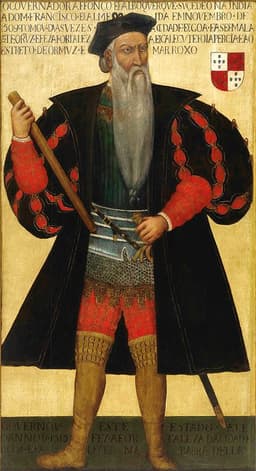
Afonso de Albuquerque
General · Medieval
79.6Total
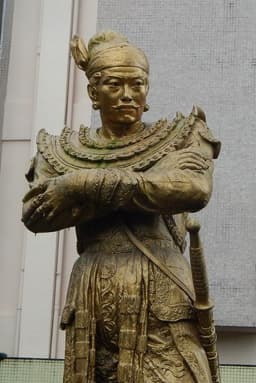
Bayinnaung
Emperor · Modern
68.6Total
Basic Information
Born
1453
1516
Died
1515
1581
Era
Medieval
Modern
Nationality
Portugal
Myanmar
Occupation
General
Emperor
Civilization
Western
Eastern
Score Comparison
Military (10%)
77.5
77.1
Political (20%)
88.0
82.0
Influence (20%)
80.0
65.0
Legacy (20%)
75.0
55.0
Leadership (15%)
78.0
74.0
Strategy (15%)
82.0
75.0
TOTAL
79.6
68.6
Afonso de Albuquerque — Complete Timeline
1503 AD
First voyage to IndiaWar◆ Major
Afonso de Albuquerque led a fleet to India, establishing the first Portuguese fort at Cochin. This voyage laid the foundation for Portuguese control of the Indian Ocean trade.
ExplorationColonialismIndia
Impact: global
1510 AD
Conquest of GoaWar◆ Major
Albuquerque captured Goa from the Sultan of Bijapur. He made Goa the capital of Portuguese India, a position it held for over 400 years.
ConquestColonialismIndia
Impact: regional
1511 AD
Conquest of MalaccaWar◆ Major
Albuquerque led a Portuguese fleet to capture the strategic port of Malacca. This gave Portugal control of the spice trade route between the Indian Ocean and the Pacific.
ConquestSpice TradeSoutheast Asia
Impact: global
1513 AD
Siege of AdenWar
Albuquerque attempted to capture Aden in Yemen but failed. This failure prevented Portugal from controlling the entrance to the Red Sea and limited their influence in the region.
SiegeFailureRed Sea
Impact: regional
1515 AD
Death at seaOther◆ Major
Afonso de Albuquerque died at sea off the coast of Goa, possibly from illness or poison. His death left the Portuguese Empire in the Indian Ocean without its most capable leader.
DeathLeadershipEmpire
Impact: regionaltragic
Bayinnaung — Complete Timeline
1550 AD
Establishment of the Toungoo EmpirePolitical Action
King Bayinnaung ascended the throne and began a series of military campaigns that created the largest empire in Southeast Asian history. At its peak, the Toungoo empire covered modern Myanmar, Thailand, Laos, and parts of China and India.
Toungoo EmpireSoutheast AsiaImperial Expansion
Impact: regionalconstructive
1557 AD
Conquest of the Shan StatesWar◆ Major
King Bayinnaung conquered the Shan States, bringing them under Toungoo control. This expansion added significant territory and resources to the Burmese empire.
Shan StatesToungoo ExpansionBurmese Empire
Impact: regional
1569 AD
Capture of AyutthayaWar
King Bayinnaung's forces captured the Siamese capital of Ayutthaya after a long siege. He installed a vassal king and made Siam a tributary state of the Toungoo empire.
Burmese-Siamese WarAyutthayaToungoo Empire
Impact: regional
1570 AD
Administrative ReformsReform◆ Major
King Bayinnaung implemented administrative reforms to govern his vast empire, including the appointment of governors and the standardization of laws and taxes. These reforms helped maintain control over conquered territories.
GovernanceAdministrationToungoo Empire
Impact: regionalconstructive
1574 AD
Conquest of Lan XangWar◆ Major
King Bayinnaung conquered the Lao kingdom of Lan Xang (modern Laos), bringing it under Toungoo control. This further expanded the Burmese empire to its greatest territorial extent.
Lan XangToungoo ExpansionLaos
Impact: regional
Expert Analysis
Afonso de Albuquerque vs Bayinnaung: Historical Comparison
Afonso de Albuquerque, a Portuguese general and statesman, and Bayinnaung, a Burmese emperor, were two of the most formidable empire-builders of the 16th century, operating in vastly different hemispheres. Albuquerque forged the Portuguese Empire in the Indian Ocean through naval dominance and strategic fortresses, while Bayinnaung united warring kingdoms to create the largest empire in mainland Southeast Asian history.
Dimension Analysis
**Military: Afonso de Albuquerque 82 / Bayinnaung 80**
Albuquerque pioneered amphibious warfare and the use of naval artillery to seize key ports like Goa and Malacca, while Bayinnaung relied on massed infantry, war elephants, and superior logistics to conquer Ayutthaya and Lan Na. Both were tactically brilliant, but Albuquerque’s technological edge (carracks, cannons) gives him a slight lead.
**Political: Afonso de Albuquerque 80 / Bayinnaung 85**
Bayinnaung excelled at consolidating conquered territories through vassalage, intermarriage, and Buddhist legitimacy, creating a stable multi-ethnic realm. Albuquerque, though a skilled diplomat, often clashed with Portuguese nobles and the crown, limiting his political longevity.
**Influence: Afonso de Albuquerque 77 / Bayinnaung 70**
Albuquerque’s establishment of Portuguese India laid the foundation for centuries of European colonialism in Asia, directly shaping global trade routes. Bayinnaung’s empire, while immense, fragmented after his death and left no lasting institutional legacy beyond Burmese cultural memory.
**Legacy: Afonso de Albuquerque 67 / Bayinnaung 73**
Bayinnaung is venerated in Myanmar as a unifier and Buddhist king, with his reign remembered as a golden age. Albuquerque’s legacy is more contested—admired for strategic genius but criticized for brutality, and his empire was quickly superseded by the Dutch and British.
**Leadership: Afonso de Albuquerque 84 / Bayinnaung 84**
Both were charismatic, iron-willed leaders who inspired fierce loyalty. Albuquerque led from the front in sieges and naval battles; Bayinnaung personally commanded campaigns for decades. They tie in this dimension due to their shared ability to motivate diverse forces under extreme conditions.
Verdict
Despite a tie in overall scores (77–77), Bayinnaung gains a marginal edge due to his superior political consolidation and enduring cultural legacy, making him the more balanced empire-builder.
FAQ
Q: Who ranks higher? A: Bayinnaung ranks slightly higher due to his stronger political skills and more positive long-term legacy in his home region.
Rankings
🥇
Afonso de AlbuquerqueLeader
Mil: 77.5Pol: 88.0Inf: 80.0
79.6
🥈
Bayinnaung
Mil: 77.1Pol: 82.0Inf: 65.0
68.6
+11.0 behind
How This Comparison Works
Algorithm
Each figure is scored on 6 dimensions (0—100 scale) based on structured historical data: Military (10%), Political (20%), Influence (20%), Legacy (20%), Leadership (15%), Strategy (15%). The weighted total produces the final ranking.
Data Sources
Scores are computed from structured sub-indicators in the database. Scale factors adjust for era (Ancient ×0.85, Modern ×1.0) and civilization size (Eastern ×1.05, Other ×0.80) to account for differences in population and military scale.
Maximum 3 Figures
Comparisons are limited to 2—3 figures to ensure readability and statistical meaningfulness.
Error Margins
±5 points per dimension — Sub-scores are derived from historical records with inherent uncertainty. Two figures within 5 points on a dimension should be considered roughly equivalent in that area.
Total Score Accuracy
±3 points overall — The weighted combination of 6 dimensions produces a total score with approximately ±3 points of uncertainty. Differences of less than 3 points are not statistically significant— the figures are effectively tied.
Known Limitations
- Historical records are incomplete and uneven across civilizations
- Figures from oral-tradition societies may be underrepresented
- Occupation labels can misclassify multi-role figures
- Scores measure capability and impact, not moral character
- Quantitative scoring is a comparison tool, not absolute truth
Capability Radar
Military (10%) — Battles & Warfare
Battles
85
85
Win Rate
80
90
Expansion
95
92
Political (20%) — Governance & Reform
Reform
80
70
Diplomacy
85
78
Economy
80
72
Influence (20%) — Cultural & Global Reach
Cultural
70
70
Global
85
55
Legacy (20%) — Historical Impact
Historical
85
75
Longevity
80
60
Leadership (15%) — Power & Stability
Tenure
70
85
Stability
65
65
Strategy (15%) — Tactics & Innovation
Strategy
95
88
Tactics
90
80
Reform
75
75
Similar Comparisons
Comments & Discussion
No comments yet. Be the first to share your thoughts!