Loading...
Bayinnaung vs Shi Dakai
Bayinnaung leads by 9.0 pts · 2 figures compared
…
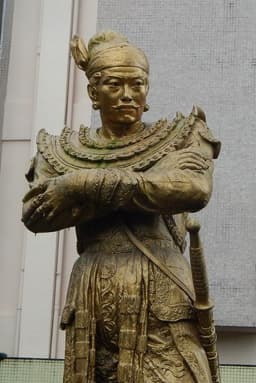
Bayinnaung
Emperor · Modern
68.6Total
Shi Dakai
General · Modern
59.6Total
Basic Information
Born
1516
1831
Died
1581
1863
Era
Modern
Modern
Nationality
Myanmar
China
Occupation
Emperor
General
Civilization
Eastern
Eastern
Score Comparison
Military (10%)
77.1
76.0
Political (20%)
82.0
45.0
Influence (20%)
65.0
56.7
Legacy (20%)
55.0
54.0
Leadership (15%)
74.0
72.0
Strategy (15%)
75.0
68.1
TOTAL
68.6
59.6
Bayinnaung — Complete Timeline
1550 AD
Establishment of the Toungoo EmpirePolitical Action
King Bayinnaung ascended the throne and began a series of military campaigns that created the largest empire in Southeast Asian history. At its peak, the Toungoo empire covered modern Myanmar, Thailand, Laos, and parts of China and India.
Toungoo EmpireSoutheast AsiaImperial Expansion
Impact: regionalconstructive
1557 AD
Conquest of the Shan StatesWar◆ Major
King Bayinnaung conquered the Shan States, bringing them under Toungoo control. This expansion added significant territory and resources to the Burmese empire.
Shan StatesToungoo ExpansionBurmese Empire
Impact: regional
1569 AD
Capture of AyutthayaWar
King Bayinnaung's forces captured the Siamese capital of Ayutthaya after a long siege. He installed a vassal king and made Siam a tributary state of the Toungoo empire.
Burmese-Siamese WarAyutthayaToungoo Empire
Impact: regional
1570 AD
Administrative ReformsReform◆ Major
King Bayinnaung implemented administrative reforms to govern his vast empire, including the appointment of governors and the standardization of laws and taxes. These reforms helped maintain control over conquered territories.
GovernanceAdministrationToungoo Empire
Impact: regionalconstructive
1574 AD
Conquest of Lan XangWar◆ Major
King Bayinnaung conquered the Lao kingdom of Lan Xang (modern Laos), bringing it under Toungoo control. This further expanded the Burmese empire to its greatest territorial extent.
Lan XangToungoo ExpansionLaos
Impact: regional
Shi Dakai — Complete Timeline
1851 AD
Jintian UprisingWar◆ Major
Shi Dakai joined the Taiping Rebellion at its inception in Jintian, Guangxi. As a core leader, he helped organize the rebel forces and was appointed Wing King, becoming one of the key military commanders of the Taiping Heavenly Kingdom.
Taiping RebellionUprisingMilitary Command
Impact: national
1854 AD
Battle of XiangtanWar◆ Major
Shi Dakai led Taiping forces to a major victory at Xiangtan, Hunan, defeating Qing imperial troops. This battle secured Taiping control over key territories in the Yangtze River valley and demonstrated his military skill.
Taiping RebellionBattleVictory
Impact: regional
1856 AD
Tianjing IncidentPolitical Action
Shi Dakai returned to Tianjing (Nanjing) after the internal purge of the Eastern King Yang Xiuqing and the murder of the Northern King Wei Changhui. He condemned the violence and was forced to flee, leading to a split in Taiping leadership.
Taiping RebellionInternal ConflictPurge
Impact: nationaltragic
1858 AD
Campaign in Zhejiang and FujianWar
Shi Dakai led a separate Taiping army into Zhejiang and Fujian provinces, capturing several cities. This campaign expanded Taiping influence into southeastern China but also isolated his forces from the main Taiping base.
Taiping RebellionCampaignExpansion
Impact: regional
1863 AD
Battle of Baishui RiverWar◆ Major
Shi Dakai's army was trapped and defeated by Qing forces at the Baishui River in Sichuan. He was captured and executed shortly after, marking the end of his military career and a significant loss for the Taiping cause.
Taiping RebellionBattleDefeatDeath
Impact: nationaltragic
Expert Analysis
Shi Dakai vs Bayinnaung
# The Conqueror and the Rebel: Bayinnaung and Shi Dakai
In 1569, the Siamese capital of Ayutthaya fell after a siege that had stretched into its tenth month. The man who entered the city as its master was a Burmese king named Bayinnaung, whose armies had already swallowed the Shan States and would soon march on the Lao kingdom of Lan Xang. Nearly three centuries later and a thousand miles to the northeast, another commander—Shi Dakai, the Wing King of the Taiping Heavenly Kingdom—led his own army through the rugged mountains of Sichuan, fighting not foreign enemies but his own countrymen in a rebellion that would become the bloodiest civil war in human history. Both men were warriors of extraordinary ability. Yet one built the largest empire Southeast Asia had ever seen, while the other ended with his head on a pike beside the Baishui River. What separates triumph from tragedy is not always talent.
Origins
Bayinnaung was born in 1516, into a world of fractured kingdoms and constant warfare. His father was a minor official in the Toungoo dynasty, which at that time controlled little more than a single valley in central Burma. The young prince grew up in the shadow of the Shan raids and Mon rebellions that had shattered the old Pagan Empire. He learned early that survival meant expansion—that a kingdom either grew or was devoured. His era was one of gunpowder and elephants, of shifting alliances and mercenary armies, where a bold commander could carve out an empire in a single campaign season.
Shi Dakai, born in 1831, came of age in the twilight of the Qing dynasty. China was a civilization in crisis: opium wars, peasant famines, and a government so corrupt that it could barely collect taxes. Shi was a Hakka, an ethnic minority often despised by the Han majority, and he grew up in Guangxi, a province of bandits and secret societies. He was literate but not a scholar, proud but not patient. When a failed examination candidate named Hong Xiuquan declared himself the younger brother of Jesus Christ and called for the overthrow of the Manchu Qing, Shi Dakai was among the first to answer. He was twenty years old.
Rise to Power
Bayinnaung did not seize power—he inherited it, but only after proving himself indispensable. His predecessor and brother-in-law, King Tabinshwehti, had begun the work of reunifying Burma, but it was Bayinnaung who commanded the armies. When Tabinshwehti was assassinated in 1550, the throne was offered to Bayinnaung not by blood but by acclaim. He was thirty-four years old, and he spent the next three decades doing what he did best: marching.
Shi Dakai rose differently. The Taiping Rebellion began in 1851 with the Jintian Uprising, and Shi was immediately recognized as a military prodigy. While Hong Xiuquan preached theology and the Eastern King Yang Xiuqing managed politics, Shi Dakai fought. At the Battle of Xiangtan in 1854, he smashed Qing imperial forces and secured Hunan for the Taiping cause. By the time the rebels captured Nanjing in 1853 and declared it their Heavenly Capital, Shi was already a legend. But the Taiping were not a dynasty—they were a movement, and movements devour their own.
Leadership & Governance
Bayinnaung ruled as a builder. After conquering the Shan States in 1557, he did not simply loot and leave; he appointed governors, standardized taxes, and built roads. His administrative reforms of 1570 created a system of vassal kings and appointed officials that allowed him to govern an empire stretching from Manipur to Cambodia. He was ruthless in war but pragmatic in peace—when he captured Ayutthaya in 1569, he installed a Siamese prince as vassal king rather than annexing the kingdom outright. He understood that an empire too large to govern directly required local allies, not just garrisons.
Shi Dakai ruled as a crusader. The Taiping ideology was millenarian: they sought to destroy the old world and build a new one based on communal property, gender equality, and the worship of God. Shi believed in this vision, but he was also a pragmatist. When the Eastern King Yang Xiuqing began to accumulate too much power, the Heavenly King Hong Xiuquan ordered his assassination. The resulting Tianjing Incident of 1856 turned into a bloodbath—thousands of Taiping soldiers killed each other in the streets of Nanjing. Shi Dakai returned to the capital to stop the slaughter and was nearly killed himself. He fled with his army and never truly returned.
Triumph & Tragedy
Bayinnaung’s greatest moment came in 1574, when his armies conquered Lan Xang and brought Laos under Toungoo control. At its peak, his empire covered most of mainland Southeast Asia—a domain larger than any before or since. He died in 1581, still on the throne, still undefeated in battle. But his empire, like all personal empires, did not survive him. Within twenty years, the Siamese had regained their independence, and the Toungoo dynasty began its long decline.
Shi Dakai’s tragedy was more personal. After the Tianjing Incident, he led his army on a separate campaign through Zhejiang and Fujian, capturing cities but never consolidating them. In 1863, he marched into Sichuan, hoping to establish a new base. But the Qing general Luo Bingzhang had laid a trap. At the Baishui River, Shi’s army was surrounded. He surrendered, hoping to spare his men, but the Qing executed him anyway. He was thirty-two years old. The Taiping Rebellion would be crushed the following year.
Character & Destiny
Bayinnaung was a king who thought like a general—methodical, patient, and calculating. He built his empire campaign by campaign, never overreaching, always consolidating. His political score of 85.1 reflects his understanding that conquest was only half the work; the other half was governance. He was not a visionary; he was a craftsman.
Shi Dakai was a general who thought like a prophet—brilliant, passionate, and doomed. His military score of 84.6 and strategy score of 81.6 show his tactical genius, but his political score of 64.8 reveals his fatal weakness. He could win battles but not build institutions. He could inspire loyalty but not forge alliances. In a rebellion that needed unity, he chose independence. In a war that required patience, he chose honor.
Legacy
Bayinnaung is remembered in Myanmar as a national hero, the king who united the country and defeated the Siamese. His legacy score of 73.0 is modest by global standards, but in Southeast Asia, he remains a symbol of imperial ambition. The Burmese still tell stories of his white elephant and his invincible armies.
Shi Dakai is remembered in China as the tragic hero of the Taiping Rebellion—the "Wing King" who might have changed history if he had not been betrayed by his own side. His legacy score of 65.9 reflects the ambiguous status of the Taiping in Chinese historiography: were they rebels or liberators? Communists or fanatics? Shi remains a figure of romance and regret, a brilliant commander who fought for a cause that was already lost when he joined it.
Conclusion
Bayinnaung and Shi Dakai were both warriors of extraordinary skill, but they inhabited different worlds. Bayinnaung’s world was one of kingdoms and dynasties, where a conqueror could build an empire and die in bed. Shi’s world was one of revolution and apocalypse, where even the victors were consumed by the fire they had lit. The difference between them is not talent—it is context. Bayinnaung fought to expand a system; Shi Dakai fought to destroy one. And as history shows, it is far easier to build an empire than to build a new world.
Rankings
🥇
BayinnaungLeader
Mil: 77.1Pol: 82.0Inf: 65.0
68.6
🥈
Shi Dakai
Mil: 76.0Pol: 45.0Inf: 56.7
59.6
+9.0 behind
How This Comparison Works
Algorithm
Each figure is scored on 6 dimensions (0—100 scale) based on structured historical data: Military (10%), Political (20%), Influence (20%), Legacy (20%), Leadership (15%), Strategy (15%). The weighted total produces the final ranking.
Data Sources
Scores are computed from structured sub-indicators in the database. Scale factors adjust for era (Ancient ×0.85, Modern ×1.0) and civilization size (Eastern ×1.05, Other ×0.80) to account for differences in population and military scale.
Maximum 3 Figures
Comparisons are limited to 2—3 figures to ensure readability and statistical meaningfulness.
Error Margins
±5 points per dimension — Sub-scores are derived from historical records with inherent uncertainty. Two figures within 5 points on a dimension should be considered roughly equivalent in that area.
Total Score Accuracy
±3 points overall — The weighted combination of 6 dimensions produces a total score with approximately ±3 points of uncertainty. Differences of less than 3 points are not statistically significant— the figures are effectively tied.
Known Limitations
- Historical records are incomplete and uneven across civilizations
- Figures from oral-tradition societies may be underrepresented
- Occupation labels can misclassify multi-role figures
- Scores measure capability and impact, not moral character
- Quantitative scoring is a comparison tool, not absolute truth
Capability Radar
Military (10%) — Battles & Warfare
Battles
85
75
Win Rate
90
70
Expansion
92
75
Political (20%) — Governance & Reform
Reform
70
50
Diplomacy
78
45
Economy
72
40
Influence (20%) — Cultural & Global Reach
Cultural
70
55
Global
55
40
Legacy (20%) — Historical Impact
Historical
75
60
Longevity
60
45
Leadership (15%) — Power & Stability
Tenure
85
55
Stability
65
35
Strategy (15%) — Tactics & Innovation
Strategy
88
80
Tactics
80
85
Reform
75
60
Similar Comparisons
Comments & Discussion
BoulderBreaker6/16/2026
Bayinnaung was a conqueror who understood logistics and consolidation; Shi Dakai was a brilliant rebel who never mastered statecraft. The difference isn’t talent—it’s that one built granaries and supply lines, while the other expected righteousness to win battles. In 1863, Shi’s army starved crossing the Dadu River because he trusted the local chieftains. Bayinnaung would have taken their grain first, then their loyalty.
王翼未展6/16/2026
说石达开失于“仁慈”,纯属扯淡。1862年他在涪州屠了清军三千人,哪里手软?根本问题是太平天国的战略困局——四面都是敌人,没有缅甸那样的缓冲腹地。拿一个掌控了中南半岛的国王,比一个扛着半个清朝火力的叛逆,这不公平。把Bayinnaung扔到1860年的南京城外,他撑不过半年。
SiegeWhisperer6/16/2026
Both were masters of siegecraft, but only one knew when to negotiate. Bayinnaung took Ayutthaya after ten months because he accepted the Siamese king’s surrender and installed a vassal. Shi Dakai besieged Baoding in 1861 for weeks, then butchered the garrison after they surrendered—a move that rallied every Qing loyalist against him. That’s not moral failure; it’s strategic incompetence. You win by making enemies into allies, not corpses.
沉戟书生6/16/2026
数据不会说谎。Bayinnaung在位三十年,领土扩张了至少三倍,控制从曼尼普尔到素可泰的千里疆土;石达开从1857年离京到1863年被杀,六年颠沛流离,地盘越打越小。别扯什么“史诗英雄输给了历史”,两人面对的都是征服与毁灭的抉择,一个选对了,一个选错了。现实就是:扩张者赢了,逃跑者死了。