Loading...
Bayinnaung vs Prem Tinsulanonda
Bayinnaung leads by 11.4 pts · 2 figures compared
…
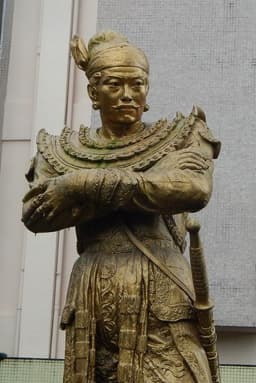
Bayinnaung
Emperor · Modern
68.6Total
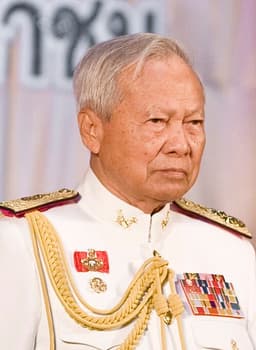
Prem Tinsulanonda
General · Modern
57.2Total
Basic Information
Born
1516
1920
Died
1581
—
Era
Modern
Modern
Nationality
Myanmar
Thailand
Occupation
Emperor
General
Civilization
Eastern
Eastern
Score Comparison
Military (10%)
77.1
50.0
Political (20%)
82.0
59.3
Influence (20%)
65.0
54.9
Legacy (20%)
55.0
47.5
Leadership (15%)
74.0
78.0
Strategy (15%)
75.0
60.0
TOTAL
68.6
57.2
Bayinnaung — Complete Timeline
1550 AD
Establishment of the Toungoo EmpirePolitical Action
King Bayinnaung ascended the throne and began a series of military campaigns that created the largest empire in Southeast Asian history. At its peak, the Toungoo empire covered modern Myanmar, Thailand, Laos, and parts of China and India.
Toungoo EmpireSoutheast AsiaImperial Expansion
Impact: regionalconstructive
1557 AD
Conquest of the Shan StatesWar◆ Major
King Bayinnaung conquered the Shan States, bringing them under Toungoo control. This expansion added significant territory and resources to the Burmese empire.
Shan StatesToungoo ExpansionBurmese Empire
Impact: regional
1569 AD
Capture of AyutthayaWar
King Bayinnaung's forces captured the Siamese capital of Ayutthaya after a long siege. He installed a vassal king and made Siam a tributary state of the Toungoo empire.
Burmese-Siamese WarAyutthayaToungoo Empire
Impact: regional
1570 AD
Administrative ReformsReform◆ Major
King Bayinnaung implemented administrative reforms to govern his vast empire, including the appointment of governors and the standardization of laws and taxes. These reforms helped maintain control over conquered territories.
GovernanceAdministrationToungoo Empire
Impact: regionalconstructive
1574 AD
Conquest of Lan XangWar◆ Major
King Bayinnaung conquered the Lao kingdom of Lan Xang (modern Laos), bringing it under Toungoo control. This further expanded the Burmese empire to its greatest territorial extent.
Lan XangToungoo ExpansionLaos
Impact: regional
Prem Tinsulanonda — Complete Timeline
1980 AD
Appointed Prime Minister after a coupPolitical Action◆ Major
Prem Tinsulanonda was appointed Prime Minister of Thailand by the military after a coup. He served for over eight years, overseeing a period of political stability and economic growth.
Prime MinisterMilitary RuleStability
Impact: national
1981 AD
Survived a coup attemptPolitical Action◆ Major
Prem survived a coup attempt by military officers loyal to the 'Young Turks' faction. The coup failed due to lack of support and the loyalty of key military units, allowing Prem to remain in power.
Coup AttemptPolitical CrisisMilitary
Impact: national
1988 AD
Resigned as Prime MinisterPolitical Action◆ Major
Prem resigned as Prime Minister after the general election, handing over power to a civilian government led by Chatichai Choonhavan. His resignation marked a rare peaceful transition of power in Thai politics.
ResignationDemocratic TransitionPeaceful
Impact: nationalconstructive
2016 AD
Appointed Regent of ThailandPolitical Action
After the death of King Bhumibol, Prem was appointed Regent of Thailand until the ascension of King Maha Vajiralongkorn. He served as a key figure in the transition of the monarchy.
RegentMonarchyTransition
Impact: national
Expert Analysis
Prem Tinsulanonda vs Bayinnaung
# The Emperor and the General: Two Paths to Power in Southeast Asia
On a sweltering afternoon in 1569, King Bayinnaung of the Toungoo dynasty stood before the shattered gates of Ayutthaya, the Siamese capital that had resisted his siege for months. The city’s defenders had finally surrendered, and the king—whose name would become synonymous with conquest across mainland Southeast Asia—ordered his troops to spare the temples and palaces. He intended not to destroy, but to absorb. Four centuries later, in 1981, another man of power faced a very different kind of siege: General Prem Tinsulanonda, Prime Minister of Thailand, sat in his Bangkok office as tanks rolled toward the capital. Young military officers, calling themselves the “Young Turks,” had launched a coup. Prem did not flee or call for troops. He waited, and the coup collapsed from lack of support. Two men, both rulers, both shaped by the same region—yet their worlds could not have been more different.
Origins
Bayinnaung was born in 1516, the son of a minor noble in the fractious Toungoo kingdom of what is now Myanmar. The sixteenth century was an age of warring states across Southeast Asia: the Burmese kingdoms fought the Shan, the Siamese, and the Lao, while Portuguese traders brought firearms and new tactics. Bayinnaung grew up in a world where power was earned through the sword, where a king’s legitimacy rested on his ability to conquer. He learned martial arts, studied military strategy, and served as a commander under his brother-in-law, King Tabinshwehti. When Tabinshwehti was assassinated in 1550, Bayinnaung seized the throne—not by birthright, but by force.
Prem Tinsulanonda was born in 1920 in Songkhla, southern Thailand, into a different era entirely. The twentieth century was the age of nationalism, Cold War alliances, and constitutional monarchies. Prem’s father was a judge, his family part of the educated elite. He attended military academy, served in World War II, and rose through the ranks of the Thai army during a period when the military dominated politics. His world was one of bureaucracy, diplomacy, and fragile coalitions—not raw conquest.
Rise to Power
Bayinnaung’s ascent was violent and swift. In 1550, immediately after becoming king, he launched a series of campaigns that would create the largest empire Southeast Asia had ever seen. He first consolidated control over the Irrawaddy Valley, then turned east. In 1557, he conquered the Shan States, bringing their fractious chieftains under Toungoo rule. He did not merely defeat them; he incorporated them, appointing loyal governors and demanding tribute. By 1569, when he captured Ayutthaya, his empire stretched from the borders of India to the Mekong River. In 1574, he conquered Lan Xang (modern Laos), completing a dominion that covered much of modern Myanmar, Thailand, Laos, and parts of China and Cambodia.
Prem’s rise was quieter but no less decisive. In 1980, after a coup ousted the civilian government, the military appointed him Prime Minister. He was not a charismatic populist; he was a steady hand, a general who understood that in Thailand, the monarchy was the true center of power. Prem cultivated close ties with King Bhumibol Adulyadej, earning the monarch’s trust. His legitimacy came not from conquest, but from the palace and the barracks.
Leadership & Governance
Bayinnaung ruled as a conqueror, but he was also an administrator. In 1570, he implemented reforms to govern his vast empire: he appointed governors to oversee provinces, standardized taxes, and built roads to connect distant regions. He was pragmatic, allowing local rulers to retain power as long as they paid tribute and remained loyal. Yet his empire was held together by personal loyalty and military might—a fragile structure that would crumble after his death.
Prem governed as a mediator. His political score of 68.8 and leadership score of 89.0 reflect his skill at navigating Thailand’s turbulent politics. He survived the 1981 coup attempt not by fighting, but by ensuring that the Young Turks lacked support from the army, the monarchy, and the public. He resigned in 1988 after elections, peacefully handing power to a civilian government—a rare act in a country prone to coups. In 2016, after King Bhumibol’s death, Prem was appointed Regent, serving as the bridge between reigns.
Triumph & Tragedy
Bayinnaung’s greatest triumph was his empire—the largest in Southeast Asian history. His tragedy was its fragility. When he died in 1581, his successors could not hold it together. Within decades, the empire fractured, and Ayutthaya regained its independence. His legacy was a cautionary tale: conquest alone cannot build a lasting state.
Prem’s triumph was stability. He led Thailand through the Cold War, balancing military power with democratic processes. His tragedy was the shadow of coups: he was a general who ruled by military appointment, and his era saw the suppression of dissent. Yet he is remembered as a statesman who prioritized the monarchy and the nation over personal ambition.
Character & Destiny
Bayinnaung was driven by ambition and a vision of unity. He believed that a single empire could bring peace to a warring region. His personality was that of a warrior-king: decisive, ruthless, yet capable of mercy. Prem was driven by duty and loyalty—to the king, to the military, to the nation. He was cautious, patient, and deeply conservative. Their characters reflected their eras: one was forged in the chaos of gunpowder empires, the other in the delicate dance of Cold War politics.
Legacy
Bayinnaung is remembered as a national hero in Myanmar, but his empire’s collapse overshadows his achievements. His military score of 79.8 and political score of 85.1 are high, but his influence score of 69.5 and legacy score of 73.0 suggest a man whose impact was limited by time. Prem’s legacy is more ambiguous: his leadership score of 89.0 is the highest among his metrics, but his military score of 33.7 reflects a man who was more politician than warrior. His influence score of 73.9 and legacy score of 66.8 show a figure respected but not revered.
Conclusion
Bayinnaung and Prem Tinsulanonda are bookends of Southeast Asian history: one built an empire with blood and fire, the other held a nation together with patience and compromise. The emperor’s world was one of conquest, where power was measured in territory and tribute. The general’s world was one of negotiation, where power was measured in trust and stability. Both succeeded in their own ways, and both faced the limits of their methods. The emperor’s empire crumbled; the general’s nation survived. In the end, the story of Southeast Asia is not just one of kings and generals—it is a story of how power adapts to its time, and how the men who wield it are shaped by the world they inherit.
Rankings
🥇
BayinnaungLeader
Mil: 77.1Pol: 82.0Inf: 65.0
68.6
🥈
Prem Tinsulanonda
Mil: 50.0Pol: 59.3Inf: 54.9
57.2
+11.4 behind
How This Comparison Works
Algorithm
Each figure is scored on 6 dimensions (0—100 scale) based on structured historical data: Military (10%), Political (20%), Influence (20%), Legacy (20%), Leadership (15%), Strategy (15%). The weighted total produces the final ranking.
Data Sources
Scores are computed from structured sub-indicators in the database. Scale factors adjust for era (Ancient ×0.85, Modern ×1.0) and civilization size (Eastern ×1.05, Other ×0.80) to account for differences in population and military scale.
Maximum 3 Figures
Comparisons are limited to 2—3 figures to ensure readability and statistical meaningfulness.
Error Margins
±5 points per dimension — Sub-scores are derived from historical records with inherent uncertainty. Two figures within 5 points on a dimension should be considered roughly equivalent in that area.
Total Score Accuracy
±3 points overall — The weighted combination of 6 dimensions produces a total score with approximately ±3 points of uncertainty. Differences of less than 3 points are not statistically significant— the figures are effectively tied.
Known Limitations
- Historical records are incomplete and uneven across civilizations
- Figures from oral-tradition societies may be underrepresented
- Occupation labels can misclassify multi-role figures
- Scores measure capability and impact, not moral character
- Quantitative scoring is a comparison tool, not absolute truth
Capability Radar
Military (10%) — Battles & Warfare
Battles
85
20
Win Rate
90
25
Expansion
92
10
Political (20%) — Governance & Reform
Reform
70
55
Diplomacy
78
60
Economy
72
50
Influence (20%) — Cultural & Global Reach
Cultural
70
30
Global
55
30
Legacy (20%) — Historical Impact
Historical
75
40
Longevity
60
35
Leadership (15%) — Power & Stability
Tenure
85
65
Stability
65
60
Strategy (15%) — Tactics & Innovation
Strategy
88
30
Tactics
80
30
Reform
75
35
Similar Comparisons
Comments & Discussion
BURMA-BASHER6/16/2026
Bayinnaung was the ultimate expansionist - a 16th century steamroller who took over Siam, Laos, and Manipur in his quest to make the Toungoo empire the "greatest in Southeast Asia." Prem? A bureaucratic placeholder who stumbled into power after Thanom's fall and clung to it by pitting army factions against each other. Let's be real: Bayinnaung conquered 19 vassal states; Prem couldn't even keep a few Young Turks loyal. One built an empire of swords, the other a career of lukewarm tea.
战象领主6/16/2026
拿普雷姆和莽应龙比?笑话。莽应龙用战象踏平了清迈、大城、万象,普雷姆不过在曼谷办公室坐了八年。前者把白象送给锡兰国王当外交礼物,后者连个内部政变都压不住要靠国王出面。说穿了,一个是血与火的帝王,一个是看人眼色的政客,隔着四百年根本没可比性。