Loading...
Bayinnaung vs Napoleon Bonaparte
Napoleon Bonaparte leads by 2.3 pts · 2 figures compared
…
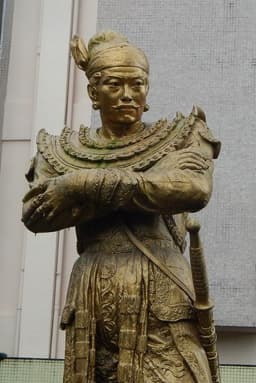
Bayinnaung
Emperor · Modern
68.6Total

Napoleon Bonaparte
General · Modern
70.9Total
Basic Information
Born
1516
1769
Died
1581
1821
Era
Modern
Modern
Nationality
Myanmar
France
Occupation
Emperor
General
Civilization
Eastern
Western
Score Comparison
Military (10%)
77.1
94.0
Political (20%)
82.0
72.0
Influence (20%)
65.0
40.0
Legacy (20%)
55.0
80.0
Leadership (15%)
74.0
78.0
Strategy (15%)
75.0
90.0
TOTAL
68.6
70.9
Bayinnaung — Complete Timeline
1550 AD
Establishment of the Toungoo EmpirePolitical Action
King Bayinnaung ascended the throne and began a series of military campaigns that created the largest empire in Southeast Asian history. At its peak, the Toungoo empire covered modern Myanmar, Thailand, Laos, and parts of China and India.
Toungoo EmpireSoutheast AsiaImperial Expansion
Impact: regionalconstructive
1557 AD
Conquest of the Shan StatesWar◆ Major
King Bayinnaung conquered the Shan States, bringing them under Toungoo control. This expansion added significant territory and resources to the Burmese empire.
Shan StatesToungoo ExpansionBurmese Empire
Impact: regional
1569 AD
Capture of AyutthayaWar
King Bayinnaung's forces captured the Siamese capital of Ayutthaya after a long siege. He installed a vassal king and made Siam a tributary state of the Toungoo empire.
Burmese-Siamese WarAyutthayaToungoo Empire
Impact: regional
1570 AD
Administrative ReformsReform◆ Major
King Bayinnaung implemented administrative reforms to govern his vast empire, including the appointment of governors and the standardization of laws and taxes. These reforms helped maintain control over conquered territories.
GovernanceAdministrationToungoo Empire
Impact: regionalconstructive
1574 AD
Conquest of Lan XangWar◆ Major
King Bayinnaung conquered the Lao kingdom of Lan Xang (modern Laos), bringing it under Toungoo control. This further expanded the Burmese empire to its greatest territorial extent.
Lan XangToungoo ExpansionLaos
Impact: regional
Napoleon Bonaparte — Complete Timeline
1799 AD
Coup of 18 BrumaireOther◆ Major
Napoleon Bonaparte, with support from his brother Lucien and key political figures, overthrew the Directory in a bloodless coup. He established the Consulate with himself as First Consul, effectively becoming the ruler of France. This event ended the French Revolution's most unstable period.
French RevolutionCoupRise to Power
Impact: regional
1804 AD
Promulgation of the Napoleonic CodeOther◆ Major
Napoleon enacted the Civil Code of the French, known as the Napoleonic Code, a comprehensive set of laws that replaced the fragmented feudal legal systems. The code established legal equality, protected property rights, and secularized law. It became the basis for legal systems in many European and world countries.
Legal ReformNapoleonic CodeCivil Law
Impact: globalconstructive
1805 AD
Battle of AusterlitzWar◆ Major
Napoleon's Grande Arm
Napoleonic WarsBattleDecisive Victory
Impact: global
1812 AD
Invasion of RussiaWar◆ Major
Napoleon led the Grande Arm
Napoleonic WarsInvasionDisaster
Impact: globaldestructive
1815 AD
Battle of WaterlooWar◆ Major
Napoleon's French army was defeated by the combined forces of the Duke of Wellington's Anglo-Allied army and Gebhard Leberecht von Bl
Napoleonic WarsBattleFinal Defeat
Impact: globaldestructive
Expert Analysis
bayinnaung-vs-napoleon-bonaparte
# The Eagle and the Elephant: Napoleon and Bayinnaung, Two Visions of Empire
In the summer of 1815, a defeated Napoleon Bonaparte stood on the deck of HMS *Bellerophon*, watching the coast of France disappear into the Atlantic mist. His empire, which had stretched from Madrid to Warsaw, had crumbled in a single day of battle. Two and a half centuries earlier and half a world away, another emperor—Bayinnaung of Burma—had gazed upon a different kind of horizon. His dominion, the largest Southeast Asia had ever known, stretched from the borders of India to the Mekong River. Yet when he died in 1581, his vast creation unraveled within decades. Both men built empires of breathtaking scale. Both saw their life’s work collapse. But the paths they took—and the worlds they left behind—could not have been more different.
Origins
Napoleon was born in 1769 on the Mediterranean island of Corsica, a place that had only recently become French. His family was minor nobility, poor but proud, and the young boy spoke Italian-accented French that drew snickers from his schoolmates. He was an outsider in a nation that did not quite accept him. This hunger for recognition—this need to prove himself—would drive him for the rest of his life.
Bayinnaung, born in 1516, came from humbler stock. He was not born a king. His father was a minor official in the Toungoo kingdom, and young Bayinnaung began his career as a common soldier. But he had a gift: he caught the eye of King Tabinshwehti, who made him a trusted general and, eventually, his brother-in-law. Where Napoleon’s rise was fueled by revolutionary chaos, Bayinnaung’s was built on personal loyalty and the relentless logic of Southeast Asian warfare—a world of shifting alliances, vassal states, and constant border raids.
Rise to Power
Napoleon’s ascent was meteoric because the French Revolution had shattered the old order. In 1793, at age twenty-four, he drove British forces out of Toulon and became a brigadier general. By 1796, he commanded the Army of Italy and won victory after victory against the Austrians. Each triumph elevated him further. In 1799, he seized power in a coup, making himself First Consul. By 1804, he crowned himself Emperor. The entire journey took eleven years.
Bayinnaung’s path was different. When King Tabinshwehti was assassinated in 1550, the Toungoo kingdom nearly collapsed. Bayinnaung, then a general, had to fight a civil war to claim the throne. He did not seize power through a dramatic coup; he earned it, province by province, battle by battle. By 1550, he had established the Toungoo Empire and began the campaigns that would define his reign. His rise was slower, more methodical, and rooted in the brutal realities of Southeast Asian politics, where a king’s legitimacy depended on his ability to protect and expand his realm.
Leadership & Governance
Napoleon ruled through a combination of military genius and administrative brilliance. His strategic mind was extraordinary—he could read a battlefield like a chessboard, and his victories at Austerlitz in 1805 and Jena in 1806 are still studied in war colleges today. But his true innovation was the Napoleonic Code, a legal system that standardized French law, abolished feudal privileges, and enshrined merit over birth. It was a revolutionary document that spread across Europe and beyond.
Bayinnaung governed differently. He conquered the Shan States in 1557, adding vast territories to his empire. In 1569, he captured the Siamese capital of Ayutthaya after a long siege, installing a vassal king. In 1574, he conquered Lan Xang, modern-day Laos. But his empire was not ruled by a unified legal code. Instead, Bayinnaung implemented administrative reforms in 1570, appointing governors and establishing a system of tribute and loyalty. His power was personal, not institutional. A vassal king swore allegiance to Bayinnaung, not to Burma.
This difference was critical. Napoleon’s empire was built on ideas—on law, on bureaucracy, on the promise of a new order. Bayinnaung’s empire was built on relationships—on oaths, on marriage alliances, on the fear of his armies. Both methods worked, but only as long as the emperor lived.
Triumph & Tragedy
Napoleon’s greatest moment was arguably his coronation in 1804, when he took the crown from the Pope’s hands and placed it on his own head. It was a gesture of supreme confidence, a statement that his power came from himself, not from God or tradition. His greatest tragedy was the invasion of Russia in 1812. He marched with 600,000 men; he returned with fewer than 100,000. The Grand Army was destroyed, and with it, his aura of invincibility. By 1814, Paris fell; by 1815, Waterloo sealed his fate.
Bayinnaung’s triumph was the capture of Ayutthaya in 1569, a victory that made him the undisputed master of mainland Southeast Asia. His tragedy was that his empire depended entirely on his own energy. When he died in 1581, the vassal kings rebelled, the Shan states broke away, and the Toungoo Empire began its long decline. Within a generation, much of what he had built was gone.
Character & Destiny
Napoleon was restless, ambitious, and supremely confident. “Impossible,” he once said, “is a word to be found only in the dictionary of fools.” He believed he could shape history through sheer will. And for a time, he was right. But his arrogance blinded him. He could not stop. He could not consolidate. He had to conquer, always.
Bayinnaung was different. He was patient, calculating, and deeply pragmatic. He understood that loyalty had to be earned and that an empire required constant attention. But he failed to build institutions that could outlast him. His empire was a pyramid balanced on a single point. When that point vanished, the pyramid collapsed.
Legacy
Napoleon’s legacy is immense. The Napoleonic Code influences legal systems from France to Louisiana to Japan. His military tactics are still taught. His name is synonymous with ambition, genius, and downfall. His memory is a warning and an inspiration.
Bayinnaung is remembered differently. In Myanmar, he is a national hero, the king who united the country and created its greatest empire. But outside Southeast Asia, he is largely unknown. His empire left no legal code, no lasting institution, no global influence. It was a monument to one man’s ability, and when the man died, the monument crumbled.
Conclusion
Two emperors, two empires, two different worlds. Napoleon built with ideas; Bayinnaung built with oaths. Napoleon’s empire was a revolution that spread across a continent; Bayinnaung’s was a personal achievement that faded with his breath. Both men were extraordinary. Both failed. But one failure taught the world about law and ambition; the other taught only that no man is irreplaceable. In the end, the difference between them is not in their victories, but in what they left behind.
Rankings
🥇
Napoleon BonaparteLeader
Mil: 94.0Pol: 72.0Inf: 40.0
70.9
🥈
Bayinnaung
Mil: 77.1Pol: 82.0Inf: 65.0
68.6
+2.3 behind
How This Comparison Works
Algorithm
Each figure is scored on 6 dimensions (0—100 scale) based on structured historical data: Military (10%), Political (20%), Influence (20%), Legacy (20%), Leadership (15%), Strategy (15%). The weighted total produces the final ranking.
Data Sources
Scores are computed from structured sub-indicators in the database. Scale factors adjust for era (Ancient ×0.85, Modern ×1.0) and civilization size (Eastern ×1.05, Other ×0.80) to account for differences in population and military scale.
Maximum 3 Figures
Comparisons are limited to 2—3 figures to ensure readability and statistical meaningfulness.
Error Margins
±5 points per dimension — Sub-scores are derived from historical records with inherent uncertainty. Two figures within 5 points on a dimension should be considered roughly equivalent in that area.
Total Score Accuracy
±3 points overall — The weighted combination of 6 dimensions produces a total score with approximately ±3 points of uncertainty. Differences of less than 3 points are not statistically significant— the figures are effectively tied.
Known Limitations
- Historical records are incomplete and uneven across civilizations
- Figures from oral-tradition societies may be underrepresented
- Occupation labels can misclassify multi-role figures
- Scores measure capability and impact, not moral character
- Quantitative scoring is a comparison tool, not absolute truth
Capability Radar
Military (10%) — Battles & Warfare
Battles
85
95
Win Rate
90
90
Expansion
92
95
Political (20%) — Governance & Reform
Reform
70
95
Diplomacy
78
80
Economy
72
85
Influence (20%) — Cultural & Global Reach
Cultural
70
85
Global
55
90
Legacy (20%) — Historical Impact
Historical
75
95
Longevity
60
90
Leadership (15%) — Power & Stability
Tenure
85
85
Stability
65
70
Strategy (15%) — Tactics & Innovation
Strategy
88
95
Tactics
80
98
Reform
75
92
Similar Comparisons
Comments & Discussion
No comments yet. Be the first to share your thoughts!