Loading...
Bayinnaung vs Julius Caesar
Julius Caesar leads by 14.2 pts · 2 figures compared
…
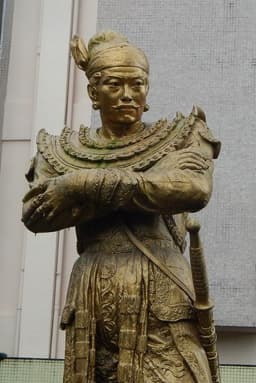
Bayinnaung
Emperor · Modern
68.6Total

Julius Caesar
General · Ancient
82.8Total
Basic Information
Born
1516
-100
Died
1581
-44
Era
Modern
Ancient
Nationality
Myanmar
Roman Republic
Occupation
Emperor
General
Civilization
Eastern
Western
Score Comparison
Military (10%)
77.1
88.0
Political (20%)
82.0
78.0
Influence (20%)
65.0
85.0
Legacy (20%)
55.0
82.0
Leadership (15%)
74.0
80.0
Strategy (15%)
75.0
85.0
TOTAL
68.6
82.8
Bayinnaung — Complete Timeline
1550 AD
Establishment of the Toungoo EmpirePolitical Action
King Bayinnaung ascended the throne and began a series of military campaigns that created the largest empire in Southeast Asian history. At its peak, the Toungoo empire covered modern Myanmar, Thailand, Laos, and parts of China and India.
Toungoo EmpireSoutheast AsiaImperial Expansion
Impact: regionalconstructive
1557 AD
Conquest of the Shan StatesWar◆ Major
King Bayinnaung conquered the Shan States, bringing them under Toungoo control. This expansion added significant territory and resources to the Burmese empire.
Shan StatesToungoo ExpansionBurmese Empire
Impact: regional
1569 AD
Capture of AyutthayaWar
King Bayinnaung's forces captured the Siamese capital of Ayutthaya after a long siege. He installed a vassal king and made Siam a tributary state of the Toungoo empire.
Burmese-Siamese WarAyutthayaToungoo Empire
Impact: regional
1570 AD
Administrative ReformsReform◆ Major
King Bayinnaung implemented administrative reforms to govern his vast empire, including the appointment of governors and the standardization of laws and taxes. These reforms helped maintain control over conquered territories.
GovernanceAdministrationToungoo Empire
Impact: regionalconstructive
1574 AD
Conquest of Lan XangWar◆ Major
King Bayinnaung conquered the Lao kingdom of Lan Xang (modern Laos), bringing it under Toungoo control. This further expanded the Burmese empire to its greatest territorial extent.
Lan XangToungoo ExpansionLaos
Impact: regional
Julius Caesar — Complete Timeline
58 BC
Gallic WarsWar◆ Major
Caesar, as proconsul of Gaul, launched a series of campaigns that conquered all of Gaul (modern France, Belgium, and parts of Switzerland). He fought numerous battles, including against the Helvetii, the Belgae, and the Gallic chieftain Vercingetorix. The wars brought immense wealth and a loyal army to Caesar.
Gallic WarsConquestRoman Expansion
Impact: regional
49 BC
Crossing the RubiconPolitical Action◆ Major
Caesar led Legio XIII across the Rubicon River into Italy, defying the Roman Senate's order to disband his army. This act triggered a civil war against Pompey and the Optimates, ultimately leading to Caesar's dictatorship and the end of the Roman Republic.
Roman Civil WarEnd of RepublicPower Struggle
Impact: global
48 BC
Battle of PharsalusWar◆ Major
Caesar's outnumbered army defeated the larger forces of Pompey the Great at Pharsalus in Greece. Caesar's tactical use of a reserve line to counter Pompey's cavalry charge proved decisive. Pompey fled to Egypt, where he was assassinated, leaving Caesar as the undisputed master of the Roman world.
Roman Civil WarBattleDecisive Victory
Impact: regional
44 BC
Appointment as Dictator for LifePolitical Action◆ Major
The Roman Senate appointed Caesar dictator perpetuo (dictator for life), granting him unprecedented personal power. This move concentrated military, legislative, and judicial authority in one person, effectively ending the Roman Republic's traditional system of checks and balances and alarming many senators.
DictatorshipEnd of RepublicPower Consolidation
Impact: regionaldestructive
Assassination on the Ides of MarchPolitical Action◆ Major
A group of Roman senators, led by Marcus Junius Brutus and Gaius Cassius Longinus, stabbed Caesar to death at a meeting of the Senate in the Theatre of Pompey. The assassination was intended to restore the Republic, but instead triggered another civil war that led to the rise of the Roman Empire.
AssassinationRoman PoliticsEnd of Republic
Impact: globaldestructive
Expert Analysis
bayinnaung-vs-julius-caesar
# The Emperor and the Dictator: Two Paths to Empire
On a spring morning in 44 BCE, a man in a purple toga fell bleeding at the foot of a marble colonnade in Rome, stabbed twenty-three times by men he had once called friends. Half a world away and sixteen centuries later, another ruler died quietly in his palace at Pegu, surrounded by the trappings of an empire he had built from nothing. Julius Caesar and Bayinnaung never met, never knew of each other's existence. Yet both men transformed their worlds, expanded their civilizations to their greatest extents, and left behind puzzles that historians still debate: Why did one man's empire crumble within years of his death, while the other's endured for generations? Why did one become a name that echoes through Western civilization, while the other remains largely unknown beyond his own region? The answers lie not in their achievements—both were extraordinary—but in the soil from which they grew.
Origins
Caesar was born into the chaos of a dying republic. The year was 100 BCE, and Rome was tearing itself apart—slave revolts, civil wars, populist tribunes clashing with conservative senators. His family, the Julii, claimed descent from the goddess Venus, but they were political outsiders, part of the *populares* faction that championed the common people against the aristocracy. Young Caesar learned early that in Rome, power came not from birth alone but from charisma, ruthlessness, and the ability to read a crowd. He watched his uncle Gaius Marius fight a bloody civil war, then watched the dictator Sulla proscribe his enemies. The lesson was clear: politics was war by other means.
Bayinnaung was born in 1516 into a very different world—a fragmented Southeast Asia where small kingdoms fought endlessly for supremacy. The Toungoo dynasty, to which he belonged, was itself a minor power in what is now Myanmar, hemmed in by the larger Shan states to the north and the Mon kingdoms to the south. Unlike Caesar, Bayinnaung did not come from an elite family. His father was a provincial governor, his mother a commoner. He rose through loyalty and military skill, serving as a general under King Tabinshwehti, the man who first began unifying Burma. When Tabinshwehti was assassinated in 1550, Bayinnaung seized the throne not by birthright but by acclamation of the army. He was thirty-four years old—the same age Caesar would be when he first won a major command in Spain.
Rise to Power
Caesar's path to supremacy was a masterclass in patience and audacity. He spent years climbing the Roman political ladder, borrowing enormous sums to fund extravagant games and bribes, building a network of allies that included the wealthy Crassus and the powerful Pompey. But his true breakthrough came in 58 BCE, when he secured command of Gaul. Over the next eight years, he conquered a territory larger than Italy itself, writing his own propaganda—the *Commentaries*—to ensure Rome knew every victory. He crossed the Rhine, invaded Britain, and built an army that was loyal to him personally, not to the Republic. When his enemies in the Senate tried to strip him of command, he made his fateful decision: on January 10, 49 BCE, he led that army across the Rubicon River, the boundary of his legal authority. "The die is cast," he reportedly said. Civil war had begun.
Bayinnaung's rise was more straightforward, but no less dramatic. Upon taking the throne in 1550, he faced a kingdom in rebellion—the Mon people had risen, and rival claimants contested his rule. He crushed them with relentless efficiency. Then he turned outward. In 1557, he conquered the Shan States to the north, bringing their cavalry and resources into his army. In 1569, after a long siege, he captured Ayutthaya, the capital of Siam, installing a vassal king. In 1574, he took Lan Xang, modern Laos. Each conquest was methodical, complete. Unlike Caesar, who often pardoned his enemies (a calculated generosity that sometimes backfired), Bayinnaung demanded total submission. He moved populations, resettled conquered peoples, and built roads and canals to bind his empire together.
Leadership & Governance
Here the two men diverged most sharply. Caesar governed as a reformer, not a conqueror. He extended Roman citizenship to Gauls, reformed the calendar (giving us the Julian calendar), launched public works projects, and centralized tax collection. But he never fully consolidated his power. He ruled as dictator for only a few years, and his reforms were imposed from above, often resented by the old aristocracy. He was a brilliant politician but a poor administrator of peace—he left no clear succession plan, no stable institutions. His power rested on his personality and his legions. When he fell, the structure collapsed.
Bayinnaung governed as an empire-builder in the Asian tradition. He appointed governors from among his loyal followers, but he also co-opted local elites, allowing them to retain power as long as they paid tribute and provided troops. He established a system of vassal kingdoms, with Ayutthaya and Lan Xang ruled by puppet kings. He standardized weights and measures, built irrigation systems, and promoted Buddhism as a unifying force. His empire, at its peak, stretched from the borders of India to the South China Sea. But unlike Caesar's centralized autocracy, Bayinnaung's was a decentralized federation—a strength that allowed it to survive his death, but also a weakness that would eventually lead to fragmentation.
Triumph & Tragedy
Caesar's greatest triumph was also his greatest tragedy. On the Ides of March, 44 BCE, he stood at the pinnacle of power—dictator for life, master of Rome, planning a war against Parthia that would have extended Roman rule to India. In a single hour, sixty senators turned on him. He died not in battle, but in a meeting, betrayed by men he had promoted, including his adopted son Brutus. "Et tu, Brute?"—the words may be Shakespeare's, but the shock was real. Caesar's tragedy was that he had no way to institutionalize his power; the Republic he tried to save by destroying it could not be rebuilt.
Bayinnaung's tragedy was different. He died in 1581, aged sixty-five, at the height of his power. His empire was intact, his vassals loyal, his sons prepared. But within decades, it began to unravel. The vassal kingdoms revolted, the Shan states broke away, and by the early 1600s, the Toungoo Empire had shrunk to little more than modern Myanmar. Bayinnaung's tragedy was that he built an empire too large for its foundation—a network of conquered states held together by his personal authority. Without him, the center could not hold.
Character & Destiny
Caesar was a man of contradictions: generous and ruthless, visionary and pragmatic, charming and cold. He forgave his enemies, then destroyed them. He loved Cleopatra, but used her. He wrote brilliant Latin prose while sleeping in his armor. His personality drove him to take risks that no cautious man would attempt—crossing the Rubicon, pardoning Brutus, dismissing his bodyguard on the Ides. He believed in his own star, and that belief killed him.
Bayinnaung was more methodical, more patient. He was a builder, not a gambler. He consolidated before expanding, governed before conquering. His personality was that of an administrator-warrior—he wrote no memoirs, left no famous quotes, founded no dynasty of writers. He simply built. And that building, while less dramatic than Caesar's fall, may have been more lasting.
Legacy
Caesar's legacy is immeasurable. His name became a title—Kaiser, Tsar—used by emperors for two millennia. His writings shaped Latin literature. His reforms outlasted him. But his greatest legacy was negative: by destroying the Republic, he proved that Rome could not be governed by a few families, that it needed a single ruler. Augustus, his adopted heir, learned from his mistakes and built an empire that lasted five hundred years.
Bayinnaung's legacy is more local but no less profound. In Myanmar, he is remembered as the greatest king in history, a unifier who brought peace and prosperity. His administrative systems influenced Burmese governance for centuries. His promotion of Theravada Buddhism shaped the religious landscape of Southeast Asia. But his empire did not last, and his name is little known beyond his homeland.
Conclusion
Two men, two empires, two fates. Caesar's story is a tragedy of ambition unchecked, of a man who could conquer the world but not his own destiny. Bayinnaung's story is a triumph of method over charisma, of building over conquering. One died young, betrayed by friends; the other died old, surrounded by family. Which was more successful? The answer depends on what you value: the flash of genius or the slow work of construction. Caesar's Rome became a civilization. Bayinnaung's Burma became a memory. Both men, in their different ways, remind us that empire is always a gamble—and that even the greatest conquerors cannot conquer time.
Rankings
🥇
Julius CaesarLeader
Mil: 88.0Pol: 78.0Inf: 85.0
82.8
🥈
Bayinnaung
Mil: 77.1Pol: 82.0Inf: 65.0
68.6
+14.2 behind
How This Comparison Works
Algorithm
Each figure is scored on 6 dimensions (0—100 scale) based on structured historical data: Military (10%), Political (20%), Influence (20%), Legacy (20%), Leadership (15%), Strategy (15%). The weighted total produces the final ranking.
Data Sources
Scores are computed from structured sub-indicators in the database. Scale factors adjust for era (Ancient ×0.85, Modern ×1.0) and civilization size (Eastern ×1.05, Other ×0.80) to account for differences in population and military scale.
Maximum 3 Figures
Comparisons are limited to 2—3 figures to ensure readability and statistical meaningfulness.
Error Margins
±5 points per dimension — Sub-scores are derived from historical records with inherent uncertainty. Two figures within 5 points on a dimension should be considered roughly equivalent in that area.
Total Score Accuracy
±3 points overall — The weighted combination of 6 dimensions produces a total score with approximately ±3 points of uncertainty. Differences of less than 3 points are not statistically significant— the figures are effectively tied.
Known Limitations
- Historical records are incomplete and uneven across civilizations
- Figures from oral-tradition societies may be underrepresented
- Occupation labels can misclassify multi-role figures
- Scores measure capability and impact, not moral character
- Quantitative scoring is a comparison tool, not absolute truth
Capability Radar
Military (10%) — Battles & Warfare
Battles
85
95
Win Rate
90
92
Expansion
92
97
Political (20%) — Governance & Reform
Reform
70
90
Diplomacy
78
85
Economy
72
82
Influence (20%) — Cultural & Global Reach
Cultural
70
88
Global
55
94
Legacy (20%) — Historical Impact
Historical
75
95
Longevity
60
96
Leadership (15%) — Power & Stability
Tenure
85
75
Stability
65
60
Strategy (15%) — Tactics & Innovation
Strategy
88
94
Tactics
80
96
Reform
75
88
Similar Comparisons
Comments & Discussion
No comments yet. Be the first to share your thoughts!