Loading...
Bayinnaung vs Hideki Tojo
Bayinnaung leads by 14.7 pts · 2 figures compared
…
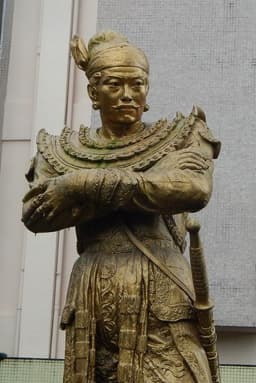
Bayinnaung
Emperor · Modern
68.6Total
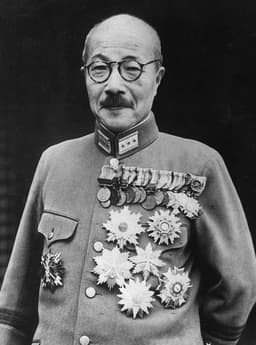
Hideki Tojo
General · Modern
53.9Total
Basic Information
Born
1516
1884
Died
1581
1948
Era
Modern
Modern
Nationality
Myanmar
Japan
Occupation
Emperor
General
Civilization
Eastern
Eastern
Score Comparison
Military (10%)
77.1
70.0
Political (20%)
82.0
48.0
Influence (20%)
65.0
55.0
Legacy (20%)
55.0
50.0
Leadership (15%)
74.0
53.2
Strategy (15%)
75.0
55.0
TOTAL
68.6
53.9
Bayinnaung — Complete Timeline
1550 AD
Establishment of the Toungoo EmpirePolitical Action
King Bayinnaung ascended the throne and began a series of military campaigns that created the largest empire in Southeast Asian history. At its peak, the Toungoo empire covered modern Myanmar, Thailand, Laos, and parts of China and India.
Toungoo EmpireSoutheast AsiaImperial Expansion
Impact: regionalconstructive
1557 AD
Conquest of the Shan StatesWar◆ Major
King Bayinnaung conquered the Shan States, bringing them under Toungoo control. This expansion added significant territory and resources to the Burmese empire.
Shan StatesToungoo ExpansionBurmese Empire
Impact: regional
1569 AD
Capture of AyutthayaWar
King Bayinnaung's forces captured the Siamese capital of Ayutthaya after a long siege. He installed a vassal king and made Siam a tributary state of the Toungoo empire.
Burmese-Siamese WarAyutthayaToungoo Empire
Impact: regional
1570 AD
Administrative ReformsReform◆ Major
King Bayinnaung implemented administrative reforms to govern his vast empire, including the appointment of governors and the standardization of laws and taxes. These reforms helped maintain control over conquered territories.
GovernanceAdministrationToungoo Empire
Impact: regionalconstructive
1574 AD
Conquest of Lan XangWar◆ Major
King Bayinnaung conquered the Lao kingdom of Lan Xang (modern Laos), bringing it under Toungoo control. This further expanded the Burmese empire to its greatest territorial extent.
Lan XangToungoo ExpansionLaos
Impact: regional
Hideki Tojo — Complete Timeline
1941 AD
Attack on Pearl HarborWar
As Prime Minister, Hideki Tojo authorized the attack on the US naval base at Pearl Harbor, Hawaii. The surprise attack brought the United States into World War II. Tojo's decision was based on the belief that war with the US was inevitable due to resource embargoes and diplomatic failures.
World War IIPearl HarborUS-Japan War
Impact: globaldestructive
Appointment as Prime MinisterPolitical Action◆ Major
Hideki Tojo was appointed Prime Minister of Japan, replacing Fumimaro Konoe. He retained his position as Army Minister and later took on other portfolios, consolidating power. His appointment marked the ascendancy of the military faction in the Japanese government and the shift towards total war.
Prime MinisterMilitary GovernmentWorld War II
Impact: national
1942 AD
Fall of SingaporeWar◆ Major
Under Tojo's leadership, Japanese forces captured Singapore from the British in a swift campaign. The fall of Singapore was one of the worst British military defeats in history. It demonstrated Japanese military prowess and led to the occupation of a key strategic location in Southeast Asia.
World War IISingaporeJapanese Victory
Impact: global
1948 AD
Execution by the International Military Tribunal for the Far EastPolitical Action◆ Major
Hideki Tojo was found guilty of war crimes by the International Military Tribunal for the Far East and sentenced to death. He was executed by hanging on December 23, 1948. His trial and execution symbolized the Allied effort to hold Japanese leaders accountable for wartime atrocities.
War CrimesExecutionTokyo Trials
Impact: globaltragic
Expert Analysis
Hideki Tojo vs Bayinnaung
# The Empire Builder and the Empire Destroyer
On a humid December morning in 1941, Hideki Tojo stood before the Japanese Diet and declared war on the United States, setting in motion a chain of events that would end with his own execution seven years later. Four centuries earlier, on the other side of Asia, King Bayinnaung of the Toungoo dynasty looked out from his newly conquered capital at Pegu, surveying an empire that stretched from the borders of India to the South China Sea. Both men commanded armies. Both built empires. But where one constructed a realm that would endure for centuries, the other presided over a catastrophe that consumed everything it touched. The question of why haunts the historical imagination.
Origins
Hideki Tojo was born into a military family in 1884, the son of a samurai-turned-army-officer who had fought for the emperor during the Meiji Restoration. His Japan was a nation in furious transformation, industrializing at breakneck speed while nursing ambitions of regional dominance. Tojo absorbed the militarist ethos of his era: discipline, hierarchy, and an unshakeable belief that Japan’s survival depended on expansion. He graduated from the Imperial Japanese Army Academy at the top of his class, but his mind was that of a bureaucrat, not a philosopher. He never questioned the system he served.
Bayinnaung, born in 1516 in the small principality of Toungoo, grew up in a fractured Burma where rival kingdoms tore at one another like starving dogs. The Shan States raided from the north. The Mon kingdoms menaced from the south. The Siamese lurked to the east. His early life was shaped by constant warfare, but also by the example of his brother-in-law, King Tabinshwehti, who first dreamed of reuniting Burma. When Tabinshwehti was assassinated in 1550, Bayinnaung inherited not a stable kingdom but a rebellion. He was thirty-four years old, and the throne was made of knives.
Rise to Power
Tojo’s ascent was methodical, almost bureaucratic. He served as military attaché in Berlin and Geneva, commanded troops in Manchuria, and rose through the ranks of the Kwantung Army, the shadow government that controlled Japan’s puppet state in northeast China. By 1937, he was chief of staff of the Kwantung Army, overseeing operations in China that grew increasingly brutal. His reputation was that of a competent administrator who never hesitated to use force. When Prime Minister Fumimaro Konoe resigned in October 1941 over the question of war with the United States, Tojo was the natural successor—a man the militarists trusted and the emperor could not refuse.
Bayinnaung’s rise was forged in battle. Upon taking the throne in 1550, he faced revolts across his domain. He did not negotiate. He marched. Within a year, he had crushed the rebellion in Prome, then turned east to subdue the Mon kingdoms. His method was relentless: he gave his enemies no time to breathe, no opportunity to ally against him. By 1555, he had reunited all of Burma, something no king had achieved in three decades. But Bayinnaung did not stop at unification. He saw beyond the borders.
Leadership & Governance
Tojo governed through fear and control. As prime minister, he held simultaneous portfolios—army minister, home minister, and later chief of the general staff—concentrating power in his hands with a paranoia that paralyzed decision-making. He micromanaged military operations from Tokyo, overruling field commanders who understood local conditions. His political score of 65.0 reflects a leader who could manipulate institutions but could not inspire loyalty beyond the chain of command. When the war turned against Japan after 1942, Tojo’s response was not strategic adaptation but repression: he tightened censorship, expanded the secret police, and demanded total sacrifice from a population he never truly trusted.
Bayinnaung, by contrast, governed with a political score of 85.1, and the difference lay in his understanding of empire as relationship, not domination. After conquering the Shan States in 1557, he did not impose Burmese governors. Instead, he confirmed local rulers as tributary kings, binding them through marriage alliances and Buddhist patronage. When he captured Ayutthaya in 1569, he installed a vassal king but allowed Siamese culture and religion to continue. In Lan Xang, conquered in 1574, he did the same. His administrative reforms—appointing governors, standardizing tax collection, building roads and canals—were designed to integrate, not exploit. He understood that an empire held by force alone would shatter at the first weakness.
Triumph & Tragedy
Tojo’s greatest triumph was also his greatest tragedy. The attack on Pearl Harbor on December 7, 1941, was a masterpiece of tactical surprise that crippled the U.S. Pacific Fleet. For six months, Japanese forces swept across Southeast Asia, capturing Singapore in February 1942 in the largest surrender of British troops in history. The fall of Singapore was Tojo’s moment of glory—a victory that seemed to confirm that Japan’s destiny was conquest. But Pearl Harbor was also the decision that guaranteed Japan’s eventual defeat. Tojo had awakened an industrial giant and given it no choice but total war. He had no plan for victory, only for the opening gambit.
Bayinnaung’s tragedy was the opposite: he built an empire too vast to hold. By 1570, his domain stretched from the borders of Manipur to the Mekong River, the largest empire Southeast Asia had ever seen. But the cost of constant warfare drained his treasury and depopulated his countryside. His sons, raised in the shadow of a conqueror, lacked his diplomatic skill. When Bayinnaung died in 1581, the empire began to fracture almost immediately. Within twenty years, Siam had regained independence, and the Shan States had broken away. The great edifice collapsed not from external attack but from internal exhaustion.
Character & Destiny
Tojo’s character was rigid, humorless, and driven by a narrow conception of duty. He once told his cabinet, “Sometimes it is necessary to shut one’s eyes and jump.” This was not wisdom but fatalism—a refusal to confront the consequences of his choices. He believed in Japan’s spiritual superiority over Western materialism, yet he modeled his military on German tactics and his industry on American efficiency. The contradiction never troubled him. At his trial, he accepted responsibility for the war but denied guilt for atrocities, claiming he had been too busy to know what his generals were doing. The International Military Tribunal for the Far East sentenced him to death in 1948. He was hanged, a bureaucrat who had destroyed a nation.
Bayinnaung’s character was expansive, pragmatic, and deeply religious. He saw himself as a Buddhist king in the tradition of Ashoka, a conqueror who spread the dharma through righteous rule. He built pagodas, commissioned scriptures, and sought to unify his empire through faith. But he was also ruthless when necessary: when the king of Ayutthaya broke his oath of vassalage, Bayinnaung returned and sacked the city so thoroughly that it remained abandoned for decades. The difference from Tojo was that Bayinnaung understood the limits of violence. He used terror as a tool, not a philosophy.
Legacy
Tojo’s legacy is a warning. In Japan, he is remembered as a war criminal, his name synonymous with the militarism that led to Hiroshima and Nagasaki. His total score of 70.2 reflects a figure of moderate historical importance but profound moral failure. The institutions he served—the imperial system, the military clique, the cult of sacrifice—collapsed with his death. Today, his ghost haunts Japanese politics, a reminder of what happens when nationalism becomes a religion and obedience becomes a virtue.
Bayinnaung’s legacy is more complex. In Myanmar, he is revered as a national hero, the unifier who proved that Southeast Asia could produce an empire to rival any in the world. His total score of 77.2 reflects genuine achievement: he created a political system that outlasted his dynasty, influenced Thai and Lao statecraft for centuries, and left a cultural imprint visible in the pagodas and chronicles that survive today. But his name also carries a darker echo. Modern Burmese nationalists have invoked his conquests to justify their own ambitions, and the empire he built—multi-ethnic, tolerant, and fragile—stands in tragic contrast to the fractured, conflict-ridden Myanmar of the present.
Conclusion
The difference between Tojo and Bayinnaung is not merely one of success or failure. It is a difference in the very conception of power. Tojo saw power as domination—an end in itself, to be accumulated and exercised without restraint. Bayinnaung saw power as stewardship—a means to create order, to build something that could survive its creator. One man’s empire lasted six months of victories before collapsing into ash. The other’s empire lasted a generation before dissolving into its constituent parts, but its memory shaped a region for centuries. In the end, the question is not who was stronger or smarter, but who understood that the greatest empires are not built on the fear of the conquered but on the loyalty of the willing. Tojo never learned this lesson. Bayinnaung learned it, but could not teach it to his sons. And so both empires, in their own ways, were lost.
Rankings
🥇
BayinnaungLeader
Mil: 77.1Pol: 82.0Inf: 65.0
68.6
🥈
Hideki Tojo
Mil: 70.0Pol: 48.0Inf: 55.0
53.9
+14.7 behind
How This Comparison Works
Algorithm
Each figure is scored on 6 dimensions (0—100 scale) based on structured historical data: Military (10%), Political (20%), Influence (20%), Legacy (20%), Leadership (15%), Strategy (15%). The weighted total produces the final ranking.
Data Sources
Scores are computed from structured sub-indicators in the database. Scale factors adjust for era (Ancient ×0.85, Modern ×1.0) and civilization size (Eastern ×1.05, Other ×0.80) to account for differences in population and military scale.
Maximum 3 Figures
Comparisons are limited to 2—3 figures to ensure readability and statistical meaningfulness.
Error Margins
±5 points per dimension — Sub-scores are derived from historical records with inherent uncertainty. Two figures within 5 points on a dimension should be considered roughly equivalent in that area.
Total Score Accuracy
±3 points overall — The weighted combination of 6 dimensions produces a total score with approximately ±3 points of uncertainty. Differences of less than 3 points are not statistically significant— the figures are effectively tied.
Known Limitations
- Historical records are incomplete and uneven across civilizations
- Figures from oral-tradition societies may be underrepresented
- Occupation labels can misclassify multi-role figures
- Scores measure capability and impact, not moral character
- Quantitative scoring is a comparison tool, not absolute truth
Capability Radar
Military (10%) — Battles & Warfare
Battles
85
65
Win Rate
90
40
Expansion
92
70
Political (20%) — Governance & Reform
Reform
70
30
Diplomacy
78
35
Economy
72
25
Influence (20%) — Cultural & Global Reach
Cultural
70
30
Global
55
55
Legacy (20%) — Historical Impact
Historical
75
55
Longevity
60
40
Leadership (15%) — Power & Stability
Tenure
85
60
Stability
65
20
Strategy (15%) — Tactics & Innovation
Strategy
88
50
Tactics
80
55
Reform
75
45
Similar Comparisons
Comments & Discussion
BigMouthData6/16/2026
Calling this an "Empire Builder vs Empire Destroyer" comparison is pure clickbait. Bayinnaung's "aggressive conquests" killed hundreds of thousands and destabilized mainland Southeast Asia for decades—the Toungoo Empire collapsed within 30 years of his death, precisely because he overextended supply lines that even his war elephants couldn't sustain. Tojo at least built modern military infrastructure that Japan's postwar recovery literally rode on. Both guys wrecked things; let's stop pretending
太极老掌故6/16/2026
把东条英机跟莽应龙放一块比?这俩人差着四百年政治生态呢。莽应龙当年打阿瑜陀耶,是为了控制印度洋贸易线的香料钱,跟东条那种“大东亚共荣”的抽象口号完全两码事。你翻翻《琉璃宫史》,莽应龙每打下一地就搞缅泰联姻、设总督府,这叫务实殖民;东条呢?珍珠港一炸直接把英美全惹毛了,战略上蠢得掉渣。帝国能撑多久,看的是后勤,不是口号。
VaultKeeper6/16/2026
The summary glosses over a critical detail: Bayinnaung unified fractured kingdoms using marriage alliances and local autonomy—he literally made his vassal rulers swear oaths on sacred Buddhist relics to ensure loyalty. Tojo, by contrast, centralized everything under the Imperial Rule Assistance Association and stripped local commanders of initiative, which is why his empire cracked the moment Midway happened. Leadership style matters more than ambition, and these two aren't even close.
血字研究6/16/2026
说什么“未质疑体制”?东条可是亲手把日本陆军省变成自己私人指挥所的——1941年他当首相兼陆相兼内相,权力集中到连天皇都压不住他。莽应龙再凶,底下还有个勃印曩(他弟弟)能拍桌子骂他,东条身边全是点头虫。前者治理靠军事+宗教双系统,后者靠恐怖和洗脑,你说哪个更像“帝国毁灭者”?
SkepticalSundial6/16/2026
Can we talk about the elephant in the room—literally? Bayinnaung's battle tactics relied on war elephants trained for shock charges, which worked brilliantly against Thai and Lao armies but would have been useless against Tojo's Type 89 tanks and Zero fighters. You can't compare "empire building" across four centuries of technological revolution. Tojo's failure was strategic overreach, sure, but Bayinnaung's success was partly just lucky timing against less-organized neighbors. Context is king,