Loading...
Bayinnaung vs Fuad Chehab
Bayinnaung leads by 18.7 pts · 2 figures compared
…
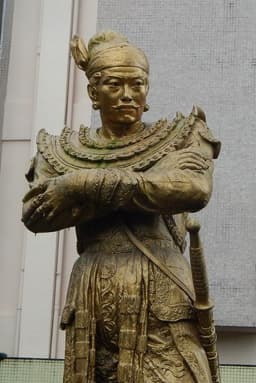
Bayinnaung
Emperor · Modern
68.6Total
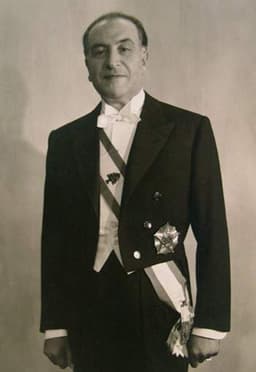
Fuad Chehab
General · Modern
49.9Total
Basic Information
Born
1516
1902
Died
1581
1973
Era
Modern
Modern
Nationality
Myanmar
Lebanon
Occupation
Emperor
General
Civilization
Eastern
Middle Eastern
Score Comparison
Military (10%)
77.1
10.2
Political (20%)
82.0
70.0
Influence (20%)
65.0
54.1
Legacy (20%)
55.0
44.2
Leadership (15%)
74.0
72.0
Strategy (15%)
75.0
30.3
TOTAL
68.6
49.9
Bayinnaung — Complete Timeline
1550 AD
Establishment of the Toungoo EmpirePolitical Action
King Bayinnaung ascended the throne and began a series of military campaigns that created the largest empire in Southeast Asian history. At its peak, the Toungoo empire covered modern Myanmar, Thailand, Laos, and parts of China and India.
Toungoo EmpireSoutheast AsiaImperial Expansion
Impact: regionalconstructive
1557 AD
Conquest of the Shan StatesWar◆ Major
King Bayinnaung conquered the Shan States, bringing them under Toungoo control. This expansion added significant territory and resources to the Burmese empire.
Shan StatesToungoo ExpansionBurmese Empire
Impact: regional
1569 AD
Capture of AyutthayaWar
King Bayinnaung's forces captured the Siamese capital of Ayutthaya after a long siege. He installed a vassal king and made Siam a tributary state of the Toungoo empire.
Burmese-Siamese WarAyutthayaToungoo Empire
Impact: regional
1570 AD
Administrative ReformsReform◆ Major
King Bayinnaung implemented administrative reforms to govern his vast empire, including the appointment of governors and the standardization of laws and taxes. These reforms helped maintain control over conquered territories.
GovernanceAdministrationToungoo Empire
Impact: regionalconstructive
1574 AD
Conquest of Lan XangWar◆ Major
King Bayinnaung conquered the Lao kingdom of Lan Xang (modern Laos), bringing it under Toungoo control. This further expanded the Burmese empire to its greatest territorial extent.
Lan XangToungoo ExpansionLaos
Impact: regional
Fuad Chehab — Complete Timeline
1958 AD
Launched Chehabist reforms and modernizationReform◆ Major
President Chehab implemented a series of reforms known as Chehabism, including administrative modernization, economic planning, and strengthening state institutions. He established the Central Bank of Lebanon and the Civil Service Board.
ReformModernizationState Building
Impact: nationalconstructive
Elected President of LebanonPolitical Action◆ Major
Fuad Chehab was elected President of Lebanon on September 23, 1958, succeeding Camille Chamoun. His election ended the 1958 crisis and was supported by both Christian and Muslim factions seeking stability.
PresidencyElectionStabilization
Impact: nationalconstructive
Created the Deuxième Bureau intelligence agencyPolitical Action
Chehab expanded the role of the Deuxi
IntelligenceSecurityAuthoritarianism
Impact: national
1960 AD
Presided over the 1960s economic boomOther
Under Chehab's presidency, Lebanon experienced a period of economic growth and stability, with Beirut becoming a major financial and tourism hub. His policies attracted foreign investment and expanded the middle class.
Economic GrowthBeirutProsperity
Impact: nationalconstructive
1964 AD
Refused to amend constitution for a second termPolitical Action
Chehab declined to seek a second term as president, respecting the constitutional limit. He retired from politics in 1964, setting a precedent for peaceful transitions of power in Lebanon.
ConstitutionTerm LimitRetirement
Impact: nationalconstructive
Expert Analysis
Fuad Chehab vs Bayinnaung
# The Emperor and the General: Two Visions of Power in Divided Lands
In 1569, King Bayinnaung of the Toungoo dynasty stood before the shattered gates of Ayutthaya, the Siamese capital that had fallen after a grueling siege. His war elephants, adorned with gold and lacquer, cast long shadows over the smoldering city. Nearly four centuries later, in 1958, General Fuad Chehab entered the presidential palace in Beirut not through breached walls but through a political crisis that had brought Lebanon to the brink of civil war. One man built an empire with blood and iron; the other tried to hold a fragile nation together with reforms and intelligence. Both faced the same fundamental challenge—how to rule diverse peoples—but their answers could not have been more different.
Origins
Bayinnaung was born in 1516 into a world of fragmentation. The once-mighty Pagan kingdom had collapsed, and the Toungoo dynasty was still a rising power in the chaotic landscape of warring states in what is now Myanmar. His father was a minor noble, and the young prince grew up in the shadow of his more famous brother-in-law, King Tabinshwehti. From an early age, Bayinnaung learned that survival meant conquest and that loyalty was the currency of power. The Shan hills, the Thai plains, and the Lao forests were not borders but opportunities.
Fuad Chehab, born in 1902, came from a different world entirely. His family was part of Lebanon’s Maronite Christian elite, but the Ottoman Empire was crumbling, and the French Mandate was about to redraw the map of the Middle East. Chehab grew up in a Lebanon that was not yet a nation—a patchwork of sects and clans held together by French bayonets and a fragile consensus. He chose a military career, not for conquest, but for order. The Lebanese army, under French tutelage, was one of the few institutions that could claim to be truly national.
Rise to Power
Bayinnaung’s path to power was forged in war. When Tabinshwehti was assassinated in 1550, the kingdom was in chaos. Bayinnaung did not hesitate. He seized the throne, crushed his rivals, and immediately launched the campaigns that would define his reign. Within seven years, he had conquered the Shan States, bringing their powerful sawbwas (chieftains) under his rule. By 1569, he had humiliated Siam and made Ayutthaya a vassal. In 1574, he added Lan Xang, the Lao kingdom, to his dominions. His empire stretched from the borders of Manipur to the Mekong Delta—the largest Southeast Asia had ever seen.
Chehab’s rise was quieter but no less decisive. He became commander of the Lebanese army in 1945, just as Lebanon gained independence. For thirteen years, he built the military into a professional, non-sectarian force. When the 1958 crisis erupted—a rebellion against President Camille Chamoun’s pro-Western policies and alleged manipulation of elections—Chehab refused to use the army to crush the insurgents. Instead, he positioned himself as a neutral arbiter. When Chamoun stepped down, Chehab was the natural choice to restore order. On September 23, 1958, he was elected president.
Leadership & Governance
Bayinnaung ruled through fear and patronage. His military campaigns were relentless, but he understood that conquest alone could not hold an empire. He appointed loyal governors to the conquered territories, often leaving local rulers in place as vassals. He standardized weights and measures, built roads, and promoted Theravada Buddhism as a unifying force. Yet his empire was a personal creation, held together by his own charisma and the constant threat of force. When he marched, his enemies submitted. When he stopped, they plotted.
Chehab governed through institutions and intelligence. His philosophy, known as Chehabism, aimed to modernize Lebanon’s state apparatus and reduce the sectarian tensions that threatened to tear the country apart. He created the Deuxième Bureau, the military intelligence agency, to monitor political opponents and prevent coups. He launched economic planning, built infrastructure, and tried to balance the interests of Christians, Muslims, and Druze. Unlike Bayinnaung, Chehab did not seek to expand Lebanon’s borders; he sought to strengthen its foundations. The economy boomed in the early 1960s, and Beirut became a financial hub for the Arab world.
Triumph & Tragedy
Bayinnaung’s greatest triumph was the sheer scale of his empire. He was the first ruler to unite most of mainland Southeast Asia under a single crown. His capital at Pegu was a marvel of Buddhist architecture and cosmopolitan trade. But his tragedy was that his empire was unsustainable. After his death in 1581, his successors could not hold it together. The vassals rebelled, the Siamese broke free, and the Toungoo dynasty collapsed into internal strife within decades.
Chehab’s triumph was that he kept Lebanon from falling apart. He gave the country a decade of stability and growth, and he respected the constitution by refusing to seek a second term in 1964. His tragedy was that his reforms were too shallow. The Deuxième Bureau became a tool of repression, and the sectarian system he tried to manage remained intact. When he retired, the old rivalries resurfaced. By 1975, Lebanon was in civil war.
Character & Destiny
Bayinnaung was a man of boundless ambition and iron will. He once declared, “I will not rest until the whole of the region is under my umbrella.” His personality was suited to an age of endless war, where a king’s worth was measured in conquered cities and tribute-bearing envoys. He was ruthless but pragmatic—he spared defeated kings who submitted and rewarded loyalty generously. But he could not delegate, and he could not plan for succession. His empire was his shadow; when he turned away, it vanished.
Chehab was a man of caution and principle. He was known for his integrity and his reluctance to wield power. “I am not a savior,” he once said, “I am a soldier who wants his country to live in peace.” His personality was suited to a fragile democracy, where a leader’s worth was measured in stability and compromise. But his caution had a cost. He refused to confront the deep inequalities and sectarian loyalties that plagued Lebanon, hoping that modernization would dissolve them. It did not.
Legacy
Bayinnaung is remembered in Myanmar as a national hero, a symbol of unity and strength. His statue stands in Naypyidaw, and his campaigns are taught in schools. But in Thailand and Laos, he is remembered as a conqueror and a tyrant. His legacy is a warning: empires built on conquest alone cannot endure.
Chehab is remembered in Lebanon as a rare example of honest, principled leadership. His name is given to schools and streets, and his presidency is often called a golden age. But his legacy is also a cautionary tale: reforms that do not address the root causes of division may only postpone the reckoning.
Conclusion
Bayinnaung and Chehab faced the same fundamental question: how to govern a diverse and fractured land. One answered with the sword, the other with the law. One built an empire that collapsed, the other preserved a nation that later shattered. Neither solution was perfect, and both men were prisoners of their times. But their stories remind us that leadership is never just about power—it is about understanding the limits of power. Bayinnaung conquered everything except time. Chehab reformed everything except human nature. In the end, both left behind not solutions, but questions that still haunt their descendants today.
Rankings
🥇
BayinnaungLeader
Mil: 77.1Pol: 82.0Inf: 65.0
68.6
🥈
Fuad Chehab
Mil: 10.2Pol: 70.0Inf: 54.1
49.9
+18.7 behind
How This Comparison Works
Algorithm
Each figure is scored on 6 dimensions (0—100 scale) based on structured historical data: Military (10%), Political (20%), Influence (20%), Legacy (20%), Leadership (15%), Strategy (15%). The weighted total produces the final ranking.
Data Sources
Scores are computed from structured sub-indicators in the database. Scale factors adjust for era (Ancient ×0.85, Modern ×1.0) and civilization size (Eastern ×1.05, Other ×0.80) to account for differences in population and military scale.
Maximum 3 Figures
Comparisons are limited to 2—3 figures to ensure readability and statistical meaningfulness.
Error Margins
±5 points per dimension — Sub-scores are derived from historical records with inherent uncertainty. Two figures within 5 points on a dimension should be considered roughly equivalent in that area.
Total Score Accuracy
±3 points overall — The weighted combination of 6 dimensions produces a total score with approximately ±3 points of uncertainty. Differences of less than 3 points are not statistically significant— the figures are effectively tied.
Known Limitations
- Historical records are incomplete and uneven across civilizations
- Figures from oral-tradition societies may be underrepresented
- Occupation labels can misclassify multi-role figures
- Scores measure capability and impact, not moral character
- Quantitative scoring is a comparison tool, not absolute truth
Capability Radar
Military (10%) — Battles & Warfare
Battles
85
5
Win Rate
90
5
Expansion
92
5
Political (20%) — Governance & Reform
Reform
70
65
Diplomacy
78
60
Economy
72
50
Influence (20%) — Cultural & Global Reach
Cultural
70
30
Global
55
25
Legacy (20%) — Historical Impact
Historical
75
35
Longevity
60
30
Leadership (15%) — Power & Stability
Tenure
85
55
Stability
65
45
Strategy (15%) — Tactics & Innovation
Strategy
88
10
Tactics
80
10
Reform
75
20
Similar Comparisons
Comments & Discussion
古典学小记6/16/2026
Bayinnaung的战役记录堪比《历史》中的薛西斯,以大象为舰,以人头筑塔。但细读汉译缅史,他也在孟族地区推行过有限自治,这类似罗马的分省之策。Chehab则更像晚期罗马的皇帝,用法律与情报维系多元帝国。两者皆在碎片化中求统合,但Bayinnaung的武力统一如昙花,Chehab的文治妥协如浮萍。真问题:如何让多元共存,而非暴力或僵局?
热情历史票友6/16/2026
别扯什么数据和政治正确。Bayinnaung就是个狠人,1569年攻破阿瑜陀耶后,他把泰国王子当人质,直接吞并领土。Chehab倒好,1958年黎巴嫩危机时,他既没派兵镇压穆斯林起义,也没改革选举制度,最后靠美军登陆稳住局面。一个是真刀真枪的征服,一个是绥靖战术的官僚。要我说,Bayinnaung至少留下了东吁王朝的版图,Chehab连黎巴嫩都没保住。
修正主义杠精6/16/2026
别总吹Bayinnaung“东南亚拿破仑”了。他最大问题就是不懂治理,统一后强行推行缅族文化,结果掸邦、兰纳全造反。Chehab呢?虽然是个军人,但他真试过用黎巴嫩化政策融合教派,比如1960年搞的行政改革给教派分权。Bayinnaung是暴力同化,Chehab是柔性分裂。一个用剑统治,一个用秤,但秤砣乱了,剑也生锈了。半斤八两。
Historian4036/16/2026
The “Bayinnaung vs. Chehab” comparison is just romanticizing different failures. Bayinnaung created a short-lived empire that splintered after his death—typical for conquest states, with zero institutional longevity. Chehab’s “reforms” in Lebanon? GDP growth data shows they barely dented sectarian inequality. By 1975, his legacy was a civil war. Both cases? High ambition, low return. History remembers them partly because they’re tragic outliers, not because they worked.
Chronicler72756/16/2026
Bayinnaung was the ultimate empire-builder, a master of siege warfare who expanded Toungoo to its greatest extent. But let’s be honest—he was just another conqueror who couldn't hold what he took. The 1569 sack of Ayutthaya? Sure, it was brutal, but within decades Siam was back. Meanwhile, Chehab never fired a shot in anger as president. That’s real governance, not just battlefield glory. Generals win battles; statesmen win peace.