Loading...
Augusto Pinochet vs Olusegun Obasanjo
Olusegun Obasanjo leads by 9.5 pts · 2 figures compared
…

Augusto Pinochet
General · Modern
50.7Total
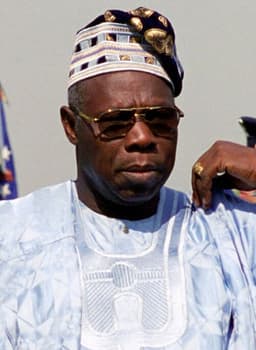
Olusegun Obasanjo
General · Modern
60.2Total
Basic Information
Born
1915
1937
Died
2006
—
Era
Modern
Modern
Nationality
Chile
Nigeria
Occupation
General
General
Civilization
Western
Other
Score Comparison
Military (10%)
25.9
45.0
Political (20%)
42.2
72.0
Influence (20%)
55.7
55.0
Legacy (20%)
46.7
54.0
Leadership (15%)
80.0
78.0
Strategy (15%)
41.7
60.0
TOTAL
50.7
60.2
Augusto Pinochet — Complete Timeline
1973 AD
1973 Chilean Coup d'ÉtatPolitical Action
Pinochet led a military coup that overthrew President Salvador Allende. The coup involved bombing the presidential palace and resulted in Allende's death, establishing a military junta with Pinochet as its leader.
CoupMilitary DictatorshipAllende Overthrow
Impact: globaldestructive
Caravan of DeathPolitical Action◆ Major
Pinochet ordered a military death squad to travel across Chile, executing political prisoners. At least 75 people were killed without trial, marking the beginning of systematic human rights abuses under his regime.
Human Rights AbusesPolitical RepressionExecutions
Impact: nationaldestructive
1980 AD
1980 Chilean ConstitutionReform◆ Major
Pinochet enacted a new constitution approved in a disputed referendum. It entrenched military influence, limited political freedoms, and allowed Pinochet to remain president until 1990, shaping Chile's political system.
ConstitutionAuthoritarianismPolitical Control
Impact: nationaldestructive
1988 AD
1988 Plebiscite LossPolitical Action
Pinochet lost a national plebiscite on extending his rule, with 55% voting 'No'. The result forced him to step down in 1990, leading to Chile's transition to democracy after 17 years of dictatorship.
PlebisciteDemocratic TransitionEnd of Dictatorship
Impact: nationalconstructive
1998 AD
Arrest in LondonPolitical Action◆ Major
Pinochet was arrested in London under a Spanish extradition warrant for human rights crimes. The arrest sparked international legal debates on universal jurisdiction and held him under house arrest for 16 months.
ArrestInternational LawHuman Rights
Impact: global
Olusegun Obasanjo — Complete Timeline
1976 AD
Military coup that brought Obasanjo to powerPolitical Action
Following the assassination of General Murtala Mohammed in a failed coup, Obasanjo, as Chief of Staff, Supreme Headquarters, succeeded him as head of state. He oversaw the continuation of the transition to civilian rule.
CoupSuccessionMilitary Rule
Impact: national
1979 AD
Handover of power to civilian governmentPolitical Action
Obasanjo voluntarily handed over power to the elected civilian government of Shehu Shagari, marking the first peaceful transfer of power from military to civilian rule in Nigeria. This act established a precedent for democratic transition.
DemocracyTransitionCivilian Rule
Impact: nationalconstructive
1999 AD
Election as President of NigeriaPolitical Action
Obasanjo won the 1999 Nigerian presidential election as the candidate of the People's Democratic Party (PDP). His victory ended 16 years of military rule and began the Fourth Nigerian Republic.
ElectionDemocracyFourth Republic
Impact: nationalprogressive
2005 AD
Debt relief from Paris ClubPolitical Action◆ Major
Obasanjo's government negotiated a debt relief agreement with the Paris Club, resulting in the cancellation of $18 billion of Nigeria's external debt. This freed up resources for domestic spending and was a major economic achievement.
Debt ReliefEconomyNegotiation
Impact: nationalconstructive
2006 AD
Third term bid failurePolitical Action◆ Major
Obasanjo attempted to amend the Nigerian constitution to allow him to run for a third term. The bid was rejected by the National Assembly, marking a significant political defeat and reinforcing term limits.
Third TermConstitutionDefeat
Impact: national
Expert Analysis
Origins
Augusto Pinochet (born 1915) was the son of a customs officer in Valparaíso, Chile. He entered the military academy at age 18, graduating as an infantry officer. His career advanced steadily through the ranks, with assignments to military schools and diplomatic posts. By 1971, he was appointed commander of the Santiago Army Garrison, a position that placed him at the center of political turmoil under President Salvador Allende.
Olusegun Obasanjo (born 1937) grew up in a farming family in Abeokuta, Nigeria. He enlisted in the Nigerian Army in 1958, training in Nigeria, the UK, and India. He served in the UN peacekeeping force in the Congo (1960) and later fought in the Nigerian Civil War (1967-1970), where he commanded the 3rd Marine Commando Division. His military career was marked by discipline and administrative competence.
Rise to Power
Pinochet rose to power through the 1973 Chilean coup d'état. On September 11, 1973, he led a military junta that bombarded the presidential palace and overthrew Allende. Pinochet was initially a member of the four-man junta but quickly consolidated control, becoming President of the Junta in 1974. His rise was enabled by U.S. support, elite opposition to Allende, and the military's institutional solidarity.
Obasanjo rose to power by succession after the assassination of General Murtala Mohammed in February 1976. As Chief of Staff, Supreme Headquarters, he assumed leadership of the military government. Unlike Pinochet, Obasanjo inherited power in a crisis and committed to a transition to civilian rule. In 1979, he handed over power to Shehu Shagari, becoming the first military leader in Africa to voluntarily cede power.
Leadership & Governance
Pinochet ruled as a dictator from 1974 to 1990. His regime suppressed political opposition through torture, executions, and exile. The Caravan of Death in 1973 executed at least 75 prisoners without trial. He enacted a new constitution in 1980 that entrenched military influence and limited democratic rights. Economically, he implemented free-market reforms with the help of the 'Chicago Boys', which stabilized the economy but increased inequality. His leadership style was authoritarian and personalist, concentrating power in his own hands.
Obasanjo's leadership evolved from military ruler to democratically elected president. As military head of state (1976-1979), he focused on rebuilding institutions after the civil war and overseeing a transition to democracy. As civilian president (1999-2007), he pursued economic reforms, anti-corruption campaigns, and foreign policy engagement. He negotiated $18 billion in debt relief from the Paris Club in 2005. His governance was consultative but also marked by attempts to extend his rule. In 2006, his bid to amend the constitution for a third term was rejected by the National Assembly. Obasanjo scores 72.0 in political leadership compared to Pinochet's 42.2.
Triumph & Tragedy
Pinochet's greatest success was economic stabilization: inflation dropped from 605% in 1973 to 9.9% by 1980, and GDP growth averaged 7% per year in the late 1980s. His tragedy was the human cost: over 3,000 people were killed or disappeared, and tens of thousands were tortured. His 1988 plebiscite loss, with 55% voting 'No', forced him to step down in 1990. The 1980 constitution, however, allowed him to remain as senator-for-life until 2002.
Obasanjo's triumph was overseeing Nigeria's transition from military rule to democracy in 1999 and securing debt relief that saved $1 billion annually. His tragedy was the failure of his third-term bid, which damaged his democratic legacy. Under his watch, corruption persisted, and the Niger Delta crisis intensified. Obasanjo's military score is 45.0, reflecting his role in the civil war and coup, but his political score of 72.0 highlights his democratic contributions.
Character & Destiny
Pinochet was methodical and ruthless. He saw himself as saving Chile from communism. His authoritarian personality made compromise impossible, leading to the 1988 plebiscite defeat. Historians assess him as a brutal dictator who left a mixed economic legacy. His arrest in London in 1998 on human rights charges sparked international legal debates. He died in 2006 without facing trial.
Obasanjo was pragmatic and ambitious. He cultivated an image of a statesman but was willing to bend rules to retain power. His voluntary handover in 1979 and return to democracy in 1999 show a commitment to civilian rule, yet his third-term bid revealed a desire for prolonged influence. He is seen as a flawed democrat who stabilized Nigeria but failed to fully reform it.
Legacy
Pinochet's legacy is deeply contested. His economic model persisted through democratic governments, but his human rights abuses have been condemned internationally. Chilean courts have prosecuted former officials, and his name is synonymous with state terror. His constitution was reformed in 2005 to remove authoritarian elements. Pinochet scores 46.7 in legacy, reflecting this divided memory.
Obasanjo's legacy is more positive but also mixed. He is credited with restoring democracy and negotiating debt relief. His handover in 1979 set a precedent for military withdrawal. However, corruption and poverty remain acute. He remains influential as an elder statesman. Obasanjo scores 54.0 in legacy, higher than Pinochet.
Conclusion
Olusegun Obasanjo had greater overall impact than Augusto Pinochet. His total score of 60.2 exceeds Pinochet's 50.7 by 9.5 points. While Pinochet's economic reforms were significant, they came at the cost of thousands of lives and a legacy of repression. Obasanjo's peaceful transition to democracy in 1979 and 1999, combined with debt relief of $18 billion, provided tangible benefits to millions. Both were military leaders who seized power, but Obasanjo ultimately used his authority to foster democratic governance, whereas Pinochet entrenched authoritarianism. The data supports Obasanjo as the more consequential figure, with higher scores in political leadership (72.0 vs 42.2) and a more favorable historical assessment.
Rankings
🥇
Olusegun ObasanjoLeader
Mil: 45.0Pol: 72.0Inf: 55.0
60.2
🥈
Augusto Pinochet
Mil: 25.9Pol: 42.2Inf: 55.7
50.7
+9.5 behind
How This Comparison Works
Algorithm
Each figure is scored on 6 dimensions (0—100 scale) based on structured historical data: Military (10%), Political (20%), Influence (20%), Legacy (20%), Leadership (15%), Strategy (15%). The weighted total produces the final ranking.
Data Sources
Scores are computed from structured sub-indicators in the database. Scale factors adjust for era (Ancient ×0.85, Modern ×1.0) and civilization size (Eastern ×1.05, Other ×0.80) to account for differences in population and military scale.
Maximum 3 Figures
Comparisons are limited to 2—3 figures to ensure readability and statistical meaningfulness.
Error Margins
±5 points per dimension — Sub-scores are derived from historical records with inherent uncertainty. Two figures within 5 points on a dimension should be considered roughly equivalent in that area.
Total Score Accuracy
±3 points overall — The weighted combination of 6 dimensions produces a total score with approximately ±3 points of uncertainty. Differences of less than 3 points are not statistically significant— the figures are effectively tied.
Known Limitations
- Historical records are incomplete and uneven across civilizations
- Figures from oral-tradition societies may be underrepresented
- Occupation labels can misclassify multi-role figures
- Scores measure capability and impact, not moral character
- Quantitative scoring is a comparison tool, not absolute truth
Capability Radar
Military (10%) — Battles & Warfare
Battles
10
25
Win Rate
15
30
Expansion
5
20
Political (20%) — Governance & Reform
Reform
20
65
Diplomacy
25
75
Economy
40
55
Influence (20%) — Cultural & Global Reach
Cultural
25
45
Global
40
60
Legacy (20%) — Historical Impact
Historical
50
55
Longevity
30
50
Leadership (15%) — Power & Stability
Tenure
65
70
Stability
30
60
Strategy (15%) — Tactics & Innovation
Strategy
25
40
Tactics
20
35
Reform
30
50
Similar Comparisons
Comments & Discussion
No comments yet. Be the first to share your thoughts!