Loading...
Antonio Lopez de Santa Anna vs Suharto
Antonio Lopez de Santa Anna leads by 1.7 pts · 2 figures compared
…
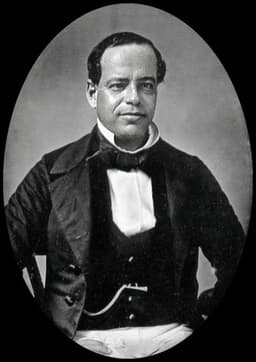
Antonio Lopez de Santa Anna
General · Modern
58.9Total
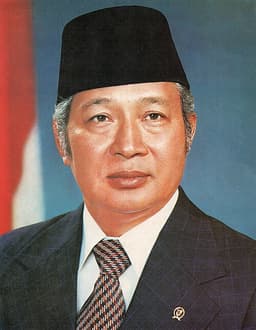
Suharto
General · Modern
57.2Total
Basic Information
Born
1794
1921
Died
1876
—
Era
Modern
Modern
Nationality
Mexico
Indonesia
Occupation
General
General
Civilization
Western
Eastern
Score Comparison
Military (10%)
70.0
20.0
Political (20%)
46.6
59.3
Influence (20%)
56.7
60.0
Legacy (20%)
58.0
52.0
Leadership (15%)
68.0
82.0
Strategy (15%)
60.0
60.0
TOTAL
58.9
57.2
Antonio Lopez de Santa Anna — Complete Timeline
1823 AD
Led the Plan of Casa Mata rebellionPolitical Action
Santa Anna, then a general, issued the Plan of Casa Mata on February 1, 1823, calling for the overthrow of Emperor Agust
RebellionOverthrowRepublic
Impact: nationalconstructive
1829 AD
Defended Mexico at the Battle of TampicoWar◆ Major
Santa Anna commanded Mexican forces that defeated a Spanish invasion force at Tampico on September 11, 1829. The victory ended Spain's last attempt to reconquer Mexico and made Santa Anna a national hero. He was hailed as the 'Hero of Tampico' and used this fame to advance politically.
VictorySpanish InvasionNational Hero
Impact: nationalconstructive
1833 AD
Became President of Mexico for the first timePolitical Action◆ Major
Santa Anna was elected President of Mexico in 1833. He quickly delegated power to Vice President Valent
PresidencyPolitical InstabilityPower
Impact: national
1836 AD
Commanded at the Siege of the AlamoWar◆ Major
Santa Anna personally led the Mexican army in the siege of the Alamo mission in San Antonio, Texas. After a 13-day siege, Mexican forces stormed the fort on March 6, 1836, killing all 180-250 Texan defenders. The battle became a symbol of Texan resistance and a rallying cry for independence.
BattleTexas RevolutionAlamo
Impact: regionaldestructive
Defeated and captured at the Battle of San JacintoWar
Santa Anna's army was surprised and routed by Texan forces under Sam Houston at the Battle of San Jacinto on April 21, 1836. Santa Anna was captured the next day. He was forced to sign the Treaties of Velasco, recognizing Texan independence, though Mexico later repudiated them.
DefeatCaptureTexas Independence
Impact: regionaltragic
1847 AD
Lost the Mexican-American WarWar
Santa Anna returned from exile to command Mexican forces during the Mexican-American War. Despite initial efforts, his army was defeated at the Battle of Cerro Gordo and later at the Battle of Chapultepec. US forces captured Mexico City on September 14, 1847, leading to the Treaty of Guadalupe Hidalgo and massive territorial losses.
Mexican-American WarDefeatTerritorial Loss
Impact: globaltragic
1853 AD
Sold La Mesilla to the United StatesPolitical Action◆ Major
During his final presidency, Santa Anna agreed to the Gadsden Purchase, selling 29,670 square miles of territory (La Mesilla) to the United States for $10 million. The sale was widely condemned in Mexico as a betrayal. This act further damaged his reputation and led to his overthrow.
Territorial CessionGadsden PurchaseBetrayal
Impact: nationaldestructive
1855 AD
Overthrown and exiled for the final timePolitical Action◆ Major
The Plan of Ayutla, led by Juan
OverthrowExileEnd of Career
Impact: nationaltragic
Suharto — Complete Timeline
1966 AD
Supersemar and Transfer of PowerPolitical Action
President Sukarno signed the Supersemar order, delegating authority to General Suharto to restore order after the 30 September Movement. Suharto used this to ban the Communist Party, purge leftists, and gradually assume executive power, effectively beginning his New Order regime.
SupersemarNew OrderIndonesia
Impact: nationaldestructive
1967 AD
New Order Economic DevelopmentReform◆ Major
Suharto implemented the New Order's economic policies, focusing on foreign investment, agricultural self-sufficiency, and industrialization. The government achieved high growth rates, reduced poverty, and stabilized the economy, but also fostered crony capitalism and corruption.
Economic GrowthDevelopmentIndonesia
Impact: nationalconstructive
1975 AD
Invasion of East TimorWar◆ Major
Suharto ordered the invasion of East Timor after Portugal withdrew. Indonesian forces occupied the territory, leading to a 24-year occupation marked by widespread human rights abuses, including massacres and forced displacement, resulting in an estimated 100,000-200,000 deaths.
East TimorOccupationHuman Rights
Impact: regionaldestructive
1998 AD
Asian Financial Crisis and Fall from PowerPolitical Action
The Asian Financial Crisis devastated Indonesia's economy, leading to massive unemployment and food shortages. Widespread protests and riots forced Suharto to resign in May 1998 after 31 years in power, ending his authoritarian rule and ushering in the Reformasi era.
Financial CrisisResignationReformasi
Impact: nationaltragic
Expert Analysis
Antonio Lopez de Santa Anna vs Suharto
# The General Who Lost a Nation
On a spring morning in 1836, Antonio López de Santa Anna stood before the smoking ruins of the Alamo, convinced he had crushed the Texas rebellion. Thirteen years later, on a different continent, a young Indonesian boy named Suharto was born into a world of Dutch colonial rule and Javanese mysticism. One man would lose half his country; the other would build a nation from chaos. Yet both were generals who seized power and held it for decades, leaving behind a tangled legacy of development and destruction. What separates a leader who loses a nation from one who transforms it? The answer lies not in their ambition, which was equal, but in how they understood the nature of power itself.
Origins
Santa Anna was born in 1794 in Jalapa, Veracruz, into a Spanish colonial family of modest means. The world of his youth was one of rigid hierarchy, where a creole could rise through military service but never fully escape the shadow of Spain. He entered the army at sixteen, and by his twenties had already learned the central lesson of Mexican politics: loyalty was a commodity, and rebellion a career path. The chaos of Mexico's early independence—a dizzying cycle of emperors, coups, and constitutions—shaped him into a master of opportunism.
Suharto, born in 1921 in the village of Kemusuk, Java, grew up in a different kind of chaos. His father was a minor village official, his mother a peasant. He was raised by relatives, shuffled between households, and learned early the Javanese arts of *slametan* (ritual harmony) and *unggah-ungguh* (proper deference). The Dutch East Indies were orderly but oppressive, and the Japanese occupation that followed taught him that power belonged to those who could navigate between worlds. Where Santa Anna learned that politics was a game of betrayal, Suharto learned it was a game of patience.
Rise to Power
Santa Anna's rise was theatrical and swift. In 1823, at age twenty-nine, he issued the Plan of Casa Mata, a rebellion that overthrew Emperor Agustín de Iturbide. This was his pattern: identify the winning side, join it, then claim credit. By 1829, he had become a national hero at the Battle of Tampico, where he defeated a Spanish invasion force. The victory was genuine, but Santa Anna understood that in Mexico, glory was currency. He spent it wisely, becoming president in 1833—though he soon delegated power to his vice president and retreated to his hacienda, waiting for the inevitable crisis that would call him back.
Suharto's rise was slower and more deliberate. He was a minor officer during Indonesia's war of independence, distinguished not by brilliance but by reliability. When the 30 September Movement attempted a coup in 1965, killing six generals, Suharto, then commander of the Army Strategic Reserve, moved with calculated restraint. He did not seize power immediately; he waited for President Sukarno to discredit himself, then accepted the Supersemar order in March 1966—a document that transferred authority without technically being a coup. Where Santa Anna rode in on a white horse, Suharto walked through an open door.
Leadership & Governance
Santa Anna ruled Mexico eleven times, but he never governed. His leadership was a performance: he would appear during crises, command armies, then disappear to his estate. His military genius was real but brittle. At the Alamo in 1836, he won a costly victory, then marched his exhausted army into the trap at San Jacinto, where Sam Houston's Texans captured him while he slept. The Gadsden Purchase of 1853, in which he sold 29,670 square miles of territory to the United States, was less a betrayal than a symptom: Santa Anna saw Mexico as his personal estate, and territory as bargaining chips.
Suharto's New Order, by contrast, was built on structure. From 1967 onward, he implemented economic policies that brought foreign investment, achieved rice self-sufficiency, and lifted millions from poverty. His regime was authoritarian but predictable—a "development dictatorship" that traded political freedom for economic stability. Yet the invasion of East Timor in 1975 revealed the darkness beneath: Suharto's order was maintained through violence, and the prosperity was built on corruption. Santa Anna lost territory through incompetence; Suharto lost legitimacy through cruelty.
Triumph & Tragedy
Santa Anna's greatest moment was Tampico, where he defended Mexico against Spain. His greatest failure was San Jacinto, where he lost Texas. But his true tragedy was that he never understood why he failed. He saw betrayal everywhere except in his own mirror.
Suharto's triumph was economic transformation: Indonesia's GDP per capita grew fivefold during his rule. His tragedy was the Asian Financial Crisis of 1998, which exposed the rot beneath the facade. When the currency collapsed and riots erupted, Suharto, like Santa Anna, blamed everyone but himself. He resigned in May 1998, a bitter old man watching his legacy burn.
Character & Destiny
Santa Anna was a narcissist who called himself the "Napoleon of the West." He wore wooden legs, fought cocks, and believed his own propaganda. Suharto was a Javanese mystic who consulted *dukun* (spiritual advisors) and projected an aura of calm authority. Both were ruthless, but their ruthlessness took different forms. Santa Anna's was impulsive—he ordered the execution of prisoners at the Alamo and then wondered why the Texans fought to the death. Suharto's was systematic—he imprisoned tens of thousands of communists and never once expressed doubt.
Their characters shaped their fates. Santa Anna could not build because he could not trust. Suharto could not adapt because he could not listen. One died in 1876, poor and forgotten, in Mexico City. The other died under house arrest, his family's fortune frozen, his name a curse.
Legacy
Santa Anna is remembered in Mexico as the man who lost half the country. In Texas, he is the villain who gave the Alamo its myth. His legacy is a cautionary tale about the cost of vanity.
Suharto's legacy is more ambiguous. Indonesia's economy grew, but its democracy was strangled. His children became billionaires; his prisons filled with dissidents. Today, some Indonesians remember the stability, others the theft. The scorecard reads: economic development, yes; human rights, no.
Conclusion
What separates the general who loses a nation from the one who transforms it? Not ambition, not intelligence, not even luck. Santa Anna and Suharto both rose through chaos, both held power for decades, both enriched themselves and their families. The difference was in their understanding of what power was for. Santa Anna saw it as a stage for his own glory; Suharto saw it as a tool for control. One built nothing; the other built a system that outlasted him, even if it was built on sand. In the end, both were consumed by the very forces they thought they had mastered—Santa Anna by his own ego, Suharto by the global economy he had embraced. Their stories remind us that the hardest thing for a general to learn is not how to seize power, but what to do with it once it is in his hands.
Rankings
🥇
Antonio Lopez de Santa AnnaLeader
Mil: 70.0Pol: 46.6Inf: 56.7
58.9
🥈
Suharto
Mil: 20.0Pol: 59.3Inf: 60.0
57.2
+1.7 behind
How This Comparison Works
Algorithm
Each figure is scored on 6 dimensions (0—100 scale) based on structured historical data: Military (10%), Political (20%), Influence (20%), Legacy (20%), Leadership (15%), Strategy (15%). The weighted total produces the final ranking.
Data Sources
Scores are computed from structured sub-indicators in the database. Scale factors adjust for era (Ancient ×0.85, Modern ×1.0) and civilization size (Eastern ×1.05, Other ×0.80) to account for differences in population and military scale.
Maximum 3 Figures
Comparisons are limited to 2—3 figures to ensure readability and statistical meaningfulness.
Error Margins
±5 points per dimension — Sub-scores are derived from historical records with inherent uncertainty. Two figures within 5 points on a dimension should be considered roughly equivalent in that area.
Total Score Accuracy
±3 points overall — The weighted combination of 6 dimensions produces a total score with approximately ±3 points of uncertainty. Differences of less than 3 points are not statistically significant— the figures are effectively tied.
Known Limitations
- Historical records are incomplete and uneven across civilizations
- Figures from oral-tradition societies may be underrepresented
- Occupation labels can misclassify multi-role figures
- Scores measure capability and impact, not moral character
- Quantitative scoring is a comparison tool, not absolute truth
Capability Radar
Military (10%) — Battles & Warfare
Battles
65
40
Win Rate
40
45
Expansion
50
30
Political (20%) — Governance & Reform
Reform
20
55
Diplomacy
35
60
Economy
15
65
Influence (20%) — Cultural & Global Reach
Cultural
55
40
Global
50
50
Legacy (20%) — Historical Impact
Historical
60
55
Longevity
55
45
Leadership (15%) — Power & Stability
Tenure
75
85
Stability
10
50
Strategy (15%) — Tactics & Innovation
Strategy
45
40
Tactics
60
35
Reform
30
50
Similar Comparisons
Comments & Discussion
Biscuits&Blood6/16/2026
Santa Anna literally sold a chunk of Texas for personal profit after being captured. Suharto built a whole damn kleptocracy that lasted 30 years. Night and day. One was a short-term grifter in uniform; the other was a systematic organizer of national-scale theft. Military historians love talking strategy, but the real difference is bookkeeping. Suharto understood spreadsheets.
LostLegion6/16/2026
Suharto's New Order killed way more of its own people, half a million in East Timor alone. Santa Anna was a disaster, sure, but he never pulled off that scale of state-sponsored extermination. If we’re ranking monsters by body count, this is a mismatch. One man lost a province; the other ran a mass grave.
数据侦探6/16/2026
说发展?苏哈托的GDP增长全靠石油美元和血汗工厂,印尼人均收入到现在还在挤泡沫。圣安娜虽然丢了一半国土,但至少没把国家搞成外债傀儡。比谁更烂?苏哈托对经济的破坏是系统性的长期腐烂,圣安娜就是个短命赌徒。
古典文献员6/16/2026
圣安娜的《军事手稿》里有句话:“胜利靠的是敌人的恐惧,而非士兵的献身”。苏哈托呢?靠的是美式CIA特训和伊斯兰神秘主义混搭。一个把战争当表演,一个把统治当邪教。读文本就知道,权力观差了三个世纪。圣安娜追求的是个人传奇,苏哈托追求的是绝对控制链。
Historian8936/16/2026
Both were corrupt as hell, but Suharto built the Trans-Java Highway and a green revolution. Santa Anna’s infrastructure legacy? A half-burned Alamo and a debt to the US for his own ransom. One at least modernized something; the other left a literal scorched earth. Yeah, Suharto was a tyrant, but he wasn't a pyromaniac with stars on his collar.