Loading...
Antonio Lopez de Santa Anna vs Yitzhak Rabin
Yitzhak Rabin leads by 7.5 pts · 2 figures compared
…
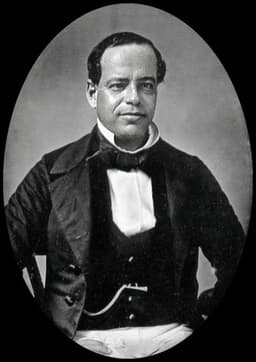
Antonio Lopez de Santa Anna
General · Modern
58.9Total
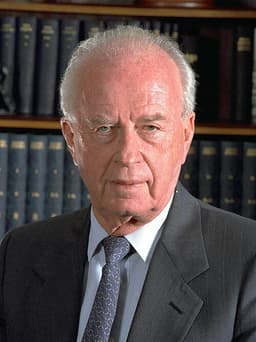
Yitzhak Rabin
General · Modern
66.4Total
Basic Information
Born
1794
1922
Died
1876
—
Era
Modern
Modern
Nationality
Mexico
Israel
Occupation
General
General
Civilization
Western
Middle Eastern
Score Comparison
Military (10%)
70.0
61.7
Political (20%)
46.6
82.0
Influence (20%)
56.7
68.0
Legacy (20%)
58.0
55.0
Leadership (15%)
68.0
78.0
Strategy (15%)
60.0
55.0
TOTAL
58.9
66.4
Antonio Lopez de Santa Anna — Complete Timeline
1823 AD
Led the Plan of Casa Mata rebellionPolitical Action
Santa Anna, then a general, issued the Plan of Casa Mata on February 1, 1823, calling for the overthrow of Emperor Agust
RebellionOverthrowRepublic
Impact: nationalconstructive
1829 AD
Defended Mexico at the Battle of TampicoWar◆ Major
Santa Anna commanded Mexican forces that defeated a Spanish invasion force at Tampico on September 11, 1829. The victory ended Spain's last attempt to reconquer Mexico and made Santa Anna a national hero. He was hailed as the 'Hero of Tampico' and used this fame to advance politically.
VictorySpanish InvasionNational Hero
Impact: nationalconstructive
1833 AD
Became President of Mexico for the first timePolitical Action◆ Major
Santa Anna was elected President of Mexico in 1833. He quickly delegated power to Vice President Valent
PresidencyPolitical InstabilityPower
Impact: national
1836 AD
Commanded at the Siege of the AlamoWar◆ Major
Santa Anna personally led the Mexican army in the siege of the Alamo mission in San Antonio, Texas. After a 13-day siege, Mexican forces stormed the fort on March 6, 1836, killing all 180-250 Texan defenders. The battle became a symbol of Texan resistance and a rallying cry for independence.
BattleTexas RevolutionAlamo
Impact: regionaldestructive
Defeated and captured at the Battle of San JacintoWar
Santa Anna's army was surprised and routed by Texan forces under Sam Houston at the Battle of San Jacinto on April 21, 1836. Santa Anna was captured the next day. He was forced to sign the Treaties of Velasco, recognizing Texan independence, though Mexico later repudiated them.
DefeatCaptureTexas Independence
Impact: regionaltragic
1847 AD
Lost the Mexican-American WarWar
Santa Anna returned from exile to command Mexican forces during the Mexican-American War. Despite initial efforts, his army was defeated at the Battle of Cerro Gordo and later at the Battle of Chapultepec. US forces captured Mexico City on September 14, 1847, leading to the Treaty of Guadalupe Hidalgo and massive territorial losses.
Mexican-American WarDefeatTerritorial Loss
Impact: globaltragic
1853 AD
Sold La Mesilla to the United StatesPolitical Action◆ Major
During his final presidency, Santa Anna agreed to the Gadsden Purchase, selling 29,670 square miles of territory (La Mesilla) to the United States for $10 million. The sale was widely condemned in Mexico as a betrayal. This act further damaged his reputation and led to his overthrow.
Territorial CessionGadsden PurchaseBetrayal
Impact: nationaldestructive
1855 AD
Overthrown and exiled for the final timePolitical Action◆ Major
The Plan of Ayutla, led by Juan
OverthrowExileEnd of Career
Impact: nationaltragic
Yitzhak Rabin — Complete Timeline
1967 AD
Chief of Staff during the Six-Day WarWar
As Chief of Staff of the Israel Defense Forces, Rabin commanded the Israeli military during the Six-Day War against Egypt, Jordan, and Syria. Israel captured the Sinai Peninsula, Gaza Strip, West Bank, East Jerusalem, and Golan Heights, reshaping the region.
Six-Day WarTerritorial ExpansionMilitary Victory
Impact: global
1993 AD
Signing of the Oslo AccordsPolitical Action
As prime minister, Rabin signed the Oslo Accords with PLO Chairman Yasser Arafat on the White House lawn. The agreement established the Palestinian Authority and set a framework for Palestinian self-governance in the West Bank and Gaza Strip.
Peace ProcessPalestiniansOslo
Impact: globalconstructive
1995 AD
Assassination at Peace RallyPolitical Action
Rabin was assassinated by Israeli extremist Yigal Amir after a peace rally in Tel Aviv. The assassination shocked Israel and the world, derailing the Oslo peace process and leading to a period of political instability.
AssassinationPeace ProcessPolitical Violence
Impact: globaltragic
Expert Analysis
Yitzhak Rabin vs Antonio Lopez de Santa Anna
# The General and the Peacemaker
On a warm September evening in 1995, Yitzhak Rabin stood before a crowd of 100,000 Israelis in Tel Aviv's Kings of Israel Square, singing a song of peace. Hours later, he lay dying from three bullets fired by a fellow Jew who believed his leader had betrayed the nation. A century earlier, Antonio López de Santa Anna, having lost half his country to the United States, fled Mexico for the last time, a disgraced old man who had been president eleven times. One general was assassinated for making peace; the other was exiled for losing war. Both men dominated their nations' politics for decades, yet their stories ended in opposite corners of tragedy. Why did one become a martyr for reconciliation while the other became a byword for betrayal?
Origins
Santa Anna was born in 1794 in Jalapa, a colonial city in Spain's most prized American territory. He joined the Spanish army at sixteen, learning war in an empire already cracking under the weight of its own contradictions. Mexico's independence struggle shaped him not as an idealist but as a survivor—he switched sides from Spain to the insurgents in 1821, sensing which way the wind blew. His Mexico was a land of vast inequalities, weak institutions, and regional caudillos who commanded personal loyalties stronger than any constitution.
Yitzhak Rabin was born in Jerusalem in 1922, the son of Russian-Jewish immigrants who had fled pogroms. He grew up in Tel Aviv, a city built on sand dunes by pioneers who believed they were creating a new kind of Jew—practical, tough, and ready to fight. Unlike Santa Anna, who inherited a nation's problems, Rabin helped build a nation from scratch. He joined the Palmach, the elite strike force of the Jewish underground, at eighteen, learning command not in colonial garrisons but in secret night operations against British soldiers and Arab militias.
Rise to Power
Santa Anna's path to power was a series of dramatic gambits. In 1823, he issued the Plan of Casa Mata, a rebellion that toppled Emperor Agustín de Iturbide and established a republic. He was thirty-one years old and already a kingmaker. Six years later, at the Battle of Tampico, he crushed a Spanish invasion force and became a national hero. But Santa Anna never fought for ideals—he fought for position. He would lead armies against foreign invaders, then turn those same armies against his own government when the moment suited.
Rabin's rise was slower, more institutional. He spent decades in the military, rising through the ranks of a defense force that valued competence over charisma. His turning point came in 1967, when as Chief of Staff he commanded Israel's lightning victory in the Six-Day War. In six days, his forces captured the Sinai, the Golan Heights, the West Bank, and East Jerusalem. But unlike Santa Anna, who milked his Tampico triumph for political power, Rabin seemed uncomfortable with glory. He retired from the military, served as ambassador to the United States, and entered politics almost reluctantly.
Leadership & Governance
Santa Anna governed through absence and spectacle. Elected president in 1833, he immediately delegated power to his vice president and retreated to his hacienda, returning only when crisis demanded—or when his popularity waned. He was a master of political theater, staging grand entrances and dramatic resignations. But beneath the show lay a fundamental failure: he never built institutions. Mexico remained a collection of personal loyalties, and every victory he won for the nation became a victory for himself.
Rabin governed through relentless pragmatism. As prime minister, he was not a stirring speaker or a magnetic personality. He was a technocrat who studied problems until he understood them, then acted with cold determination. His leadership style was the opposite of Santa Anna's—where the Mexican general ruled through emotion and manipulation, Rabin led through analysis and trust. His military background gave him credibility with Israel's security establishment, which he used to pursue the most controversial decision of his career: negotiating with the Palestine Liberation Organization.
Triumph & Tragedy
Santa Anna's greatest moment was also his most brutal. At the Alamo in 1836, he ordered "no quarter" and executed the survivors, a decision that turned the Texan rebellion into a war of vengeance. Three weeks later, he was captured at San Jacinto, forced to sign away Texas while wearing a common soldier's uniform. His greatest tragedy was not personal defeat but national catastrophe: during the Mexican-American War of 1847, his mismanagement and political scheming helped lose half of Mexico's territory. And in 1853, as his final act of power, he sold the La Mesilla valley to the United States for ten million dollars—a transaction Mexicans remember as a national humiliation.
Rabin's greatest triumph was the Oslo Accords, signed on the White House lawn in 1993. He shook hands with Yasser Arafat, his sworn enemy, and committed Israel to a peace process that promised Palestinian self-government. It was a gamble—and he knew it. "I was a military man for twenty-seven years," he said. "I fought as long as there was no chance for peace." His tragedy came two years later, when an Israeli extremist named Yigal Amir shot him dead after a peace rally. The assassin's bullets did not just kill a man; they killed a moment.
Character & Destiny
Santa Anna's character was his destiny. He was vain, opportunistic, and incapable of loyalty to anything but his own advancement. "A hundred years to come," he once said, "my people will not be fit for liberty." He believed in nothing beyond his own power, and so he built nothing that outlasted him. Every betrayal he committed against others returned to him in exile.
Rabin's character was also his destiny, but in a different way. He was a soldier who learned to hate war, a nationalist who came to see his enemy's humanity. "I was a military man for twenty-seven years," he repeated, as if trying to convince himself. His tragedy was that he changed—and the nation he led had not yet finished changing with him.
Legacy
Santa Anna is remembered in Mexico as the man who lost half the country. His name is a curse, a synonym for treachery and incompetence. Statues of him have been torn down; his birthday passes unremarked. He died in 1876, poor and forgotten, in Mexico City.
Rabin's legacy is more complex. He is remembered as a martyr for peace, his assassination a sacred wound in Israeli national memory. But the peace he died for remains unfinished. The Oslo process collapsed into the Second Intifada. The square where he was shot was renamed Rabin Square, but the hope he embodied has faded. He left behind not a settled peace, but a question: can a nation of soldiers learn to be a nation of peacemakers?
Conclusion
Two generals, two nations, two centuries. Santa Anna fought for himself and lost everything. Rabin fought for his country and then fought for peace with his former enemies. One died in bed, disgraced; the other died in the open air, singing. The difference between them is not talent or intelligence—Santa Anna was as clever as any man of his time. The difference is purpose. Santa Anna served only himself, and so his nation's story became his own tragedy. Rabin served an idea larger than himself, and so his death became a testament to the possibility of change. In the end, what separates a tyrant from a leader is not the battles they win, but the cause for which they are willing to lose.
Rankings
🥇
Yitzhak RabinLeader
Mil: 61.7Pol: 82.0Inf: 68.0
66.4
🥈
Antonio Lopez de Santa Anna
Mil: 70.0Pol: 46.6Inf: 56.7
58.9
+7.5 behind
How This Comparison Works
Algorithm
Each figure is scored on 6 dimensions (0—100 scale) based on structured historical data: Military (10%), Political (20%), Influence (20%), Legacy (20%), Leadership (15%), Strategy (15%). The weighted total produces the final ranking.
Data Sources
Scores are computed from structured sub-indicators in the database. Scale factors adjust for era (Ancient ×0.85, Modern ×1.0) and civilization size (Eastern ×1.05, Other ×0.80) to account for differences in population and military scale.
Maximum 3 Figures
Comparisons are limited to 2—3 figures to ensure readability and statistical meaningfulness.
Error Margins
±5 points per dimension — Sub-scores are derived from historical records with inherent uncertainty. Two figures within 5 points on a dimension should be considered roughly equivalent in that area.
Total Score Accuracy
±3 points overall — The weighted combination of 6 dimensions produces a total score with approximately ±3 points of uncertainty. Differences of less than 3 points are not statistically significant— the figures are effectively tied.
Known Limitations
- Historical records are incomplete and uneven across civilizations
- Figures from oral-tradition societies may be underrepresented
- Occupation labels can misclassify multi-role figures
- Scores measure capability and impact, not moral character
- Quantitative scoring is a comparison tool, not absolute truth
Capability Radar
Military (10%) — Battles & Warfare
Battles
65
65
Win Rate
40
70
Expansion
50
50
Political (20%) — Governance & Reform
Reform
20
65
Diplomacy
35
85
Economy
15
60
Influence (20%) — Cultural & Global Reach
Cultural
55
55
Global
50
70
Legacy (20%) — Historical Impact
Historical
60
75
Longevity
55
60
Leadership (15%) — Power & Stability
Tenure
75
70
Stability
10
40
Strategy (15%) — Tactics & Innovation
Strategy
45
75
Tactics
60
60
Reform
30
55
Similar Comparisons
Comments & Discussion
No comments yet. Be the first to share your thoughts!