Loading...
Antonio Lopez de Santa Anna vs Ramon Castilla
Ramon Castilla leads by 0.8 pts · 2 figures compared
…
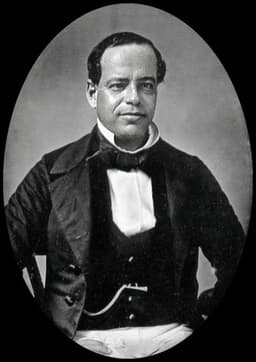
Antonio Lopez de Santa Anna
General · Modern
58.9Total
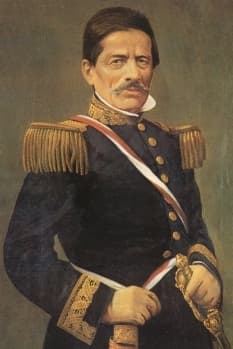
Ramon Castilla
General · Modern
59.7Total
Basic Information
Born
1794
1797
Died
1876
1867
Era
Modern
Modern
Nationality
Mexico
Peru
Occupation
General
General
Civilization
Western
Western
Score Comparison
Military (10%)
70.0
40.0
Political (20%)
46.6
72.0
Influence (20%)
56.7
56.7
Legacy (20%)
58.0
52.0
Leadership (15%)
68.0
78.0
Strategy (15%)
60.0
60.0
TOTAL
58.9
59.7
Antonio Lopez de Santa Anna — Complete Timeline
1823 AD
Led the Plan of Casa Mata rebellionPolitical Action
Santa Anna, then a general, issued the Plan of Casa Mata on February 1, 1823, calling for the overthrow of Emperor Agust
RebellionOverthrowRepublic
Impact: nationalconstructive
1829 AD
Defended Mexico at the Battle of TampicoWar◆ Major
Santa Anna commanded Mexican forces that defeated a Spanish invasion force at Tampico on September 11, 1829. The victory ended Spain's last attempt to reconquer Mexico and made Santa Anna a national hero. He was hailed as the 'Hero of Tampico' and used this fame to advance politically.
VictorySpanish InvasionNational Hero
Impact: nationalconstructive
1833 AD
Became President of Mexico for the first timePolitical Action◆ Major
Santa Anna was elected President of Mexico in 1833. He quickly delegated power to Vice President Valent
PresidencyPolitical InstabilityPower
Impact: national
1836 AD
Commanded at the Siege of the AlamoWar◆ Major
Santa Anna personally led the Mexican army in the siege of the Alamo mission in San Antonio, Texas. After a 13-day siege, Mexican forces stormed the fort on March 6, 1836, killing all 180-250 Texan defenders. The battle became a symbol of Texan resistance and a rallying cry for independence.
BattleTexas RevolutionAlamo
Impact: regionaldestructive
Defeated and captured at the Battle of San JacintoWar
Santa Anna's army was surprised and routed by Texan forces under Sam Houston at the Battle of San Jacinto on April 21, 1836. Santa Anna was captured the next day. He was forced to sign the Treaties of Velasco, recognizing Texan independence, though Mexico later repudiated them.
DefeatCaptureTexas Independence
Impact: regionaltragic
1847 AD
Lost the Mexican-American WarWar
Santa Anna returned from exile to command Mexican forces during the Mexican-American War. Despite initial efforts, his army was defeated at the Battle of Cerro Gordo and later at the Battle of Chapultepec. US forces captured Mexico City on September 14, 1847, leading to the Treaty of Guadalupe Hidalgo and massive territorial losses.
Mexican-American WarDefeatTerritorial Loss
Impact: globaltragic
1853 AD
Sold La Mesilla to the United StatesPolitical Action◆ Major
During his final presidency, Santa Anna agreed to the Gadsden Purchase, selling 29,670 square miles of territory (La Mesilla) to the United States for $10 million. The sale was widely condemned in Mexico as a betrayal. This act further damaged his reputation and led to his overthrow.
Territorial CessionGadsden PurchaseBetrayal
Impact: nationaldestructive
1855 AD
Overthrown and exiled for the final timePolitical Action◆ Major
The Plan of Ayutla, led by Juan
OverthrowExileEnd of Career
Impact: nationaltragic
Ramon Castilla — Complete Timeline
1824 AD
Battle of AyacuchoWar
Castilla fought as a junior officer in the decisive Battle of Ayacucho, which ended Spanish rule in Peru. This victory secured Peruvian independence and marked the end of the Spanish Empire in South America, shaping Castilla's nationalist views.
Peruvian War of IndependenceBattleLiberation
Impact: regional
1845 AD
First Presidency of PeruPolitical Action◆ Major
Castilla was elected President of Peru in 1845, serving until 1851. His first term focused on economic development, including the guano boom, and infrastructure projects such as railroads and ports, modernizing the Peruvian state.
PresidencyEconomic DevelopmentGuano
Impact: nationalconstructive
1854 AD
Abolition of Slavery in PeruReform◆ Major
During his second presidency, Castilla issued a decree abolishing slavery in Peru on December 3, 1854. This reform freed approximately 25,000 slaves and was part of a broader liberal agenda, though it faced opposition from slave-owning elites.
AbolitionSlaveryHuman Rights
Impact: nationalprogressive
Abolition of Indigenous TributeReform◆ Major
Castilla also abolished the indigenous tribute tax in 1854, which had been a burden on native communities since colonial times. This measure aimed to integrate indigenous peoples into the Peruvian state as equal citizens, though its implementation was uneven.
Indigenous RightsTax ReformCitizenship
Impact: nationalprogressive
1855 AD
Second Presidency and Guano BoomPolitical Action◆ Major
Castilla served a second term from 1855 to 1862, during the peak of the guano export boom. He used guano revenues to fund public works, pay off foreign debt, and modernize the military, but also faced criticism for corruption and over-reliance on a single resource.
PresidencyGuanoModernization
Impact: nationalconstructive
1860 AD
Constitutional Reform of 1860Reform◆ Major
Castilla oversaw the adoption of a new constitution in 1860, which established a centralized republic with a strong executive. The constitution remained in effect until 1920 and shaped Peru's political structure, though it limited regional autonomy.
ConstitutionPolitical ReformCentralization
Impact: nationalconstructive
Expert Analysis
Antonio Lopez de Santa Anna vs Ramon Castilla
### The General Who Lost a Nation and the General Who Built One
On a spring day in 1836, Antonio López de Santa Anna stood in the smoldering ruins of the Alamo, a conqueror. He had crushed the Texan rebels after a 13-day siege, and his message was clear: no mercy. Eighteen years later, on a December morning in 1854, Ramón Castilla sat in Lima, Peru, signing a decree that would free thousands of enslaved people. Both men were generals who became presidents. Both fought in the wars of independence that shattered Spanish rule in the Americas. Yet one is remembered as a caudillo whose greed and vanity cost his country half its territory, while the other is celebrated as a reformer who used a bird-dung windfall to build a modern nation. What made the difference?
### Origins: Two Paths from the Same Wreckage
Santa Anna was born in 1794 in Jalapa, Mexico, into a moderately well-off Spanish colonial family. He chose a military career early, joining the royalist army at age 16. When Mexico’s war for independence erupted, he served both sides with equal pragmatism, switching allegiances in 1821 to join Agustín de Iturbide’s movement. This early lesson—that loyalty was a tool, not a principle—would define his life. Castilla, born three years later in 1797 in Tarapacá, Peru, came from a more modest background; his father was a Spanish miner, his mother a Peruvian of indigenous descent. He joined the royalist army too, but the Battle of Ayacucho in 1824 changed everything. As a junior officer fighting for Spain, he saw the patriot victory that ended Spanish rule in South America. Rather than flee, he switched sides—but he did so with a genuine conversion to the republican cause. Both men emerged from the chaos of independence, but Santa Anna saw the new nations as personal fiefdoms, while Castilla saw them as unfinished projects.
### Rise to Power: The Caudillo vs. the Reformer
Santa Anna’s ascent was a series of dramatic gambles. In 1823, he issued the Plan of Casa Mata, a rebellion that overthrew Emperor Iturbide. He was 29. Six years later, he defeated a Spanish invasion at Tampico, becoming the “Hero of Tampico.” This military fame propelled him to the presidency in 1833. But he quickly delegated power to his vice president and withdrew to his hacienda, only to return when crisis called. He was elected and resigned so many times that he became a political phantom, always available to “save” the nation from disaster—disasters he often helped create. Castilla’s rise was slower and steadier. After Ayacucho, he served in various administrative and military posts, building a reputation for competence. He was elected president in 1845, at age 48, after a decade of political chaos. Where Santa Anna grasped power through coups and charisma, Castilla earned it through patience and performance.
### Leadership & Governance: The Despot and the Builder
Santa Anna’s style was theatrical and authoritarian. He styled himself the “Napoleon of the West,” wore lavish uniforms, and demanded absolute loyalty. During the Texas Revolution, he marched north with a massive army, but his arrogance proved fatal: at San Jacinto on April 21, 1836, Sam Houston’s outnumbered Texans surprised his camp during siesta, captured him, and forced him to sign away Texas. He later returned to power, only to lose the Mexican-American War in 1847, when U.S. forces marched to Mexico City. His final disgrace came in 1853, when he sold the La Mesilla territory to the United States for $10 million—the Gadsden Purchase—to fund his own lavish court. He was overthrown in 1855 and exiled for good. Castilla governed very differently. During his first term (1845–1851), he used the booming guano exports—Peru’s “white gold”—to pay off foreign debt, build railroads, and modernize the military. In his second term (1855–1862), he abolished slavery in 1854 and the indigenous tribute tax the same year, freeing both Afro-Peruvians and native communities from centuries-old burdens. He then oversaw the Constitution of 1860, which centralized the republic and strengthened the executive, but also guaranteed civil rights. He did not cling to power; he stepped down after his second term, a rare act in 19th-century Latin America.
### Triumph & Tragedy: Victory and Loss
Santa Anna’s greatest moment was Tampico in 1829, when he repelled a Spanish invasion and became a national hero. But his greatest failure was the Mexican-American War. He returned from exile to lead the army, but his indecision, poor logistics, and political infighting led to defeat. He lost not just battles, but half of Mexico’s territory: Texas, California, and the Southwest. The tragedy was not just territorial; it was moral. He had sold his country for personal gain. Castilla’s triumph was the abolition of slavery, a reform that gave Peru a moral edge over its neighbors and modernized its economy. His tragedy was the guano boom itself: he used the revenues wisely, but later leaders squandered the wealth, leading to debt and war with Chile. Castilla could not control what came after him.
### Character & Destiny: The Two Faces of Power
Santa Anna was driven by ego and opportunism. He once said, “A hundred years to come, my people will not be fit for liberty.” He believed in authoritarian rule because he saw Mexicans as children. This contempt for his own people justified his betrayals. Castilla, by contrast, believed in institutions. He was a pragmatist, but a principled one. He saw the state as a tool for progress, not personal enrichment. When he abolished the indigenous tribute, he said, “The Indian is not a beast of burden; he is a citizen.” That sentence captures the difference. Santa Anna saw subjects; Castilla saw citizens.
### Legacy: The Ruin and the Foundation
Santa Anna died in 1876, poor and forgotten in Mexico City. His legacy is a cautionary tale: the caudillo who lost a nation. Today, he is reviled in Mexico as a traitor and a fool. Castilla died in 1867, remembered as a founder. His portrait hangs in the Peruvian Congress, and his reforms are taught as the foundation of modern Peru. The guano is gone, but the railroads, the constitution, and the freed slaves remain.
### Conclusion: The Mirror of History
What separates a nation-builder from a nation-breaker? Not talent—both were skilled generals. Not opportunity—both ruled during eras of crisis. The difference lies in purpose. Santa Anna governed for himself; Castilla governed for his country. In the end, the men who see power as a means to serve others leave monuments. Those who see it as a prize leave ruins. And the ruins of a lost half-continent still haunt Mexico today.
Rankings
🥇
Ramon CastillaLeader
Mil: 40.0Pol: 72.0Inf: 56.7
59.7
🥈
Antonio Lopez de Santa Anna
Mil: 70.0Pol: 46.6Inf: 56.7
58.9
+0.8 behind
How This Comparison Works
Algorithm
Each figure is scored on 6 dimensions (0—100 scale) based on structured historical data: Military (10%), Political (20%), Influence (20%), Legacy (20%), Leadership (15%), Strategy (15%). The weighted total produces the final ranking.
Data Sources
Scores are computed from structured sub-indicators in the database. Scale factors adjust for era (Ancient ×0.85, Modern ×1.0) and civilization size (Eastern ×1.05, Other ×0.80) to account for differences in population and military scale.
Maximum 3 Figures
Comparisons are limited to 2—3 figures to ensure readability and statistical meaningfulness.
Error Margins
±5 points per dimension — Sub-scores are derived from historical records with inherent uncertainty. Two figures within 5 points on a dimension should be considered roughly equivalent in that area.
Total Score Accuracy
±3 points overall — The weighted combination of 6 dimensions produces a total score with approximately ±3 points of uncertainty. Differences of less than 3 points are not statistically significant— the figures are effectively tied.
Known Limitations
- Historical records are incomplete and uneven across civilizations
- Figures from oral-tradition societies may be underrepresented
- Occupation labels can misclassify multi-role figures
- Scores measure capability and impact, not moral character
- Quantitative scoring is a comparison tool, not absolute truth
Capability Radar
Military (10%) — Battles & Warfare
Battles
65
45
Win Rate
40
50
Expansion
50
30
Political (20%) — Governance & Reform
Reform
20
85
Diplomacy
35
70
Economy
15
75
Influence (20%) — Cultural & Global Reach
Cultural
55
55
Global
50
50
Legacy (20%) — Historical Impact
Historical
60
65
Longevity
55
60
Leadership (15%) — Power & Stability
Tenure
75
65
Stability
10
60
Strategy (15%) — Tactics & Innovation
Strategy
45
45
Tactics
60
40
Reform
30
55
Similar Comparisons
Comments & Discussion
SantaSlandered6/16/2026
Look, Santa Anna wasn't just vain—he was strategically incompetent. The Alamo victory wasn't genius; it was brutality against 200 exhausted rebels. Compare that to Castilla's savvy: using guano revenue (Peru made $600 million from bird shit!) to abolish slavery *and* pay compensation. One man modernized his country; the other sold it piecemeal. Mexico lost half its land because Santa Anna thought dynastic glory mattered more than stable governance. History got this one right.
数据拆弹手6/16/2026
吹Castilla?省省吧。他废除奴隶制不过是政治表演——1860年代秘鲁依然有事实上的种姓压迫,华人契约劳工比奴隶还惨。Santa Anna至少敢在1847年踩着雪带队翻越内华达山脉回防墨西哥城。Castilla除了挖鸟粪还有什么?连玻利维亚的硝石都没守住。说他是“国家建设者”,不如说是走了狗屎运的包税人。
ClassicsChad6/16/2026
You're missing the tragic arc: Santa Anna was a creature of his chaotic era, not mere villain. He commanded *11* presidential terms amid Mexico's existential crises. Castilla had the luxury of guano—Peru's GDP jumped 400% in his era. Give Santa Anna that economic windfall, and maybe he builds railroads instead of spending on ceremonial uniforms. Leadership isn't just character; it's contingency. Both men swam in different currents.
历史棱镜6/16/2026
注意一个细节:Santa Anna在1833年推动过政教分离和税收改革,早于Castilla任何进步政策。只是他太善变,后来把改革全推翻。Castilla的稳定来自控制政治节奏——他两次任期间隔8年,让国家喘息。一个是火,烧了太多;一个是水,但水也会淹死印第安人(1850年代秘鲁土著土地被强制征用)。没有完美的英雄,只有不同的代价。
BattlefieldDust6/16/2026
Military historian here: stop romanticizing the Alamo. Santa Anna's real failure was the Texas campaign strategy itself. That 13-day siege allowed Houston to build an army. Compare Castilla at the Battle of Alto de la Alianza (1880): he coordinated flank attacks that saved Tacna temporarily. Santa Anna couldn't manage supply lines across 300 miles of desert; Castilla used guano cash to build the first Peruvian railway. Tactics vs. logistics—that's the split.