Loading...
Antonio Lopez de Santa Anna vs Oscar Mejia Victores
Antonio Lopez de Santa Anna leads by 7.0 pts · 2 figures compared
…
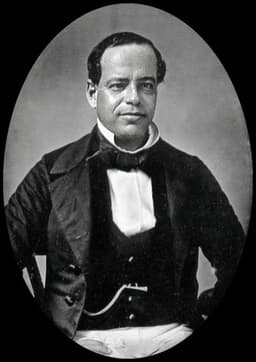
Antonio Lopez de Santa Anna
General · Modern
58.9Total

Oscar Mejia Victores
General · Modern
51.9Total
Basic Information
Born
1794
1930
Died
1876
—
Era
Modern
Modern
Nationality
Mexico
Guatemala
Occupation
General
General
Civilization
Western
Western
Score Comparison
Military (10%)
70.0
22.6
Political (20%)
46.6
68.0
Influence (20%)
56.7
50.2
Legacy (20%)
58.0
43.3
Leadership (15%)
68.0
80.0
Strategy (15%)
60.0
41.0
TOTAL
58.9
51.9
Antonio Lopez de Santa Anna — Complete Timeline
1823 AD
Led the Plan of Casa Mata rebellionPolitical Action
Santa Anna, then a general, issued the Plan of Casa Mata on February 1, 1823, calling for the overthrow of Emperor Agust
RebellionOverthrowRepublic
Impact: nationalconstructive
1829 AD
Defended Mexico at the Battle of TampicoWar◆ Major
Santa Anna commanded Mexican forces that defeated a Spanish invasion force at Tampico on September 11, 1829. The victory ended Spain's last attempt to reconquer Mexico and made Santa Anna a national hero. He was hailed as the 'Hero of Tampico' and used this fame to advance politically.
VictorySpanish InvasionNational Hero
Impact: nationalconstructive
1833 AD
Became President of Mexico for the first timePolitical Action◆ Major
Santa Anna was elected President of Mexico in 1833. He quickly delegated power to Vice President Valent
PresidencyPolitical InstabilityPower
Impact: national
1836 AD
Commanded at the Siege of the AlamoWar◆ Major
Santa Anna personally led the Mexican army in the siege of the Alamo mission in San Antonio, Texas. After a 13-day siege, Mexican forces stormed the fort on March 6, 1836, killing all 180-250 Texan defenders. The battle became a symbol of Texan resistance and a rallying cry for independence.
BattleTexas RevolutionAlamo
Impact: regionaldestructive
Defeated and captured at the Battle of San JacintoWar
Santa Anna's army was surprised and routed by Texan forces under Sam Houston at the Battle of San Jacinto on April 21, 1836. Santa Anna was captured the next day. He was forced to sign the Treaties of Velasco, recognizing Texan independence, though Mexico later repudiated them.
DefeatCaptureTexas Independence
Impact: regionaltragic
1847 AD
Lost the Mexican-American WarWar
Santa Anna returned from exile to command Mexican forces during the Mexican-American War. Despite initial efforts, his army was defeated at the Battle of Cerro Gordo and later at the Battle of Chapultepec. US forces captured Mexico City on September 14, 1847, leading to the Treaty of Guadalupe Hidalgo and massive territorial losses.
Mexican-American WarDefeatTerritorial Loss
Impact: globaltragic
1853 AD
Sold La Mesilla to the United StatesPolitical Action◆ Major
During his final presidency, Santa Anna agreed to the Gadsden Purchase, selling 29,670 square miles of territory (La Mesilla) to the United States for $10 million. The sale was widely condemned in Mexico as a betrayal. This act further damaged his reputation and led to his overthrow.
Territorial CessionGadsden PurchaseBetrayal
Impact: nationaldestructive
1855 AD
Overthrown and exiled for the final timePolitical Action◆ Major
The Plan of Ayutla, led by Juan
OverthrowExileEnd of Career
Impact: nationaltragic
Oscar Mejia Victores — Complete Timeline
1983 AD
1983 Guatemalan coup d'étatPolitical Action◆ Major
Mejia Victores, then Defense Minister, led a coup that ousted President Efrain Rios Montt. He assumed the presidency, becoming the last military ruler of Guatemala.
CoupMilitary RuleGuatemala
Impact: nationaldestructive
1984 AD
Human rights abuses during his ruleOther◆ Major
During his presidency, Mejia Victores' government continued counterinsurgency operations that resulted in forced disappearances and massacres of indigenous Maya communities, as documented by truth commissions.
Human RightsCivil WarAtrocities
Impact: nationaltragic
1985 AD
Transition to civilian rulePolitical Action
Under pressure, Mejia Victores oversaw the drafting of a new constitution and called for democratic elections. He transferred power to civilian President Vinicio Cerezo in 1986, ending decades of military rule.
DemocratizationConstitutionElection
Impact: nationalconstructive
Expert Analysis
Antonio Lopez de Santa Anna vs Oscar Mejia Victores
# The General’s Two Paths
On a sweltering April afternoon in 1836, Antonio López de Santa Anna stood in the mud of San Jacinto, watching his army disintegrate around him. Within hours, he would be a prisoner, stripped of his gold braid and his dignity, forced to sign away Texas. A century and a half later, in the cool highlands of Guatemala, another general named Oscar Mejía Víctores sat in a presidential office, signing a very different kind of document: a new constitution that would end military rule and hand power to civilians. Both men were generals who seized control of their nations. One left a trail of lost territory, bankrupted treasuries, and a people exhausted by his vanity. The other left a fragile democracy. What made the difference?
Origins
Santa Anna was born in 1794, a child of the Spanish colonial twilight. His family was of respectable but modest means in Veracruz, a coastal state that would forever shape his fortunes. He entered the army at sixteen, a boy who learned war in the brutal frontier campaigns against Indigenous tribes and later in the chaos of Mexico’s war for independence. He was a creature of the early republic, a time when the line between hero and traitor blurred with every pronunciamiento. His era was one of fracture: Mexico emerged from Spanish rule not as a nation but as a collection of rival regions, personal loyalties, and competing visions. In such a world, a charismatic general could become kingmaker overnight.
Mejía Víctores was born in 1930, into a Guatemala that had known dictators for decades. The son of a military family, he grew up under the shadow of the United Fruit Company and the long, bloody Cold War. He attended the Escuela Politécnica, the country’s military academy, where discipline and anticommunism were twin creeds. His era was the Central American nightmare of the 1970s and 1980s, when generals fought Marxist insurgencies with scorched-earth tactics, and the United States looked the other way. By the time he rose to power, Guatemala had already endured a CIA-backed coup, a civil war, and the genocidal presidency of his predecessor, Efraín Ríos Montt.
Rise to Power
Santa Anna’s ascent was a series of gambles. In 1823, he issued the Plan of Casa Mata, a rebellion that overthrew Emperor Agustín de Iturbide. He was twenty-eight. He understood that in Mexico, loyalty was negotiable; the man who could deliver troops to the winning side was the man who would rule. Six years later, in 1829, he defended Mexico at the Battle of Tampico, crushing a Spanish invasion force. The victory made him a national hero. He was elected president in 1833, but he quickly tired of the job, handing power to his liberal vice president while he retired to his hacienda. It was a pattern: he would leave, then return, always as the savior the country supposedly needed.
Mejía Víctores rose differently. He was not a revolutionary; he was a technician of power. In 1983, as defense minister, he led a coup that ousted Ríos Montt, who had become an international embarrassment for his brutal campaign against Maya villagers. The coup was bloodless, a quiet transfer among officers. Mejía Víctores took the presidency not to remake Guatemala but to stabilize it—and to protect the army’s interests. He was not a man of grand ambitions; he was a man who saw the writing on the wall.
Leadership & Governance
Santa Anna’s rule was a theater of the absurd. He styled himself the “Napoleon of the West,” wore extravagant uniforms, and demanded that his subordinates address him as “Most Serene Highness.” He governed through charisma and fear, alternating between liberal and conservative policies depending on which faction threatened him most. His military record was a paradox: he could inspire troops to extraordinary feats, as at Tampico, but he could also abandon his army to flee, as he did during the Mexican-American War. He was a brilliant tactician but a catastrophic strategist. His greatest failure was the Alamo: he won the battle but lost the war, because his brutality at San Antonio galvanized Texan resistance and ensured his defeat at San Jacinto.
Mejía Víctores governed with cold pragmatism. He did not pretend to be a Napoleon. He continued the counterinsurgency war, and human rights abuses persisted under his watch: forced disappearances, massacres, a military that answered to no one. Yet he also saw that the old model was dying. International pressure, economic collapse, and the exhaustion of Guatemalan society forced his hand. In 1985, he oversaw the drafting of a new constitution and called for elections. He did not try to rig the outcome or cling to power. When the votes were counted, a civilian president took office, and Mejía Víctores stepped aside.
Triumph & Tragedy
Santa Anna’s greatest moment was Tampico, where he defeated a Spanish force that sought to reconquer Mexico. It was a genuine national triumph, and for a fleeting moment, he was the hero Mexicans needed. But his tragedies were many: the loss of Texas, the catastrophic Mexican-American War that cost Mexico half its territory, and the 1853 Gadsden Purchase, when he sold 29,670 square miles of land—La Mesilla—to the United States for a pittance. He was overthrown and exiled for the final time in 1855, a man who had been president eleven times and left his country smaller and poorer than he found it.
Mejía Víctores’s tragedy was quieter. His government was responsible for atrocities that remain unpunished. The mothers of the disappeared still search for their children. But his triumph was the transition itself. He did not leave a trail of glory; he left a constitution. He did not lose territory; he lost power, and he did so voluntarily.
Character & Destiny
Santa Anna was driven by vanity and a hunger for adoration. He once said, “A hundred years to come, my people will not be fit for liberty.” He believed he was indispensable, and that belief destroyed him. Every defeat was someone else’s fault; every return was a redemption. His personality was a vortex that pulled Mexico into chaos.
Mejía Víctores was driven by survival, not glory. He saw that the army’s grip was slipping and that a violent end awaited those who held too tight. He was not a democrat; he was a realist. His character was that of a man who read the room and chose the least catastrophic exit.
Legacy
Santa Anna is remembered as a traitor, a buffoon, a man who sold his country for gold braid. Mexicans curse his name. The Alamo is a shrine to his enemies. His legacy is a warning: the cult of personality can destroy a nation.
Mejía Víctores is barely remembered. His name appears in footnotes. He is not a hero, but he is not a villain of Santa Anna’s scale. His legacy is ambiguous: he held the door for democracy, but the door opened onto a country still scarred by war.
Conclusion
Santa Anna and Mejía Víctores were both generals who ruled their nations, but they inhabited different worlds. Santa Anna’s Mexico was a young nation with no stable institutions, where a man with an army could become a caudillo. Mejía Víctores’s Guatemala was a Cold War battleground where the old certainties were crumbling. One man’s arrogance cost his country half its land. The other’s pragmatism gave his country a chance. In the end, the difference was not in their uniforms but in their ability to see that power, once held, must sometimes be let go.
Rankings
🥇
Antonio Lopez de Santa AnnaLeader
Mil: 70.0Pol: 46.6Inf: 56.7
58.9
🥈
Oscar Mejia Victores
Mil: 22.6Pol: 68.0Inf: 50.2
51.9
+7.0 behind
How This Comparison Works
Algorithm
Each figure is scored on 6 dimensions (0—100 scale) based on structured historical data: Military (10%), Political (20%), Influence (20%), Legacy (20%), Leadership (15%), Strategy (15%). The weighted total produces the final ranking.
Data Sources
Scores are computed from structured sub-indicators in the database. Scale factors adjust for era (Ancient ×0.85, Modern ×1.0) and civilization size (Eastern ×1.05, Other ×0.80) to account for differences in population and military scale.
Maximum 3 Figures
Comparisons are limited to 2—3 figures to ensure readability and statistical meaningfulness.
Error Margins
±5 points per dimension — Sub-scores are derived from historical records with inherent uncertainty. Two figures within 5 points on a dimension should be considered roughly equivalent in that area.
Total Score Accuracy
±3 points overall — The weighted combination of 6 dimensions produces a total score with approximately ±3 points of uncertainty. Differences of less than 3 points are not statistically significant— the figures are effectively tied.
Known Limitations
- Historical records are incomplete and uneven across civilizations
- Figures from oral-tradition societies may be underrepresented
- Occupation labels can misclassify multi-role figures
- Scores measure capability and impact, not moral character
- Quantitative scoring is a comparison tool, not absolute truth
Capability Radar
Military (10%) — Battles & Warfare
Battles
65
10
Win Rate
40
10
Expansion
50
5
Political (20%) — Governance & Reform
Reform
20
55
Diplomacy
35
50
Economy
15
30
Influence (20%) — Cultural & Global Reach
Cultural
55
15
Global
50
15
Legacy (20%) — Historical Impact
Historical
60
30
Longevity
55
20
Leadership (15%) — Power & Stability
Tenure
75
40
Stability
10
35
Strategy (15%) — Tactics & Innovation
Strategy
45
15
Tactics
60
15
Reform
30
20
Similar Comparisons
Comments & Discussion
No comments yet. Be the first to share your thoughts!