Loading...
Antonio Lopez de Santa Anna vs Olusegun Obasanjo
Olusegun Obasanjo leads by 1.3 pts · 2 figures compared
…
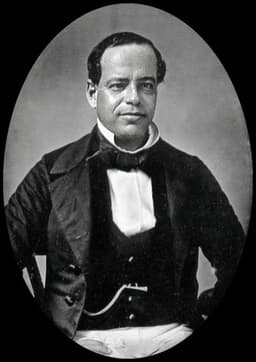
Antonio Lopez de Santa Anna
General · Modern
58.9Total
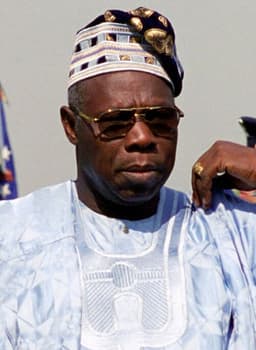
Olusegun Obasanjo
General · Modern
60.2Total
Basic Information
Born
1794
1937
Died
1876
—
Era
Modern
Modern
Nationality
Mexico
Nigeria
Occupation
General
General
Civilization
Western
Other
Score Comparison
Military (10%)
70.0
45.0
Political (20%)
46.6
72.0
Influence (20%)
56.7
55.0
Legacy (20%)
58.0
54.0
Leadership (15%)
68.0
78.0
Strategy (15%)
60.0
60.0
TOTAL
58.9
60.2
Antonio Lopez de Santa Anna — Complete Timeline
1823 AD
Led the Plan of Casa Mata rebellionPolitical Action
Santa Anna, then a general, issued the Plan of Casa Mata on February 1, 1823, calling for the overthrow of Emperor Agust
RebellionOverthrowRepublic
Impact: nationalconstructive
1829 AD
Defended Mexico at the Battle of TampicoWar◆ Major
Santa Anna commanded Mexican forces that defeated a Spanish invasion force at Tampico on September 11, 1829. The victory ended Spain's last attempt to reconquer Mexico and made Santa Anna a national hero. He was hailed as the 'Hero of Tampico' and used this fame to advance politically.
VictorySpanish InvasionNational Hero
Impact: nationalconstructive
1833 AD
Became President of Mexico for the first timePolitical Action◆ Major
Santa Anna was elected President of Mexico in 1833. He quickly delegated power to Vice President Valent
PresidencyPolitical InstabilityPower
Impact: national
1836 AD
Commanded at the Siege of the AlamoWar◆ Major
Santa Anna personally led the Mexican army in the siege of the Alamo mission in San Antonio, Texas. After a 13-day siege, Mexican forces stormed the fort on March 6, 1836, killing all 180-250 Texan defenders. The battle became a symbol of Texan resistance and a rallying cry for independence.
BattleTexas RevolutionAlamo
Impact: regionaldestructive
Defeated and captured at the Battle of San JacintoWar
Santa Anna's army was surprised and routed by Texan forces under Sam Houston at the Battle of San Jacinto on April 21, 1836. Santa Anna was captured the next day. He was forced to sign the Treaties of Velasco, recognizing Texan independence, though Mexico later repudiated them.
DefeatCaptureTexas Independence
Impact: regionaltragic
1847 AD
Lost the Mexican-American WarWar
Santa Anna returned from exile to command Mexican forces during the Mexican-American War. Despite initial efforts, his army was defeated at the Battle of Cerro Gordo and later at the Battle of Chapultepec. US forces captured Mexico City on September 14, 1847, leading to the Treaty of Guadalupe Hidalgo and massive territorial losses.
Mexican-American WarDefeatTerritorial Loss
Impact: globaltragic
1853 AD
Sold La Mesilla to the United StatesPolitical Action◆ Major
During his final presidency, Santa Anna agreed to the Gadsden Purchase, selling 29,670 square miles of territory (La Mesilla) to the United States for $10 million. The sale was widely condemned in Mexico as a betrayal. This act further damaged his reputation and led to his overthrow.
Territorial CessionGadsden PurchaseBetrayal
Impact: nationaldestructive
1855 AD
Overthrown and exiled for the final timePolitical Action◆ Major
The Plan of Ayutla, led by Juan
OverthrowExileEnd of Career
Impact: nationaltragic
Olusegun Obasanjo — Complete Timeline
1976 AD
Military coup that brought Obasanjo to powerPolitical Action
Following the assassination of General Murtala Mohammed in a failed coup, Obasanjo, as Chief of Staff, Supreme Headquarters, succeeded him as head of state. He oversaw the continuation of the transition to civilian rule.
CoupSuccessionMilitary Rule
Impact: national
1979 AD
Handover of power to civilian governmentPolitical Action
Obasanjo voluntarily handed over power to the elected civilian government of Shehu Shagari, marking the first peaceful transfer of power from military to civilian rule in Nigeria. This act established a precedent for democratic transition.
DemocracyTransitionCivilian Rule
Impact: nationalconstructive
1999 AD
Election as President of NigeriaPolitical Action
Obasanjo won the 1999 Nigerian presidential election as the candidate of the People's Democratic Party (PDP). His victory ended 16 years of military rule and began the Fourth Nigerian Republic.
ElectionDemocracyFourth Republic
Impact: nationalprogressive
2005 AD
Debt relief from Paris ClubPolitical Action◆ Major
Obasanjo's government negotiated a debt relief agreement with the Paris Club, resulting in the cancellation of $18 billion of Nigeria's external debt. This freed up resources for domestic spending and was a major economic achievement.
Debt ReliefEconomyNegotiation
Impact: nationalconstructive
2006 AD
Third term bid failurePolitical Action◆ Major
Obasanjo attempted to amend the Nigerian constitution to allow him to run for a third term. The bid was rejected by the National Assembly, marking a significant political defeat and reinforcing term limits.
Third TermConstitutionDefeat
Impact: national
Expert Analysis
Antonio Lopez de Santa Anna vs Olusegun Obasanjo
# The General and the Democrat: Two Paths of Power in Mexico and Nigeria
On a sweltering April afternoon in 1836, Antonio López de Santa Anna, the self-styled "Napoleon of the West," was captured hiding in a marsh, disguised as a common soldier. He had just lost Texas. More than a century later, in 1979, another general, Olusegun Obasanjo, stood before the Nigerian nation and did something almost unheard of in military-ruled Africa: he handed power to a civilian president, then retired to his farm. One man spent a lifetime grasping for power; the other spent a lifetime learning that power was a trust, not a possession. What made the difference?
Origins
Santa Anna was born in 1794 in Jalapa, Mexico, into a colonial world already cracking apart. The son of a minor Spanish official, he grew up watching the Napoleonic Wars convulse Europe and then Mexico's War of Independence. He joined the royalist army at fifteen, a young man in a land where loyalty was a currency and violence a trade. By contrast, Obasanjo was born in 1937 in the village of Ibogun-Olaogun, in what was then British Nigeria. His father was a farmer; his mother traded cassava. He grew up under the quiet tyranny of colonialism, but also in a world where community and negotiation mattered. He joined the Nigerian army in 1958, a year before independence, when the army was less a tool of conquest than a symbol of a new nation. Their eras shaped them: Santa Anna came of age in a revolution that devoured its children; Obasanjo came of age in a liberation that demanded builders.
Rise to Power
Santa Anna’s rise was a study in opportunism. In 1823, he issued the Plan of Casa Mata, a rebellion that overthrew Emperor Agustín de Iturbide. He was twenty-nine. He switched sides so often that his contemporaries called him "the chameleon." He supported federalists, then centralists; republicans, then monarchists. Each shift advanced his career. In 1829, he defended Mexico against a Spanish invasion at Tampico, becoming a national hero. By 1833, he was president—but he immediately handed the day-to-day work to his vice president and retired to his hacienda, only to return when crisis called. He governed by absence, then by force.
Obasanjo’s rise was quieter, more accidental. He served as a military engineer in the Congo and during Nigeria’s civil war (1967–1970), earning a reputation for competence. In 1975, he became Chief of Staff, Supreme Headquarters, under General Murtala Mohammed. Then, on February 13, 1976, Mohammed was assassinated in a failed coup. Obasanjo, who had been next in line, suddenly found himself head of state. He did not seek the power; it found him. And he decided, almost immediately, that he would not keep it.
Leadership & Governance
Santa Anna ruled Mexico eleven times, but he never governed. He preferred the drama of battle to the tedium of administration. He led the siege of the Alamo in 1836, a costly victory that turned a rebel nuisance into a martyr cause. Six weeks later, he was asleep in his tent when Sam Houston’s Texans overran his camp at San Jacinto. He surrendered, was captured, and signed away Texas. A decade later, during the Mexican-American War, he returned from exile to command again—and lost again. His military strategy was aggressive but brittle, his political wisdom nonexistent. He sold 29,670 square miles of Mexican territory in the Gadsden Purchase of 1853, pocketing a portion of the payment. His reforms were always self-serving.
Obasanjo governed with a different logic. He inherited a fractured military and a nation scarred by civil war. He did not seek glory; he sought stability. In 1979, he oversaw the writing of a new constitution, then handed power to Shehu Shagari. It was the first peaceful transfer of power in Nigerian history. He returned to office in 1999, elected president after decades of military rule. This time, he tackled debt: by 2005, he had negotiated the cancellation of $18 billion in Nigerian debt from the Paris Club. He was not a visionary, but he was a manager. His greatest failure came in 2006, when he tried to amend the constitution for a third term—a bid that failed, revealing that even he could be tempted by the drug of permanence.
Triumph & Tragedy
Santa Anna’s greatest moment was Tampico in 1829, when he expelled the Spanish. His greatest tragedy was everything that followed: the Alamo, San Jacinto, the Mexican-American War, the Gadsden Purchase. He led his nation into disaster, then blamed others. Obasanjo’s triumph was the 1979 handover, a quiet act that proved military rulers could leave. His tragedy was the third-term bid, a stumble that tarnished his reputation. One man’s tragedy was a nation’s loss; the other’s was a personal failure.
Character & Destiny
Santa Anna was narcissistic, charming, and utterly convinced of his own genius. He once wrote, "I am the father of my country." He believed in destiny as entitlement. Obasanjo was pragmatic, stubborn, and self-aware. He told a journalist, "Power is not for the power-hungry. It is for the service-minded." Santa Anna’s personality drove Mexico into the ground; Obasanjo’s pulled Nigeria back from the brink. Their characters were their fates.
Legacy
Santa Anna is remembered in Mexico as a traitor and a buffoon. His name is a curse. In Texas, he is the villain of the Alamo story. His legacy is a cautionary tale of ambition without principle. Obasanjo is remembered as a flawed but essential figure. He is criticized for corruption in his second term, but praised for saving Nigeria from collapse. His legacy is a story of redemption and compromise.
Conclusion
Santa Anna died in 1876, poor and blind, a ghost ignored by the nation he had ruined. Obasanjo, still alive today at eighty-seven, farms yams and writes memoirs. Both were generals. Both held supreme power. But one saw power as a prize to be hoarded; the other saw it as a burden to be shared. In that difference lies the lesson for every nation that has ever trusted a man in uniform.
Rankings
🥇
Olusegun ObasanjoLeader
Mil: 45.0Pol: 72.0Inf: 55.0
60.2
🥈
Antonio Lopez de Santa Anna
Mil: 70.0Pol: 46.6Inf: 56.7
58.9
+1.3 behind
How This Comparison Works
Algorithm
Each figure is scored on 6 dimensions (0—100 scale) based on structured historical data: Military (10%), Political (20%), Influence (20%), Legacy (20%), Leadership (15%), Strategy (15%). The weighted total produces the final ranking.
Data Sources
Scores are computed from structured sub-indicators in the database. Scale factors adjust for era (Ancient ×0.85, Modern ×1.0) and civilization size (Eastern ×1.05, Other ×0.80) to account for differences in population and military scale.
Maximum 3 Figures
Comparisons are limited to 2—3 figures to ensure readability and statistical meaningfulness.
Error Margins
±5 points per dimension — Sub-scores are derived from historical records with inherent uncertainty. Two figures within 5 points on a dimension should be considered roughly equivalent in that area.
Total Score Accuracy
±3 points overall — The weighted combination of 6 dimensions produces a total score with approximately ±3 points of uncertainty. Differences of less than 3 points are not statistically significant— the figures are effectively tied.
Known Limitations
- Historical records are incomplete and uneven across civilizations
- Figures from oral-tradition societies may be underrepresented
- Occupation labels can misclassify multi-role figures
- Scores measure capability and impact, not moral character
- Quantitative scoring is a comparison tool, not absolute truth
Capability Radar
Military (10%) — Battles & Warfare
Battles
65
25
Win Rate
40
30
Expansion
50
20
Political (20%) — Governance & Reform
Reform
20
65
Diplomacy
35
75
Economy
15
55
Influence (20%) — Cultural & Global Reach
Cultural
55
45
Global
50
60
Legacy (20%) — Historical Impact
Historical
60
55
Longevity
55
50
Leadership (15%) — Power & Stability
Tenure
75
70
Stability
10
60
Strategy (15%) — Tactics & Innovation
Strategy
45
40
Tactics
60
35
Reform
30
50
Similar Comparisons
Comments & Discussion
No comments yet. Be the first to share your thoughts!