Loading...
Antonio Lopez de Santa Anna vs Mohammad Fahim
Antonio Lopez de Santa Anna leads by 9.2 pts · 2 figures compared
…
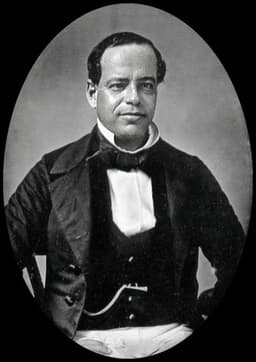
Antonio Lopez de Santa Anna
General · Modern
58.9Total

Mohammad Fahim
General · Modern
49.7Total
Basic Information
Born
1794
1957
Died
1876
—
Era
Modern
Modern
Nationality
Mexico
Afghanistan
Occupation
General
General
Civilization
Western
Middle Eastern
Score Comparison
Military (10%)
70.0
40.0
Political (20%)
46.6
43.7
Influence (20%)
56.7
51.0
Legacy (20%)
58.0
43.3
Leadership (15%)
68.0
74.0
Strategy (15%)
60.0
45.0
TOTAL
58.9
49.7
Antonio Lopez de Santa Anna — Complete Timeline
1823 AD
Led the Plan of Casa Mata rebellionPolitical Action
Santa Anna, then a general, issued the Plan of Casa Mata on February 1, 1823, calling for the overthrow of Emperor Agust
RebellionOverthrowRepublic
Impact: nationalconstructive
1829 AD
Defended Mexico at the Battle of TampicoWar◆ Major
Santa Anna commanded Mexican forces that defeated a Spanish invasion force at Tampico on September 11, 1829. The victory ended Spain's last attempt to reconquer Mexico and made Santa Anna a national hero. He was hailed as the 'Hero of Tampico' and used this fame to advance politically.
VictorySpanish InvasionNational Hero
Impact: nationalconstructive
1833 AD
Became President of Mexico for the first timePolitical Action◆ Major
Santa Anna was elected President of Mexico in 1833. He quickly delegated power to Vice President Valent
PresidencyPolitical InstabilityPower
Impact: national
1836 AD
Commanded at the Siege of the AlamoWar◆ Major
Santa Anna personally led the Mexican army in the siege of the Alamo mission in San Antonio, Texas. After a 13-day siege, Mexican forces stormed the fort on March 6, 1836, killing all 180-250 Texan defenders. The battle became a symbol of Texan resistance and a rallying cry for independence.
BattleTexas RevolutionAlamo
Impact: regionaldestructive
Defeated and captured at the Battle of San JacintoWar
Santa Anna's army was surprised and routed by Texan forces under Sam Houston at the Battle of San Jacinto on April 21, 1836. Santa Anna was captured the next day. He was forced to sign the Treaties of Velasco, recognizing Texan independence, though Mexico later repudiated them.
DefeatCaptureTexas Independence
Impact: regionaltragic
1847 AD
Lost the Mexican-American WarWar
Santa Anna returned from exile to command Mexican forces during the Mexican-American War. Despite initial efforts, his army was defeated at the Battle of Cerro Gordo and later at the Battle of Chapultepec. US forces captured Mexico City on September 14, 1847, leading to the Treaty of Guadalupe Hidalgo and massive territorial losses.
Mexican-American WarDefeatTerritorial Loss
Impact: globaltragic
1853 AD
Sold La Mesilla to the United StatesPolitical Action◆ Major
During his final presidency, Santa Anna agreed to the Gadsden Purchase, selling 29,670 square miles of territory (La Mesilla) to the United States for $10 million. The sale was widely condemned in Mexico as a betrayal. This act further damaged his reputation and led to his overthrow.
Territorial CessionGadsden PurchaseBetrayal
Impact: nationaldestructive
1855 AD
Overthrown and exiled for the final timePolitical Action◆ Major
The Plan of Ayutla, led by Juan
OverthrowExileEnd of Career
Impact: nationaltragic
Mohammad Fahim — Complete Timeline
2001 AD
Led Northern Alliance Forces in Fall of KabulWar
Mohammad Fahim, as a senior Northern Alliance commander, led forces that captured Kabul from the Taliban in November 2001. This victory followed the US invasion and was a turning point in the war, leading to the collapse of Taliban rule.
AfghanistanWarTaliban
Impact: national
Appointed Vice President of AfghanistanPolitical Action◆ Major
Mohammad Fahim was appointed Vice President of Afghanistan under Hamid Karzai in 2001, serving until 2004. He was a key Northern Alliance commander and his appointment was part of the post-Taliban power-sharing arrangement.
AfghanistanVice PresidencyNorthern Alliance
Impact: nationalconstructive
Served as Minister of DefensePolitical Action◆ Major
Mohammad Fahim served as Afghanistan's Minister of Defense from 2001 to 2004. He oversaw the formation of the new Afghan National Army and security forces, integrating former mujahideen and Northern Alliance fighters.
AfghanistanDefenseMilitary
Impact: nationalconstructive
2009 AD
Appointed First Vice President in 2009Political Action◆ Major
Mohammad Fahim was appointed First Vice President of Afghanistan under President Hamid Karzai in 2009. He served until his death in 2014, playing a key role in security and political affairs.
AfghanistanVice PresidencyGovernment
Impact: nationalconstructive
Expert Analysis
Antonio Lopez de Santa Anna vs Mohammad Fahim
# The General’s Bargain: Santa Anna and Fahim, Two Lives of Power and Loss
On a dusty April afternoon in 1836, Antonio López de Santa Anna stood before Sam Houston, a prisoner in his own torn uniform, watching his dreams of a Mexican empire dissolve into the muddy banks of the San Jacinto River. Nearly 170 years later, another general, Mohammad Fahim, rode into Kabul at the head of Northern Alliance forces, the Taliban fleeing before him, and for a fleeting moment, he held the future of a broken country in his hands. One man lost everything in a single afternoon; the other gained everything in a single season. Both were generals, both were politicians, both rose from chaos and fell back into it. But their paths—and their fates—could not have been more different.
Origins
Santa Anna was born in 1794 in Jalapa, a provincial town in New Spain, into a respectable but unremarkable Creole family. The Spanish colonial system was already cracking, and young Antonio, like many ambitious men of his class, saw the army as the fastest ladder to prominence. He joined the military at fifteen, fought both for and against the Spanish crown, and learned early that loyalty was a tool, not a principle. His Mexico was a newborn nation convulsing between monarchy and republic, federalism and centralism—a landscape that rewarded the bold and devoured the cautious.
Mohammad Fahim was born in 1957 in the Panjshir Valley of Afghanistan, a region carved by rivers and war. His people were Tajiks, a minority in a country dominated by Pashtuns. He grew up in the shadow of the Soviet invasion, the mujahideen resistance, and the brutal civil wars that followed. Where Santa Anna inherited a fragile state, Fahim inherited a shattered one. Where Santa Anna learned to maneuver in the salons of Mexico City, Fahim learned to survive in the caves and ridges of the Hindu Kush. Their worlds were separated by oceans and centuries, but both were forged in the fire of collapse.
Rise to Power
Santa Anna’s ascent was theatrical. In 1823, he issued the Plan of Casa Mata, a rebellion that toppled Emperor Agustín de Iturbide. It was a masterstroke of timing—he switched sides just as the emperor’s support crumbled, emerging as a kingmaker rather than a traitor. Then came the Battle of Tampico in 1829, when he defeated a Spanish invasion force and was hailed as the “Hero of Tampico.” His military score of 66.3 was respectable, but his political instincts—81.1—were far sharper. He understood that in Mexico, victory on the battlefield was currency, and he spent it freely.
Fahim’s rise was quieter, more brutal. He was a commander in the Northern Alliance, the anti-Taliban coalition led by Ahmad Shah Massoud. When Massoud was assassinated by Al-Qaeda on September 9, 2001, just two days before the 9/11 attacks, Fahim inherited the military leadership. He had no grand rebellion, no dramatic victory—just the sudden, terrible weight of command. His political score of 56.5 was modest, but his leadership score of 75.8 reflected something else: the raw ability to hold men together when everything else fell apart.
Leadership & Governance
Santa Anna governed like a man who saw power as a personal possession. He became president for the first time in 1833, but quickly delegated the boring work to Vice President Valentín Gómez Farías while he retired to his estate. When reforms sparked backlash, he returned, crushed the opposition, and abolished the federal system. He was president eleven times, each return more cynical than the last. His strategy score of 59.4 reveals a man who thought in tactics, not systems—he could win a battle, but he could never build a nation.
Fahim, by contrast, governed in the shadow of others. As Vice President under Hamid Karzai from 2001 to 2004, and again from 2009 until his death, he was a fixer and a power broker, not a visionary. He served as Minister of Defense, overseeing the creation of a new Afghan army from the wreckage of decades of war. But his influence was rooted in loyalty and patronage, not ideology. He was a warlord who learned to wear a suit, but he never fully shed the old ways.
Triumph & Tragedy
Santa Anna’s greatest triumph was also his greatest tragedy. At the Siege of the Alamo in 1836, he crushed the Texan rebels after a 13-day siege, ordering no quarter. It was a brutal victory, and it cost him everything. The massacre galvanized Texan resistance, and weeks later, at San Jacinto, his army was annihilated and he was captured. He signed away Texas in exchange for his freedom. Then came the Mexican-American War in 1847, when he returned from exile to lead a nation already broken. He lost again. And in 1853, in his final act of desperation, he sold La Mesilla—29,670 square miles—to the United States in the Gadsden Purchase. He was overthrown in 1855 and exiled for the last time.
Fahim’s triumph came in November 2001, when he led Northern Alliance forces into Kabul. The Taliban had ruled for five years; they fled in hours. For a moment, Fahim was the man who liberated a capital. But triumph is fragile in Afghanistan. He never fought a great war, never lost a decisive battle—but he also never won the peace. His legacy is one of survival, not conquest.
Character & Destiny
Santa Anna was a peacock: vain, charismatic, and utterly convinced of his own destiny. He called himself the “Napoleon of the West,” but he lacked Napoleon’s strategic depth. His personality was his undoing—he could not share power, could not learn from defeat, could not see beyond the next coup. He died in 1876, old and poor, almost forgotten, a cautionary tale of ambition without architecture.
Fahim was a survivor in a land that kills the careless. He was pragmatic, patient, and ruthless when necessary. He did not seek glory; he sought stability—for himself, his faction, and his country, in that order. He died in 2014, still vice president, still powerful, still ambiguous. His personality did not shape history; it adapted to it.
Legacy
Santa Anna’s legacy is written in lost territory. Every Mexican schoolchild learns his name with a sigh—the man who lost Texas, who sold the north, who led the nation into catastrophe. His legacy score of 65.2 reflects a figure remembered more for failure than for any lasting achievement. He is a symbol of what went wrong.
Fahim’s legacy is more complex. He is remembered as a warlord who helped end Taliban rule, but also as a symbol of the corruption and factionalism that plagued post-2001 Afghanistan. His legacy score of 56.7 is lower, but perhaps more honest—it reflects a man who was essential but not transformative.
Conclusion
Santa Anna and Fahim both rose from chaos, both held power in fragile states, and both left behind countries still struggling to find their footing. But Santa Anna’s story is one of overreach—a man who had everything and lost it through arrogance. Fahim’s story is one of endurance—a man who had little and held on. One died in exile, the other in office. One is a national villain, the other a footnote. Their differences are not just personal; they are the differences between a nation that dreamed of empire and a nation that dreamed only of survival. And in the end, both dreams proved equally fragile.
Rankings
🥇
Antonio Lopez de Santa AnnaLeader
Mil: 70.0Pol: 46.6Inf: 56.7
58.9
🥈
Mohammad Fahim
Mil: 40.0Pol: 43.7Inf: 51.0
49.7
+9.2 behind
How This Comparison Works
Algorithm
Each figure is scored on 6 dimensions (0—100 scale) based on structured historical data: Military (10%), Political (20%), Influence (20%), Legacy (20%), Leadership (15%), Strategy (15%). The weighted total produces the final ranking.
Data Sources
Scores are computed from structured sub-indicators in the database. Scale factors adjust for era (Ancient ×0.85, Modern ×1.0) and civilization size (Eastern ×1.05, Other ×0.80) to account for differences in population and military scale.
Maximum 3 Figures
Comparisons are limited to 2—3 figures to ensure readability and statistical meaningfulness.
Error Margins
±5 points per dimension — Sub-scores are derived from historical records with inherent uncertainty. Two figures within 5 points on a dimension should be considered roughly equivalent in that area.
Total Score Accuracy
±3 points overall — The weighted combination of 6 dimensions produces a total score with approximately ±3 points of uncertainty. Differences of less than 3 points are not statistically significant— the figures are effectively tied.
Known Limitations
- Historical records are incomplete and uneven across civilizations
- Figures from oral-tradition societies may be underrepresented
- Occupation labels can misclassify multi-role figures
- Scores measure capability and impact, not moral character
- Quantitative scoring is a comparison tool, not absolute truth
Capability Radar
Military (10%) — Battles & Warfare
Battles
65
35
Win Rate
40
40
Expansion
50
25
Political (20%) — Governance & Reform
Reform
20
20
Diplomacy
35
40
Economy
15
15
Influence (20%) — Cultural & Global Reach
Cultural
55
15
Global
50
20
Legacy (20%) — Historical Impact
Historical
60
30
Longevity
55
20
Leadership (15%) — Power & Stability
Tenure
75
45
Stability
10
20
Strategy (15%) — Tactics & Innovation
Strategy
45
35
Tactics
60
30
Reform
30
20
Similar Comparisons
Comments & Discussion
No comments yet. Be the first to share your thoughts!