Loading...
Antonio Lopez de Santa Anna vs Huang Xing
Antonio Lopez de Santa Anna leads by 1.4 pts · 2 figures compared
…
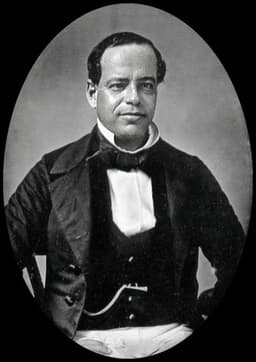
Antonio Lopez de Santa Anna
General · Modern
58.9Total
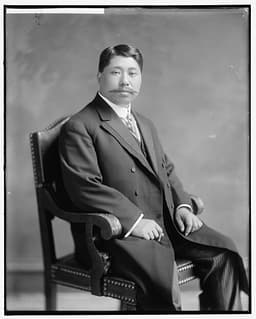
Huang Xing
General · Modern
57.5Total
Basic Information
Born
1794
1874
Died
1876
1916
Era
Modern
Modern
Nationality
Mexico
China
Occupation
General
General
Civilization
Western
Eastern
Score Comparison
Military (10%)
70.0
46.7
Political (20%)
46.6
53.8
Influence (20%)
56.7
62.0
Legacy (20%)
58.0
56.0
Leadership (15%)
68.0
62.0
Strategy (15%)
60.0
60.0
TOTAL
58.9
57.5
Antonio Lopez de Santa Anna — Complete Timeline
1823 AD
Led the Plan of Casa Mata rebellionPolitical Action
Santa Anna, then a general, issued the Plan of Casa Mata on February 1, 1823, calling for the overthrow of Emperor Agust
RebellionOverthrowRepublic
Impact: nationalconstructive
1829 AD
Defended Mexico at the Battle of TampicoWar◆ Major
Santa Anna commanded Mexican forces that defeated a Spanish invasion force at Tampico on September 11, 1829. The victory ended Spain's last attempt to reconquer Mexico and made Santa Anna a national hero. He was hailed as the 'Hero of Tampico' and used this fame to advance politically.
VictorySpanish InvasionNational Hero
Impact: nationalconstructive
1833 AD
Became President of Mexico for the first timePolitical Action◆ Major
Santa Anna was elected President of Mexico in 1833. He quickly delegated power to Vice President Valent
PresidencyPolitical InstabilityPower
Impact: national
1836 AD
Commanded at the Siege of the AlamoWar◆ Major
Santa Anna personally led the Mexican army in the siege of the Alamo mission in San Antonio, Texas. After a 13-day siege, Mexican forces stormed the fort on March 6, 1836, killing all 180-250 Texan defenders. The battle became a symbol of Texan resistance and a rallying cry for independence.
BattleTexas RevolutionAlamo
Impact: regionaldestructive
Defeated and captured at the Battle of San JacintoWar
Santa Anna's army was surprised and routed by Texan forces under Sam Houston at the Battle of San Jacinto on April 21, 1836. Santa Anna was captured the next day. He was forced to sign the Treaties of Velasco, recognizing Texan independence, though Mexico later repudiated them.
DefeatCaptureTexas Independence
Impact: regionaltragic
1847 AD
Lost the Mexican-American WarWar
Santa Anna returned from exile to command Mexican forces during the Mexican-American War. Despite initial efforts, his army was defeated at the Battle of Cerro Gordo and later at the Battle of Chapultepec. US forces captured Mexico City on September 14, 1847, leading to the Treaty of Guadalupe Hidalgo and massive territorial losses.
Mexican-American WarDefeatTerritorial Loss
Impact: globaltragic
1853 AD
Sold La Mesilla to the United StatesPolitical Action◆ Major
During his final presidency, Santa Anna agreed to the Gadsden Purchase, selling 29,670 square miles of territory (La Mesilla) to the United States for $10 million. The sale was widely condemned in Mexico as a betrayal. This act further damaged his reputation and led to his overthrow.
Territorial CessionGadsden PurchaseBetrayal
Impact: nationaldestructive
1855 AD
Overthrown and exiled for the final timePolitical Action◆ Major
The Plan of Ayutla, led by Juan
OverthrowExileEnd of Career
Impact: nationaltragic
Huang Xing — Complete Timeline
1905 AD
Co-founded the TongmenghuiPolitical Action◆ Major
Huang Xing co-founded the Tongmenghui (Revolutionary Alliance) in Tokyo with Sun Yat-sen. He became its military leader, organizing armed uprisings against the Qing dynasty.
TongmenghuiRevolutionMilitary
Impact: nationalconstructive
1911 AD
Led the Wuchang UprisingWar
Huang Xing led the Wuchang Uprising, which sparked the Xinhai Revolution. He commanded revolutionary forces against Qing troops, securing initial victories that led to the dynasty's collapse.
Xinhai RevolutionUprisingMilitary
Impact: nationalconstructive
1912 AD
Served as Minister of War in the RepublicPolitical Action◆ Major
Huang Xing served as Minister of War in the provisional government of the Republic of China. He worked to organize a national army and defend the republic against counter-revolutionary forces.
GovernmentMilitaryRepublic
Impact: nationalconstructive
1913 AD
Led the Second Revolution Against Yuan ShikaiWar◆ Major
Huang Xing led the Second Revolution, an armed uprising against President Yuan Shikai's authoritarian rule. The rebellion failed due to lack of coordination and military inferiority, forcing Huang into exile.
Second RevolutionYuan ShikaiExile
Impact: nationaltragic
1916 AD
Died in Exile in ShanghaiPolitical Action
Huang Xing died in Shanghai after returning from exile in Japan and the United States. His death marked the loss of a key military leader of the Chinese revolution, though his legacy endured.
DeathExileRevolution
Impact: nationaltragic
Expert Analysis
Huang Xing vs Antonio Lopez de Santa Anna
# The General Who Lost a Nation, and the General Who Lost His Chance
In the spring of 1836, two men stood at opposite ends of a continent, each convinced that history would remember them as liberators. Antonio López de Santa Anna watched his troops storm the Alamo mission in San Antonio, believing he had crushed a rebellion that would never rise again. Half a world away, Huang Xing, then a young revolutionary in exile, was planning an uprising that would topple an empire. Both were generals. Both dreamed of forging new nations. But where Santa Anna would spend a lifetime seizing power only to lose half his country, Huang Xing would spend his brief career building a republic only to watch it crumble into warlordism. The difference between them is not merely one of skill or luck—it is a story of how character, circumstance, and the very nature of revolution shaped two very different destinies.
Origins
Santa Anna was born in 1794 in Jalapa, Mexico, into a colonial world already cracking under the weight of Spanish rule. He joined the army at fifteen, a young man of ambition but little education, shaped by the chaos of the Mexican War of Independence. He fought first for Spain, then switched sides to join Agustín de Iturbide, and later turned against Iturbide himself. He was a creature of opportunity, not ideology. By contrast, Huang Xing was born in 1874 in Changsha, China, into a declining Qing dynasty reeling from foreign humiliation. He studied in Japan, where he absorbed Western military science and revolutionary thought. Where Santa Anna was a caudillo—a personalist strongman—Huang Xing was a modernizer, a man who believed that China needed not a new emperor but a republic.
Rise to Power
Santa Anna’s rise was a series of calculated gambles. In 1823, he issued the Plan of Casa Mata, a rebellion that overthrew Emperor Iturbide. He was not the architect of the republic that followed, but he positioned himself as its indispensable defender. In 1829, his victory at the Battle of Tampico against a Spanish invasion force made him a national hero. He became president in 1833, but he did not want the job—he wanted the power. He handed the presidency to his vice president, Valentín Gómez Farías, then returned to his hacienda, waiting to be called back as savior whenever crisis struck.
Huang Xing’s path was different. He was not a man of coups but of organization. In 1905, he co-founded the Tongmenghui with Sun Yat-sen in Tokyo, becoming its military commander. He raised funds, smuggled weapons, and planned uprisings. When the Wuchang Uprising finally erupted in October 1911, Huang Xing rushed to the scene and led revolutionary forces against the Qing. He was not a charismatic figurehead like Sun; he was the man who did the work. His rise was not through betrayal but through sacrifice.
Leadership & Governance
Santa Anna governed as a caudillo, ruling through personal loyalty and patronage. He was a gifted military tactician but a poor strategist. At the Alamo, he achieved a brutal victory, ordering no quarter for the defenders. But he failed to secure his supply lines, and weeks later, Sam Houston’s smaller force caught him napping at San Jacinto. Santa Anna was captured, and Texas was lost. He returned to power repeatedly, but his leadership was always reactive, never constructive. In 1847, during the Mexican-American War, his generalship was erratic. He lost battle after battle, and by the war’s end, Mexico had lost half its territory. In 1853, his final presidency was marked by the Gadsden Purchase, selling 29,670 square miles of La Mesilla to the United States for $10 million—a transaction that Mexicans saw as national betrayal.
Huang Xing, in contrast, tried to build institutions. As Minister of War in the provisional republic in 1912, he worked to create a national army loyal to the state, not to any general. But the republic was fragile. Yuan Shikai, a former Qing general, maneuvered to become president and then emperor. In 1913, Huang Xing led the Second Revolution against Yuan’s authoritarianism. It failed. He fled to Japan, then to the United States. His governance was never given a real chance; China’s chaos overwhelmed his ideals.
Triumph & Tragedy
Santa Anna’s greatest triumph was Tampico in 1829, where he defeated a Spanish invasion and cemented his reputation. His greatest tragedy was San Jacinto in 1836, where he lost Texas and, with it, any claim to strategic genius. But his true tragedy was longer: he ruled Mexico for decades, yet left it smaller, poorer, and more divided than he found it. He died in 1876, old and forgotten, a man who had been president eleven times and accomplished nothing lasting.
Huang Xing’s triumph was the Wuchang Uprising itself, which sparked the revolution that ended 2,000 years of imperial rule. His tragedy was that he could not finish the work. He died in 1916 in Shanghai, at just forty-two, after returning from exile. His body was given a state funeral, but the republic he helped found was already dying. Within a decade, China would descend into civil war.
Character & Destiny
Santa Anna was vain, opportunistic, and utterly convinced of his own genius. He once said, “I am the Napoleon of the West.” But he lacked Napoleon’s strategic depth and administrative vision. He saw power as personal, not institutional. Huang Xing was selfless, disciplined, and committed to a cause larger than himself. He once wrote, “To die for the revolution is to live forever.” But he lacked the ruthlessness to hold power, and the political environment of early republican China was too fractured for his idealism.
Legacy
Santa Anna is remembered in Mexico as the man who lost Texas, who sold the nation’s land, who embodied everything wrong with the caudillo tradition. His name is a curse. Huang Xing is remembered in China as a founding father, a hero of the 1911 Revolution, a man of integrity. But he is also a symbol of a road not taken—the path of republican democracy that China abandoned for dictatorship and revolution.
Conclusion
One man died in disgrace, the other in honor. But both were generals who failed. Santa Anna failed because he was too selfish to build a nation. Huang Xing failed because he was too selfless to hold one together. In the end, the difference between them is not a matter of scores or statistics—it is a lesson about what kind of leader a country gets, and what kind of leader it needs. Mexico got a man who loved power. China got a man who loved his country. Neither was enough.
Rankings
🥇
Antonio Lopez de Santa AnnaLeader
Mil: 70.0Pol: 46.6Inf: 56.7
58.9
🥈
Huang Xing
Mil: 46.7Pol: 53.8Inf: 62.0
57.5
+1.4 behind
How This Comparison Works
Algorithm
Each figure is scored on 6 dimensions (0—100 scale) based on structured historical data: Military (10%), Political (20%), Influence (20%), Legacy (20%), Leadership (15%), Strategy (15%). The weighted total produces the final ranking.
Data Sources
Scores are computed from structured sub-indicators in the database. Scale factors adjust for era (Ancient ×0.85, Modern ×1.0) and civilization size (Eastern ×1.05, Other ×0.80) to account for differences in population and military scale.
Maximum 3 Figures
Comparisons are limited to 2—3 figures to ensure readability and statistical meaningfulness.
Error Margins
±5 points per dimension — Sub-scores are derived from historical records with inherent uncertainty. Two figures within 5 points on a dimension should be considered roughly equivalent in that area.
Total Score Accuracy
±3 points overall — The weighted combination of 6 dimensions produces a total score with approximately ±3 points of uncertainty. Differences of less than 3 points are not statistically significant— the figures are effectively tied.
Known Limitations
- Historical records are incomplete and uneven across civilizations
- Figures from oral-tradition societies may be underrepresented
- Occupation labels can misclassify multi-role figures
- Scores measure capability and impact, not moral character
- Quantitative scoring is a comparison tool, not absolute truth
Capability Radar
Military (10%) — Battles & Warfare
Battles
65
35
Win Rate
40
30
Expansion
50
20
Political (20%) — Governance & Reform
Reform
20
60
Diplomacy
35
55
Economy
15
30
Influence (20%) — Cultural & Global Reach
Cultural
55
40
Global
50
40
Legacy (20%) — Historical Impact
Historical
60
55
Longevity
55
45
Leadership (15%) — Power & Stability
Tenure
75
40
Stability
10
25
Strategy (15%) — Tactics & Innovation
Strategy
45
45
Tactics
60
40
Reform
30
50
Similar Comparisons
Comments & Discussion
Critic McCannon6/16/2026
People romanticize Huang Xing as a tragic hero, but let’s be real: he fumbled the bag worse than Santa Anna lost Texas. Santa Anna at least had the balls to fight and lose—Huang Xing chickened out on key campaigns, then let Yuan Shikai steamroll the revolution. Santa Anna’s a trainwreck, sure, but Huang Xing’s legacy is built on what he didn’t do, not what he did. History’s forgiving of nice guys who fail quietly.
数据拆弹手6/16/2026
严格比数据:Santa Anna打了二十年仗,平均每场赢30%,丢得地比赢得多——但他是统治者,有权直接操作国家。黄兴从头到尾是二号人物,指挥二十几次起义,九成失败,但他没掌过一天实权。骂他“丢机会”等于骂前锋没守好门。基数不同,别拿总统比副手。
Classics Scribe6/16/2026
Compare these two and you see the curse of charisma vs. competence. Santa Anna was a theatrical peacock who lost half of Mexico because he couldn’t stop posturing—think quotes about his own genius before San Jacinto. Huang Xing was the inverse: a stoic workhorse who planned every detail but couldn’t rally a crowd to save his life. The republic needed a speaker; it got a mechanic. Both failed to match moment to method.
硝烟老参谋6/16/2026
军事上,Santa Anna是典型机会型统帅——会打顺风仗,比如阿拉莫,但逆风就崩。黄兴是硬仗型,阳夏战役守汉口四十六天,顶住北洋精锐,打得袁军怀疑人生。一个靠运气赢局部,一个用血换时间。可惜革命靠的不是牺牲,是结果。Santa Anna输得明白,黄兴输得冤枉,但都输。
Revisionist Flash6/16/2026
Don’t buy the “noble exile” myth on Huang Xing. Sure, Santa Anna was a venal sellout, but Huang Xing’s anti-imperialist cred is overblown—he wanted a constitutional monarchy at first, then switched to republicanism mid-game. That’s not principle, that’s hedging. Santa Anna at least owned his power grabs. Huang Xing’s indecisiveness left China without either a strong leader or a stable system. Sometimes failure by committee is worse than failure by ego.
半壶野史6/16/2026
说黄兴“稳”是屁话。他1913年二次革命时犹豫不决,等袁世凯已动手才想起打仗,结果连南京都守不住。Santa Anna好歹敢押注——赌盘输光也比不下注的男人强。黄兴一辈子温和得没牙,最后被历史当抹布擦了。建议别拿他和Santa Anna比,