Loading...
Antonio Lopez de Santa Anna vs Ehud Barak
Ehud Barak leads by 1.0 pts · 2 figures compared
…
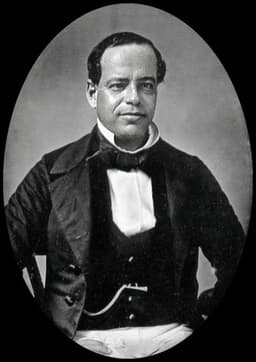
Antonio Lopez de Santa Anna
General · Modern
58.9Total
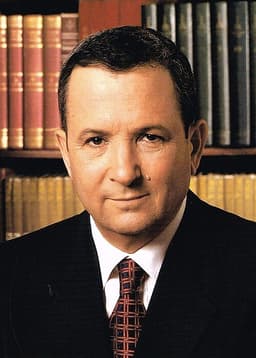
Ehud Barak
General · Modern
59.9Total
Basic Information
Born
1794
1942
Died
1876
—
Era
Modern
Modern
Nationality
Mexico
Israel
Occupation
General
General
Civilization
Western
Middle Eastern
Score Comparison
Military (10%)
70.0
63.3
Political (20%)
46.6
72.0
Influence (20%)
56.7
55.0
Legacy (20%)
58.0
52.0
Leadership (15%)
68.0
66.0
Strategy (15%)
60.0
61.2
TOTAL
58.9
59.9
Antonio Lopez de Santa Anna — Complete Timeline
1823 AD
Led the Plan of Casa Mata rebellionPolitical Action
Santa Anna, then a general, issued the Plan of Casa Mata on February 1, 1823, calling for the overthrow of Emperor Agust
RebellionOverthrowRepublic
Impact: nationalconstructive
1829 AD
Defended Mexico at the Battle of TampicoWar◆ Major
Santa Anna commanded Mexican forces that defeated a Spanish invasion force at Tampico on September 11, 1829. The victory ended Spain's last attempt to reconquer Mexico and made Santa Anna a national hero. He was hailed as the 'Hero of Tampico' and used this fame to advance politically.
VictorySpanish InvasionNational Hero
Impact: nationalconstructive
1833 AD
Became President of Mexico for the first timePolitical Action◆ Major
Santa Anna was elected President of Mexico in 1833. He quickly delegated power to Vice President Valent
PresidencyPolitical InstabilityPower
Impact: national
1836 AD
Commanded at the Siege of the AlamoWar◆ Major
Santa Anna personally led the Mexican army in the siege of the Alamo mission in San Antonio, Texas. After a 13-day siege, Mexican forces stormed the fort on March 6, 1836, killing all 180-250 Texan defenders. The battle became a symbol of Texan resistance and a rallying cry for independence.
BattleTexas RevolutionAlamo
Impact: regionaldestructive
Defeated and captured at the Battle of San JacintoWar
Santa Anna's army was surprised and routed by Texan forces under Sam Houston at the Battle of San Jacinto on April 21, 1836. Santa Anna was captured the next day. He was forced to sign the Treaties of Velasco, recognizing Texan independence, though Mexico later repudiated them.
DefeatCaptureTexas Independence
Impact: regionaltragic
1847 AD
Lost the Mexican-American WarWar
Santa Anna returned from exile to command Mexican forces during the Mexican-American War. Despite initial efforts, his army was defeated at the Battle of Cerro Gordo and later at the Battle of Chapultepec. US forces captured Mexico City on September 14, 1847, leading to the Treaty of Guadalupe Hidalgo and massive territorial losses.
Mexican-American WarDefeatTerritorial Loss
Impact: globaltragic
1853 AD
Sold La Mesilla to the United StatesPolitical Action◆ Major
During his final presidency, Santa Anna agreed to the Gadsden Purchase, selling 29,670 square miles of territory (La Mesilla) to the United States for $10 million. The sale was widely condemned in Mexico as a betrayal. This act further damaged his reputation and led to his overthrow.
Territorial CessionGadsden PurchaseBetrayal
Impact: nationaldestructive
1855 AD
Overthrown and exiled for the final timePolitical Action◆ Major
The Plan of Ayutla, led by Juan
OverthrowExileEnd of Career
Impact: nationaltragic
Ehud Barak — Complete Timeline
1973 AD
Awarded Medal of Distinguished ServiceOther
Barak received the Medal of Distinguished Service, Israel's highest military decoration, for his actions during the Yom Kippur War. He led a commando raid deep into Egyptian territory, destroying radar installations. This was part of a broader operation to open a supply route.
Military DecorationYom Kippur War
Impact: nationalconstructive
1976 AD
Led Operation Thunderbolt (Entebbe Raid)War◆ Major
As Chief of Staff, Barak planned and oversaw the Entebbe raid, a rescue of hostages hijacked by Palestinian and German militants in Uganda. Israeli commandos rescued 102 hostages. The operation was a major military success and boosted Israeli morale and international standing.
EntebbeHostage RescueCounterterrorism
Impact: globalconstructive
1991 AD
Appointed Chief of Staff of the IDFPolitical Action◆ Major
Barak was appointed the 14th Chief of Staff of the Israel Defense Forces. He served until 1995, overseeing military operations during the First Intifada and the Oslo Accords period. His tenure included the 1993 Operation Accountability in Lebanon.
Military CommandIDF
Impact: national
1999 AD
Elected Prime Minister of IsraelPolitical Action◆ Major
Barak was elected Prime Minister of Israel, defeating incumbent Benjamin Netanyahu. He campaigned on a platform of peace negotiations and domestic reform. His government pursued the Camp David Summit with Palestinians and withdrew from southern Lebanon.
ElectionPeace Process
Impact: regionalconstructive
2000 AD
Camp David Summit with ArafatPolitical Action
Barak participated in the Camp David Summit with Palestinian leader Yasser Arafat and U.S. President Bill Clinton. The summit aimed to reach a final status agreement but failed. Barak offered territorial concessions that were rejected. The failure contributed to the Second Intifada.
Peace NegotiationsCamp DavidIsraeli-Palestinian Conflict
Impact: global
Withdrew from Southern LebanonPolitical Action◆ Major
Barak ordered the unilateral withdrawal of Israeli forces from the security zone in southern Lebanon, ending 18 years of occupation. The withdrawal was completed in May 2000. Hezbollah claimed victory, and the move was criticized by some as a retreat under fire.
WithdrawalLebanonHezbollah
Impact: regional
Expert Analysis
Antonio Lopez de Santa Anna vs Ehud Barak
### The General and the Peacemaker
In the spring of 1836, a Mexican general with a flair for dramatic uniforms stood before the smoldering ruins of the Alamo, convinced he had crushed a rebellion. In the summer of 2000, an Israeli prime minister in a plain suit sat across a table from Yasser Arafat in the Maryland mountains, trying to forge a peace that would end a century of conflict. Antonio López de Santa Anna and Ehud Barak—both decorated soldiers, both leaders of their nations at critical moments—followed paths that could not have diverged more sharply. One became a cautionary tale of personal ambition devouring national destiny; the other, a story of how military discipline can be turned toward a fragile hope for peace. What drove these two generals to such different outcomes?
### Origins
Santa Anna was born in 1794 in Jalapa, Veracruz, into a colonial world where loyalty to Spain was the only path to power. He joined the Spanish army at age sixteen, learning war in the brutal campaigns of Mexico’s War of Independence—but he was a pragmatist, not an idealist. When the tide turned against Spain, he switched sides with ease. Ehud Barak, born in 1942 on a kibbutz in British Palestine, grew up in a world where survival itself was the cause. His parents were Jewish immigrants from Eastern Europe; his childhood was defined by the creation of Israel in 1948 and the wars that followed. Where Santa Anna learned that loyalty was a mask to be worn for advantage, Barak learned that loyalty to the nation was everything.
### Rise to Power
Santa Anna’s rise was a masterclass in opportunism. In 1823, he issued the Plan of Casa Mata, a rebellion that overthrew Emperor Agustín de Iturbide. It was a pattern he would repeat: find a grievance, rally the army, and claim to speak for the people. By 1833, he was president of Mexico—but he quickly tired of governing, delegating power to his liberal vice president while he retreated to his hacienda. He returned whenever crisis called, always as the indispensable man. Barak’s rise was built on merit. He joined the elite Sayeret Matkal commando unit, leading operations that required both intellect and nerve. He was awarded the Medal of Distinguished Service for the 1973 Yom Kippur War, and in 1976, as Chief of Staff, he planned the Entebbe Raid—a rescue of hostages hijacked to Uganda that became a legend of precision and daring. By 1999, when he was elected Prime Minister of Israel, he had spent decades proving himself through competence, not cunning.
### Leadership & Governance
Santa Anna’s leadership was a cycle of glory and disaster. At the Battle of Tampico in 1829, he defeated a Spanish invasion and became the “Hero of Tampico.” But at the Alamo in 1836, his victory came at a terrible cost: he ordered the execution of all survivors, a brutality that galvanized Texan resistance. Weeks later, at San Jacinto, he was captured while napping, his army destroyed. He returned to power repeatedly, selling Mexican territory in the Gadsden Purchase of 1853, and was finally overthrown in 1855. His governance was personal rule—he called himself the “Napoleon of the West,” but he left his country weaker each time. Barak’s governance was a study in controlled risk. He ordered the unilateral withdrawal from southern Lebanon in 2000, ending an 18-year occupation that had drained Israeli morale. At the Camp David Summit that same year, he offered Arafat a Palestinian state on most of the West Bank and Gaza, with a shared Jerusalem. Arafat said no. Barak’s military mind had sought a decisive peace, but he found that some enemies do not want victory—they want the fight.
### Triumph & Tragedy
Santa Anna’s greatest moment was Tampico, a genuine national victory. His greatest tragedy was the Mexican-American War, where he returned from exile to lead a country he had bankrupted and divided. He lost not only the war but also half of Mexico’s territory. Barak’s greatest moment was Entebbe—a rescue that showed Israel’s reach and resolve. His greatest tragedy was the failure of Camp David, which collapsed into the Second Intifada. He had staked his political life on peace, and lost both the peace and his office.
### Character & Destiny
Santa Anna was driven by vanity and a hunger for power that had no higher purpose. He once said, “A hundred years to come, my people will not be fit for liberty.” He believed in nothing but himself. Barak, by contrast, was driven by a belief that the strongest soldier must become the strongest negotiator. He once said, “If I were a Palestinian, I would join a terrorist organization.” He understood the enemy because he had fought them. But his analytical mind, trained for military problems, could not solve a political one where the other side refused to accept reality.
### Legacy
Santa Anna is remembered in Mexico as a traitor who sold his country, and in Texas as the villain of the Alamo. His legacy is a warning about the cost of personal ambition. Barak is remembered as a warrior who tried to be a peacemaker but could not close the deal. His legacy is a lesson that military victory does not guarantee political success, and that the hardest battles are the ones fought at the negotiating table.
### Conclusion
Standing at the Alamo, Santa Anna believed he had won. Sitting at Camp David, Barak believed he was close. Both were wrong—but for opposite reasons. Santa Anna’s failure came from caring only for himself; Barak’s came from believing that reason could conquer hatred. In the end, the difference between them is the difference between a man who fought for his own glory and a man who fought for a nation’s future. One left a trail of blood and lost land; the other left a question that still haunts the Middle East: what if the other side had said yes?
Rankings
🥇
Ehud BarakLeader
Mil: 63.3Pol: 72.0Inf: 55.0
59.9
🥈
Antonio Lopez de Santa Anna
Mil: 70.0Pol: 46.6Inf: 56.7
58.9
+1.0 behind
How This Comparison Works
Algorithm
Each figure is scored on 6 dimensions (0—100 scale) based on structured historical data: Military (10%), Political (20%), Influence (20%), Legacy (20%), Leadership (15%), Strategy (15%). The weighted total produces the final ranking.
Data Sources
Scores are computed from structured sub-indicators in the database. Scale factors adjust for era (Ancient ×0.85, Modern ×1.0) and civilization size (Eastern ×1.05, Other ×0.80) to account for differences in population and military scale.
Maximum 3 Figures
Comparisons are limited to 2—3 figures to ensure readability and statistical meaningfulness.
Error Margins
±5 points per dimension — Sub-scores are derived from historical records with inherent uncertainty. Two figures within 5 points on a dimension should be considered roughly equivalent in that area.
Total Score Accuracy
±3 points overall — The weighted combination of 6 dimensions produces a total score with approximately ±3 points of uncertainty. Differences of less than 3 points are not statistically significant— the figures are effectively tied.
Known Limitations
- Historical records are incomplete and uneven across civilizations
- Figures from oral-tradition societies may be underrepresented
- Occupation labels can misclassify multi-role figures
- Scores measure capability and impact, not moral character
- Quantitative scoring is a comparison tool, not absolute truth
Capability Radar
Military (10%) — Battles & Warfare
Battles
65
65
Win Rate
40
70
Expansion
50
55
Political (20%) — Governance & Reform
Reform
20
50
Diplomacy
35
60
Economy
15
45
Influence (20%) — Cultural & Global Reach
Cultural
55
50
Global
50
55
Legacy (20%) — Historical Impact
Historical
60
55
Longevity
55
45
Leadership (15%) — Power & Stability
Tenure
75
55
Stability
10
40
Strategy (15%) — Tactics & Innovation
Strategy
45
70
Tactics
60
75
Reform
30
60
Similar Comparisons
Comments & Discussion
Generalissimo de Perdición6/16/2026
Comparing Santa Anna to Barak is like comparing a peacock to a falcon. Santa Anna lost half of Mexico’s territory because he cared more about his gold-braided uniforms than holding Texas. By 1847, he had sold out his own country for personal gain. Barak, whatever his flaws, was the most decorated soldier in Israeli history—he literally dressed in disguise to assassinate terrorists in Beirut. One chased glory, the other chased results. Saint Anna was a peacock; Barak was a predator.
战场假面6/16/2026
说圣安纳是军事天才?他赢了阿拉莫纯粹是靠兵力碾压,可之后呢?1836年他签署了委拉斯科条约,把德克萨斯拱手让人,转头又声称自己是受害者。巴拉克不一样,他的指挥是精确的战术手术刀——1973年他指挥萨耶雷特突击队越过苏伊士运河,从0到1地改变了战争态势。圣安纳是蹩脚的赌徒,输光了一切;巴拉克是棋手,每一步都算计到位。
GloryHound vs Ghost6/16/2026
Barak gives me the creeps in a good way—he’s the spook who turned prime minister. The guy was literally a undercover commando in Beirut with a disguise so good he passed as a woman. Santa Anna? He demanded to be called "The Napoleon of the West" while losing Santa Fe, Texas, and half the American Southwest. One man’s military record is mostly theater; the other’s reads like a Tom Clancy novel. Give me the ghost over the ham any day.
沙场伪装6/16/2026
你们别忘了巴拉克在特种部队时的绰号是"小幽灵"——他不是靠人数取胜的将军,而是精准打击的艺术大师。1992年他还在总参谋部策划了清除真主党领袖的行动。相比之下,圣安纳就是个自我膨胀的笑话:他在墨西哥独立战争里换了三次阵营,每次都说是为了国家。军队不是化装舞会,将军的诚信比他的肩章更有价值。巴拉克是暗夜的刀锋,圣安纳是广场上的小丑。
Data Skeptic No.56/16/2026
Let’s look at the numbers: Santa Anna’s Mexico lost 55% of its territory by 1848. Barak’s Israel gave up land in the 2000 Camp David negotiations for a peace that didn't happen, but he still kept Israel secure. Military effectiveness? Santa Anna was captured or betrayed his own troops multiple times—he literally sold out Mexican positions for money in the 1840s. Barak eliminated enemies and built up the IDF’s precision strike capacity. If you judge by measurable outcomes, there is no contest. On