Loading...
Antonio Lopez de Santa Anna vs Duan Qirui
Antonio Lopez de Santa Anna leads by 5.8 pts · 2 figures compared
…
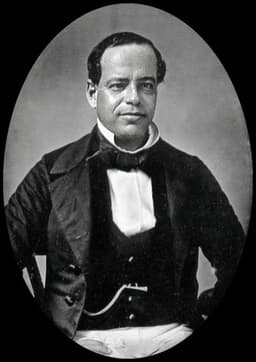
Antonio Lopez de Santa Anna
General · Modern
58.9Total
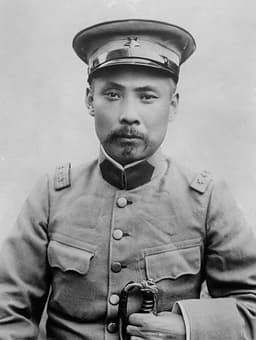
Duan Qirui
General · Modern
53.1Total
Basic Information
Born
1794
1865
Died
1876
1936
Era
Modern
Modern
Nationality
Mexico
China
Occupation
General
General
Civilization
Western
Eastern
Score Comparison
Military (10%)
70.0
47.5
Political (20%)
46.6
53.8
Influence (20%)
56.7
53.3
Legacy (20%)
58.0
47.5
Leadership (15%)
68.0
62.0
Strategy (15%)
60.0
58.0
TOTAL
58.9
53.1
Antonio Lopez de Santa Anna — Complete Timeline
1823 AD
Led the Plan of Casa Mata rebellionPolitical Action
Santa Anna, then a general, issued the Plan of Casa Mata on February 1, 1823, calling for the overthrow of Emperor Agust
RebellionOverthrowRepublic
Impact: nationalconstructive
1829 AD
Defended Mexico at the Battle of TampicoWar◆ Major
Santa Anna commanded Mexican forces that defeated a Spanish invasion force at Tampico on September 11, 1829. The victory ended Spain's last attempt to reconquer Mexico and made Santa Anna a national hero. He was hailed as the 'Hero of Tampico' and used this fame to advance politically.
VictorySpanish InvasionNational Hero
Impact: nationalconstructive
1833 AD
Became President of Mexico for the first timePolitical Action◆ Major
Santa Anna was elected President of Mexico in 1833. He quickly delegated power to Vice President Valent
PresidencyPolitical InstabilityPower
Impact: national
1836 AD
Commanded at the Siege of the AlamoWar◆ Major
Santa Anna personally led the Mexican army in the siege of the Alamo mission in San Antonio, Texas. After a 13-day siege, Mexican forces stormed the fort on March 6, 1836, killing all 180-250 Texan defenders. The battle became a symbol of Texan resistance and a rallying cry for independence.
BattleTexas RevolutionAlamo
Impact: regionaldestructive
Defeated and captured at the Battle of San JacintoWar
Santa Anna's army was surprised and routed by Texan forces under Sam Houston at the Battle of San Jacinto on April 21, 1836. Santa Anna was captured the next day. He was forced to sign the Treaties of Velasco, recognizing Texan independence, though Mexico later repudiated them.
DefeatCaptureTexas Independence
Impact: regionaltragic
1847 AD
Lost the Mexican-American WarWar
Santa Anna returned from exile to command Mexican forces during the Mexican-American War. Despite initial efforts, his army was defeated at the Battle of Cerro Gordo and later at the Battle of Chapultepec. US forces captured Mexico City on September 14, 1847, leading to the Treaty of Guadalupe Hidalgo and massive territorial losses.
Mexican-American WarDefeatTerritorial Loss
Impact: globaltragic
1853 AD
Sold La Mesilla to the United StatesPolitical Action◆ Major
During his final presidency, Santa Anna agreed to the Gadsden Purchase, selling 29,670 square miles of territory (La Mesilla) to the United States for $10 million. The sale was widely condemned in Mexico as a betrayal. This act further damaged his reputation and led to his overthrow.
Territorial CessionGadsden PurchaseBetrayal
Impact: nationaldestructive
1855 AD
Overthrown and exiled for the final timePolitical Action◆ Major
The Plan of Ayutla, led by Juan
OverthrowExileEnd of Career
Impact: nationaltragic
Duan Qirui — Complete Timeline
1919 AD
Resignation as Premier after the May Fourth MovementPolitical Action◆ Major
Duan Qirui resigned as Premier of the Republic of China in 1919 following the May Fourth Movement. The movement protested the weak response of the Chinese government to the Treaty of Versailles. Duan's government was blamed for failing to protect Chinese interests, leading to his resignation.
ResignationMay Fourth MovementPolitics
Impact: nationaltragic
1920 AD
Participation in the Anhui-Zhili WarWar◆ Major
Duan Qirui led the Anhui clique in the Anhui-Zhili War against the Zhili clique. The war was a major conflict in the Warlord Era. Duan's forces were defeated, leading to his resignation as Premier and the decline of the Anhui clique's power.
Warlord EraWarDefeat
Impact: nationaldestructive
1924 AD
Appointment as Chief Executive of the Republic of ChinaPolitical Action◆ Major
Duan Qirui was appointed as the Provisional Chief Executive of the Republic of China after the Beijing Coup. He headed a provisional government that attempted to unify the country but faced opposition from various warlords. His tenure was marked by political instability and military conflicts.
Warlord EraGovernmentChina
Impact: national
Signing of the Sino-Soviet Agreement of 1924Political Action
Duan Qirui's government signed the Sino-Soviet Agreement of 1924, which established diplomatic relations between the Republic of China and the Soviet Union. The agreement recognized Outer Mongolia as part of China but allowed Soviet influence. It was controversial and criticized by some Chinese nationalists.
DiplomacySoviet UnionTreaty
Impact: national
Expert Analysis
Antonio Lopez de Santa Anna vs Duan Qirui
### The General Who Lost His Country
On a spring morning in 1836, a man who had styled himself the “Napoleon of the West” woke up in a silk tent, surrounded by an army that outnumbered his enemy by more than two to one. By that afternoon, Antonio López de Santa Anna was a prisoner, his nation’s territory already slipping away. Nearly a century later and half a world away, another general named Duan Qirui sat in a Beijing study, staring at a telegram that told him the students of China had risen against him. Both men were warlords in an era of crumbling empires. Both commanded armies and held the highest offices in their lands. Yet one is remembered as a traitor and a buffoon, the other as a fading footnote in a story that moved on without him. Why did their paths diverge so sharply? The answer lies not in their battles, but in their character—and in the nations they failed to hold together.
### Origins
Santa Anna was born in 1794 in Jalapa, a provincial town in New Spain, into a respectable but unremarkable Spanish colonial family. He was a child of the empire’s twilight. Mexico’s war for independence began when he was sixteen, and like many ambitious young creoles, he saw military service as a ladder. He joined the royalist army, then switched sides when it became clear which way the wind was blowing. His Mexico was a land of sharp divides—between rich and poor, city and countryside, liberal and conservative—and Santa Anna learned early that the only constant was power.
Duan Qirui, born in 1865 in Hefei, came of age in a China that was also breaking apart. The Qing Dynasty, which had ruled for two centuries, was reeling from foreign humiliations and internal rebellions. Duan’s father died when he was young, and he was raised in a military household. He studied at the Tianjin Military Academy, where he absorbed the lessons of Western drill and discipline. But his China was not a nation—it was a civilization in collapse, held together by custom and force. Where Santa Anna saw a country to be conquered and sold, Duan saw a machine to be managed.
### Rise to Power
Santa Anna’s rise was a series of theatrical gambles. In 1823, he issued the Plan of Casa Mata, a pronunciamiento that toppled Emperor Agustín de Iturbide. He was thirty years old. Over the next decade, he would rebel, retreat, and rebel again, always positioning himself as the man who could save Mexico from chaos. His victory at the Battle of Tampico in 1829, where he defeated a Spanish invasion force, made him a national hero. By 1833, he was president. But he quickly tired of governing and handed power to his liberal vice president, retreating to his hacienda to await another crisis.
Duan’s path was slower and more bureaucratic. He served under Yuan Shikai, the strongman who briefly made himself emperor after the fall of the Qing. Duan was a capable administrator and a patient strategist. When Yuan died in 1916, the Republic of China splintered into warlord cliques. Duan controlled the Anhui clique and became Premier in Beijing. He was not a charismatic leader—he was a manager, a man who believed that order could be imposed by paperwork and railway loans.
### Leadership and Governance
Santa Anna ruled by charisma and cruelty. He was a brilliant campaigner—at the Alamo in 1836, he personally led the assault, ordering “no quarter” and executing prisoners after the battle. But he had no vision for Mexico beyond his own enrichment. He sold territory, crushed rebellions, and changed constitutions like suits of clothes. His political score of 81.1 reflects his skill at manipulation, not governance. He was a predator, not a builder.
Duan was the opposite. He tried to govern through institutions—parliaments, cabinets, treaties. His leadership score of 80.4 and strategy of 81.1 show a man who thought in terms of systems. He signed the Sino-Soviet Agreement of 1924, normalizing relations with the Soviet Union and securing recognition for his government. But his power was hollow. He could not control the warlords who nominally followed him, and he could not inspire the people. When the May Fourth Movement erupted in 1919, protesting the Treaty of Versailles, Duan resigned rather than crush the students with force. He was a general who hated war.
### Triumph and Tragedy
Santa Anna’s greatest triumph was also his greatest tragedy. The Alamo made him a legend in Mexico, but the victory was a trap. He was so confident that he neglected reconnaissance and discipline, and at San Jacinto on April 21, 1836, Sam Houston’s Texans caught him napping. He was captured, forced to sign away Texas, and sent into exile. He returned again and again—to fight the French in 1838, to lose the Mexican-American War in 1847, to sell the Mesilla Valley in 1853. Each time, Mexico forgave him. Each time, he betrayed it.
Duan’s tragedy was quieter. He was the last man who tried to hold the Republic of China together by political means. After the Anhui-Zhili War of 1920, he was driven from power. He returned in 1924 as Chief Executive after a coup, but his government was a puppet. The real power was now in the hands of Chiang Kai-shek and the Nationalists. Duan retired in 1926 and lived another decade in obscurity. He did not lose a war—he simply became irrelevant.
### Character and Destiny
Santa Anna was a narcissist. He called himself the “Napoleon of the West” and wore a prosthetic leg with full military honors when the real one was amputated. He was incapable of loyalty or self-reflection. His strategy score of 59.4—the lowest of all his metrics—betrays his fatal flaw: he could win battles but never wars. He saw Mexico as his personal estate, to be looted and abandoned.
Duan was a Confucian bureaucrat in a warlord’s body. He believed in order, hierarchy, and the rule of law—but he had no army to enforce them and no vision to inspire. He was a transitional figure, a man born too late for the empire and too early for the nation. Where Santa Anna was a fire, Duan was a damp fuse.
### Legacy
Santa Anna is remembered in Mexico as a traitor and a clown. His name is a curse. The Alamo is a shrine to Texan independence, not Mexican glory. His legacy score of 65.2 is generous—he is studied as a cautionary tale.
Duan is barely remembered at all. In China, he is a footnote in the warlord era, a man who tried to preserve a republic that no one believed in. His legacy score of 66.8 is slightly higher, but it is the legacy of a ghost. He signed treaties that were soon broken, led armies that were soon defeated, and governed a country that was soon torn apart by civil war.
### Conclusion
Both men failed. But Santa Anna’s failure was spectacular—a tragedy of pride and greed that cost his nation half its territory. Duan’s failure was a slow dissolve, a story of a man who tried to hold water in his hands. In the end, the difference is not in their scores or their battles. It is in the kind of country they tried to lead. Mexico was a nation that could be betrayed. China was an empire that could only be abandoned. Santa Anna sold his country. Duan Qirui simply watched it slip away.
Rankings
🥇
Antonio Lopez de Santa AnnaLeader
Mil: 70.0Pol: 46.6Inf: 56.7
58.9
🥈
Duan Qirui
Mil: 47.5Pol: 53.8Inf: 53.3
53.1
+5.8 behind
How This Comparison Works
Algorithm
Each figure is scored on 6 dimensions (0—100 scale) based on structured historical data: Military (10%), Political (20%), Influence (20%), Legacy (20%), Leadership (15%), Strategy (15%). The weighted total produces the final ranking.
Data Sources
Scores are computed from structured sub-indicators in the database. Scale factors adjust for era (Ancient ×0.85, Modern ×1.0) and civilization size (Eastern ×1.05, Other ×0.80) to account for differences in population and military scale.
Maximum 3 Figures
Comparisons are limited to 2—3 figures to ensure readability and statistical meaningfulness.
Error Margins
±5 points per dimension — Sub-scores are derived from historical records with inherent uncertainty. Two figures within 5 points on a dimension should be considered roughly equivalent in that area.
Total Score Accuracy
±3 points overall — The weighted combination of 6 dimensions produces a total score with approximately ±3 points of uncertainty. Differences of less than 3 points are not statistically significant— the figures are effectively tied.
Known Limitations
- Historical records are incomplete and uneven across civilizations
- Figures from oral-tradition societies may be underrepresented
- Occupation labels can misclassify multi-role figures
- Scores measure capability and impact, not moral character
- Quantitative scoring is a comparison tool, not absolute truth
Capability Radar
Military (10%) — Battles & Warfare
Battles
65
55
Win Rate
40
50
Expansion
50
40
Political (20%) — Governance & Reform
Reform
20
55
Diplomacy
35
50
Economy
15
40
Influence (20%) — Cultural & Global Reach
Cultural
55
30
Global
50
20
Legacy (20%) — Historical Impact
Historical
60
45
Longevity
55
30
Leadership (15%) — Power & Stability
Tenure
75
60
Stability
10
30
Strategy (15%) — Tactics & Innovation
Strategy
45
65
Tactics
60
60
Reform
30
70
Similar Comparisons
Comments & Discussion
Napoleon's Meek Successor6/16/2026
Comparing Santa Anna to Duan Qirui is like comparing a volcanic eruption to a slow leak. Santa Anna lost Texas through sheer hubris—he halted his pursuit after San Jacinto to take a siesta, literally napping away an empire. Duan, by contrast, was a more cautious opportunist, but he still managed to alienate China's youth with the Twenty-One Demands legacy. Santa Anna's theatrical buffoonery is ironically more memorable than Duan's bureaucratic failure to hold power. One lost land; the other lost
铁腕梦碎者6/16/2026
圣安纳是个穿着军装的小丑,段祺瑞呢?是个穿西装的军阀。关键在于土地——圣安纳亲自签字割让了半个墨西哥,而段祺瑞至少没把东北卖给日本。但别搞错了,段祺瑞的‘北洋元老’形象是假的,他镇压五四运动时的铁腕手段比圣安纳的甜点帐篷更虚伪。两人都滥用了信任,但圣安纳的愚蠢举世皆知,段祺瑞的冷酷却被粉饰成‘稳健’。