Loading...
Antonio Lopez de Santa Anna vs Deodoro da Fonseca
Antonio Lopez de Santa Anna leads by 10.1 pts · 2 figures compared
…
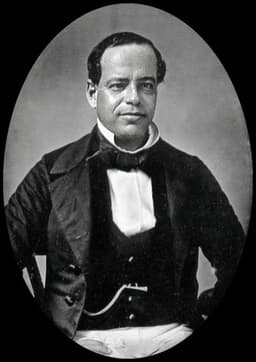
Antonio Lopez de Santa Anna
General · Modern
58.9Total
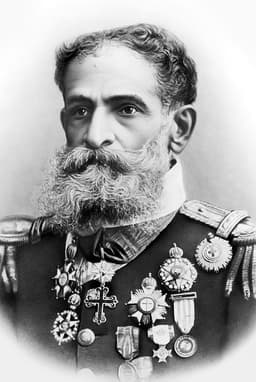
Deodoro da Fonseca
General · Modern
48.8Total
Basic Information
Born
1794
1827
Died
1876
1892
Era
Modern
Modern
Nationality
Mexico
Brazil
Occupation
General
General
Civilization
Western
Western
Score Comparison
Military (10%)
70.0
50.0
Political (20%)
46.6
45.1
Influence (20%)
56.7
54.1
Legacy (20%)
58.0
44.2
Leadership (15%)
68.0
57.6
Strategy (15%)
60.0
38.6
TOTAL
58.9
48.8
Antonio Lopez de Santa Anna — Complete Timeline
1823 AD
Led the Plan of Casa Mata rebellionPolitical Action
Santa Anna, then a general, issued the Plan of Casa Mata on February 1, 1823, calling for the overthrow of Emperor Agust
RebellionOverthrowRepublic
Impact: nationalconstructive
1829 AD
Defended Mexico at the Battle of TampicoWar◆ Major
Santa Anna commanded Mexican forces that defeated a Spanish invasion force at Tampico on September 11, 1829. The victory ended Spain's last attempt to reconquer Mexico and made Santa Anna a national hero. He was hailed as the 'Hero of Tampico' and used this fame to advance politically.
VictorySpanish InvasionNational Hero
Impact: nationalconstructive
1833 AD
Became President of Mexico for the first timePolitical Action◆ Major
Santa Anna was elected President of Mexico in 1833. He quickly delegated power to Vice President Valent
PresidencyPolitical InstabilityPower
Impact: national
1836 AD
Commanded at the Siege of the AlamoWar◆ Major
Santa Anna personally led the Mexican army in the siege of the Alamo mission in San Antonio, Texas. After a 13-day siege, Mexican forces stormed the fort on March 6, 1836, killing all 180-250 Texan defenders. The battle became a symbol of Texan resistance and a rallying cry for independence.
BattleTexas RevolutionAlamo
Impact: regionaldestructive
Defeated and captured at the Battle of San JacintoWar
Santa Anna's army was surprised and routed by Texan forces under Sam Houston at the Battle of San Jacinto on April 21, 1836. Santa Anna was captured the next day. He was forced to sign the Treaties of Velasco, recognizing Texan independence, though Mexico later repudiated them.
DefeatCaptureTexas Independence
Impact: regionaltragic
1847 AD
Lost the Mexican-American WarWar
Santa Anna returned from exile to command Mexican forces during the Mexican-American War. Despite initial efforts, his army was defeated at the Battle of Cerro Gordo and later at the Battle of Chapultepec. US forces captured Mexico City on September 14, 1847, leading to the Treaty of Guadalupe Hidalgo and massive territorial losses.
Mexican-American WarDefeatTerritorial Loss
Impact: globaltragic
1853 AD
Sold La Mesilla to the United StatesPolitical Action◆ Major
During his final presidency, Santa Anna agreed to the Gadsden Purchase, selling 29,670 square miles of territory (La Mesilla) to the United States for $10 million. The sale was widely condemned in Mexico as a betrayal. This act further damaged his reputation and led to his overthrow.
Territorial CessionGadsden PurchaseBetrayal
Impact: nationaldestructive
1855 AD
Overthrown and exiled for the final timePolitical Action◆ Major
The Plan of Ayutla, led by Juan
OverthrowExileEnd of Career
Impact: nationaltragic
Deodoro da Fonseca — Complete Timeline
1889 AD
Proclamation of the Brazilian RepublicPolitical Action
Deodoro da Fonseca led a military coup that overthrew Emperor Pedro II on November 15, 1889. He proclaimed the Republic of the United States of Brazil, ending 67 years of imperial rule.
CoupRepublic
Impact: globalprogressive
1891 AD
Election as First President of BrazilPolitical Action◆ Major
Deodoro da Fonseca was elected the first President of Brazil by the Constituent Congress on February 25, 1891. He took office under the new republican constitution, but his rule was brief and authoritarian.
ElectionPresidency
Impact: national
Dissolution of the National CongressPolitical Action◆ Major
Facing political opposition, Deodoro da Fonseca dissolved the National Congress on November 3, 1891, and declared a state of siege. This authoritarian act triggered a naval revolt and his eventual resignation.
AuthoritarianismPolitical Crisis
Impact: nationaldestructive
Resignation from the PresidencyPolitical Action◆ Major
Deodoro da Fonseca resigned the presidency on November 23, 1891, after a naval rebellion threatened his government. He handed power to Vice President Floriano Peixoto, ending his 9-month rule.
ResignationPolitical Crisis
Impact: nationaltragic
Expert Analysis
Deodoro da Fonseca vs Antonio Lopez de Santa Anna
# The Republic's Two Generals: Santa Anna and Deodoro da Fonseca
On a humid November morning in 1889, Marshal Deodoro da Fonseca, a sixty-two-year-old veteran of Brazil’s wars, stood at the head of a column of troops in Rio de Janeiro. He was not a man who sought power — his health was failing, his mood uncertain — yet history had thrust him into the role of liberator. Across the continent, another general had once stood in a similar position: Antonio Lopez de Santa Anna, a man who had ridden into Mexico City as a hero and would leave it as a tyrant. Both men were soldiers who became presidents. But one founded a republic; the other nearly destroyed one.
Origins
Santa Anna was born in 1794 in Jalapa, a provincial town in New Spain, to a middle-class Spanish family. The world he entered was one of rigid colonial hierarchy, where the Spanish-born elite ruled over a restless Creole population. Mexico was a powder keg, and Santa Anna learned early how to read the winds of rebellion. He joined the Spanish army at fifteen, fought against insurgents, and then, with the same ease, switched sides when independence became inevitable. He was a creature of opportunism, not ideology.
Deodoro da Fonseca, born in 1827 in Alagoas, Brazil, came from a military family steeped in service. The Brazilian Empire was stable, monarchical, and far less violent than Mexico’s early republic. Deodoro grew up in a world where the emperor, Dom Pedro II, was respected, where the army was an institution, not a plaything of factions. He fought in the Paraguayan War, a brutal conflict that forged his sense of duty. Where Santa Anna was a political chameleon, Deodoro was a soldier of the old school — loyal, hesitant, and burdened by conscience.
Rise to Power
Santa Anna’s path to power was a series of calculated betrayals. In 1823, he issued the Plan of Casa Mata, a rebellion that toppled Emperor Agustín de Iturbide, the very man he had helped install. This was his signature move: he made himself indispensable to whichever faction seemed strongest, then turned on them when it suited him. By 1829, he had become a national hero after defeating a Spanish invasion at Tampico. The victory was genuine, but Santa Anna knew how to milk it. He was elected president in 1833, but he soon delegated power to his vice president and retreated to his estate, waiting for the right moment to seize absolute control.
Deodoro’s rise was slower and more reluctant. He had no ambition for the presidency. The republican movement in Brazil was small, conspiatorial, and centered on a group of young officers and intellectuals. They needed a figurehead, a general with prestige to lead a coup. Deodoro was their reluctant choice. On November 15, 1889, after a tense night of indecision, he mounted his horse and marched on the War Ministry. The coup was bloodless. Emperor Pedro II was deposed, and the Republic was proclaimed. Deodoro did not seek power; power sought him.
Leadership & Governance
Santa Anna governed Mexico seven times, each presidency more erratic than the last. He was a master of political theater — he loved grand uniforms, dramatic gestures, and the title “His Most Serene Highness.” But his governance was hollow. He centralized power, crushed federalism, and sold territory. In 1836, he personally led the siege of the Alamo, a brutal victory that cost him everything when he was captured at San Jacinto. He signed away Texas under duress, then returned to power as if nothing had happened. During the Mexican-American War, he again commanded armies, but his strategy was chaotic, his logistics nonexistent. By 1853, he sold the Mesilla Valley to the United States in the Gadsden Purchase — a final act of desperation that made him a national traitor.
Deodoro was no better as an administrator, but his failure was one of temperament, not greed. Elected president in 1891, he faced a divided Congress and a struggling economy. He was a soldier, not a statesman. When opposition grew, he dissolved Congress and declared a state of siege. It was a dictator’s move, but Deodoro lacked the ruthlessness to sustain it. A naval rebellion erupted, and he resigned after only nine months. “I do not wish to be the cause of civil war,” he said. Santa Anna would have fought to the last man.
Triumph & Tragedy
Santa Anna’s greatest moment was Tampico in 1829 — a genuine victory that saved Mexico from Spanish reconquest. His greatest tragedy was the Alamo, which he won but which made him a villain in American memory. The Mexican-American War was his final humiliation: he lost half his country and could not even hold the presidency.
Deodoro’s triumph was the Proclamation of the Republic, a peaceful transition that ended the monarchy without bloodshed. His tragedy was the dissolution of Congress, a clumsy authoritarian act that shattered his legitimacy. He died in 1892, a year after his resignation, mourned by few but respected by many.
Character & Destiny
Santa Anna was a man of infinite vanity and zero self-reflection. He believed he was Mexico’s savior, but he was its ruin. His personality — charming, ruthless, and utterly selfish — drove him to seize power again and again, each time leaving the country weaker. He died in 1876, blind and forgotten, a cautionary tale of ambition without principle.
Deodoro was a man of contradictions. He overthrew an emperor he respected, led a republic he did not understand, and resigned when he could have fought. His personality — dutiful, hesitant, and honorable — made him a reluctant revolutionary. He was not a great leader, but he was a decent man in a role that demanded more than he could give.
Legacy
Santa Anna is remembered in Mexico as a traitor and a buffoon. His name is synonymous with betrayal, his face a caricature of corruption. The United States remembers him as the villain of the Alamo, a convenient enemy for a national myth.
Deodoro is remembered in Brazil as a founder, but a flawed one. His image appears on coins, his name on streets, but few Brazilians know his story. He is a statue in a park, a footnote in textbooks. Yet he did something Santa Anna never could: he stepped aside.
Conclusion
Two generals, two republics, two fates. Santa Anna could not stop grasping power; Deodoro could not bear to hold it. One lost his country; the other gave his country a chance. In the end, the difference between them was not talent or luck, but character. Santa Anna believed the republic existed for him. Deodoro believed he existed for the republic. That is the difference between a tyrant and a patriot — and history, for all its mercilessness, still knows how to tell them apart.
Rankings
🥇
Antonio Lopez de Santa AnnaLeader
Mil: 70.0Pol: 46.6Inf: 56.7
58.9
🥈
Deodoro da Fonseca
Mil: 50.0Pol: 45.1Inf: 54.1
48.8
+10.1 behind
How This Comparison Works
Algorithm
Each figure is scored on 6 dimensions (0—100 scale) based on structured historical data: Military (10%), Political (20%), Influence (20%), Legacy (20%), Leadership (15%), Strategy (15%). The weighted total produces the final ranking.
Data Sources
Scores are computed from structured sub-indicators in the database. Scale factors adjust for era (Ancient ×0.85, Modern ×1.0) and civilization size (Eastern ×1.05, Other ×0.80) to account for differences in population and military scale.
Maximum 3 Figures
Comparisons are limited to 2—3 figures to ensure readability and statistical meaningfulness.
Error Margins
±5 points per dimension — Sub-scores are derived from historical records with inherent uncertainty. Two figures within 5 points on a dimension should be considered roughly equivalent in that area.
Total Score Accuracy
±3 points overall — The weighted combination of 6 dimensions produces a total score with approximately ±3 points of uncertainty. Differences of less than 3 points are not statistically significant— the figures are effectively tied.
Known Limitations
- Historical records are incomplete and uneven across civilizations
- Figures from oral-tradition societies may be underrepresented
- Occupation labels can misclassify multi-role figures
- Scores measure capability and impact, not moral character
- Quantitative scoring is a comparison tool, not absolute truth
Capability Radar
Military (10%) — Battles & Warfare
Battles
65
20
Win Rate
40
25
Expansion
50
10
Political (20%) — Governance & Reform
Reform
20
40
Diplomacy
35
25
Economy
15
15
Influence (20%) — Cultural & Global Reach
Cultural
55
20
Global
50
15
Legacy (20%) — Historical Impact
Historical
60
35
Longevity
55
20
Leadership (15%) — Power & Stability
Tenure
75
30
Stability
10
10
Strategy (15%) — Tactics & Innovation
Strategy
45
25
Tactics
60
20
Reform
30
15
Similar Comparisons
Comments & Discussion
No comments yet. Be the first to share your thoughts!