Loading...
Antonio Lopez de Santa Anna vs Colin Powell
Antonio Lopez de Santa Anna leads by 0.4 pts · 2 figures compared
…
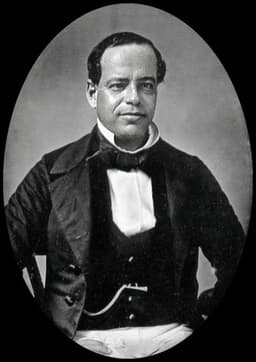
Antonio Lopez de Santa Anna
General · Modern
58.9Total

Colin Powell
General · Modern
58.5Total
Basic Information
Born
1794
1937
Died
1876
—
Era
Modern
Modern
Nationality
Mexico
United States
Occupation
General
General
Civilization
Western
Western
Score Comparison
Military (10%)
70.0
25.0
Political (20%)
46.6
68.0
Influence (20%)
56.7
68.0
Legacy (20%)
58.0
52.0
Leadership (15%)
68.0
72.0
Strategy (15%)
60.0
50.0
TOTAL
58.9
58.5
Antonio Lopez de Santa Anna — Complete Timeline
1823 AD
Led the Plan of Casa Mata rebellionPolitical Action
Santa Anna, then a general, issued the Plan of Casa Mata on February 1, 1823, calling for the overthrow of Emperor Agust
RebellionOverthrowRepublic
Impact: nationalconstructive
1829 AD
Defended Mexico at the Battle of TampicoWar◆ Major
Santa Anna commanded Mexican forces that defeated a Spanish invasion force at Tampico on September 11, 1829. The victory ended Spain's last attempt to reconquer Mexico and made Santa Anna a national hero. He was hailed as the 'Hero of Tampico' and used this fame to advance politically.
VictorySpanish InvasionNational Hero
Impact: nationalconstructive
1833 AD
Became President of Mexico for the first timePolitical Action◆ Major
Santa Anna was elected President of Mexico in 1833. He quickly delegated power to Vice President Valent
PresidencyPolitical InstabilityPower
Impact: national
1836 AD
Commanded at the Siege of the AlamoWar◆ Major
Santa Anna personally led the Mexican army in the siege of the Alamo mission in San Antonio, Texas. After a 13-day siege, Mexican forces stormed the fort on March 6, 1836, killing all 180-250 Texan defenders. The battle became a symbol of Texan resistance and a rallying cry for independence.
BattleTexas RevolutionAlamo
Impact: regionaldestructive
Defeated and captured at the Battle of San JacintoWar
Santa Anna's army was surprised and routed by Texan forces under Sam Houston at the Battle of San Jacinto on April 21, 1836. Santa Anna was captured the next day. He was forced to sign the Treaties of Velasco, recognizing Texan independence, though Mexico later repudiated them.
DefeatCaptureTexas Independence
Impact: regionaltragic
1847 AD
Lost the Mexican-American WarWar
Santa Anna returned from exile to command Mexican forces during the Mexican-American War. Despite initial efforts, his army was defeated at the Battle of Cerro Gordo and later at the Battle of Chapultepec. US forces captured Mexico City on September 14, 1847, leading to the Treaty of Guadalupe Hidalgo and massive territorial losses.
Mexican-American WarDefeatTerritorial Loss
Impact: globaltragic
1853 AD
Sold La Mesilla to the United StatesPolitical Action◆ Major
During his final presidency, Santa Anna agreed to the Gadsden Purchase, selling 29,670 square miles of territory (La Mesilla) to the United States for $10 million. The sale was widely condemned in Mexico as a betrayal. This act further damaged his reputation and led to his overthrow.
Territorial CessionGadsden PurchaseBetrayal
Impact: nationaldestructive
1855 AD
Overthrown and exiled for the final timePolitical Action◆ Major
The Plan of Ayutla, led by Juan
OverthrowExileEnd of Career
Impact: nationaltragic
Colin Powell — Complete Timeline
1987 AD
Appointed National Security AdvisorPolitical Action◆ Major
Powell was appointed National Security Advisor by President Ronald Reagan in November 1987, serving until January 1989. He coordinated foreign policy and national security matters, including arms control negotiations with the Soviet Union and the Iran-Iraq War, becoming the first African American in this role.
National SecurityReagan AdministrationForeign Policy
Impact: global
1989 AD
Became Chairman of the Joint Chiefs of StaffOther◆ Major
On October 1, 1989, Powell became the 12th Chairman of the Joint Chiefs of Staff, the first African American to hold the position. He oversaw U.S. military operations during the invasion of Panama (1989) and the Gulf War (1990-1991), becoming a highly visible public figure.
Military LeadershipGulf WarFirst African American
Impact: global
1990 AD
Developed the Powell DoctrineOther◆ Major
During the Gulf War planning, Powell articulated the Powell Doctrine, which stated that U.S. military force should only be used as a last resort, with overwhelming force, clear objectives, and an exit strategy. This doctrine influenced U.S. military interventions for the next decade.
Military DoctrineGulf WarStrategic Thinking
Impact: global
2001 AD
Appointed Secretary of StatePolitical Action◆ Major
On January 20, 2001, Powell was confirmed as the 65th U.S. Secretary of State under President George W. Bush, becoming the first African American to hold the office. He advocated for diplomacy and multilateralism, but his influence waned after the September 11 attacks.
DiplomacyBush AdministrationFirst African American
Impact: global
2003 AD
Presented Iraq WMD Case to the UN Security CouncilOther◆ Major
On February 5, 2003, Powell addressed the UN Security Council, presenting evidence that Iraq possessed weapons of mass destruction. The intelligence later proved to be inaccurate, damaging Powell's reputation and becoming a major controversy that he later called a 'blot' on his record.
Iraq WarUN SpeechControversy
Impact: globaldestructive
2004 AD
Resigned as Secretary of StateOther◆ Major
Powell resigned as Secretary of State on November 15, 2004, after President Bush's re-election. His departure was widely seen as a result of policy disagreements with Vice President Cheney and Secretary of Defense Rumsfeld, particularly over the conduct of the Iraq War.
ResignationIraq WarBush Administration
Impact: national
Expert Analysis
Antonio Lopez de Santa Anna vs Colin Powell
### The General and the Statesman: Santa Anna and Powell
In the spring of 1836, a Mexican general, resplendent in a gold-laced uniform, stood before the smoldering ruins of the Alamo. He was Antonio López de Santa Anna, the self-styled “Napoleon of the West,” and he had just crushed a rebellion. A century and a half later, in a Pentagon briefing room, another general, calm and deliberate, laid out the case for a war in the Persian Gulf. Colin Powell, the son of Jamaican immigrants, spoke not of glory but of overwhelming force and a clear exit strategy. One man saw war as a path to personal power; the other, as a last resort of statecraft. How did two men, both generals in Western armies, come to embody such opposite visions of leadership and legacy?
### Origins
Santa Anna was born in 1794 into a Spanish colonial world that was already cracking apart. His family was of modest means, and he left school at fifteen to join the army, a career that promised the social mobility that civilian life could not. The early 1800s in Mexico were a cauldron of revolution, royalist reaction, and brutal civil war. Santa Anna learned his trade in this chaos, where loyalty was a currency and betrayal a tool. He was a creature of his era—a time when a man with a horse and a rifle could remake a nation, or at least try to.
Colin Powell, born in 1937 in Harlem, New York, came of age in a very different America. The son of a shipping clerk and a seamstress, he grew up in the South Bronx, a world of tenements and rising expectations. The Cold War was his crucible. He joined the ROTC at City College, not out of a burning desire for combat, but because it offered structure and a path. His era was one of institutional stability, nuclear standoff, and a military that was becoming a meritocratic ladder for minorities. Where Santa Anna’s world was fluid and violent, Powell’s was bureaucratic and rule-bound.
### Rise to Power
Santa Anna’s rise was a series of calculated gambles. In 1823, he issued the Plan of Casa Mata, a rebellion that toppled Emperor Agustín de Iturbide. He was just twenty-nine. He then pivoted with the wind, supporting federalists, then centralists, as it suited him. His great military triumph came in 1829 at the Battle of Tampico, where he defeated a Spanish invasion force. This made him a national hero. He used that fame to win the presidency in 1833—only to immediately delegate power to his vice president and retreat to his hacienda. He wanted the title, not the work.
Powell’s ascent was steadier, built on competence and reputation. He served two tours in Vietnam, where he witnessed the fog of war firsthand. Later, as a White House Fellow, he learned the inner workings of Washington. His key turning point was not a battlefield victory but an assignment as National Security Advisor to President Ronald Reagan. He was a staff officer, not a coup-maker. When he became Chairman of the Joint Chiefs of Staff in 1989, it was the culmination of a career of service, not a seizure of opportunity.
### Leadership & Governance
Santa Anna ruled Mexico eleven times, often as a dictator. He was a charismatic but erratic commander. At the Alamo in 1836, he displayed tactical boldness by storming the mission, but his strategic judgment was poor. He then divided his army, allowing Sam Houston to surprise and capture him at San Jacinto. As a president, he was corrupt and self-serving, selling the La Mesilla territory to the United States in 1853 for personal gain. He governed through fear and patronage, leaving Mexico bankrupt and dismembered.
Powell’s leadership was defined by the “Powell Doctrine,” a set of principles for waging war: use overwhelming force, have clear political objectives, and ensure an exit strategy. He applied this in the 1991 Gulf War, which was a swift and decisive victory. As Secretary of State under George W. Bush, he was the most popular figure in the administration, a voice of caution. But he also made a catastrophic error: his 2003 UN speech, based on flawed intelligence, helped justify the Iraq War. It was his San Jacinto—a moment of trust misplaced.
### Triumph & Tragedy
Santa Anna’s greatest moment was Tampico in 1829, when he saved Mexico from Spanish reconquest. His worst was San Jacinto in 1836, where he was captured and forced to sign the Treaties of Velasco, effectively granting Texas independence. He later lost the Mexican-American War, leading to the loss of half of Mexico’s territory. His life was a cycle of victory and exile.
Powell’s triumph was the Gulf War, a conflict that restored Kuwait and boosted American prestige. His tragedy was the Iraq War, a conflict that stained his reputation. He later called his UN speech a “blot” on his record. Where Santa Anna died in obscurity in 1876, Powell lived to see his legacy debated, but not destroyed.
### Character & Destiny
Santa Anna was a gambler, a man who believed in his own star. He was vain, cruel, and pragmatic. “A hundred years to come, my people will not be fit for liberty,” he once said. He saw leadership as a personal entitlement. Powell, by contrast, was disciplined and institutional. He famously said, “There are no secrets to success. It is the result of preparation, hard work, and learning from failure.” He believed in systems, not self.
### Legacy
Santa Anna is remembered in Mexico as a traitor and a failure, the man who lost Texas and sold the nation’s land. His name is synonymous with betrayal. Powell is remembered as a pioneer—the first Black Chairman of the Joint Chiefs and Secretary of State—and a man of integrity, even if his final act in office was flawed. His legacy is one of service, not self-aggrandizement.
### Conclusion
One man fought for himself, the other for his country. Santa Anna, born in the chaos of a new nation, tried to master it and failed. Powell, born in the order of a superpower, served it and succeeded—until he didn’t. Their stories are mirrors of their eras: one a tale of ambition unchecked, the other of ambition disciplined. Both were generals; only one understood that the greatest battles are not for territory, but for trust.
Rankings
🥇
Antonio Lopez de Santa AnnaLeader
Mil: 70.0Pol: 46.6Inf: 56.7
58.9
🥈
Colin Powell
Mil: 25.0Pol: 68.0Inf: 68.0
58.5
+0.4 behind
How This Comparison Works
Algorithm
Each figure is scored on 6 dimensions (0—100 scale) based on structured historical data: Military (10%), Political (20%), Influence (20%), Legacy (20%), Leadership (15%), Strategy (15%). The weighted total produces the final ranking.
Data Sources
Scores are computed from structured sub-indicators in the database. Scale factors adjust for era (Ancient ×0.85, Modern ×1.0) and civilization size (Eastern ×1.05, Other ×0.80) to account for differences in population and military scale.
Maximum 3 Figures
Comparisons are limited to 2—3 figures to ensure readability and statistical meaningfulness.
Error Margins
±5 points per dimension — Sub-scores are derived from historical records with inherent uncertainty. Two figures within 5 points on a dimension should be considered roughly equivalent in that area.
Total Score Accuracy
±3 points overall — The weighted combination of 6 dimensions produces a total score with approximately ±3 points of uncertainty. Differences of less than 3 points are not statistically significant— the figures are effectively tied.
Known Limitations
- Historical records are incomplete and uneven across civilizations
- Figures from oral-tradition societies may be underrepresented
- Occupation labels can misclassify multi-role figures
- Scores measure capability and impact, not moral character
- Quantitative scoring is a comparison tool, not absolute truth
Capability Radar
Military (10%) — Battles & Warfare
Battles
65
35
Win Rate
40
40
Expansion
50
20
Political (20%) — Governance & Reform
Reform
20
40
Diplomacy
35
70
Economy
15
30
Influence (20%) — Cultural & Global Reach
Cultural
55
55
Global
50
65
Legacy (20%) — Historical Impact
Historical
60
60
Longevity
55
45
Leadership (15%) — Power & Stability
Tenure
75
65
Stability
10
55
Strategy (15%) — Tactics & Innovation
Strategy
45
55
Tactics
60
45
Reform
30
60
Similar Comparisons
Comments & Discussion
No comments yet. Be the first to share your thoughts!