Loading...
Antonio Lopez de Santa Anna vs Cesare Borgia
Cesare Borgia leads by 1.3 pts · 2 figures compared
…
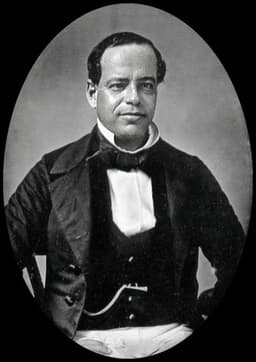
Antonio Lopez de Santa Anna
General · Modern
58.9Total
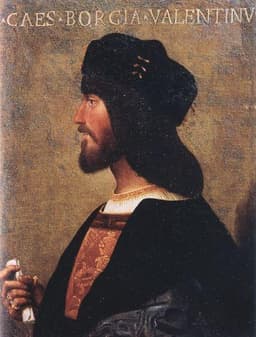
Cesare Borgia
General · Medieval
60.2Total
Basic Information
Born
1794
1475
Died
1876
1507
Era
Modern
Medieval
Nationality
Mexico
Italy
Occupation
General
General
Civilization
Western
Western
Score Comparison
Military (10%)
70.0
67.5
Political (20%)
46.6
68.0
Influence (20%)
56.7
68.0
Legacy (20%)
58.0
40.0
Leadership (15%)
68.0
64.0
Strategy (15%)
60.0
66.3
TOTAL
58.9
60.2
Antonio Lopez de Santa Anna — Complete Timeline
1823 AD
Led the Plan of Casa Mata rebellionPolitical Action
Santa Anna, then a general, issued the Plan of Casa Mata on February 1, 1823, calling for the overthrow of Emperor Agust
RebellionOverthrowRepublic
Impact: nationalconstructive
1829 AD
Defended Mexico at the Battle of TampicoWar◆ Major
Santa Anna commanded Mexican forces that defeated a Spanish invasion force at Tampico on September 11, 1829. The victory ended Spain's last attempt to reconquer Mexico and made Santa Anna a national hero. He was hailed as the 'Hero of Tampico' and used this fame to advance politically.
VictorySpanish InvasionNational Hero
Impact: nationalconstructive
1833 AD
Became President of Mexico for the first timePolitical Action◆ Major
Santa Anna was elected President of Mexico in 1833. He quickly delegated power to Vice President Valent
PresidencyPolitical InstabilityPower
Impact: national
1836 AD
Commanded at the Siege of the AlamoWar◆ Major
Santa Anna personally led the Mexican army in the siege of the Alamo mission in San Antonio, Texas. After a 13-day siege, Mexican forces stormed the fort on March 6, 1836, killing all 180-250 Texan defenders. The battle became a symbol of Texan resistance and a rallying cry for independence.
BattleTexas RevolutionAlamo
Impact: regionaldestructive
Defeated and captured at the Battle of San JacintoWar
Santa Anna's army was surprised and routed by Texan forces under Sam Houston at the Battle of San Jacinto on April 21, 1836. Santa Anna was captured the next day. He was forced to sign the Treaties of Velasco, recognizing Texan independence, though Mexico later repudiated them.
DefeatCaptureTexas Independence
Impact: regionaltragic
1847 AD
Lost the Mexican-American WarWar
Santa Anna returned from exile to command Mexican forces during the Mexican-American War. Despite initial efforts, his army was defeated at the Battle of Cerro Gordo and later at the Battle of Chapultepec. US forces captured Mexico City on September 14, 1847, leading to the Treaty of Guadalupe Hidalgo and massive territorial losses.
Mexican-American WarDefeatTerritorial Loss
Impact: globaltragic
1853 AD
Sold La Mesilla to the United StatesPolitical Action◆ Major
During his final presidency, Santa Anna agreed to the Gadsden Purchase, selling 29,670 square miles of territory (La Mesilla) to the United States for $10 million. The sale was widely condemned in Mexico as a betrayal. This act further damaged his reputation and led to his overthrow.
Territorial CessionGadsden PurchaseBetrayal
Impact: nationaldestructive
1855 AD
Overthrown and exiled for the final timePolitical Action◆ Major
The Plan of Ayutla, led by Juan
OverthrowExileEnd of Career
Impact: nationaltragic
Cesare Borgia — Complete Timeline
1493 AD
Appointment as CardinalPolitical Action◆ Major
Cesare Borgia was appointed cardinal by his father, Pope Alexander VI. This position gave him significant power within the Church and access to papal resources. He used his cardinalate to advance his family's political interests in Italy.
CardinalNepotismPapacy
Impact: regional
1498 AD
Resignation from the CardinalatePolitical Action◆ Major
Cesare Borgia resigned as cardinal to pursue a military and political career. He became the first person to voluntarily leave the College of Cardinals. This move allowed him to focus on conquering territories in the Romagna region of Italy.
ResignationMilitaryRomagna
Impact: regional
1499 AD
Conquest of the RomagnaWar◆ Major
Cesare Borgia, with French support, launched a campaign to conquer the cities of the Romagna. He captured Imola, Forl
ConquestRomagnaMachiavelli
Impact: regional
1503 AD
Fall from PowerPolitical Action
After the death of Pope Alexander VI, Cesare Borgia lost his political support. He was captured by his enemies and imprisoned in Spain. His territories in Italy quickly collapsed. This sudden fall demonstrated the fragility of his power base.
FallImprisonmentCollapse
Impact: regionaltragic
1507 AD
Death in BattleWar
Cesare Borgia was killed in a skirmish near Viana, Navarre, while serving as a mercenary captain. His death ended any chance of restoring his former power. He died at age 31, having failed to regain his Italian territories.
DeathMercenaryNavarre
tragic
Expert Analysis
Antonio Lopez de Santa Anna vs Cesare Borgia
# The General and the Prince
On a dusty April afternoon in 1836, Antonio López de Santa Anna stood in the shadow of the Alamo’s broken walls, a conqueror surveying his bloody victory. Just over three centuries earlier, another ambitious young man might have looked upon a conquered Italian city with the same cold satisfaction. Cesare Borgia, born into the corruption of Renaissance Rome, had crushed his enemies with a precision that would make Machiavelli weep with admiration. Yet one of these men would be remembered as a brilliant failure, the other as a cautionary tale. What separated them was not merely luck, but the deep currents of history that shaped their souls.
Origins
Santa Anna was born in 1794 in Jalapa, Mexico, into a respectable but not wealthy Spanish colonial family. His world was one of rigid hierarchy, where the Church and Crown held absolute sway, and where a young man’s path to power lay through the military. The son of a minor bureaucrat, he absorbed the volatile politics of New Spain’s twilight years—a society trembling on the edge of revolution. By contrast, Cesare Borgia entered the world in 1475 as the second son of Cardinal Rodrigo Borgia, later Pope Alexander VI. His Italy was a patchwork of warring city-states, where the papacy itself was a political prize, and where a Borgia could rise only by cunning, ruthlessness, and the complete absence of scruple. Santa Anna learned to navigate a crumbling empire; Borgia was born into a family that was building one.
Rise to Power
Santa Anna’s ascent began not with a throne but with a rebellion. In 1823, he issued the Plan of Casa Mata, a political manifesto that helped overthrow Emperor Agustín de Iturbide. This was classic Santa Anna—switching sides at precisely the right moment, presenting himself as the champion of the people while securing his own advancement. He was a master of the political pivot, a man who understood that in Mexico’s chaotic post-independence landscape, loyalty was a commodity to be traded, not a virtue to be kept.
Cesare Borgia’s rise was more direct, more brutal, and more dependent on blood. Appointed cardinal in 1493 at age eighteen, he wielded the Church’s immense power as his father’s instrument. But in 1498, he did the unthinkable: he resigned the cardinalate, the first man ever to do so voluntarily. He wanted a sword, not a scepter. With French backing, he launched his campaign to conquer the Romagna in 1499, capturing cities like Imola and Forlì with a terrifying efficiency that made Machiavelli take notes. Santa Anna rose by opportunism; Borgia rose by design.
Leadership & Governance
As a ruler, Santa Anna was a chameleon. He became president of Mexico for the first time in 1833, promptly handed power to his vice president, and then returned to reclaim it when convenient. He governed through charisma and spectacle—the “Hero of Tampico” who had repelled a Spanish invasion in 1829, the man who could rally a nation with a speech. But his military strategy was fatally flawed. At the Alamo in 1836, he won a costly victory, but his arrogance led to disaster at San Jacinto, where Sam Houston’s Texans captured him while he napped. He sold Mexican territory in the Gadsden Purchase of 1853, trading land for personal power. He was a general who could win battles but never wars.
Cesare Borgia governed differently. He understood that cruelty, when used efficiently, could be a tool of order. Machiavelli admired how Borgia had his brutal lieutenant Remirro de Orco executed and displayed in the town square of Cesena—a shocking act that simultaneously eliminated a liability and terrified the populace into submission. Borgia’s military strategy, with a score of 72.0, was superior to Santa Anna’s 59.4. He conquered the Romagna not by overwhelming force but by calculated terror, alliances, and the systematic elimination of rivals. Yet his political score of 54.0 lagged behind Santa Anna’s 81.1—because Borgia’s power depended entirely on his father’s life.
Triumph & Tragedy
Santa Anna’s greatest moment was the Battle of Tampico in 1829, where he crushed a Spanish attempt to reconquer Mexico. He was hailed as the savior of the nation. His greatest tragedy was the Mexican-American War of 1847, where his return from exile ended in ignominious defeat, the loss of half Mexico’s territory, and his final exile in 1855 after the Plan of Ayutla overthrew his dictatorship. He died in 1876, poor and forgotten, a man who had ruled Mexico six times and lost it all.
Cesare Borgia’s triumph was the Romagna itself—a unified territory under his iron hand, a model of Renaissance statecraft. His tragedy came with the death of Pope Alexander VI in 1503. Without his father’s protection, Borgia’s enemies closed in. He was captured, imprisoned, and eventually killed in a skirmish near Viana, Navarre, in 1507, at age thirty-one. He had built a kingdom on sand, and the tide washed it away.
Character & Destiny
Santa Anna was a man of immense charm and no principles. He loved power more than country, and his decisions—switching sides, selling territory, abandoning his people—reflected a man who saw politics as theater. He was a performer, not a builder. His personality shaped a destiny of repeated rises and falls, each more dramatic than the last.
Borgia was colder, more calculating. He was the prince that Machiavelli would later immortalize—a man who understood that it is better to be feared than loved, and who acted accordingly. But his destiny was shaped by a fatal dependence on his father’s papacy. Without that foundation, his entire edifice crumbled. Santa Anna’s flaw was his lack of vision; Borgia’s was his reliance on a single source of power.
Legacy
Santa Anna is remembered in Mexico as a traitor and a buffoon. His name is synonymous with corruption, incompetence, and national humiliation. The Alamo may be a shrine in Texas, but in Mexico, it is a wound. His legacy score of 65.2 reflects a man who lost more than he gained.
Cesare Borgia’s legacy is more complex. Machiavelli’s *The Prince* used him as a model of ruthless statecraft, and his influence score of 67.0 reflects that. But he also remains a symbol of Renaissance corruption—the Borgia pope’s son who killed, betrayed, and schemed his way to temporary power. His legacy score of 60.0 is lower, but his shadow looms larger in the imagination. He died young, but he became a myth.
Conclusion
Standing at the Alamo, Santa Anna believed he had crushed a rebellion. He did not understand that he had created a legend. Cesare Borgia, surveying his conquered Romagna, believed he had built a state. He did not understand that he had built a lesson. Both men were products of their times—Santa Anna of a fragile new nation struggling to find itself, Borgia of a Renaissance world where power was the only morality. One lived too long and lost everything; the other died too young and became immortal. In the end, history judges not by victories but by what those victories reveal about the human hunger for power, and the price it exacts.
Rankings
🥇
Cesare BorgiaLeader
Mil: 67.5Pol: 68.0Inf: 68.0
60.2
🥈
Antonio Lopez de Santa Anna
Mil: 70.0Pol: 46.6Inf: 56.7
58.9
+1.3 behind
How This Comparison Works
Algorithm
Each figure is scored on 6 dimensions (0—100 scale) based on structured historical data: Military (10%), Political (20%), Influence (20%), Legacy (20%), Leadership (15%), Strategy (15%). The weighted total produces the final ranking.
Data Sources
Scores are computed from structured sub-indicators in the database. Scale factors adjust for era (Ancient ×0.85, Modern ×1.0) and civilization size (Eastern ×1.05, Other ×0.80) to account for differences in population and military scale.
Maximum 3 Figures
Comparisons are limited to 2—3 figures to ensure readability and statistical meaningfulness.
Error Margins
±5 points per dimension — Sub-scores are derived from historical records with inherent uncertainty. Two figures within 5 points on a dimension should be considered roughly equivalent in that area.
Total Score Accuracy
±3 points overall — The weighted combination of 6 dimensions produces a total score with approximately ±3 points of uncertainty. Differences of less than 3 points are not statistically significant— the figures are effectively tied.
Known Limitations
- Historical records are incomplete and uneven across civilizations
- Figures from oral-tradition societies may be underrepresented
- Occupation labels can misclassify multi-role figures
- Scores measure capability and impact, not moral character
- Quantitative scoring is a comparison tool, not absolute truth
Capability Radar
Military (10%) — Battles & Warfare
Battles
65
55
Win Rate
40
60
Expansion
50
55
Political (20%) — Governance & Reform
Reform
20
40
Diplomacy
35
55
Economy
15
35
Influence (20%) — Cultural & Global Reach
Cultural
55
55
Global
50
60
Legacy (20%) — Historical Impact
Historical
60
70
Longevity
55
65
Leadership (15%) — Power & Stability
Tenure
75
45
Stability
10
30
Strategy (15%) — Tactics & Innovation
Strategy
45
60
Tactics
60
65
Reform
30
50
Similar Comparisons
Comments & Discussion
No comments yet. Be the first to share your thoughts!