Loading...
Antonio Lopez de Santa Anna vs Bayinnaung
Bayinnaung leads by 9.7 pts · 2 figures compared
…
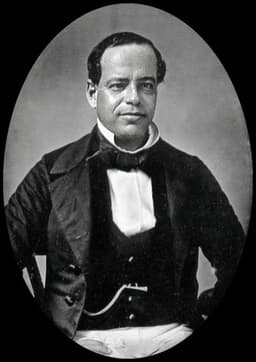
Antonio Lopez de Santa Anna
General · Modern
58.9Total
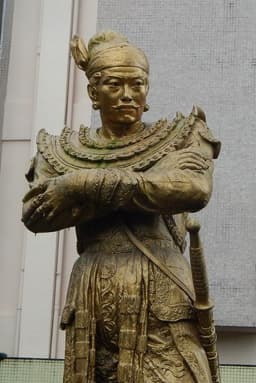
Bayinnaung
Emperor · Modern
68.6Total
Basic Information
Born
1794
1516
Died
1876
1581
Era
Modern
Modern
Nationality
Mexico
Myanmar
Occupation
General
Emperor
Civilization
Western
Eastern
Score Comparison
Military (10%)
70.0
77.1
Political (20%)
46.6
82.0
Influence (20%)
56.7
65.0
Legacy (20%)
58.0
55.0
Leadership (15%)
68.0
74.0
Strategy (15%)
60.0
75.0
TOTAL
58.9
68.6
Antonio Lopez de Santa Anna — Complete Timeline
1823 AD
Led the Plan of Casa Mata rebellionPolitical Action
Santa Anna, then a general, issued the Plan of Casa Mata on February 1, 1823, calling for the overthrow of Emperor Agust
RebellionOverthrowRepublic
Impact: nationalconstructive
1829 AD
Defended Mexico at the Battle of TampicoWar◆ Major
Santa Anna commanded Mexican forces that defeated a Spanish invasion force at Tampico on September 11, 1829. The victory ended Spain's last attempt to reconquer Mexico and made Santa Anna a national hero. He was hailed as the 'Hero of Tampico' and used this fame to advance politically.
VictorySpanish InvasionNational Hero
Impact: nationalconstructive
1833 AD
Became President of Mexico for the first timePolitical Action◆ Major
Santa Anna was elected President of Mexico in 1833. He quickly delegated power to Vice President Valent
PresidencyPolitical InstabilityPower
Impact: national
1836 AD
Commanded at the Siege of the AlamoWar◆ Major
Santa Anna personally led the Mexican army in the siege of the Alamo mission in San Antonio, Texas. After a 13-day siege, Mexican forces stormed the fort on March 6, 1836, killing all 180-250 Texan defenders. The battle became a symbol of Texan resistance and a rallying cry for independence.
BattleTexas RevolutionAlamo
Impact: regionaldestructive
Defeated and captured at the Battle of San JacintoWar
Santa Anna's army was surprised and routed by Texan forces under Sam Houston at the Battle of San Jacinto on April 21, 1836. Santa Anna was captured the next day. He was forced to sign the Treaties of Velasco, recognizing Texan independence, though Mexico later repudiated them.
DefeatCaptureTexas Independence
Impact: regionaltragic
1847 AD
Lost the Mexican-American WarWar
Santa Anna returned from exile to command Mexican forces during the Mexican-American War. Despite initial efforts, his army was defeated at the Battle of Cerro Gordo and later at the Battle of Chapultepec. US forces captured Mexico City on September 14, 1847, leading to the Treaty of Guadalupe Hidalgo and massive territorial losses.
Mexican-American WarDefeatTerritorial Loss
Impact: globaltragic
1853 AD
Sold La Mesilla to the United StatesPolitical Action◆ Major
During his final presidency, Santa Anna agreed to the Gadsden Purchase, selling 29,670 square miles of territory (La Mesilla) to the United States for $10 million. The sale was widely condemned in Mexico as a betrayal. This act further damaged his reputation and led to his overthrow.
Territorial CessionGadsden PurchaseBetrayal
Impact: nationaldestructive
1855 AD
Overthrown and exiled for the final timePolitical Action◆ Major
The Plan of Ayutla, led by Juan
OverthrowExileEnd of Career
Impact: nationaltragic
Bayinnaung — Complete Timeline
1550 AD
Establishment of the Toungoo EmpirePolitical Action
King Bayinnaung ascended the throne and began a series of military campaigns that created the largest empire in Southeast Asian history. At its peak, the Toungoo empire covered modern Myanmar, Thailand, Laos, and parts of China and India.
Toungoo EmpireSoutheast AsiaImperial Expansion
Impact: regionalconstructive
1557 AD
Conquest of the Shan StatesWar◆ Major
King Bayinnaung conquered the Shan States, bringing them under Toungoo control. This expansion added significant territory and resources to the Burmese empire.
Shan StatesToungoo ExpansionBurmese Empire
Impact: regional
1569 AD
Capture of AyutthayaWar
King Bayinnaung's forces captured the Siamese capital of Ayutthaya after a long siege. He installed a vassal king and made Siam a tributary state of the Toungoo empire.
Burmese-Siamese WarAyutthayaToungoo Empire
Impact: regional
1570 AD
Administrative ReformsReform◆ Major
King Bayinnaung implemented administrative reforms to govern his vast empire, including the appointment of governors and the standardization of laws and taxes. These reforms helped maintain control over conquered territories.
GovernanceAdministrationToungoo Empire
Impact: regionalconstructive
1574 AD
Conquest of Lan XangWar◆ Major
King Bayinnaung conquered the Lao kingdom of Lan Xang (modern Laos), bringing it under Toungoo control. This further expanded the Burmese empire to its greatest territorial extent.
Lan XangToungoo ExpansionLaos
Impact: regional
Expert Analysis
Antonio Lopez de Santa Anna vs Bayinnaung
# The Emperor and the Opportunist: Bayinnaung and Santa Anna, Two Paths to Power
In 1569, the Siamese capital of Ayutthaya fell after a brutal siege. Its king was led in chains before a conqueror whose empire now stretched from the Bay of Bengal to the Mekong River. Two hundred and sixty-seven years later, in 1836, another general stood triumphant before the smoldering ruins of the Alamo, believing he had crushed a rebellion for good. One man would die in bed, his empire intact, his name revered for centuries. The other would see his nation halved, his reputation shredded, and his final years spent in penniless exile. What separated Bayinnaung of Burma from Antonio López de Santa Anna of Mexico was not merely luck—it was the difference between building something lasting and merely holding onto power.
Origins
Bayinnaung was born in 1516 to a minor noble family in the Toungoo region of Burma. His world was one of fragmented kingdoms and constant warfare, where the great Burmese empire of Pagan had long since crumbled. He grew up in the shadow of his childhood friend and future king, Tabinshwehti, learning the arts of war and statecraft in a court that valued loyalty above all. His era demanded empire-builders, and he absorbed that calling like air.
Santa Anna, born in 1794 in Jalapa, Mexico, came of age in a different kind of chaos. The Spanish Empire was collapsing, and Mexico was a newborn republic trying to find its footing. His father was a minor Spanish colonial official, his mother a criolla—a class that resented Spanish rule but feared the masses below them. Santa Anna learned early that in a world of coups and constitutions, the man who could seize the moment could seize the country.
Rise to Power
Bayinnaung’s path was forged in war and friendship. When Tabinshwehti became king in 1530, Bayinnaung served as his most trusted general, leading campaigns that reunited the Irrawaddy Valley. He was the architect of victory, the man who made the king’s ambitions real. When Tabinshwehti was assassinated in 1550, Bayinnaung did not hesitate. He crushed the rebels, executed the plotters, and ascended the throne not as a usurper but as the rightful successor to a vision they had shared.
Santa Anna’s rise was swifter and more cynical. In 1823, he issued the Plan of Casa Mata, turning against Emperor Agustín de Iturbide—the very man he had helped to power. The rebellion succeeded, and Santa Anna became a hero of the republic. But where Bayinnaung had a kingdom to build, Santa Anna had a system to manipulate. He would switch sides, switch ideologies, and switch allegiances with a flexibility that amazed even his enemies.
Leadership & Governance
Bayinnaung ruled with the patience of a statesman and the precision of a general. After conquering the Shan States in 1557, he did not simply impose Burmese governors. He appointed local chiefs as vassals, married Shan princesses, and allowed Buddhist monasteries to flourish across his domain. His administrative reforms of 1570 created a system of appointed governors and standardized taxes that held his empire together without constant bloodshed. When he captured Ayutthaya in 1569, he installed a vassal king and demanded tribute, but he did not destroy the Siamese identity. He understood that an empire built on fear alone would crumble the moment he turned his back.
Santa Anna governed as he fought—with flair, impulsiveness, and a desperate need for adulation. He became president in 1833 but quickly handed power to his vice president, preferring the battlefield to the bureaucracy. He returned to office repeatedly, each time promising stability, each time delivering chaos. He sold Mexican territory in the Gadsden Purchase of 1853 for $10 million, a decision that still stings in Mexican memory. He had no administrative reforms, no long-term vision—only the endless pursuit of personal glory.
Triumph & Tragedy
Bayinnaung’s greatest triumph was the conquest of Lan Xang in 1574, which brought modern Laos under his control and completed the largest empire Southeast Asia had ever seen. His tragedy was that this empire depended on his personal authority. The moment he died in 1581, the vassal kings began to slip away, and within decades, the empire had fractured. He had built a colossus, but he had not built the institutions to sustain it.
Santa Anna’s triumph was the Battle of Tampico in 1829, where he defeated a Spanish invasion and became the “Hero of Tampico.” His tragedy was the Battle of San Jacinto in 1836, where he was captured while napping, forced to sign away Texas, and never recovered his reputation. The Mexican-American War of 1847 compounded the disaster, as his mismanagement and political infighting led to the loss of half of Mexico’s territory. He was overthrown for the final time in 1855, fleeing to Cuba in disguise.
Character & Destiny
Bayinnaung was driven by duty and ambition in equal measure. His personality was steady, his decisions deliberate. He believed in the empire he was building and the Buddhist values that underpinned it. He was not cruel without purpose, nor merciful without calculation. His character shaped his destiny: he died at the height of his power, respected and feared.
Santa Anna was driven by vanity and opportunism. He styled himself the “Napoleon of the West,” wore extravagant uniforms, and demanded to be called “His Most Serene Highness.” He trusted no one and was trusted by no one. His character shaped his destiny: he died in 1876, poor and forgotten, a cautionary tale of what happens when ambition has no anchor.
Legacy
Bayinnaung is remembered as Burma’s greatest king, a unifier who gave his people a moment of dominance they had never known and would never know again. His statues stand in Myanmar, and his name is spoken with reverence. His legacy is a question: what does it mean to build an empire that cannot survive its founder?
Santa Anna is remembered as the man who lost Texas, who sold Mexican land, who led his country to ruin. His name is a curse in Mexican history, a symbol of betrayal and incompetence. His legacy is a warning: that leadership without principle is not leadership at all.
Conclusion
Both men rose from modest beginnings to command vast armies and shape the destinies of millions. Bayinnaung built an empire that defined an era; Santa Anna dismantled one that could have defined a nation. The difference was not in their ambition but in their purpose. Bayinnaung wanted to create something greater than himself. Santa Anna wanted only to be greater than everyone else. In the end, one became a legend; the other became a lesson. History, as always, had the final word.
Rankings
🥇
BayinnaungLeader
Mil: 77.1Pol: 82.0Inf: 65.0
68.6
🥈
Antonio Lopez de Santa Anna
Mil: 70.0Pol: 46.6Inf: 56.7
58.9
+9.7 behind
How This Comparison Works
Algorithm
Each figure is scored on 6 dimensions (0—100 scale) based on structured historical data: Military (10%), Political (20%), Influence (20%), Legacy (20%), Leadership (15%), Strategy (15%). The weighted total produces the final ranking.
Data Sources
Scores are computed from structured sub-indicators in the database. Scale factors adjust for era (Ancient ×0.85, Modern ×1.0) and civilization size (Eastern ×1.05, Other ×0.80) to account for differences in population and military scale.
Maximum 3 Figures
Comparisons are limited to 2—3 figures to ensure readability and statistical meaningfulness.
Error Margins
±5 points per dimension — Sub-scores are derived from historical records with inherent uncertainty. Two figures within 5 points on a dimension should be considered roughly equivalent in that area.
Total Score Accuracy
±3 points overall — The weighted combination of 6 dimensions produces a total score with approximately ±3 points of uncertainty. Differences of less than 3 points are not statistically significant— the figures are effectively tied.
Known Limitations
- Historical records are incomplete and uneven across civilizations
- Figures from oral-tradition societies may be underrepresented
- Occupation labels can misclassify multi-role figures
- Scores measure capability and impact, not moral character
- Quantitative scoring is a comparison tool, not absolute truth
Capability Radar
Military (10%) — Battles & Warfare
Battles
65
85
Win Rate
40
90
Expansion
50
92
Political (20%) — Governance & Reform
Reform
20
70
Diplomacy
35
78
Economy
15
72
Influence (20%) — Cultural & Global Reach
Cultural
55
70
Global
50
55
Legacy (20%) — Historical Impact
Historical
60
75
Longevity
55
60
Leadership (15%) — Power & Stability
Tenure
75
85
Stability
10
65
Strategy (15%) — Tactics & Innovation
Strategy
45
88
Tactics
60
80
Reform
30
75
Similar Comparisons
Comments & Discussion
Chronicler13386/16/2026
Let's be real: comparing Santa Anna to Bayinnaung is like comparing a used chariot salesman to a war elephant. Bayinnaung built an empire that lasted, uniting fragmented kingdoms with actual strategy. Santa Anna lost half of Mexico's territory while wearing flashy uniforms. One man had vision; the other had theatricality. Bayinnaung conquered Ayutthaya in 1569—Santa Anna couldn't even hold Texas. Context matters, and Santa Anna's legacy is a cautionary tale of ego over empire.