Loading...
This comparison has not been analyzed yet.
One-time AI generation (~1 minute). Scores and timeline are already available below.
Andrew Moray vs Cesare Borgia
Cesare Borgia leads by 17.6 pts · 2 figures compared
…

Andrew Moray
General · Medieval
42.6Total
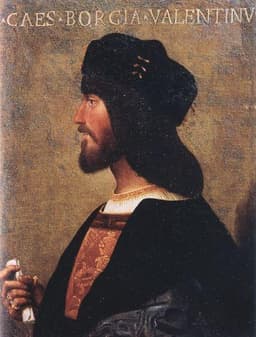
Cesare Borgia
General · Medieval
60.2Total
Basic Information
Born
1265
1475
Died
1297
1507
Era
Medieval
Medieval
Nationality
Scotland
Italy
Occupation
General
General
Civilization
Western
Western
Score Comparison
Military (10%)
25.0
67.5
Political (20%)
35.0
68.0
Influence (20%)
44.0
68.0
Legacy (20%)
40.0
40.0
Leadership (15%)
57.1
64.0
Strategy (15%)
52.5
66.3
TOTAL
42.6
60.2
Andrew Moray — Complete Timeline
1297 AD
Battle of Stirling BridgeWar
Andrew Moray co-commanded the Scottish army with William Wallace at Stirling Bridge. The Scottish forces defeated a larger English army under John de Warenne, killing Hugh de Cressingham. Moray was mortally wounded during the battle.
Scottish Wars of IndependenceBattleVictory
Impact: national
Cesare Borgia — Complete Timeline
1493 AD
Appointment as CardinalPolitical Action◆ Major
Cesare Borgia was appointed cardinal by his father, Pope Alexander VI. This position gave him significant power within the Church and access to papal resources. He used his cardinalate to advance his family's political interests in Italy.
CardinalNepotismPapacy
Impact: regional
1498 AD
Resignation from the CardinalatePolitical Action◆ Major
Cesare Borgia resigned as cardinal to pursue a military and political career. He became the first person to voluntarily leave the College of Cardinals. This move allowed him to focus on conquering territories in the Romagna region of Italy.
ResignationMilitaryRomagna
Impact: regional
1499 AD
Conquest of the RomagnaWar◆ Major
Cesare Borgia, with French support, launched a campaign to conquer the cities of the Romagna. He captured Imola, Forl
ConquestRomagnaMachiavelli
Impact: regional
1503 AD
Fall from PowerPolitical Action
After the death of Pope Alexander VI, Cesare Borgia lost his political support. He was captured by his enemies and imprisoned in Spain. His territories in Italy quickly collapsed. This sudden fall demonstrated the fragility of his power base.
FallImprisonmentCollapse
Impact: regionaltragic
1507 AD
Death in BattleWar
Cesare Borgia was killed in a skirmish near Viana, Navarre, while serving as a mercenary captain. His death ended any chance of restoring his former power. He died at age 31, having failed to regain his Italian territories.
DeathMercenaryNavarre
tragic
This comparison has not been analyzed yet.
One-time AI generation (~1 minute). Scores and timeline are already available below.
Rankings
🥇
Cesare BorgiaLeader
Mil: 67.5Pol: 68.0Inf: 68.0
60.2
🥈
Andrew Moray
Mil: 25.0Pol: 35.0Inf: 44.0
42.6
+17.6 behind
How This Comparison Works
Algorithm
Each figure is scored on 6 dimensions (0—100 scale) based on structured historical data: Military (10%), Political (20%), Influence (20%), Legacy (20%), Leadership (15%), Strategy (15%). The weighted total produces the final ranking.
Data Sources
Scores are computed from structured sub-indicators in the database. Scale factors adjust for era (Ancient ×0.85, Modern ×1.0) and civilization size (Eastern ×1.05, Other ×0.80) to account for differences in population and military scale.
Maximum 3 Figures
Comparisons are limited to 2—3 figures to ensure readability and statistical meaningfulness.
Error Margins
±5 points per dimension — Sub-scores are derived from historical records with inherent uncertainty. Two figures within 5 points on a dimension should be considered roughly equivalent in that area.
Total Score Accuracy
±3 points overall — The weighted combination of 6 dimensions produces a total score with approximately ±3 points of uncertainty. Differences of less than 3 points are not statistically significant— the figures are effectively tied.
Known Limitations
- Historical records are incomplete and uneven across civilizations
- Figures from oral-tradition societies may be underrepresented
- Occupation labels can misclassify multi-role figures
- Scores measure capability and impact, not moral character
- Quantitative scoring is a comparison tool, not absolute truth
Capability Radar
Military (10%) — Battles & Warfare
Battles
15
55
Win Rate
60
60
Expansion
10
55
Political (20%) — Governance & Reform
Reform
5
40
Diplomacy
10
55
Economy
5
35
Influence (20%) — Cultural & Global Reach
Cultural
20
55
Global
10
60
Legacy (20%) — Historical Impact
Historical
40
70
Longevity
30
65
Leadership (15%) — Power & Stability
Tenure
10
45
Stability
5
30
Strategy (15%) — Tactics & Innovation
Strategy
50
60
Tactics
65
65
Reform
10
50
Similar Comparisons
Comments & Discussion
No comments yet. Be the first to share your thoughts!