Loading...
Andres de Santa Cruz vs Tadeusz Kosciuszko
Tadeusz Kosciuszko leads by 3.6 pts · 2 figures compared
…
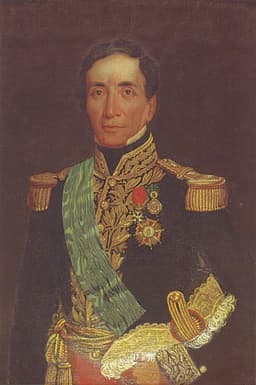
Andres de Santa Cruz
General · Modern
60.5Total
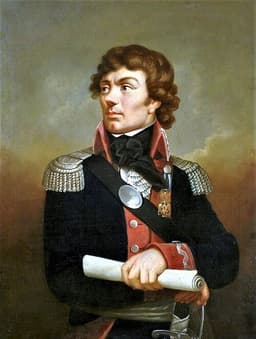
Tadeusz Kosciuszko
General · Modern
64.1Total
Basic Information
Born
1792
1746
Died
1865
1817
Era
Modern
Modern
Nationality
Bolivia
Poland
Occupation
General
General
Civilization
Western
Western
Score Comparison
Military (10%)
67.5
47.5
Political (20%)
59.3
68.0
Influence (20%)
62.0
68.0
Legacy (20%)
50.0
68.0
Leadership (15%)
68.0
64.5
Strategy (15%)
66.3
55.0
TOTAL
60.5
64.1
Andres de Santa Cruz — Complete Timeline
1823 AD
Battle of ZepitaWar
Santa Cruz commanded Peruvian forces in a victory over Spanish royalists at Zepita during the Peruvian War of Independence. This battle enhanced his military reputation and contributed to the eventual liberation of Peru from Spanish rule.
Peruvian War of IndependenceBattleLiberation
Impact: regional
1826 AD
Presidency of PeruPolitical Action
Santa Cruz served as President of the Council of Government of Peru from 1826 to 1827, effectively ruling the country. His administration focused on centralizing power and organizing the state, but he was overthrown by a rebellion led by Agust
PresidencyPeruCentralization
Impact: national
1829 AD
Presidency of BoliviaPolitical Action◆ Major
Santa Cruz became President of Bolivia in 1829, serving until 1839. He implemented administrative reforms, stabilized the economy, and modernized the military, establishing Bolivia as a more coherent state after the chaos following independence.
PresidencyBoliviaReforms
Impact: nationalconstructive
1836 AD
War of the ConfederationWar◆ Major
Chile and Argentina declared war on the Peru-Bolivia Confederation, viewing it as a threat to the balance of power. Santa Cruz led the confederation's forces in a conflict that lasted until 1839, ultimately resulting in the confederation's defeat.
WarChileArgentinaConfederation
Impact: regional
Creation of the Peru-Bolivia ConfederationPolitical Action
Santa Cruz established the Peru-Bolivia Confederation, uniting Bolivia and Peru into a single state with himself as Supreme Protector. This confederation aimed to create a powerful Andean nation and challenged the regional influence of Chile and Argentina.
ConfederationUnificationAndean Power
Impact: regional
1839 AD
Battle of YungayWar
Santa Cruz's confederation forces were decisively defeated by the Chilean army at the Battle of Yungay. This defeat led to the dissolution of the Peru-Bolivia Confederation and forced Santa Cruz into exile, ending his political project.
BattleDefeatEnd of Confederation
Impact: regionaltragic
Exile and DeathPolitical Action
After the defeat at Yungay, Santa Cruz fled to Ecuador and later to France. He spent the rest of his life in exile, making unsuccessful attempts to return to power. He died in France in 1865, never regaining his former influence.
ExileDeathFailure
Impact: nationaltragic
Tadeusz Kosciuszko — Complete Timeline
1777 AD
Battle of Saratoga (engineering contributions)War◆ Major
Kosciuszko designed fortifications and selected defensive positions for the American army at Saratoga. His work contributed to the American victory, a turning point in the Revolutionary War.
American RevolutionSaratogaEngineering
Impact: regional
1778 AD
Fortification of West PointWar◆ Major
Kosciuszko was assigned to fortify West Point on the Hudson River. He designed and supervised the construction of fortifications that made the site a key American stronghold for the remainder of the war.
American RevolutionWest PointFortifications
Impact: regionalconstructive
1794 AD
Kosciuszko UprisingWar
Kosciuszko led a national uprising in Poland against Russian and Prussian occupation. He proclaimed the Act of Insurrection and won the Battle of Rac
Polish UprisingIndependenceDefeat
Impact: nationaltragic
Battle of RacławiceWar◆ Major
Kosciuszko led Polish forces, including peasant scythemen, to victory over a larger Russian army at Rac
Kosciuszko UprisingBattlePeasants
Impact: national
Capture and imprisonment at the Battle of MaciejowiceWar◆ Major
Kosciuszko was wounded and captured by Russian forces at the Battle of Maciejowice. His capture effectively ended the uprising, and he was imprisoned in St. Petersburg until 1796.
Kosciuszko UprisingCaptureImprisonment
Impact: nationaltragic
Expert Analysis
Andres de Santa Cruz vs Tadeusz Kosciuszko
### The General Who Built a Nation, and the General Who Dreamed of One
In the winter of 1777, a Polish engineer with a quiet demeanor and a genius for earthworks stood on a hillside overlooking the Hudson River. He had chosen the ground for the American army at Saratoga, and his fortifications would soon help turn the tide of a revolution. Twenty years later and half a world away, a mestizo general from the high Andes would unite two countries under one flag, only to see his confederation shattered by a single battle. Tadeusz Kosciuszko and Andrés de Santa Cruz both wielded swords for independence, but their paths diverged dramatically: one became the eternal symbol of a lost cause, the other the architect of a failed union. What drove these two men, and why did one leave a legacy of inspiration while the other left a lesson in overreach?
### Origins
Tadeusz Kosciuszko was born in 1746 into the minor nobility of the Polish-Lithuanian Commonwealth, a vast but decaying state that was being slowly devoured by its neighbors. He grew up in an atmosphere of fading grandeur and simmering resentment. Educated at the Royal Corps of Cadets in Warsaw, he absorbed Enlightenment ideals of liberty and republicanism, then traveled to France to study military engineering. When he arrived in America in 1776, he was a thirty-year-old stranger in a strange land, armed with technical skill and a burning belief that freedom was worth fighting for.
Andrés de Santa Cruz, born in 1792 in La Paz, Bolivia, came from a different world. His father was a Spanish colonial official, his mother a noblewoman of Quechua descent. The son of two cultures, Santa Cruz grew up fluent in both Spanish and indigenous languages, a man who straddled the racial divide of the Andes. The wars of independence against Spain broke out when he was in his twenties, and he joined the patriot cause not as an engineer but as a cavalry officer, learning war on horseback across the vast, unforgiving landscape of the altiplano.
### Rise to Power
Kosciuszko’s rise was slow and earned through sweat. In America, he did not command armies; he built fortifications. At Saratoga in 1777, his careful selection of defensive positions and his design of fieldworks allowed the American army to hold the British long enough for reinforcements to arrive, a victory that convinced France to enter the war. His greatest engineering achievement came in 1778, when he was assigned to fortify West Point, the fortress that would guard the Hudson River. He designed a system of batteries, redoubts, and chains that made the post nearly impregnable—a labor of months that he called “the key to America.”
Santa Cruz rose through politics as much as war. After commanding a victorious Peruvian force at the Battle of Zepita in 1823, he became President of Peru’s Council of Government in 1826, effectively ruling the country. But it was in Bolivia, where he became president in 1829, that he found his true stage. He stabilized the economy, reformed the administration, and built a disciplined army. By 1836, he had engineered the creation of the Peru-Bolivia Confederation, a single state uniting both nations under his rule as Supreme Protector.
### Leadership & Governance
Kosciuszko’s leadership was that of a republican idealist. When he returned to Poland in 1784, he found his homeland in crisis. In 1794, he launched the Kosciuszko Uprising, a desperate attempt to throw off Russian and Prussian occupation. He proclaimed the Act of Insurrection, calling for the abolition of serfdom and granting personal freedom to peasants. At the Battle of Racławice that year, he led a force that included peasants armed with scythes—the famous “scythemen”—to a stunning victory over a larger Russian army. It was a moment of pure, improbable glory. But he was a military engineer, not a political strategist. He could win battles but not a war.
Santa Cruz governed as a pragmatist and a unifier. As president of Bolivia, he built roads, reformed taxes, and centralized the state. His Peru-Bolivia Confederation was a bold geopolitical experiment, designed to create a powerful Andean state that could resist the ambitions of Chile and Argentina. He was a capable administrator and a skilled diplomat, but his vision was fragile. The confederation rested on his personal authority and the loyalty of his army, not on the consent of the people.
### Triumph & Tragedy
Kosciuszko’s triumph was Racławice, where his peasant army proved that courage could overcome numbers. His tragedy came at the Battle of Maciejowice later that year. Wounded and captured, he was thrown into a Russian prison. The uprising collapsed. He was eventually released, but he spent his final years in exile, refusing to accept any offer of pardon from the tsar. He died in 1817, a broken man who had seen his country erased from the map.
Santa Cruz’s triumph was the creation of the confederation itself, a political masterpiece that briefly made him the most powerful man in South America. His tragedy came at the Battle of Yungay in 1839, where the Chilean army decisively defeated his forces. The confederation dissolved overnight. Santa Cruz fled to Ecuador and then to France, spending the rest of his life in exile, writing memoirs and making futile attempts to return. He died in 1865, a forgotten figure in a foreign land.
### Character & Destiny
Kosciuszko was driven by principle. He believed in liberty for all men, including the serfs of Poland and the slaves of America—he left his American pension to free and educate slaves. His character was unyielding, his idealism absolute. That same rigidity made him a poor politician; he could not compromise with the Russian Empire or with his own nobility. His destiny was to be a martyr for a cause that would not be realized for another century.
Santa Cruz was driven by ambition and vision. He saw the Andes as a natural unit, a single civilization split by colonial borders. He was a pragmatist who understood power, but he underestimated the forces of nationalism and the resentment of his neighbors. His character was that of a builder, not a fighter; his confederation was a house of cards, and when it fell, he had no plan B. His destiny was to be a warning, not a model.
### Legacy
Kosciuszko is remembered as a hero in two nations. In Poland, he is a symbol of the struggle for independence, his name on streets and monuments. In the United States, he is honored as a founding engineer of the republic, with a bridge and a statue in his likeness. His scores—Military 79.2, Political 84.3, Influence 78.0—reflect a man who shaped history through his ideas and his sacrifices, not through conquest.
Santa Cruz is remembered as a controversial figure. In Bolivia, he is sometimes praised as a capable president who brought stability. In Peru, he is often reviled as a usurper. His scores—Military 60.2, Political 60.2, Influence 76.2—show a man of significant influence but limited strategic success. He is a footnote in the history of South America, a dreamer whose dream collapsed.
### Conclusion
Both Kosciuszko and Santa Cruz fought for unity—one for a free Poland, the other for a united Andes. Both were exiled, both died far from home, both saw their greatest works undone. But Kosciuszko’s failure was a seed planted for future generations, while Santa Cruz’s failure was a road not taken. One built fortifications that still stand; the other built a confederation that vanished. In the end, the difference is not in their talents, but in their timing. Kosciuszko fought for a nation that existed only in memory, and his sacrifice made it real again. Santa Cruz fought for a nation that existed only in his mind, and his ambition could not make it last. History rewards the martyr more than the architect, and the general who loses everything for a dream lives longer than the one who loses a dream for everything.
Rankings
🥇
Tadeusz KosciuszkoLeader
Mil: 47.5Pol: 68.0Inf: 68.0
64.1
🥈
Andres de Santa Cruz
Mil: 67.5Pol: 59.3Inf: 62.0
60.5
+3.6 behind
How This Comparison Works
Algorithm
Each figure is scored on 6 dimensions (0—100 scale) based on structured historical data: Military (10%), Political (20%), Influence (20%), Legacy (20%), Leadership (15%), Strategy (15%). The weighted total produces the final ranking.
Data Sources
Scores are computed from structured sub-indicators in the database. Scale factors adjust for era (Ancient ×0.85, Modern ×1.0) and civilization size (Eastern ×1.05, Other ×0.80) to account for differences in population and military scale.
Maximum 3 Figures
Comparisons are limited to 2—3 figures to ensure readability and statistical meaningfulness.
Error Margins
±5 points per dimension — Sub-scores are derived from historical records with inherent uncertainty. Two figures within 5 points on a dimension should be considered roughly equivalent in that area.
Total Score Accuracy
±3 points overall — The weighted combination of 6 dimensions produces a total score with approximately ±3 points of uncertainty. Differences of less than 3 points are not statistically significant— the figures are effectively tied.
Known Limitations
- Historical records are incomplete and uneven across civilizations
- Figures from oral-tradition societies may be underrepresented
- Occupation labels can misclassify multi-role figures
- Scores measure capability and impact, not moral character
- Quantitative scoring is a comparison tool, not absolute truth
Capability Radar
Military (10%) — Battles & Warfare
Battles
60
55
Win Rate
55
60
Expansion
55
30
Political (20%) — Governance & Reform
Reform
65
45
Diplomacy
60
55
Economy
55
35
Influence (20%) — Cultural & Global Reach
Cultural
45
65
Global
35
55
Legacy (20%) — Historical Impact
Historical
50
70
Longevity
40
60
Leadership (15%) — Power & Stability
Tenure
60
40
Stability
40
30
Strategy (15%) — Tactics & Innovation
Strategy
65
65
Tactics
60
70
Reform
50
50
Similar Comparisons
Comments & Discussion
VIENNA'S GHOST6/16/2026
The real difference here isn't talent—it's that Kosciuszko fought for a Poland that already existed in memory, while Santa Cruz tried to create Bolivia-Peru from scratch. Santa Cruz's failure at Yungay in 1839 proves that unions built on one man's ambition collapse faster than those born from shared identity. Kosciuszko's 1794 uprising, though doomed, tapped a deeper national wound that survived partitions. One remains a martyr; the other, a cautionary footnote.
La Paz's Last Inca6/16/2026
Santa Cruz had a coherent vision: uniting the mineral wealth of Bolivia with the Pacific access of Peru. His customs union and administrative reforms were ahead of their time. But he underestimated Chilean resentment and overestimated his army's loyalty. Kosciuszko, by contrast, never aimed for grand federations—he just knew how to dig trenches and inspire farmers to fight. One dreamed too big for his resources; the other made the most of what little he had.
砧板上的数学家6/16/2026
Santa Cruz的秘鲁-玻利维亚邦联本质上就是个经济实验,他搞统一关税、修公路、搞矿业改革,这些在当时南美都是超前的东西。但他偏偏忘了,智利人最恨的就是被卡住瓦尔帕莱索的贸易命脉。1839年Yungay一战,他的洋枪队连智利骑兵都没挡住。Kosciuszko就聪明多了,Maciejowice之战输得再惨也没人说他战略失误——他输在人数悬殊,不是脑子发热。
共和国的矿工6/16/2026
别把Kosciuszko捧成纯粹的理想主义者。他在美国修西点要塞时就知道咋选战场,回波兰后搞全民起义,连农民都发自由宣言。Santa Cruz呢?跟智利打Yungay战役前,他还指望英国调停呢——一个天天玩权术的总督,哪有Koszciuszko那种破釜沉舟的狠劲?前者靠算盘联盟,后者靠血肉之躯,历史不会原谅优柔寡断的人。
波兰的泥瓦匠6/16/2026
Kosciuszko最牛的地方不是萨拉托加,而是他在波兰起义时写的Połaniec宣言——取消农奴制、给农民土地。这在1794年的东欧简直是核弹级想法。Santa Cruz的邦联虽然统一了印加王冠和玻利瓦尔遗产,但本质上还是caudillos精英游戏。一个要改革社会结构,一个只想着换国旗。高下立判,不需要比战功。