Loading...
Andres de Santa Cruz vs Suharto
Andres de Santa Cruz leads by 3.3 pts · 2 figures compared
…
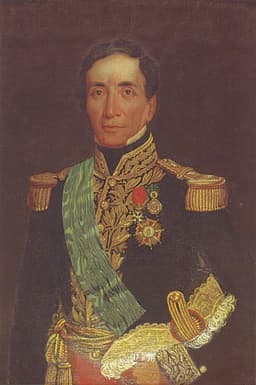
Andres de Santa Cruz
General · Modern
60.5Total
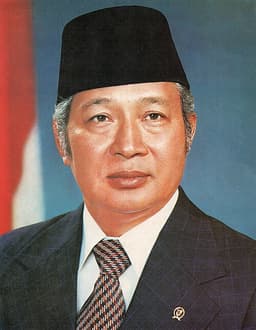
Suharto
General · Modern
57.2Total
Basic Information
Born
1792
1921
Died
1865
—
Era
Modern
Modern
Nationality
Bolivia
Indonesia
Occupation
General
General
Civilization
Western
Eastern
Score Comparison
Military (10%)
67.5
20.0
Political (20%)
59.3
59.3
Influence (20%)
62.0
60.0
Legacy (20%)
50.0
52.0
Leadership (15%)
68.0
82.0
Strategy (15%)
66.3
60.0
TOTAL
60.5
57.2
Andres de Santa Cruz — Complete Timeline
1823 AD
Battle of ZepitaWar
Santa Cruz commanded Peruvian forces in a victory over Spanish royalists at Zepita during the Peruvian War of Independence. This battle enhanced his military reputation and contributed to the eventual liberation of Peru from Spanish rule.
Peruvian War of IndependenceBattleLiberation
Impact: regional
1826 AD
Presidency of PeruPolitical Action
Santa Cruz served as President of the Council of Government of Peru from 1826 to 1827, effectively ruling the country. His administration focused on centralizing power and organizing the state, but he was overthrown by a rebellion led by Agust
PresidencyPeruCentralization
Impact: national
1829 AD
Presidency of BoliviaPolitical Action◆ Major
Santa Cruz became President of Bolivia in 1829, serving until 1839. He implemented administrative reforms, stabilized the economy, and modernized the military, establishing Bolivia as a more coherent state after the chaos following independence.
PresidencyBoliviaReforms
Impact: nationalconstructive
1836 AD
War of the ConfederationWar◆ Major
Chile and Argentina declared war on the Peru-Bolivia Confederation, viewing it as a threat to the balance of power. Santa Cruz led the confederation's forces in a conflict that lasted until 1839, ultimately resulting in the confederation's defeat.
WarChileArgentinaConfederation
Impact: regional
Creation of the Peru-Bolivia ConfederationPolitical Action
Santa Cruz established the Peru-Bolivia Confederation, uniting Bolivia and Peru into a single state with himself as Supreme Protector. This confederation aimed to create a powerful Andean nation and challenged the regional influence of Chile and Argentina.
ConfederationUnificationAndean Power
Impact: regional
1839 AD
Battle of YungayWar
Santa Cruz's confederation forces were decisively defeated by the Chilean army at the Battle of Yungay. This defeat led to the dissolution of the Peru-Bolivia Confederation and forced Santa Cruz into exile, ending his political project.
BattleDefeatEnd of Confederation
Impact: regionaltragic
Exile and DeathPolitical Action
After the defeat at Yungay, Santa Cruz fled to Ecuador and later to France. He spent the rest of his life in exile, making unsuccessful attempts to return to power. He died in France in 1865, never regaining his former influence.
ExileDeathFailure
Impact: nationaltragic
Suharto — Complete Timeline
1966 AD
Supersemar and Transfer of PowerPolitical Action
President Sukarno signed the Supersemar order, delegating authority to General Suharto to restore order after the 30 September Movement. Suharto used this to ban the Communist Party, purge leftists, and gradually assume executive power, effectively beginning his New Order regime.
SupersemarNew OrderIndonesia
Impact: nationaldestructive
1967 AD
New Order Economic DevelopmentReform◆ Major
Suharto implemented the New Order's economic policies, focusing on foreign investment, agricultural self-sufficiency, and industrialization. The government achieved high growth rates, reduced poverty, and stabilized the economy, but also fostered crony capitalism and corruption.
Economic GrowthDevelopmentIndonesia
Impact: nationalconstructive
1975 AD
Invasion of East TimorWar◆ Major
Suharto ordered the invasion of East Timor after Portugal withdrew. Indonesian forces occupied the territory, leading to a 24-year occupation marked by widespread human rights abuses, including massacres and forced displacement, resulting in an estimated 100,000-200,000 deaths.
East TimorOccupationHuman Rights
Impact: regionaldestructive
1998 AD
Asian Financial Crisis and Fall from PowerPolitical Action
The Asian Financial Crisis devastated Indonesia's economy, leading to massive unemployment and food shortages. Widespread protests and riots forced Suharto to resign in May 1998 after 31 years in power, ending his authoritarian rule and ushering in the Reformasi era.
Financial CrisisResignationReformasi
Impact: nationaltragic
Expert Analysis
Andres de Santa Cruz vs Suharto
### The Architect and the Strongman
History is a cruel ledger, and seldom does it balance accounts with mercy. Consider two men, born nearly 130 years apart, yet bound by a shared ambition: to forge a nation from the fractured clay of a continent. Andrés de Santa Cruz, a general of the Andes, dreamed of a confederation that would restore the glory of the Incan Empire. Suharto, a general of the archipelago, inherited a sprawling, chaotic nation and imposed a silence that lasted three decades. Both seized power in moments of crisis. Both left indelible marks on their peoples. But one died in exile, his grand vision shattered at the foot of a mountain; the other died in the capital he ruled for thirty-one years, his legacy a paradox of development and dictatorship. What drove these two men to such different ends? The answer lies not merely in their choices, but in the very texture of the eras that shaped them.
### Origins: The Creole and the Peasant
Andrés de Santa Cruz was born in 1792 in La Paz, the son of a Spanish nobleman and a Quechua mother. He was a *mestizo*, a man of two worlds, living in a rigid colonial caste system that scorned his mixed blood. This duality would define him. He was educated, ambitious, and acutely aware of the injustices of Spanish rule. His world was one of Enlightenment ideals simmering beneath the surface of a decaying empire. He was a product of the revolutionary age, a man who believed that grand political architecture—a new state, a new union—could solve the problems of history.
Suharto, born in 1921 in a small village in Java, was a man of the earth. His father was a minor village official, and his early life was marked by poverty and the strict hierarchies of Javanese mysticism. He was a quiet, diligent student, but his world was one of survival, not philosophy. He joined the Dutch colonial army not out of ideological fervor, but for a steady salary. Where Santa Cruz was shaped by the clash of empires and ideas, Suharto was shaped by the clash of occupation and survival. One was a visionary; the other, a pragmatist. One saw history as a problem to be solved; the other, as a current to be navigated.
### Rise to Power: The Confederation and the Coup
Santa Cruz’s path to power was forged in the crucible of the Wars of Independence. He fought for Spain, then switched sides to the patriots, a pragmatic move that would become a pattern. His military brilliance was undeniable. At the Battle of Zepita in 1823, he defeated the Spanish royalists, cementing his reputation. He served as President of Peru’s Council of Government in 1826, then returned to Bolivia to become its president in 1829. Each step was a calculated political maneuver. His crowning achievement came in 1836, when he united Peru and Bolivia into the Peru-Bolivia Confederation, with himself as Supreme Protector. It was a breathtaking act of will, a political masterpiece born from the belief that only a strong, unified state could resist the chaos of the post-colonial world.
Suharto’s rise was far more sinister and silent. He was a general in a nation convulsed by the chaos of President Sukarno’s "Guided Democracy." The 1960s in Indonesia were a time of Cold War paranoia, hyperinflation, and a growing Communist Party. On September 30, 1965, a leftist coup attempt failed. Suharto, commander of the strategic reserve, crushed the rebellion. Then, he did what Santa Cruz never could: he turned the crisis into absolute power. He blamed the coup on the Communist Party and orchestrated a purge that killed an estimated 500,000 to one million people. In March 1966, he forced President Sukarno to sign the Supersemar order, transferring authority to him. It was not a battle or a treaty; it was a bureaucratic seizure of power, cloaked in legality. Santa Cruz built a confederation with treaties and armies; Suharto built a regime with a signature and a massacre.
### Leadership & Governance: The Reformer and the Manager
Santa Cruz governed with a vision. As President of Bolivia, he stabilized the economy, reformed the currency, and modernized the army. He built roads, encouraged trade, and sought to integrate the indigenous population into the state. His Peru-Bolivia Confederation was a grand experiment in federalism, designed to create a counterweight to the ambitions of Argentina and Chile. He was a reformer, a man who believed that good governance could be imposed from above. But his vision lacked a crucial element: consent. The Peruvian elite resented Bolivian dominance, and Chile feared the new power on its border.
Suharto’s "New Order" was a different beast entirely. He abandoned Sukarno’s grandiose, anti-Western rhetoric for a cold, technocratic focus on economic development. He opened Indonesia to foreign investment, achieved agricultural self-sufficiency in rice, and presided over decades of rapid growth. His regime was a machine of stability: inflation was tamed, order was restored, and a new middle class emerged. But the machine ran on corruption, nepotism, and fear. The military was his instrument, and his family grew fabulously wealthy. Santa Cruz’s failure was a failure of politics; Suharto’s success was a success of control. One tried to build a nation of citizens; the other built a nation of subjects.
### Triumph & Tragedy: Yungay and the Fall
Santa Cruz’s greatest triumph was his greatest tragedy: the Confederation itself. In 1836, he stood at the apex of his power, uniting the lands of the Incas. But Chile, under the aggressive leadership of Diego Portales, saw the Confederation as a threat. The War of the Confederation began. In January 1839, at the Battle of Yungay, Santa Cruz’s forces were crushed by the Chilean army. He fled into exile, first to Ecuador, then to France, where he died in 1865, a broken man. His dream died on the battlefield.
Suharto’s triumph was his longevity. For thirty-one years, he was the undisputed master of Indonesia. The 1997 Asian Financial Crisis shattered that triumph. The economy collapsed, unemployment soared, and the carefully managed system of patronage imploded. Students took to the streets. In May 1998, his generals abandoned him. He resigned, a quiet exit for a man who had built his rule on silence. He lived under house arrest until his death in 2008, unrepentant, his fortune intact. Santa Cruz’s tragedy was a military defeat; Suharto’s was a moral one.
### Character & Destiny: The Visionary and the Survivor
Santa Cruz was a man of the 19th century: a romantic, a builder, a gambler. He believed in the power of ideas and institutions. His downfall was his inability to see that his neighbors would never tolerate his ambition. He was too trusting of his own vision. Suharto was a man of the 20th century: a cold, calculating survivor. He understood that power was not about ideals, but about control. He had no grand vision beyond stability. His downfall was his blindness to the fact that even the most stable systems can be swept away by a tide they cannot control.
### Legacy: The Dreamer and the Dictator
Santa Cruz is remembered as a hero in Bolivia, a visionary who almost created a great Andean nation. But his legacy is a cautionary tale of overreach. He is a statue in a plaza, a name in a history book. Suharto’s legacy is far more complex. He is the father of modern Indonesia’s economic development, but also the architect of a system of corruption that still plagues the nation. He is remembered by some with grudging respect, by others with bitter hatred. His legacy is not a monument, but a shadow.
### Conclusion: The Unbalanced Ledger
In the end, the difference between Santa Cruz and Suharto is the difference between a builder and a manager. One tried to build a cathedral of a nation; the other, a fortress. The cathedral was destroyed by a storm. The fortress was slowly eroded by the sea. Both men were generals. Both men seized power. But one died dreaming of a nation that never was, and the other died in the nation he had made, a nation that could not decide whether to mourn him or curse him. History, as always, offers no easy verdict. It only offers the story, and the silence.
Rankings
🥇
Andres de Santa CruzLeader
Mil: 67.5Pol: 59.3Inf: 62.0
60.5
🥈
Suharto
Mil: 20.0Pol: 59.3Inf: 60.0
57.2
+3.3 behind
How This Comparison Works
Algorithm
Each figure is scored on 6 dimensions (0—100 scale) based on structured historical data: Military (10%), Political (20%), Influence (20%), Legacy (20%), Leadership (15%), Strategy (15%). The weighted total produces the final ranking.
Data Sources
Scores are computed from structured sub-indicators in the database. Scale factors adjust for era (Ancient ×0.85, Modern ×1.0) and civilization size (Eastern ×1.05, Other ×0.80) to account for differences in population and military scale.
Maximum 3 Figures
Comparisons are limited to 2—3 figures to ensure readability and statistical meaningfulness.
Error Margins
±5 points per dimension — Sub-scores are derived from historical records with inherent uncertainty. Two figures within 5 points on a dimension should be considered roughly equivalent in that area.
Total Score Accuracy
±3 points overall — The weighted combination of 6 dimensions produces a total score with approximately ±3 points of uncertainty. Differences of less than 3 points are not statistically significant— the figures are effectively tied.
Known Limitations
- Historical records are incomplete and uneven across civilizations
- Figures from oral-tradition societies may be underrepresented
- Occupation labels can misclassify multi-role figures
- Scores measure capability and impact, not moral character
- Quantitative scoring is a comparison tool, not absolute truth
Capability Radar
Military (10%) — Battles & Warfare
Battles
60
40
Win Rate
55
45
Expansion
55
30
Political (20%) — Governance & Reform
Reform
65
55
Diplomacy
60
60
Economy
55
65
Influence (20%) — Cultural & Global Reach
Cultural
45
40
Global
35
50
Legacy (20%) — Historical Impact
Historical
50
55
Longevity
40
45
Leadership (15%) — Power & Stability
Tenure
60
85
Stability
40
50
Strategy (15%) — Tactics & Innovation
Strategy
65
40
Tactics
60
35
Reform
50
50
Similar Comparisons
Comments & Discussion
No comments yet. Be the first to share your thoughts!