Loading...
Andres de Santa Cruz vs Ramon Castilla
Andres de Santa Cruz leads by 0.8 pts · 2 figures compared
…
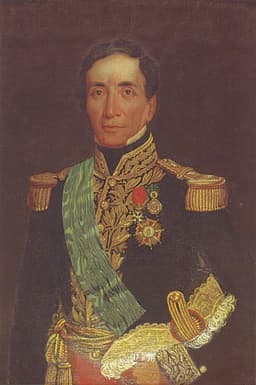
Andres de Santa Cruz
General · Modern
60.5Total
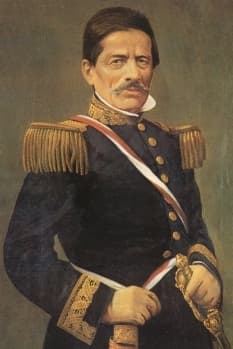
Ramon Castilla
General · Modern
59.7Total
Basic Information
Born
1792
1797
Died
1865
1867
Era
Modern
Modern
Nationality
Bolivia
Peru
Occupation
General
General
Civilization
Western
Western
Score Comparison
Military (10%)
67.5
40.0
Political (20%)
59.3
72.0
Influence (20%)
62.0
56.7
Legacy (20%)
50.0
52.0
Leadership (15%)
68.0
78.0
Strategy (15%)
66.3
60.0
TOTAL
60.5
59.7
Andres de Santa Cruz — Complete Timeline
1823 AD
Battle of ZepitaWar
Santa Cruz commanded Peruvian forces in a victory over Spanish royalists at Zepita during the Peruvian War of Independence. This battle enhanced his military reputation and contributed to the eventual liberation of Peru from Spanish rule.
Peruvian War of IndependenceBattleLiberation
Impact: regional
1826 AD
Presidency of PeruPolitical Action
Santa Cruz served as President of the Council of Government of Peru from 1826 to 1827, effectively ruling the country. His administration focused on centralizing power and organizing the state, but he was overthrown by a rebellion led by Agust
PresidencyPeruCentralization
Impact: national
1829 AD
Presidency of BoliviaPolitical Action◆ Major
Santa Cruz became President of Bolivia in 1829, serving until 1839. He implemented administrative reforms, stabilized the economy, and modernized the military, establishing Bolivia as a more coherent state after the chaos following independence.
PresidencyBoliviaReforms
Impact: nationalconstructive
1836 AD
War of the ConfederationWar◆ Major
Chile and Argentina declared war on the Peru-Bolivia Confederation, viewing it as a threat to the balance of power. Santa Cruz led the confederation's forces in a conflict that lasted until 1839, ultimately resulting in the confederation's defeat.
WarChileArgentinaConfederation
Impact: regional
Creation of the Peru-Bolivia ConfederationPolitical Action
Santa Cruz established the Peru-Bolivia Confederation, uniting Bolivia and Peru into a single state with himself as Supreme Protector. This confederation aimed to create a powerful Andean nation and challenged the regional influence of Chile and Argentina.
ConfederationUnificationAndean Power
Impact: regional
1839 AD
Battle of YungayWar
Santa Cruz's confederation forces were decisively defeated by the Chilean army at the Battle of Yungay. This defeat led to the dissolution of the Peru-Bolivia Confederation and forced Santa Cruz into exile, ending his political project.
BattleDefeatEnd of Confederation
Impact: regionaltragic
Exile and DeathPolitical Action
After the defeat at Yungay, Santa Cruz fled to Ecuador and later to France. He spent the rest of his life in exile, making unsuccessful attempts to return to power. He died in France in 1865, never regaining his former influence.
ExileDeathFailure
Impact: nationaltragic
Ramon Castilla — Complete Timeline
1824 AD
Battle of AyacuchoWar
Castilla fought as a junior officer in the decisive Battle of Ayacucho, which ended Spanish rule in Peru. This victory secured Peruvian independence and marked the end of the Spanish Empire in South America, shaping Castilla's nationalist views.
Peruvian War of IndependenceBattleLiberation
Impact: regional
1845 AD
First Presidency of PeruPolitical Action◆ Major
Castilla was elected President of Peru in 1845, serving until 1851. His first term focused on economic development, including the guano boom, and infrastructure projects such as railroads and ports, modernizing the Peruvian state.
PresidencyEconomic DevelopmentGuano
Impact: nationalconstructive
1854 AD
Abolition of Slavery in PeruReform◆ Major
During his second presidency, Castilla issued a decree abolishing slavery in Peru on December 3, 1854. This reform freed approximately 25,000 slaves and was part of a broader liberal agenda, though it faced opposition from slave-owning elites.
AbolitionSlaveryHuman Rights
Impact: nationalprogressive
Abolition of Indigenous TributeReform◆ Major
Castilla also abolished the indigenous tribute tax in 1854, which had been a burden on native communities since colonial times. This measure aimed to integrate indigenous peoples into the Peruvian state as equal citizens, though its implementation was uneven.
Indigenous RightsTax ReformCitizenship
Impact: nationalprogressive
1855 AD
Second Presidency and Guano BoomPolitical Action◆ Major
Castilla served a second term from 1855 to 1862, during the peak of the guano export boom. He used guano revenues to fund public works, pay off foreign debt, and modernize the military, but also faced criticism for corruption and over-reliance on a single resource.
PresidencyGuanoModernization
Impact: nationalconstructive
1860 AD
Constitutional Reform of 1860Reform◆ Major
Castilla oversaw the adoption of a new constitution in 1860, which established a centralized republic with a strong executive. The constitution remained in effect until 1920 and shaped Peru's political structure, though it limited regional autonomy.
ConstitutionPolitical ReformCentralization
Impact: nationalconstructive
Expert Analysis
Andres de Santa Cruz vs Ramon Castilla
### The Dreamer and the Builder
In 1836, a vision of unity blazed across the map of South America. Andrés de Santa Cruz, the president of Bolivia, declared the creation of the Peru-Bolivia Confederation, a single, powerful state that would revive the glory of the Inca Empire. A decade later, that vision lay in ashes, and Santa Cruz was a wandering exile. Meanwhile, a different kind of leader rose in Peru: Ramón Castilla. He carried no grand continental dream, but in the same generation, he abolished slavery, wiped out colonial tribute, and built a modern state. Why did one man’s ambition shatter into dust while the other’s pragmatism carved a lasting legacy? The answer lies not in their circumstances, but in their very souls.
### Origins: The Creole and the Soldier
Santa Cruz was born in 1792 in La Paz, the son of a Spanish nobleman and a Quechua mother. He was a mestizo in a world that despised mixed blood, yet his father’s rank gave him entry to the elite. The Spanish American wars of independence were his forge: he fought for the royalists first, then switched sides to the patriots. This duality—part Inca, part conquistador—became his obsession. He wanted to reconcile the two halves of his heritage into a single nation.
Castilla, born five years later in 1797 in Tarapacá, was a criollo of pure Spanish descent from a modest mining family. He joined the patriot army at fifteen and fought at the Battle of Ayacucho in 1824, the final, thunderous blow that ended Spanish rule. For Castilla, independence was not a mystical dream but a practical task: how to govern a broken land. He had seen war’s raw face, and it taught him that survival came before glory.
### Rise to Power: The Architect and the Opportunist
Santa Cruz’s ascent was swift. After commanding a victory at the Battle of Zepita in 1823, he became President of the Council of Government of Peru in 1826, effectively ruling the country. But his ambition was larger. In 1829, he took the presidency of Bolivia and began a decade of radical reform: he stabilized the currency, reorganized the army, and codified laws. His masterpiece came in 1836 with the creation of the Peru-Bolivia Confederation. He saw it as a resurrection of Tawantinsuyu, the Inca realm, a bulwark against the meddling of Chile and Argentina.
Castilla’s path was slower. He was not a brilliant general; his military score of 64.3 reflects a competent commander, not a titan. But he was a master of timing. In 1845, after decades of chaos, he was elected president of Peru. He inherited a nation bankrupt from civil wars. Instead of grand schemes, he focused on guano—the bird-dung fertilizer that was suddenly worth a fortune.
### Leadership & Governance: The Visionary vs. The Manager
Santa Cruz governed like an emperor. He centralized power, crushed opposition, and imposed his Confederation by force. His political score of 60.2 is modest, but his leadership score of 79.0 reveals a man of immense charisma and will. He believed that unity would bring strength, and he was right—but only on paper. The Confederation was a fragile mosaic of resentful regions, and his neighbors saw it as a mortal threat.
Castilla, with a political score of 77.4 and leadership of 84.0, was the opposite. He governed through negotiation and reform. In 1854, during his second presidency, he issued decrees that abolished slavery and the indigenous tribute tax—two colonial chains that had crushed Peruvians for centuries. He used the guano boom to pay off foreign debt, build railroads, and fund education. His 1860 constitution created a stable, centralized republic that lasted for decades. He did not dream of empires; he built institutions.
### Triumph & Tragedy: The Fall and the Flowering
Santa Cruz’s greatest moment was the Confederation’s birth in 1836—a political masterpiece that stunned the continent. But his tragedy was swift. Chile and Argentina declared war, viewing his state as a threat to the balance of power. At the Battle of Yungay in 1839, his forces were crushed. He fled to Ecuador, then to France, dying in obscurity in 1865. His dream died with him.
Castilla’s triumph was quieter but deeper. The abolition of slavery in 1854 freed an estimated 25,000 people. The end of indigenous tribute lifted a burden that had lasted since the Viceroyalty. He left office in 1862 as a revered elder statesman, dying in 1867. His only failure was that he could not make the guano boom last forever—a problem of economics, not of character.
### Character & Destiny: The Mestizo and the Pragmatist
Santa Cruz was driven by a vision of synthesis—a nation that blended Inca and Spanish blood. But his arrogance and inflexibility made enemies of everyone. He was a brilliant strategist (strategy score 59.3) but a poor politician; he could win battles but not hearts. His legacy score of 68.9 reflects a memory that is both grand and tragic.
Castilla was a pragmatist. He was not a great thinker, but he knew how to read the room. He abolished slavery not out of pure idealism but because it was politically expedient—and because it was right. His legacy score of 75.0 and influence of 68.5 show a man who changed his country for the better, without ever reaching for the stars.
### Legacy: The Ghost and the Father
Today, Santa Cruz is a monument of what might have been. Bolivia and Peru remember him as a visionary who dared to unite them, but his Confederation is a footnote in history. Statues of him stand in La Paz, but his name is often spoken with a sigh.
Castilla is remembered as the founder of modern Peru. His abolition decree is a national holiday. His constitution shaped the republic for generations. He is not a romantic figure, but a father of the nation—a man who built a house that still stands.
### Conclusion: Two Roads
The difference between Santa Cruz and Castilla is the difference between a poet and a carpenter. Santa Cruz dreamed of a cathedral in the sky; Castilla built a solid bridge. One reached for the heavens and fell; the other dug into the earth and created a foundation. History honors both, but it is the builder who endures. In the end, the most powerful vision is the one that can survive the morning after the dream.
Rankings
🥇
Andres de Santa CruzLeader
Mil: 67.5Pol: 59.3Inf: 62.0
60.5
🥈
Ramon Castilla
Mil: 40.0Pol: 72.0Inf: 56.7
59.7
+0.8 behind
How This Comparison Works
Algorithm
Each figure is scored on 6 dimensions (0—100 scale) based on structured historical data: Military (10%), Political (20%), Influence (20%), Legacy (20%), Leadership (15%), Strategy (15%). The weighted total produces the final ranking.
Data Sources
Scores are computed from structured sub-indicators in the database. Scale factors adjust for era (Ancient ×0.85, Modern ×1.0) and civilization size (Eastern ×1.05, Other ×0.80) to account for differences in population and military scale.
Maximum 3 Figures
Comparisons are limited to 2—3 figures to ensure readability and statistical meaningfulness.
Error Margins
±5 points per dimension — Sub-scores are derived from historical records with inherent uncertainty. Two figures within 5 points on a dimension should be considered roughly equivalent in that area.
Total Score Accuracy
±3 points overall — The weighted combination of 6 dimensions produces a total score with approximately ±3 points of uncertainty. Differences of less than 3 points are not statistically significant— the figures are effectively tied.
Known Limitations
- Historical records are incomplete and uneven across civilizations
- Figures from oral-tradition societies may be underrepresented
- Occupation labels can misclassify multi-role figures
- Scores measure capability and impact, not moral character
- Quantitative scoring is a comparison tool, not absolute truth
Capability Radar
Military (10%) — Battles & Warfare
Battles
60
45
Win Rate
55
50
Expansion
55
30
Political (20%) — Governance & Reform
Reform
65
85
Diplomacy
60
70
Economy
55
75
Influence (20%) — Cultural & Global Reach
Cultural
45
55
Global
35
50
Legacy (20%) — Historical Impact
Historical
50
65
Longevity
40
60
Leadership (15%) — Power & Stability
Tenure
60
65
Stability
40
60
Strategy (15%) — Tactics & Innovation
Strategy
65
45
Tactics
60
40
Reform
50
55
Similar Comparisons
Comments & Discussion
MACHETE_MAN6/16/2026
Santa Cruz was a romantic fool who thought he could resurrect Tahuantinsuyo with paper treaties. You can't will a confederation into existence when Bolivia and Peru share nothing but altitude sickness. His "Inca dream" was just Bolivian expansionism in costume. Meanwhile, Castilla understood the real battle: abolishing indigenous tribute in 1854 wasn't just moral—it was state-building. One man chased ghosts; the other buried colonial chains with actual legislation. I know who I'd follow into a t
草原独狼6/16/2026
拿圣克鲁斯跟卡斯蒂利亚比?简直是对实干家的侮辱。前者搞的秘鲁-玻利维亚邦联活不过三年,1839年容加伊战役就灰飞烟灭。后者三度执政,1854年废除奴隶制和印第安人贡税,1857年电报系统上线,1862年建成第一条铁路。一个在梦里建国,一个在矿场上铺铁轨。南美不缺幻想家,缺的是修路的人。
DATA_SHARD6/16/2026
Let's talk numbers, not mysticism. Santa Cruz's confederation never minted its own currency properly—they had to use Bolivian and Peruvian coins side-by-side, causing economic chaos. Castilla, by contrast, paid off Peru's foreign debt and launched the guano boom years that funded real infrastructure. Santa Cruz's GDP per capita? Stagnant. Under Castilla? Peru's exports quintupled. Vision without fiscal policy is just a hallucination. I'll take a bean-counting president over a poet-politician any
山河旧梦6/16/2026
你们都在嘲笑圣克鲁斯的野心,可谁记得他给玻利维亚留下的法典和行政系统?1831年他推行民法典,改革税收,连卡斯蒂利亚后来废除贡税时都参考了他的土地登记制度。失败不是因为愚蠢,而是因为智利和阿根廷联合绞杀——南美弱国联盟从来都是强权的靶子。卡斯蒂利亚赢在天时地利,而不是更高明的头脑。历史只给赢家立碑,不管策略深浅。
BULWARK_BLOKE6/16/2026
Three words: Battle of Yungay. Santa Cruz got his confederation demolished by a coalition of Chilean exiles and Peruvian nationalists who couldn't stomach being ruled from La Paz. That's not a dreamer's tragedy—that's a strategic moron who thought he could ignore nationalism. Castilla never tried to annex his neighbors; he just built a central bank, a postal service, and a coastal defense system. Santa Cruz's grand plan was defeated by a bunch of grumpy Chileans with bayonets. Pragmatism beats p