Loading...
Andres de Santa Cruz vs Prem Tinsulanonda
Andres de Santa Cruz leads by 3.3 pts · 2 figures compared
…
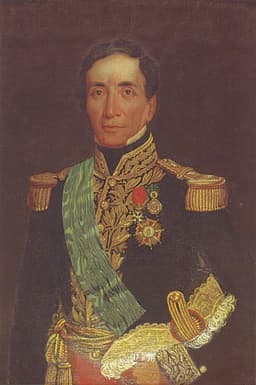
Andres de Santa Cruz
General · Modern
60.5Total
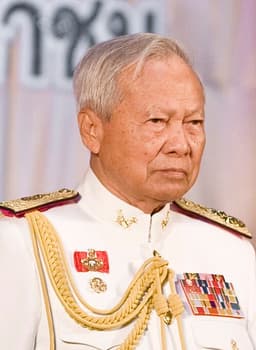
Prem Tinsulanonda
General · Modern
57.2Total
Basic Information
Born
1792
1920
Died
1865
—
Era
Modern
Modern
Nationality
Bolivia
Thailand
Occupation
General
General
Civilization
Western
Eastern
Score Comparison
Military (10%)
67.5
50.0
Political (20%)
59.3
59.3
Influence (20%)
62.0
54.9
Legacy (20%)
50.0
47.5
Leadership (15%)
68.0
78.0
Strategy (15%)
66.3
60.0
TOTAL
60.5
57.2
Andres de Santa Cruz — Complete Timeline
1823 AD
Battle of ZepitaWar
Santa Cruz commanded Peruvian forces in a victory over Spanish royalists at Zepita during the Peruvian War of Independence. This battle enhanced his military reputation and contributed to the eventual liberation of Peru from Spanish rule.
Peruvian War of IndependenceBattleLiberation
Impact: regional
1826 AD
Presidency of PeruPolitical Action
Santa Cruz served as President of the Council of Government of Peru from 1826 to 1827, effectively ruling the country. His administration focused on centralizing power and organizing the state, but he was overthrown by a rebellion led by Agust
PresidencyPeruCentralization
Impact: national
1829 AD
Presidency of BoliviaPolitical Action◆ Major
Santa Cruz became President of Bolivia in 1829, serving until 1839. He implemented administrative reforms, stabilized the economy, and modernized the military, establishing Bolivia as a more coherent state after the chaos following independence.
PresidencyBoliviaReforms
Impact: nationalconstructive
1836 AD
War of the ConfederationWar◆ Major
Chile and Argentina declared war on the Peru-Bolivia Confederation, viewing it as a threat to the balance of power. Santa Cruz led the confederation's forces in a conflict that lasted until 1839, ultimately resulting in the confederation's defeat.
WarChileArgentinaConfederation
Impact: regional
Creation of the Peru-Bolivia ConfederationPolitical Action
Santa Cruz established the Peru-Bolivia Confederation, uniting Bolivia and Peru into a single state with himself as Supreme Protector. This confederation aimed to create a powerful Andean nation and challenged the regional influence of Chile and Argentina.
ConfederationUnificationAndean Power
Impact: regional
1839 AD
Battle of YungayWar
Santa Cruz's confederation forces were decisively defeated by the Chilean army at the Battle of Yungay. This defeat led to the dissolution of the Peru-Bolivia Confederation and forced Santa Cruz into exile, ending his political project.
BattleDefeatEnd of Confederation
Impact: regionaltragic
Exile and DeathPolitical Action
After the defeat at Yungay, Santa Cruz fled to Ecuador and later to France. He spent the rest of his life in exile, making unsuccessful attempts to return to power. He died in France in 1865, never regaining his former influence.
ExileDeathFailure
Impact: nationaltragic
Prem Tinsulanonda — Complete Timeline
1980 AD
Appointed Prime Minister after a coupPolitical Action◆ Major
Prem Tinsulanonda was appointed Prime Minister of Thailand by the military after a coup. He served for over eight years, overseeing a period of political stability and economic growth.
Prime MinisterMilitary RuleStability
Impact: national
1981 AD
Survived a coup attemptPolitical Action◆ Major
Prem survived a coup attempt by military officers loyal to the 'Young Turks' faction. The coup failed due to lack of support and the loyalty of key military units, allowing Prem to remain in power.
Coup AttemptPolitical CrisisMilitary
Impact: national
1988 AD
Resigned as Prime MinisterPolitical Action◆ Major
Prem resigned as Prime Minister after the general election, handing over power to a civilian government led by Chatichai Choonhavan. His resignation marked a rare peaceful transition of power in Thai politics.
ResignationDemocratic TransitionPeaceful
Impact: nationalconstructive
2016 AD
Appointed Regent of ThailandPolitical Action
After the death of King Bhumibol, Prem was appointed Regent of Thailand until the ascension of King Maha Vajiralongkorn. He served as a key figure in the transition of the monarchy.
RegentMonarchyTransition
Impact: national
Expert Analysis
Andres de Santa Cruz vs Prem Tinsulanonda
### The Confederation Dreamer and the Quiet Kingmaker
On a dusty field in southern Peru, in the winter of 1823, a young general named Andres de Santa Cruz watched his troops scatter Spanish royalists at the Battle of Zepita. He was thirty-one, and the scent of victory was sweet. Half a world away and a century later, in the gilded halls of Bangkok in 1980, another general, Prem Tinsulanonda, accepted the prime minister’s seal after a bloodless coup. One man dreamed of forging a super-state on the spine of the Andes; the other dreamed of a Thailand that could survive its own generals. Both were soldiers who became statesmen. One built a nation only to see it shattered by war; the other built a system so durable that he ruled long after he left office. Why did Santa Cruz’s grand vision collapse into exile, while Prem’s quiet maneuvering made him the most enduring power broker of modern Thailand? The answer lies not in their ambition, but in the brittle soil where each man planted his flag.
### Origins
Andres de Santa Cruz was born in 1792 in La Paz, a mestizo son of a Spanish father and an indigenous mother. He was a child of the colonial frontier, where racial hierarchies were rigid and opportunity scarce. The wars of independence that erupted across Spanish America were his forge—they offered a mestizo officer a path to glory that peacetime could never grant. He fought for the royalists first, then switched sides to the patriots, a pragmatism that would define his career. His era was one of chaos and possibility: empires were crumbling, and new nations were being sketched on maps with uncertain hands.
Prem Tinsulanonda was born in 1920 in Songkhla, southern Thailand, into a family of minor nobility. His father was a judge; his mother, a devout Buddhist. Siam, as it was then called, had never been colonized, a fact that shaped every Thai leader’s worldview. Prem grew up in a stable kingdom where the monarchy was sacred and the military was the guardian of the state, not its destroyer. He attended the elite Suan Kulap school and the Chulachomklao Royal Military Academy. His era was one of Cold War tension, but the framework of Thai society—king, religion, nation—was solid. Santa Cruz fought to create a nation; Prem was born into one that already knew how to endure.
### Rise to Power
Santa Cruz’s rise was meteoric and violent. After Zepita, he became a key figure in the Peruvian government, serving as President of the Council of Government from 1826 to 1827. But Peru was a cauldron of feuding caudillos, and he was soon forced out. He returned to Bolivia, his birthplace, and in 1829, at the age of thirty-seven, he was elected president. He inherited a bankrupt, fractured state. Within a year, he had balanced the budget, reformed the tax system, and reorganized the army. Yet his ambition was not satisfied with Bolivia. He looked north, to the richer, more chaotic Peru, and saw a chance to reunite the old Inca heartland.
Prem’s ascent was slower, more deliberate. He rose through the ranks of the Thai army, serving in the Korean War and later commanding the Second Army during the communist insurgency in the 1970s. He was known for his integrity, his calm demeanor, and his absolute loyalty to King Bhumibol Adulyadej. When the military staged a coup in 1980, they needed a leader who could appease both the generals and the palace. Prem, then sixty, was the perfect compromise. He was appointed prime minister not by popular vote, but by royal decree—a quiet coronation that would define his style.
### Leadership & Governance
Santa Cruz governed as a reformer and a builder. He codified Bolivia’s laws, promoted education, and encouraged trade with the Pacific. But his masterpiece was the Peru-Bolivia Confederation, proclaimed in 1836. He divided the new state into three parts: North Peru, South Peru, and Bolivia, with himself as Supreme Protector. It was a federalist dream, designed to create a single economic and military power capable of resisting Argentina and Chile. He even minted new coins and wrote a new constitution. His military strategy, however, was brittle. He won battles but struggled to win hearts. The Peruvian elite resented Bolivian dominance, and Chile saw the Confederation as a mortal threat to its own ambitions.
Prem governed as a balancer and a listener. He never sought to rewrite Thailand’s constitution; he worked within it. His eight years as prime minister (1980–1988) were marked by economic growth, political stability, and a gradual opening to democracy. He survived a coup attempt in 1981—the “Young Turks” mutiny—by refusing to flee, instead rallying loyal troops and the king’s support. He did not crush his enemies; he outlasted them. His political wisdom was not in grand reforms but in quiet consensus. He was a master of the “network monarchy,” using his ties to the palace, the military, and business to keep Thailand steady while its neighbors burned.
### Triumph & Tragedy
Santa Cruz’s greatest triumph was the Confederation itself—a bold act of statecraft that briefly united two fractured nations. His tragedy was Yungay. On January 20, 1839, Chilean forces, backed by Peruvian dissidents, smashed his army in the highlands of northern Peru. The Confederation dissolved overnight. Santa Cruz fled to Ecuador, then to France, where he lived in exile until his death in 1865. He never returned. His dream was buried on a foreign shore.
Prem’s triumph was his resignation. In 1988, after eight years in power, he called a general election and handed the government to Chatichai Choonhavan, a civilian. It was the first peaceful transfer of power in Thailand in decades. His tragedy was that he never truly left. He remained a kingmaker, serving as president of the Privy Council and, after King Bhumibol’s death in 2016, as Regent. He became the gray eminence behind every Thai government, a shadow that democracy could never quite escape.
### Character & Destiny
Santa Cruz was a visionary, but his vision was too large for his time. He believed that a confederation could overcome the centrifugal forces of geography, ethnicity, and local pride. He was a strategist on paper but a gambler in the field. His personality was imperious; he expected loyalty but gave little in return. His destiny was to be the great unifier who became the great divider.
Prem was a pragmatist. He understood that in Thailand, power is not seized—it is borrowed from the king and the army. He never sought glory; he sought stability. His personality was serene, almost monastic. He lived simply, never married, and was known as “the wise old man.” His destiny was to be the bridge between military rule and democracy, a bridge that many crossed but few thanked.
### Legacy
Santa Cruz is remembered in Bolivia as a flawed hero, a president who modernized the state but overreached. In Peru, he is a villain who tried to annex the north. His legacy is the Confederation, a “what if” that still haunts Andean politics. He scored 68.9 in legacy, a reminder that grand ambition often earns a complex memory.
Prem Tinsulanonda is remembered as the father of Thailand’s “semi-democracy,” a system that balanced military power with electoral politics. He is revered by royalists and criticized by democrats. His legacy score of 66.8 reflects a quieter but deeper impact: he helped Thailand avoid the civil wars that ravaged its neighbors. He died in 2019 at the age of ninety-eight, a kingmaker to the end.
### Conclusion
Two generals, two dreams. Santa Cruz tried to build a nation from the top down, with bayonets and decrees. Prem tried to preserve a nation from the inside out, with patience and silence. One shattered against the rocks of Chilean cannon; the other melted into the fabric of a monarchy that outlasted him. Their stories remind us that leadership is not just about vision—it is about the ground you stand on. Santa Cruz stood on shifting sand; Prem stood on ancient stone. And in the end, the stone always wins.
Rankings
🥇
Andres de Santa CruzLeader
Mil: 67.5Pol: 59.3Inf: 62.0
60.5
🥈
Prem Tinsulanonda
Mil: 50.0Pol: 59.3Inf: 54.9
57.2
+3.3 behind
How This Comparison Works
Algorithm
Each figure is scored on 6 dimensions (0—100 scale) based on structured historical data: Military (10%), Political (20%), Influence (20%), Legacy (20%), Leadership (15%), Strategy (15%). The weighted total produces the final ranking.
Data Sources
Scores are computed from structured sub-indicators in the database. Scale factors adjust for era (Ancient ×0.85, Modern ×1.0) and civilization size (Eastern ×1.05, Other ×0.80) to account for differences in population and military scale.
Maximum 3 Figures
Comparisons are limited to 2—3 figures to ensure readability and statistical meaningfulness.
Error Margins
±5 points per dimension — Sub-scores are derived from historical records with inherent uncertainty. Two figures within 5 points on a dimension should be considered roughly equivalent in that area.
Total Score Accuracy
±3 points overall — The weighted combination of 6 dimensions produces a total score with approximately ±3 points of uncertainty. Differences of less than 3 points are not statistically significant— the figures are effectively tied.
Known Limitations
- Historical records are incomplete and uneven across civilizations
- Figures from oral-tradition societies may be underrepresented
- Occupation labels can misclassify multi-role figures
- Scores measure capability and impact, not moral character
- Quantitative scoring is a comparison tool, not absolute truth
Capability Radar
Military (10%) — Battles & Warfare
Battles
60
20
Win Rate
55
25
Expansion
55
10
Political (20%) — Governance & Reform
Reform
65
55
Diplomacy
60
60
Economy
55
50
Influence (20%) — Cultural & Global Reach
Cultural
45
30
Global
35
30
Legacy (20%) — Historical Impact
Historical
50
40
Longevity
40
35
Leadership (15%) — Power & Stability
Tenure
60
65
Stability
40
60
Strategy (15%) — Tactics & Innovation
Strategy
65
30
Tactics
60
30
Reform
50
35
Similar Comparisons
Comments & Discussion
No comments yet. Be the first to share your thoughts!