Loading...
Andres de Santa Cruz vs Oscar Mejia Victores
Andres de Santa Cruz leads by 8.6 pts · 2 figures compared
…
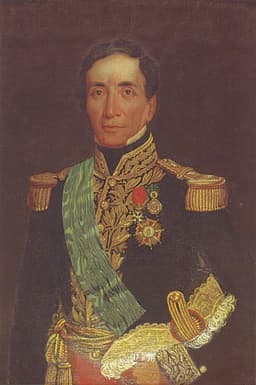
Andres de Santa Cruz
General · Modern
60.5Total

Oscar Mejia Victores
General · Modern
51.9Total
Basic Information
Born
1792
1930
Died
1865
—
Era
Modern
Modern
Nationality
Bolivia
Guatemala
Occupation
General
General
Civilization
Western
Western
Score Comparison
Military (10%)
67.5
22.6
Political (20%)
59.3
68.0
Influence (20%)
62.0
50.2
Legacy (20%)
50.0
43.3
Leadership (15%)
68.0
80.0
Strategy (15%)
66.3
41.0
TOTAL
60.5
51.9
Andres de Santa Cruz — Complete Timeline
1823 AD
Battle of ZepitaWar
Santa Cruz commanded Peruvian forces in a victory over Spanish royalists at Zepita during the Peruvian War of Independence. This battle enhanced his military reputation and contributed to the eventual liberation of Peru from Spanish rule.
Peruvian War of IndependenceBattleLiberation
Impact: regional
1826 AD
Presidency of PeruPolitical Action
Santa Cruz served as President of the Council of Government of Peru from 1826 to 1827, effectively ruling the country. His administration focused on centralizing power and organizing the state, but he was overthrown by a rebellion led by Agust
PresidencyPeruCentralization
Impact: national
1829 AD
Presidency of BoliviaPolitical Action◆ Major
Santa Cruz became President of Bolivia in 1829, serving until 1839. He implemented administrative reforms, stabilized the economy, and modernized the military, establishing Bolivia as a more coherent state after the chaos following independence.
PresidencyBoliviaReforms
Impact: nationalconstructive
1836 AD
War of the ConfederationWar◆ Major
Chile and Argentina declared war on the Peru-Bolivia Confederation, viewing it as a threat to the balance of power. Santa Cruz led the confederation's forces in a conflict that lasted until 1839, ultimately resulting in the confederation's defeat.
WarChileArgentinaConfederation
Impact: regional
Creation of the Peru-Bolivia ConfederationPolitical Action
Santa Cruz established the Peru-Bolivia Confederation, uniting Bolivia and Peru into a single state with himself as Supreme Protector. This confederation aimed to create a powerful Andean nation and challenged the regional influence of Chile and Argentina.
ConfederationUnificationAndean Power
Impact: regional
1839 AD
Battle of YungayWar
Santa Cruz's confederation forces were decisively defeated by the Chilean army at the Battle of Yungay. This defeat led to the dissolution of the Peru-Bolivia Confederation and forced Santa Cruz into exile, ending his political project.
BattleDefeatEnd of Confederation
Impact: regionaltragic
Exile and DeathPolitical Action
After the defeat at Yungay, Santa Cruz fled to Ecuador and later to France. He spent the rest of his life in exile, making unsuccessful attempts to return to power. He died in France in 1865, never regaining his former influence.
ExileDeathFailure
Impact: nationaltragic
Oscar Mejia Victores — Complete Timeline
1983 AD
1983 Guatemalan coup d'étatPolitical Action◆ Major
Mejia Victores, then Defense Minister, led a coup that ousted President Efrain Rios Montt. He assumed the presidency, becoming the last military ruler of Guatemala.
CoupMilitary RuleGuatemala
Impact: nationaldestructive
1984 AD
Human rights abuses during his ruleOther◆ Major
During his presidency, Mejia Victores' government continued counterinsurgency operations that resulted in forced disappearances and massacres of indigenous Maya communities, as documented by truth commissions.
Human RightsCivil WarAtrocities
Impact: nationaltragic
1985 AD
Transition to civilian rulePolitical Action
Under pressure, Mejia Victores oversaw the drafting of a new constitution and called for democratic elections. He transferred power to civilian President Vinicio Cerezo in 1986, ending decades of military rule.
DemocratizationConstitutionElection
Impact: nationalconstructive
Expert Analysis
Andres de Santa Cruz vs Oscar Mejia Victores
### The General and the Gatekeeper
On a December morning in 1839, Andrés de Santa Cruz, the Supreme Protector of the Peru-Bolivia Confederation, watched his dream shatter at the Battle of Yungay. Chilean troops, backed by Peruvian dissidents, routed his army in the high Andes. Within months, he was an exile, his grand federation erased from the map. A century and a half later, in 1985, another general, Oscar Mejía Victores of Guatemala, did something almost unheard of among Latin American strongmen: he handed power to a democratically elected civilian, then quietly faded into history. Two military leaders, both products of the same Western tradition of caudillo rule, yet their paths diverged with stark finality. Why did one seek to build an empire and lose everything, while the other chose to dismantle his own throne?
### Origins
Santa Cruz was born in 1792 in La Paz, then part of the Spanish Viceroyalty of Peru. He was a *mestizo*—of mixed Spanish and indigenous ancestry—a fact that shaped his ambition and his enemies’ contempt. His father was a Spanish colonel, his mother from an Inca noble line. The boy grew up fluent in Spanish and Quechua, straddling two worlds. The wars of independence, erupting across South America, offered him a stage. He joined the royalist army first, then switched to the patriot cause, a pragmatic choice common among men who sensed which way the wind blew. By 1823, at the Battle of Zepita, he commanded Peruvian forces to a victory over Spanish royalists, earning a reputation for cool-headed tactics.
Mejía Victores, born in 1930 in Guatemala City, came from a different world entirely. Guatemala in the mid-20th century was a land of entrenched inequality, Cold War paranoia, and military dominance. He trained at the Escuela Politécnica, the nation’s military academy, absorbing a doctrine that saw the army as the guardian of order against communism. He was a product of the institution, not a revolutionary. Where Santa Cruz dreamed of uniting nations, Mejía Victores learned to defend a system.
### Rise to Power
Santa Cruz’s ascent was meteoric. After Zepita, he served as President of the Council of Government of Peru from 1826 to 1827, effectively ruling the country in a turbulent period. But Peru’s elite distrusted his indigenous roots. He pivoted to Bolivia, where in 1829 he became president. There, he stabilized the economy, reformed the administration, and built a loyal base. His masterstroke came in 1836: he created the Peru-Bolivia Confederation, uniting the two countries under his Supreme Protectorship. It was a breathtaking act of political will, merging nations that had been separate for centuries.
Mejía Victores rose through the ranks of Guatemala’s brutal counterinsurgency state. In 1983, he was Defense Minister under General Efraín Ríos Montt, a dictator infamous for genocidal campaigns against indigenous Maya. On August 8, 1983, Mejía Victores led a coup that ousted Ríos Montt, citing “excesses.” He assumed the presidency himself. It was a palace coup, not a popular revolution. He was the last in a long line of military rulers, and he knew it.
### Leadership & Governance
Santa Cruz governed with a visionary’s arrogance. He built roads, standardized currency, and promoted education. His confederation was designed to create a Pacific superpower, a counterweight to Argentina and Chile. But his rule was authoritarian: he suppressed dissent and centralized power. His military strategy, despite a score of 59.3, was adequate for conquest but weak for defense. He underestimated his neighbors’ fury. Chile and Argentina, viewing the confederation as a threat to regional balance, declared war in 1836. Santa Cruz’s forces won early skirmishes but could not hold the coalition together.
Mejía Victores ruled with a different calculus. His human rights record is grim: his government continued counterinsurgency operations that resulted in forced disappearances and massacres. Yet his political score of 72.0 reflects a pragmatic turn. Under pressure from the United States, the Catholic Church, and a weary populace, he oversaw the drafting of a new constitution in 1985 and called for democratic elections. He did not try to cling to power. He did not rig the vote. He transferred power to civilian President Vinicio Cerezo in 1986, then retired to private life.
### Triumph & Tragedy
Santa Cruz’s greatest moment was the creation of the Peru-Bolivia Confederation in 1836—a feat of political imagination that briefly made him the most powerful man in South America. His tragedy was Yungay in 1839, where his confederation collapsed in a single battle. He fled to Ecuador, then to France, where he died in 1865, a forgotten pensioner in Versailles.
Mejía Victores’ triumph was its opposite: a voluntary exit. His tragedy was the blood on his hands—the thousands of disappeared, the villages razed, the terror that he inherited and perpetuated. He never faced justice. He died in obscurity, the exact year unknown.
### Character & Destiny
Santa Cruz was driven by a vision of unity, but also by personal ambition. He believed that his mixed heritage made him the natural bridge between indigenous and European worlds. Yet that same heritage made him a target. Peruvian elites called him “the Indian” behind his back. His pride blinded him to the fragility of his confederation. He gambled on war and lost.
Mejía Victores was a survivor, not a dreamer. He saw that the Cold War was ending, that the military’s grip was loosening, that democracy was the only sustainable path. He chose to step aside rather than be pushed. It was not idealism; it was calculation. But calculation, in that moment, served peace.
### Legacy
Santa Cruz is remembered in Bolivia as a flawed giant—a unifier who failed. His legacy score of 68.9 reflects a man who almost changed history. Statues of him stand in La Paz, but his confederation is a historical footnote. In Chile, he is a cautionary tale.
Mejía Victores is barely remembered at all. His legacy score of 59.5 is a gray average. In Guatemala, he is a footnote between Ríos Montt’s genocide and the fragile democracy that followed. He is neither hero nor monster—just the gatekeeper who opened the door.
### Conclusion
One general built a cathedral of nations that collapsed under its own weight. The other dismantled a prison and walked away. Both were men of their time, shaped by the currents of war and power. Santa Cruz dreamed too big; Mejía Victores dreamed small enough to survive. In the end, the difference between them is not talent or courage, but the wisdom to know when to let go.
Rankings
🥇
Andres de Santa CruzLeader
Mil: 67.5Pol: 59.3Inf: 62.0
60.5
🥈
Oscar Mejia Victores
Mil: 22.6Pol: 68.0Inf: 50.2
51.9
+8.6 behind
How This Comparison Works
Algorithm
Each figure is scored on 6 dimensions (0—100 scale) based on structured historical data: Military (10%), Political (20%), Influence (20%), Legacy (20%), Leadership (15%), Strategy (15%). The weighted total produces the final ranking.
Data Sources
Scores are computed from structured sub-indicators in the database. Scale factors adjust for era (Ancient ×0.85, Modern ×1.0) and civilization size (Eastern ×1.05, Other ×0.80) to account for differences in population and military scale.
Maximum 3 Figures
Comparisons are limited to 2—3 figures to ensure readability and statistical meaningfulness.
Error Margins
±5 points per dimension — Sub-scores are derived from historical records with inherent uncertainty. Two figures within 5 points on a dimension should be considered roughly equivalent in that area.
Total Score Accuracy
±3 points overall — The weighted combination of 6 dimensions produces a total score with approximately ±3 points of uncertainty. Differences of less than 3 points are not statistically significant— the figures are effectively tied.
Known Limitations
- Historical records are incomplete and uneven across civilizations
- Figures from oral-tradition societies may be underrepresented
- Occupation labels can misclassify multi-role figures
- Scores measure capability and impact, not moral character
- Quantitative scoring is a comparison tool, not absolute truth
Capability Radar
Military (10%) — Battles & Warfare
Battles
60
10
Win Rate
55
10
Expansion
55
5
Political (20%) — Governance & Reform
Reform
65
55
Diplomacy
60
50
Economy
55
30
Influence (20%) — Cultural & Global Reach
Cultural
45
15
Global
35
15
Legacy (20%) — Historical Impact
Historical
50
30
Longevity
40
20
Leadership (15%) — Power & Stability
Tenure
60
40
Stability
40
35
Strategy (15%) — Tactics & Innovation
Strategy
65
15
Tactics
60
15
Reform
50
20
Similar Comparisons
Comments & Discussion
StatSkeptic426/16/2026
Santa Cruz was a deluded fantasist, building a confederation that ignored the simple math of power. He had maybe 6,000 troops at Yungay against a Chilean force half again as large and better supplied. Anyone with a basic spreadsheet could see he was overextended. Meanwhile, Mejía Victores read the room: 1985 Guatemala was bleeding from civil war, and the economy was in shambles. He chose survival over glory. Sanity beats ambition every time.