Loading...
Andres de Santa Cruz vs Olusegun Obasanjo
Andres de Santa Cruz leads by 0.3 pts · 2 figures compared
…
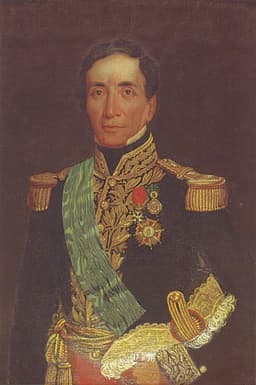
Andres de Santa Cruz
General · Modern
60.5Total
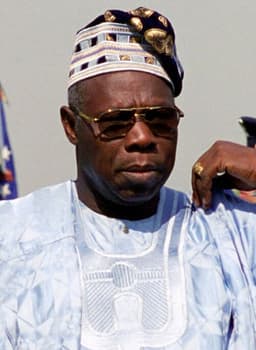
Olusegun Obasanjo
General · Modern
60.2Total
Basic Information
Born
1792
1937
Died
1865
—
Era
Modern
Modern
Nationality
Bolivia
Nigeria
Occupation
General
General
Civilization
Western
Other
Score Comparison
Military (10%)
67.5
45.0
Political (20%)
59.3
72.0
Influence (20%)
62.0
55.0
Legacy (20%)
50.0
54.0
Leadership (15%)
68.0
78.0
Strategy (15%)
66.3
60.0
TOTAL
60.5
60.2
Andres de Santa Cruz — Complete Timeline
1823 AD
Battle of ZepitaWar
Santa Cruz commanded Peruvian forces in a victory over Spanish royalists at Zepita during the Peruvian War of Independence. This battle enhanced his military reputation and contributed to the eventual liberation of Peru from Spanish rule.
Peruvian War of IndependenceBattleLiberation
Impact: regional
1826 AD
Presidency of PeruPolitical Action
Santa Cruz served as President of the Council of Government of Peru from 1826 to 1827, effectively ruling the country. His administration focused on centralizing power and organizing the state, but he was overthrown by a rebellion led by Agust
PresidencyPeruCentralization
Impact: national
1829 AD
Presidency of BoliviaPolitical Action◆ Major
Santa Cruz became President of Bolivia in 1829, serving until 1839. He implemented administrative reforms, stabilized the economy, and modernized the military, establishing Bolivia as a more coherent state after the chaos following independence.
PresidencyBoliviaReforms
Impact: nationalconstructive
1836 AD
War of the ConfederationWar◆ Major
Chile and Argentina declared war on the Peru-Bolivia Confederation, viewing it as a threat to the balance of power. Santa Cruz led the confederation's forces in a conflict that lasted until 1839, ultimately resulting in the confederation's defeat.
WarChileArgentinaConfederation
Impact: regional
Creation of the Peru-Bolivia ConfederationPolitical Action
Santa Cruz established the Peru-Bolivia Confederation, uniting Bolivia and Peru into a single state with himself as Supreme Protector. This confederation aimed to create a powerful Andean nation and challenged the regional influence of Chile and Argentina.
ConfederationUnificationAndean Power
Impact: regional
1839 AD
Battle of YungayWar
Santa Cruz's confederation forces were decisively defeated by the Chilean army at the Battle of Yungay. This defeat led to the dissolution of the Peru-Bolivia Confederation and forced Santa Cruz into exile, ending his political project.
BattleDefeatEnd of Confederation
Impact: regionaltragic
Exile and DeathPolitical Action
After the defeat at Yungay, Santa Cruz fled to Ecuador and later to France. He spent the rest of his life in exile, making unsuccessful attempts to return to power. He died in France in 1865, never regaining his former influence.
ExileDeathFailure
Impact: nationaltragic
Olusegun Obasanjo — Complete Timeline
1976 AD
Military coup that brought Obasanjo to powerPolitical Action
Following the assassination of General Murtala Mohammed in a failed coup, Obasanjo, as Chief of Staff, Supreme Headquarters, succeeded him as head of state. He oversaw the continuation of the transition to civilian rule.
CoupSuccessionMilitary Rule
Impact: national
1979 AD
Handover of power to civilian governmentPolitical Action
Obasanjo voluntarily handed over power to the elected civilian government of Shehu Shagari, marking the first peaceful transfer of power from military to civilian rule in Nigeria. This act established a precedent for democratic transition.
DemocracyTransitionCivilian Rule
Impact: nationalconstructive
1999 AD
Election as President of NigeriaPolitical Action
Obasanjo won the 1999 Nigerian presidential election as the candidate of the People's Democratic Party (PDP). His victory ended 16 years of military rule and began the Fourth Nigerian Republic.
ElectionDemocracyFourth Republic
Impact: nationalprogressive
2005 AD
Debt relief from Paris ClubPolitical Action◆ Major
Obasanjo's government negotiated a debt relief agreement with the Paris Club, resulting in the cancellation of $18 billion of Nigeria's external debt. This freed up resources for domestic spending and was a major economic achievement.
Debt ReliefEconomyNegotiation
Impact: nationalconstructive
2006 AD
Third term bid failurePolitical Action◆ Major
Obasanjo attempted to amend the Nigerian constitution to allow him to run for a third term. The bid was rejected by the National Assembly, marking a significant political defeat and reinforcing term limits.
Third TermConstitutionDefeat
Impact: national
Expert Analysis
Andres de Santa Cruz vs Olusegun Obasanjo
### The Unifier and the Transitionist: Two Generals Who Shaped Nations
On a crisp morning in 1839, the dream of a great Andean empire died on the field of Yungay. Andrés de Santa Cruz, the man who had united Peru and Bolivia into a single confederation, watched his army shatter before the disciplined ranks of Chilean soldiers. In that moment, he became a wanderer, destined for exile. A century and a half later, in 1979, another general, Olusegun Obasanjo, did what no military ruler in sub-Saharan Africa had done before: he handed power to a civilian government and walked away. Both men were soldiers who became presidents; both left indelible marks on their nations. Yet their paths, their triumphs, and their tragedies could not have been more different. Why did one general build a confederation that collapsed, while the other built a democracy that endured?
### Origins
Andrés de Santa Cruz was born in 1792, a child of the Spanish colonial elite in what is now Bolivia. His father was a Spanish nobleman, his mother a Quechua princess. This dual heritage gave him a unique perspective: he understood both the power of the old empire and the simmering grievances of the indigenous majority. The wars of independence that swept Latin America in the 1810s and 1820s shaped his youth, forging him into a soldier who believed that only a strong, unified state could resist foreign domination.
Olusegun Obasanjo, born in 1937 in southwestern Nigeria, came of age in a different crucible. The British Empire was still the dominant force in West Africa, and Nigeria itself was a colonial creation, a patchwork of ethnic groups—Yoruba, Igbo, Hausa-Fulani—forced together by imperial fiat. Obasanjo’s father was a farmer, and the boy grew up with a deep sense of community and pragmatism. He joined the Nigerian Army at a time when it was becoming a key institution in a newly independent nation, but he also saw how easily that nation could tear itself apart in the Biafran War of 1967-1970.
### Rise to Power
Santa Cruz’s rise was swift and bloody. He fought alongside Simón Bolívar in the wars against Spain, earning a reputation for tactical brilliance at the Battle of Zepita in 1823, where his Peruvian forces defeated Spanish royalists. By 1826, he was effectively ruling Peru as President of the Council of Government. But his ambition was not satisfied with one country. In 1829, he seized the presidency of Bolivia, and for the next seven years, he laid the groundwork for his grand project: the Peru-Bolivia Confederation, proclaimed in 1836. He saw himself as a new Inca, a unifier of the Andes.
Obasanjo’s path was more accidental. He was not the leader of the 1976 coup that brought him to power; he was the number two man, Chief of Staff, Supreme Headquarters. When General Murtala Mohammed was assassinated in a failed coup, Obasanjo found himself the highest-ranking officer left. He did not seek power—it fell on him. But he used it with a careful, almost methodical patience. He completed Mohammed’s reforms, then, in 1979, did the unthinkable: he handed over to a civilian government, becoming a hero to democrats.
### Leadership & Governance
Santa Cruz governed as a visionary autocrat. He centralized the state, reformed the tax system, and promoted trade between Peru and Bolivia. He even built a navy for the confederation. But his vision was always fragile. The confederation was a personal creation, held together by his authority alone. He alienated local elites in both countries, who saw him as a foreign ruler. When Chile and Argentina declared war in 1836, viewing the confederation as a threat to the balance of power, Santa Cruz was forced to fight on two fronts. His military strategy was competent, but his political strategy was brittle.
Obasanjo, by contrast, governed as a pragmatic institution-builder. His first term (1976-1979) was about stability and transition. His second term (1999-2007), after he returned to civilian life and won a democratic election, was about reform. He negotiated $18 billion in debt relief from the Paris Club in 2005, freeing up resources for schools and roads. He also tried to amend the constitution for a third term in 2006, but the Nigerian Senate rejected the bid. That failure, while a personal setback, proved that Nigeria’s democratic institutions were stronger than any one man.
### Triumph & Tragedy
Santa Cruz’s greatest moment was the creation of the Peru-Bolivia Confederation in 1836. For a brief time, the Andes were united under one flag, a dream that had eluded Bolívar himself. His tragedy was the Battle of Yungay in 1839, where Chilean forces destroyed his army. He fled to Ecuador, then to France, where he died in 1865, a forgotten man in a foreign land. His confederation was dismantled, and his legacy became a cautionary tale about overreach.
Obasanjo’s triumph was the 1979 handover, a moment that inspired democrats across Africa. His tragedy was the third-term bid of 2006, which tarnished his reputation and reminded the world that even the best leaders can be tempted by power. Yet he survived that failure, and his democratic legacy endured.
### Character & Destiny
Santa Cruz was a man of grand visions and rigid will. He believed that history demanded a unified Inca state, and he was willing to risk everything for it. That determination made him a great conqueror but a poor diplomat. He could not compromise, could not build alliances, could not see that his dream was too fragile for the jealous nations around him.
Obasanjo was a man of quiet resilience and practical wisdom. He understood that power is a tool, not an end. He knew when to seize it (1976) and when to let it go (1979). Even his failed third-term bid reflected a deep, if flawed, belief that Nigeria needed continuity. His character was shaped by the chaos of the Biafran War, which taught him that unity is precious and fragile.
### Legacy
Santa Cruz is remembered in Bolivia and Peru as a visionary who almost succeeded. His confederation is a dream that still haunts Andean politics, a what-if of history. But his legacy is also a warning: great dreams can die when they are not grounded in reality.
Obasanjo is remembered as the father of Nigerian democracy. His 1979 handover broke the cycle of coups, and his 1999 return to power stabilized a nation emerging from military rule. He is not without flaws—the third-term bid and his sometimes heavy-handed style have critics—but his legacy is one of transition, not conquest.
### Conclusion
Two generals, two nations, two different answers to the same question: what does it mean to lead? Santa Cruz sought to unite by force, to build an empire that would last a thousand years. It lasted three. Obasanjo sought to unite by consent, to build institutions that would outlast him. They have. In the end, the general who dreamed of a confederation died in exile, while the general who dreamed of a democracy died in his own bed, surrounded by a nation that had learned to govern itself. The difference was not in their ambition—both were ambitious—but in their understanding of power. Santa Cruz thought power was something to be seized. Obasanjo understood that power, to be lasting, must be given away.
Rankings
🥇
Andres de Santa CruzLeader
Mil: 67.5Pol: 59.3Inf: 62.0
60.5
🥈
Olusegun Obasanjo
Mil: 45.0Pol: 72.0Inf: 55.0
60.2
+0.3 behind
How This Comparison Works
Algorithm
Each figure is scored on 6 dimensions (0—100 scale) based on structured historical data: Military (10%), Political (20%), Influence (20%), Legacy (20%), Leadership (15%), Strategy (15%). The weighted total produces the final ranking.
Data Sources
Scores are computed from structured sub-indicators in the database. Scale factors adjust for era (Ancient ×0.85, Modern ×1.0) and civilization size (Eastern ×1.05, Other ×0.80) to account for differences in population and military scale.
Maximum 3 Figures
Comparisons are limited to 2—3 figures to ensure readability and statistical meaningfulness.
Error Margins
±5 points per dimension — Sub-scores are derived from historical records with inherent uncertainty. Two figures within 5 points on a dimension should be considered roughly equivalent in that area.
Total Score Accuracy
±3 points overall — The weighted combination of 6 dimensions produces a total score with approximately ±3 points of uncertainty. Differences of less than 3 points are not statistically significant— the figures are effectively tied.
Known Limitations
- Historical records are incomplete and uneven across civilizations
- Figures from oral-tradition societies may be underrepresented
- Occupation labels can misclassify multi-role figures
- Scores measure capability and impact, not moral character
- Quantitative scoring is a comparison tool, not absolute truth
Capability Radar
Military (10%) — Battles & Warfare
Battles
60
25
Win Rate
55
30
Expansion
55
20
Political (20%) — Governance & Reform
Reform
65
65
Diplomacy
60
75
Economy
55
55
Influence (20%) — Cultural & Global Reach
Cultural
45
45
Global
35
60
Legacy (20%) — Historical Impact
Historical
50
55
Longevity
40
50
Leadership (15%) — Power & Stability
Tenure
60
70
Stability
40
60
Strategy (15%) — Tactics & Innovation
Strategy
65
40
Tactics
60
35
Reform
50
50
Similar Comparisons
Comments & Discussion
No comments yet. Be the first to share your thoughts!