Loading...
Andres de Santa Cruz vs Nicolas Soult
Nicolas Soult leads by 2.2 pts · 2 figures compared
…
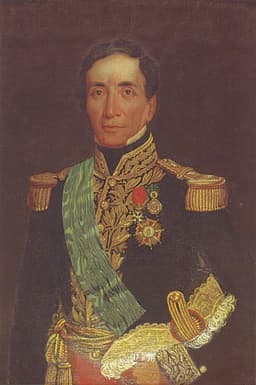
Andres de Santa Cruz
General · Modern
60.5Total
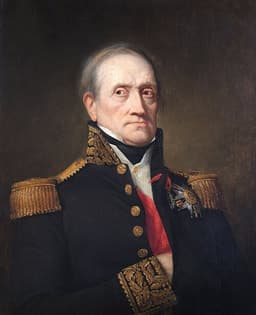
Nicolas Soult
General · Modern
62.7Total
Basic Information
Born
1792
1769
Died
1865
1851
Era
Modern
Modern
Nationality
Bolivia
France
Occupation
General
General
Civilization
Western
Western
Score Comparison
Military (10%)
67.5
74.7
Political (20%)
59.3
55.0
Influence (20%)
62.0
61.0
Legacy (20%)
50.0
54.0
Leadership (15%)
68.0
78.0
Strategy (15%)
66.3
65.4
TOTAL
60.5
62.7
Andres de Santa Cruz — Complete Timeline
1823 AD
Battle of ZepitaWar
Santa Cruz commanded Peruvian forces in a victory over Spanish royalists at Zepita during the Peruvian War of Independence. This battle enhanced his military reputation and contributed to the eventual liberation of Peru from Spanish rule.
Peruvian War of IndependenceBattleLiberation
Impact: regional
1826 AD
Presidency of PeruPolitical Action
Santa Cruz served as President of the Council of Government of Peru from 1826 to 1827, effectively ruling the country. His administration focused on centralizing power and organizing the state, but he was overthrown by a rebellion led by Agust
PresidencyPeruCentralization
Impact: national
1829 AD
Presidency of BoliviaPolitical Action◆ Major
Santa Cruz became President of Bolivia in 1829, serving until 1839. He implemented administrative reforms, stabilized the economy, and modernized the military, establishing Bolivia as a more coherent state after the chaos following independence.
PresidencyBoliviaReforms
Impact: nationalconstructive
1836 AD
War of the ConfederationWar◆ Major
Chile and Argentina declared war on the Peru-Bolivia Confederation, viewing it as a threat to the balance of power. Santa Cruz led the confederation's forces in a conflict that lasted until 1839, ultimately resulting in the confederation's defeat.
WarChileArgentinaConfederation
Impact: regional
Creation of the Peru-Bolivia ConfederationPolitical Action
Santa Cruz established the Peru-Bolivia Confederation, uniting Bolivia and Peru into a single state with himself as Supreme Protector. This confederation aimed to create a powerful Andean nation and challenged the regional influence of Chile and Argentina.
ConfederationUnificationAndean Power
Impact: regional
1839 AD
Battle of YungayWar
Santa Cruz's confederation forces were decisively defeated by the Chilean army at the Battle of Yungay. This defeat led to the dissolution of the Peru-Bolivia Confederation and forced Santa Cruz into exile, ending his political project.
BattleDefeatEnd of Confederation
Impact: regionaltragic
Exile and DeathPolitical Action
After the defeat at Yungay, Santa Cruz fled to Ecuador and later to France. He spent the rest of his life in exile, making unsuccessful attempts to return to power. He died in France in 1865, never regaining his former influence.
ExileDeathFailure
Impact: nationaltragic
Nicolas Soult — Complete Timeline
1805 AD
Battle of AusterlitzWar◆ Major
Soult commanded the IV Corps at Austerlitz. He led the assault on the Pratzen Heights, breaking the Allied center and securing the decisive French victory.
Napoleonic WarsBattleCorps Command
Impact: global
1806 AD
Battle of Jena-AuerstedtWar◆ Major
Soult commanded the IV Corps at Jena. His forces pursued the retreating Prussian army, capturing thousands of prisoners and contributing to the collapse of the Prussian state.
Napoleonic WarsBattlePursuit
Impact: regional
1811 AD
Battle of AlbueraWar◆ Major
Soult commanded the French army at Albuera in Spain. His forces fought a bloody battle against the Anglo-Spanish army, resulting in a tactical stalemate but strategic French withdrawal.
Peninsular WarBattleStalemate
Impact: regional
1814 AD
Battle of ToulouseWar◆ Major
Soult commanded the French army at Toulouse against Wellington. The battle occurred after Napoleon's abdication, and Soult surrendered the city, ending the Peninsular War.
Peninsular WarBattleDefeat
Impact: regional
1830 AD
Minister of WarPolitical Action◆ Major
Soult served as Minister of War under King Louis-Philippe. He reorganized the French army, introduced conscription reforms, and prepared for colonial campaigns in Algeria.
MinistryReformsJuly Monarchy
Impact: nationalconstructive
1832 AD
Prime Minister of FrancePolitical Action◆ Major
Soult served as Prime Minister of France under Louis-Philippe. His government focused on maintaining order, suppressing republican uprisings, and consolidating the July Monarchy.
Prime MinisterJuly MonarchyGovernment
Impact: national
Expert Analysis
Andres de Santa Cruz vs Nicolas Soult
### The Confederation and the Crown: Two Paths from the Battlefield to Power
In the winter of 1839, a defeated man in a threadbare uniform slipped across the Peruvian border into Ecuador, his grand vision crumbling behind him. Just a few years earlier, he had ruled a nation that spanned the heart of South America. Half a world away, in the summer of 1832, another soldier, older and more weathered, was summoned to the Tuileries Palace to accept the highest office in France. Both were generals. Both had tasted supreme power. But one built a confederation that collapsed in a single battle, while the other built a career that outlasted an emperor. The difference lay not in their ambition, but in the soil from which that ambition grew.
### Origins
Andrés de Santa Cruz was born in 1792 in La Paz, then part of the Spanish Viceroyalty of the Río de la Plata. His father was a Spanish officer, his mother an indigenous noblewoman. This dual heritage shaped his entire worldview: he saw himself as a bridge between the old order and the new, between the European elite and the Andean masses. The chaos of the Napoleonic Wars and the subsequent wars of independence in Latin America gave him his stage. By 1823, at the Battle of Zepita, he had already commanded Peruvian forces to a victory over the Spanish, proving himself a capable officer in a continent of revolutions.
Nicolas Soult was born in 1769 in a small village in southern France, the son of a notary. The French Revolution upended his world before he turned twenty. Enlisting as a common soldier, he rose through the ranks not by birth but by sheer competence and survival. The revolution created a meritocracy of violence, and Soult was its perfect product. By 1805, at Austerlitz, he commanded the IV Corps that broke the Allied center, earning the title “the Duke of Dalmatia” from a grateful Napoleon.
Santa Cruz’s world was one of fragile new states, shifting borders, and personal loyalties. Soult’s was one of established empires, institutional armies, and bureaucratic power. The difference was not in talent—both were formidable—but in the stage history had given them.
### Rise to Power
Santa Cruz’s path to power was a series of political maneuvers in a region where lines between states were still drawn in pencil. After serving as President of the Council of Government of Peru from 1826 to 1827, he was ousted and returned to Bolivia. In 1829, he became President of Bolivia and immediately set about stabilizing a nation that barely existed. He reformed the treasury, reorganized the army, and laid the foundations of a modern state. But his ambition was larger. In 1836, he created the Peru-Bolivia Confederation, uniting both countries under his rule as Supreme Protector. It was a bold, visionary act—an attempt to create a great Andean power that could stand against Argentina and Chile.
Soult’s rise was different. He did not create a state; he climbed an existing ladder. After Austerlitz and Jena, he was one of Napoleon’s most trusted marshals, commanding armies across Europe. But his political career truly began after Napoleon’s fall. In 1830, the July Revolution brought Louis-Philippe to the throne, and Soult, a survivor par excellence, offered his services to the new regime. He became Minister of War and reorganized the French army, introducing conscription reforms that modernized it. In 1832, he became Prime Minister of France. He had not built a nation; he had adapted to one.
### Leadership & Governance
As a ruler, Santa Cruz was a reformer. In Bolivia, he stabilized the currency, promoted education, and reduced the power of local caudillos. The Peru-Bolivia Confederation was his masterpiece: a federal system with two states, a single army, and a unified economic policy. He believed that only a large, centralized state could resist the pressures of Argentina and Chile. But his governance lacked deep roots. The confederation was held together by his personal authority and the loyalty of a few key generals. When that authority was challenged, the structure crumbled.
Soult governed differently. As Prime Minister, he focused on order and stability. His government suppressed republican uprisings and maintained the conservative monarchy of Louis-Philippe. He was not a visionary; he was a manager. His military genius—demonstrated in the brutal Battle of Albuera in 1811, where his forces fought the Anglo-Spanish to a bloody standstill—translated into a political style that valued discipline over inspiration. He knew that power in France came from institutions, not personal charisma.
### Triumph & Tragedy
Santa Cruz’s greatest moment was the creation of the Confederation in 1836. For a brief time, he was the most powerful man in South America. His tragedy came three years later at the Battle of Yungay in 1839. Chile, seeing the Confederation as a threat to its own regional ambitions, attacked. Santa Cruz’s forces were decisively defeated. He fled to Ecuador, then to France, where he spent the rest of his life in exile, a broken man who had once dreamed of a united Andes.
Soult’s triumph was his longevity. He served as Prime Minister three times, the last in 1839–1840, and died in 1851 at the age of 82, respected and powerful. His tragedy was subtler: he was a man of the revolution who ended his career defending a monarchy, a soldier who outlived his emperor and served his enemies. The Battle of Toulouse in 1814, where he fought Wellington after Napoleon’s abdication, was a final, pointless act of loyalty.
### Character & Destiny
Santa Cruz was a dreamer. His vision of a Peru-Bolivia Confederation was ahead of its time, but it was also fragile because it depended on him alone. He lacked the institutional patience of Soult. He believed that a single bold stroke could change history—and it did, but not in his favor.
Soult was a survivor. He had no grand vision beyond the next battle, the next ministry. He was pragmatic, ruthless when necessary, and willing to serve any master who offered power. If Santa Cruz was a romantic, Soult was a realist. One built a house of cards; the other built a career of stone.
### Legacy
Today, Santa Cruz is remembered as a visionary who nearly united Bolivia and Peru. His legacy is mixed: some see him as a hero of Andean unity, others as a power-hungry caudillo. His total score of 67.8 reflects this ambiguity—a man of great influence but flawed execution.
Soult is remembered as one of Napoleon’s great marshals and a capable prime minister. His legacy is more secure: a total score of 74.5, with high marks for military and political leadership. Yet he is not beloved. He was a servant of power, not a creator of nations.
### Conclusion
In the end, the difference between Santa Cruz and Soult is the difference between building a cathedral in the desert and adding a wing to an existing palace. Both were great architects in their own way, but one worked with stone and mortar, the other with sand and wind. Santa Cruz’s confederation fell because it was born too soon, in a world not ready for his vision. Soult’s career endured because he knew how to bend with the wind. Which path is more admirable? That depends on whether you value the dream or the survival.
Rankings
🥇
Nicolas SoultLeader
Mil: 74.7Pol: 55.0Inf: 61.0
62.7
🥈
Andres de Santa Cruz
Mil: 67.5Pol: 59.3Inf: 62.0
60.5
+2.2 behind
How This Comparison Works
Algorithm
Each figure is scored on 6 dimensions (0—100 scale) based on structured historical data: Military (10%), Political (20%), Influence (20%), Legacy (20%), Leadership (15%), Strategy (15%). The weighted total produces the final ranking.
Data Sources
Scores are computed from structured sub-indicators in the database. Scale factors adjust for era (Ancient ×0.85, Modern ×1.0) and civilization size (Eastern ×1.05, Other ×0.80) to account for differences in population and military scale.
Maximum 3 Figures
Comparisons are limited to 2—3 figures to ensure readability and statistical meaningfulness.
Error Margins
±5 points per dimension — Sub-scores are derived from historical records with inherent uncertainty. Two figures within 5 points on a dimension should be considered roughly equivalent in that area.
Total Score Accuracy
±3 points overall — The weighted combination of 6 dimensions produces a total score with approximately ±3 points of uncertainty. Differences of less than 3 points are not statistically significant— the figures are effectively tied.
Known Limitations
- Historical records are incomplete and uneven across civilizations
- Figures from oral-tradition societies may be underrepresented
- Occupation labels can misclassify multi-role figures
- Scores measure capability and impact, not moral character
- Quantitative scoring is a comparison tool, not absolute truth
Capability Radar
Military (10%) — Battles & Warfare
Battles
60
75
Win Rate
55
70
Expansion
55
65
Political (20%) — Governance & Reform
Reform
65
55
Diplomacy
60
65
Economy
55
50
Influence (20%) — Cultural & Global Reach
Cultural
45
45
Global
35
50
Legacy (20%) — Historical Impact
Historical
50
55
Longevity
40
50
Leadership (15%) — Power & Stability
Tenure
60
70
Stability
40
55
Strategy (15%) — Tactics & Innovation
Strategy
65
72
Tactics
60
78
Reform
50
60
Similar Comparisons
Comments & Discussion
Grenadier de Tinta6/16/2026
Santa Cruz's Peru-Bolivia Confederation was a paper tiger built on shaky alliances. He lost at Yungay because his army was a patchwork of regional militias with zero cohesion, while Soult commanded hardened veterans of Austerlitz who knew how to maneuver as a unit. Santa Cruz's "grand vision" was just a glorified customs union that collapsed the moment Chilean cannon fire broke his conscripts. Give me Soult's iron discipline over Santa Cruz's mestizo dreams any day.
南美残阳6/16/2026
拿圣克鲁斯和苏尔特比?可笑!苏尔特在乌尔姆战役里差点把马克军团包了饺子,圣克鲁斯打过几场正规战?Zepita那场胜仗也就是对付西班牙二流部队,后来在亚纳科查输得底裤都不剩。苏尔特是拿破仑亲自封的帝国元帅,圣克鲁斯也就是个军阀,靠印加血统忽悠高原农民。军事素养差了两个法兰西!
Numismatic Skeptic6/16/2026
Don't be fooled by Santa Cruz's fancy medals and uniforms—the Confederation peso was inflationary garbage, while Soult's France had the franc backed by the Bank of France's gold reserves. Santa Cruz printed money to pay his cronies, blew his budget on parades in La Paz, and left his army unpaid. Soult balanced budgets and reformed the French military payroll system. Santa Cruz's economic illiteracy killed his empire faster than any Chilean bayonet could.
历史考据党6/16/2026
你们搞错重点了!圣克鲁斯真正的遗产是玻利维亚1831年民法典,比苏尔特在法国搞的行政改革早十年。他创立了统一税制和土地登记,这比苏尔特当战争部长时改的军衔制实际得多。苏尔特也就是个玛丽绸缪的御用工具,圣克鲁斯是真正的国家建设者。输了仗又如何?拿破仑滑铁卢也输过,不妨碍他是伟人。
Sunburst of Tarija6/16/2026
Santa Cruz's tragedy was that he thought he could reconcile creoles and indigenous peoples through political union, while Soult cynically switched sides between Napoleon and the Bourbons just to keep his rank. Soult served three regimes without flinching; Santa Cruz died in exile because he tried to build something new from the rubble of empire. I'd rather lose with a dreamer who had a map of a united Andes than win with a turncoat who only cared about his pension.