Loading...
Andres de Santa Cruz vs Mohammad Fahim
Andres de Santa Cruz leads by 10.8 pts · 2 figures compared
…
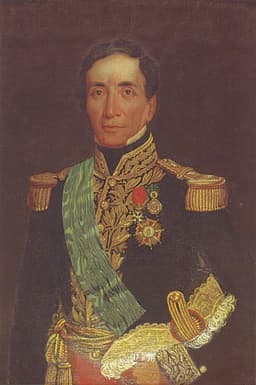
Andres de Santa Cruz
General · Modern
60.5Total

Mohammad Fahim
General · Modern
49.7Total
Basic Information
Born
1792
1957
Died
1865
—
Era
Modern
Modern
Nationality
Bolivia
Afghanistan
Occupation
General
General
Civilization
Western
Middle Eastern
Score Comparison
Military (10%)
67.5
40.0
Political (20%)
59.3
43.7
Influence (20%)
62.0
51.0
Legacy (20%)
50.0
43.3
Leadership (15%)
68.0
74.0
Strategy (15%)
66.3
45.0
TOTAL
60.5
49.7
Andres de Santa Cruz — Complete Timeline
1823 AD
Battle of ZepitaWar
Santa Cruz commanded Peruvian forces in a victory over Spanish royalists at Zepita during the Peruvian War of Independence. This battle enhanced his military reputation and contributed to the eventual liberation of Peru from Spanish rule.
Peruvian War of IndependenceBattleLiberation
Impact: regional
1826 AD
Presidency of PeruPolitical Action
Santa Cruz served as President of the Council of Government of Peru from 1826 to 1827, effectively ruling the country. His administration focused on centralizing power and organizing the state, but he was overthrown by a rebellion led by Agust
PresidencyPeruCentralization
Impact: national
1829 AD
Presidency of BoliviaPolitical Action◆ Major
Santa Cruz became President of Bolivia in 1829, serving until 1839. He implemented administrative reforms, stabilized the economy, and modernized the military, establishing Bolivia as a more coherent state after the chaos following independence.
PresidencyBoliviaReforms
Impact: nationalconstructive
1836 AD
War of the ConfederationWar◆ Major
Chile and Argentina declared war on the Peru-Bolivia Confederation, viewing it as a threat to the balance of power. Santa Cruz led the confederation's forces in a conflict that lasted until 1839, ultimately resulting in the confederation's defeat.
WarChileArgentinaConfederation
Impact: regional
Creation of the Peru-Bolivia ConfederationPolitical Action
Santa Cruz established the Peru-Bolivia Confederation, uniting Bolivia and Peru into a single state with himself as Supreme Protector. This confederation aimed to create a powerful Andean nation and challenged the regional influence of Chile and Argentina.
ConfederationUnificationAndean Power
Impact: regional
1839 AD
Battle of YungayWar
Santa Cruz's confederation forces were decisively defeated by the Chilean army at the Battle of Yungay. This defeat led to the dissolution of the Peru-Bolivia Confederation and forced Santa Cruz into exile, ending his political project.
BattleDefeatEnd of Confederation
Impact: regionaltragic
Exile and DeathPolitical Action
After the defeat at Yungay, Santa Cruz fled to Ecuador and later to France. He spent the rest of his life in exile, making unsuccessful attempts to return to power. He died in France in 1865, never regaining his former influence.
ExileDeathFailure
Impact: nationaltragic
Mohammad Fahim — Complete Timeline
2001 AD
Led Northern Alliance Forces in Fall of KabulWar
Mohammad Fahim, as a senior Northern Alliance commander, led forces that captured Kabul from the Taliban in November 2001. This victory followed the US invasion and was a turning point in the war, leading to the collapse of Taliban rule.
AfghanistanWarTaliban
Impact: national
Appointed Vice President of AfghanistanPolitical Action◆ Major
Mohammad Fahim was appointed Vice President of Afghanistan under Hamid Karzai in 2001, serving until 2004. He was a key Northern Alliance commander and his appointment was part of the post-Taliban power-sharing arrangement.
AfghanistanVice PresidencyNorthern Alliance
Impact: nationalconstructive
Served as Minister of DefensePolitical Action◆ Major
Mohammad Fahim served as Afghanistan's Minister of Defense from 2001 to 2004. He oversaw the formation of the new Afghan National Army and security forces, integrating former mujahideen and Northern Alliance fighters.
AfghanistanDefenseMilitary
Impact: nationalconstructive
2009 AD
Appointed First Vice President in 2009Political Action◆ Major
Mohammad Fahim was appointed First Vice President of Afghanistan under President Hamid Karzai in 2009. He served until his death in 2014, playing a key role in security and political affairs.
AfghanistanVice PresidencyGovernment
Impact: nationalconstructive
Expert Analysis
Andres de Santa Cruz vs Mohammad Fahim
# The Visionary and the Warlord: Andrés de Santa Cruz and Mohammad Fahim
In the high mountain passes of the Andes, in 1836, a man who had once commanded armies against the Spanish Empire stood at the apex of his ambition. Andrés de Santa Cruz, the President of Bolivia and now the Supreme Protector of the Peru-Bolivia Confederation, surveyed a new nation he had willed into existence. One hundred and sixty-five years later, on the dusty roads leading into Kabul, another general, Mohammad Fahim, watched his Northern Alliance fighters roll past the abandoned positions of the Taliban. Both men had risen from chaos to grasp power. But while Santa Cruz dreamed of a new empire, Fahim was content to be a kingmaker. Why did one end his life in exile, writing memoirs in a French village, while the other died in power as a vice president of a fragile republic?
Origins
Andrés de Santa Cruz was born in 1792 in La Paz, the son of a Spanish nobleman and a Quechua mother. This mixed heritage would define his life. In the rigid caste system of colonial Peru, he was a *mestizo*, a man caught between two worlds. He was educated in the Spanish military tradition, fighting for the Crown against indigenous uprisings before switching sides to join the independence movement. His era was one of grand, continent-spanning visions—Simón Bolívar dreamed of a united South America, and Santa Cruz absorbed that ambition.
Mohammad Fahim, born in 1957 in the Panjshir Valley of Afghanistan, came from a different world entirely. He was a Tajik, a member of an ethnic minority in a country dominated by Pashtuns. His early life was shaped by the Soviet invasion of 1979. He joined the mujahideen resistance, learning guerrilla warfare in the jagged mountains of his homeland. There was no grand continental vision here—only survival, clan loyalty, and the brutal calculus of Afghan politics. Fahim’s world was local, tribal, and unforgiving.
Rise to Power
Santa Cruz rose through the ranks of the Peruvian army during the wars of independence. His key event came in 1823 at the Battle of Zepita, where he commanded Peruvian forces to a victory over Spanish royalists. This military success launched his political career. By 1826, he was effectively ruling Peru as President of the Council of Government. But Peru was unstable, fractious, and exhausted by war. Santa Cruz saw an opportunity: if he could not stabilize Peru alone, he would join it to Bolivia, a country he would soon control.
Fahim’s rise was faster and bloodier. He was a close lieutenant of Ahmad Shah Massoud, the legendary Lion of Panjshir. When the Taliban seized Kabul in 1996, Fahim retreated to the north, becoming a senior commander in the Northern Alliance. For five years, he fought a grinding, desperate war. Then came September 11, 2001. American bombs began to fall on Taliban positions, and Fahim’s moment arrived. In November 2001, he led the forces that captured Kabul. He was not a president or a supreme protector—he was a warlord who had ridden into the capital on the back of American airpower.
Leadership & Governance
Santa Cruz governed with a vision. As President of Bolivia from 1829, he implemented administrative reforms, stabilized the currency, and modernized the bureaucracy. He built roads and schools, and he codified laws. His leadership score of 79.0 reflects a man who believed that order and progress could be imposed from above. When he created the Peru-Bolivia Confederation in 1836, he placed himself as Supreme Protector—a title that echoed the Incan past and the Napoleonic present. He was a reformer, but also a centralizer, and his neighbors saw him as a threat.
Fahim’s governance was more pragmatic and personal. As Minister of Defense from 2001 to 2004, he oversaw the formation of a new Afghan army, but he also packed it with his own Tajik loyalists. He was not building a nation; he was building a faction. His political score of 56.5 is lower than Santa Cruz’s 60.2, but that misses the point. Fahim operated in a world where the state was a fiction. Power came from men with guns, not from constitutions. He was a master of patronage, not policy.
Triumph & Tragedy
Santa Cruz’s greatest moment was the creation of the Confederation. For three years, from 1836 to 1839, he ruled a state that stretched from the Amazon to the Pacific. It was a bold experiment, a return to the unity of the Inca Empire. But it provoked war. Chile and Argentina, fearing a powerful rival, declared war on the Confederation. The decisive blow came at the Battle of Yungay in 1839. Santa Cruz’s forces were routed. He fled first to Ecuador, then to France, where he spent the rest of his life in exile, writing and dreaming of what might have been. He died in 1865, a forgotten man.
Fahim’s tragedy was different. He triumphed in 2001, but he could never escape his past. He was appointed Vice President of Afghanistan in 2009, a position he held until his death. But he remained a warlord in a suit, accused of corruption and human rights abuses. His legacy score of 56.7 reflects a man who helped topple the Taliban but also helped entrench the kleptocracy that would eventually drive Afghans back into the arms of extremists. He died in power, but his victory was hollow.
Character & Destiny
Santa Cruz was a visionary. His strategy score of 59.3 is modest, but his leadership score of 79.0 suggests a man who could inspire loyalty and command respect. He believed in grand ideas, and that belief destroyed him. He could not see that his neighbors would never tolerate a powerful, unified state on their borders. His ambition was his tragedy.
Fahim was a survivor. His strategy score of 48.9 is the lowest of any category, but his leadership score of 75.8 shows that he knew how to command men. He had no grand ideas. He wanted power, money, and security for his people. In that, he succeeded. But he also failed, because he never built anything that would outlast him. When he died, his faction crumbled, and the state he helped create collapsed.
Legacy
Santa Cruz is remembered in Bolivia and Peru as a visionary who almost succeeded. The Peru-Bolivia Confederation is studied as a “what if” of Latin American history. His influence score of 76.2 reflects a man whose ideas outlived his defeat.
Fahim is remembered, if at all, as a necessary evil. He helped end the Taliban’s first reign, but he also helped create the conditions for its return. His influence score of 67.1 is lower, and his legacy is ambiguous.
Conclusion
Both men were generals who became politicians, but they operated in fundamentally different worlds. Santa Cruz lived in an age of nation-building, where a man could dream of uniting continents. Fahim lived in an age of state collapse, where survival was the only virtue. Santa Cruz failed because he aimed too high. Fahim failed because he aimed too low. One died in exile, the other in power. But both were consumed by the same forces: ambition, war, and the cruel indifference of history. The difference was not in their character, but in the worlds that shaped them.
Rankings
🥇
Andres de Santa CruzLeader
Mil: 67.5Pol: 59.3Inf: 62.0
60.5
🥈
Mohammad Fahim
Mil: 40.0Pol: 43.7Inf: 51.0
49.7
+10.8 behind
How This Comparison Works
Algorithm
Each figure is scored on 6 dimensions (0—100 scale) based on structured historical data: Military (10%), Political (20%), Influence (20%), Legacy (20%), Leadership (15%), Strategy (15%). The weighted total produces the final ranking.
Data Sources
Scores are computed from structured sub-indicators in the database. Scale factors adjust for era (Ancient ×0.85, Modern ×1.0) and civilization size (Eastern ×1.05, Other ×0.80) to account for differences in population and military scale.
Maximum 3 Figures
Comparisons are limited to 2—3 figures to ensure readability and statistical meaningfulness.
Error Margins
±5 points per dimension — Sub-scores are derived from historical records with inherent uncertainty. Two figures within 5 points on a dimension should be considered roughly equivalent in that area.
Total Score Accuracy
±3 points overall — The weighted combination of 6 dimensions produces a total score with approximately ±3 points of uncertainty. Differences of less than 3 points are not statistically significant— the figures are effectively tied.
Known Limitations
- Historical records are incomplete and uneven across civilizations
- Figures from oral-tradition societies may be underrepresented
- Occupation labels can misclassify multi-role figures
- Scores measure capability and impact, not moral character
- Quantitative scoring is a comparison tool, not absolute truth
Capability Radar
Military (10%) — Battles & Warfare
Battles
60
35
Win Rate
55
40
Expansion
55
25
Political (20%) — Governance & Reform
Reform
65
20
Diplomacy
60
40
Economy
55
15
Influence (20%) — Cultural & Global Reach
Cultural
45
15
Global
35
20
Legacy (20%) — Historical Impact
Historical
50
30
Longevity
40
20
Leadership (15%) — Power & Stability
Tenure
60
45
Stability
40
20
Strategy (15%) — Tactics & Innovation
Strategy
65
35
Tactics
60
30
Reform
50
20
Similar Comparisons
Comments & Discussion
StatecraftScholar6/16/2026
Anyone who compares a Confederation builder to a warlord drunk on heroin money doesn’t understand logistics. Santa Cruz actually established a customs union and unified currency across Peru and Bolivia — that’s statecraft. Fahim couldn’t even suppress a single poppy field while his faction looted Kabul’s treasury. One built institutions; the other built bunkers. This isn’t a debate. It’s a tragedy of scale.|南美炮灰鉴定师|zh|Santa Cruz再烂,他至少在1836年搞出了跨安第斯关税同盟,把秘鲁和玻利维亚的边境驻军裁了三分之二。Fahim呢?2001年北方联盟进喀布尔时,他手