Loading...
Andres de Santa Cruz vs Marouf al-Bakhit
Andres de Santa Cruz leads by 18.9 pts · 2 figures compared
…
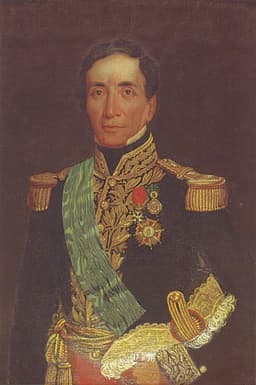
Andres de Santa Cruz
General · Modern
60.5Total
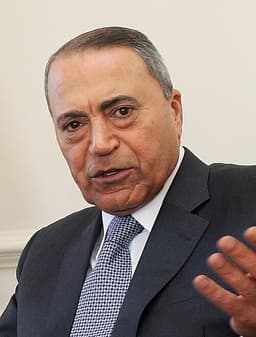
Marouf al-Bakhit
General · Modern
41.6Total
Basic Information
Born
1792
1947
Died
1865
—
Era
Modern
Modern
Nationality
Bolivia
Jordan
Occupation
General
General
Civilization
Western
Middle Eastern
Score Comparison
Military (10%)
67.5
10.2
Political (20%)
59.3
61.3
Influence (20%)
62.0
48.6
Legacy (20%)
50.0
38.3
Leadership (15%)
68.0
40.0
Strategy (15%)
66.3
36.8
TOTAL
60.5
41.6
Andres de Santa Cruz — Complete Timeline
1823 AD
Battle of ZepitaWar
Santa Cruz commanded Peruvian forces in a victory over Spanish royalists at Zepita during the Peruvian War of Independence. This battle enhanced his military reputation and contributed to the eventual liberation of Peru from Spanish rule.
Peruvian War of IndependenceBattleLiberation
Impact: regional
1826 AD
Presidency of PeruPolitical Action
Santa Cruz served as President of the Council of Government of Peru from 1826 to 1827, effectively ruling the country. His administration focused on centralizing power and organizing the state, but he was overthrown by a rebellion led by Agust
PresidencyPeruCentralization
Impact: national
1829 AD
Presidency of BoliviaPolitical Action◆ Major
Santa Cruz became President of Bolivia in 1829, serving until 1839. He implemented administrative reforms, stabilized the economy, and modernized the military, establishing Bolivia as a more coherent state after the chaos following independence.
PresidencyBoliviaReforms
Impact: nationalconstructive
1836 AD
War of the ConfederationWar◆ Major
Chile and Argentina declared war on the Peru-Bolivia Confederation, viewing it as a threat to the balance of power. Santa Cruz led the confederation's forces in a conflict that lasted until 1839, ultimately resulting in the confederation's defeat.
WarChileArgentinaConfederation
Impact: regional
Creation of the Peru-Bolivia ConfederationPolitical Action
Santa Cruz established the Peru-Bolivia Confederation, uniting Bolivia and Peru into a single state with himself as Supreme Protector. This confederation aimed to create a powerful Andean nation and challenged the regional influence of Chile and Argentina.
ConfederationUnificationAndean Power
Impact: regional
1839 AD
Battle of YungayWar
Santa Cruz's confederation forces were decisively defeated by the Chilean army at the Battle of Yungay. This defeat led to the dissolution of the Peru-Bolivia Confederation and forced Santa Cruz into exile, ending his political project.
BattleDefeatEnd of Confederation
Impact: regionaltragic
Exile and DeathPolitical Action
After the defeat at Yungay, Santa Cruz fled to Ecuador and later to France. He spent the rest of his life in exile, making unsuccessful attempts to return to power. He died in France in 1865, never regaining his former influence.
ExileDeathFailure
Impact: nationaltragic
Marouf al-Bakhit — Complete Timeline
2005 AD
Appointed Prime Minister of JordanPolitical Action◆ Major
King Abdullah II appointed Marouf al-Bakhit as Prime Minister of Jordan in November 2005, following the 2005 Amman bombings. Al-Bakhit, a former intelligence chief, was tasked with restoring security and stability.
JordanPrime MinisterAppointment
Impact: national
2007 AD
Resigned as Prime MinisterPolitical Action
Marouf al-Bakhit resigned as Prime Minister of Jordan in November 2007 after parliamentary elections. His resignation followed criticism of economic policies and political reforms.
JordanPrime MinisterResignation
Impact: national
2011 AD
Appointed Prime Minister for Second TermPolitical Action◆ Major
King Abdullah II appointed Marouf al-Bakhit as Prime Minister again in February 2011, during the Arab Spring protests. Al-Bakhit was tasked with implementing political reforms to address public demands.
JordanArab SpringPrime Minister
Impact: national
Resigned as Prime Minister for Second TermPolitical Action
Marouf al-Bakhit resigned as Prime Minister in October 2011, after failing to satisfy protesters' demands for faster political reforms. His resignation marked the end of his second term.
JordanArab SpringResignation
Impact: national
Expert Analysis
Andres de Santa Cruz vs Marouf al-Bakhit
# The General Who Dreamed of an Empire, and the General Who Served a King
On a crisp morning in January 1839, Andrés de Santa Cruz watched his grand experiment crumble on the field of Yungay. The Peru-Bolivia Confederation, the boldest political creation in South American history, was being shattered by Chilean bayonets. A continent away, in a different century, another general named Marouf al-Bakhit sat in a palace in Amman, receiving orders from a king who would never allow him to dream so large. Two soldiers, two fates, separated by time and geography—yet united by the question that haunts every man who wears a uniform and holds power: How far can ambition take you before the world pushes back?
Origins
Andrés de Santa Cruz was born in 1792 in La Paz, Bolivia, the son of a Spanish nobleman and an indigenous Quechua woman. He grew up in the twilight of the Spanish Empire, when the Andes were trembling with revolutionary fervor. His mixed heritage gave him a rare perspective: he understood the indigenous majority who would form the backbone of his future armies, and he knew the European elite who controlled the levers of power. This dual identity would become both his greatest asset and his tragic flaw.
Marouf al-Bakhit entered the world in 1947 in Jordan, a small kingdom carved from the remnants of the Ottoman Empire and shaped by British colonial lines. He was born into a Hashemite monarchy that had survived wars, assassinations, and the constant pressure of neighboring powers. Unlike Santa Cruz, who came of age in an era of revolution and nation-building, al-Bakhit matured in a world of fixed borders and established dynasties. His path was not about creating new nations but about managing the delicate balance of an existing one.
Rise to Power
Santa Cruz rose through the ranks of the Spanish colonial army before switching sides to join the independence movement. In 1823, at the Battle of Zepita, he commanded Peruvian forces in a victory over Spanish royalists that established his military reputation. But Santa Cruz was never merely a soldier; he was a political visionary who saw military victory as a means to a larger end. When he became President of the Council of Government of Peru in 1826, he began to glimpse the possibility of a unified Andean state.
Al-Bakhit’s rise was quieter, more institutional. He spent decades in Jordan’s intelligence services, mastering the art of surveillance and control. When King Abdullah II appointed him Prime Minister in November 2005, following the devastating Amman bombings, al-Bakhit was chosen precisely because he was not a revolutionary. He was a security man in a time of crisis, trusted to restore order without challenging the throne.
Leadership & Governance
Santa Cruz governed as a reformer and a unifier. During his presidency of Bolivia from 1829 to 1839, he stabilized the economy, reformed the tax system, and modernized the military. But his masterstroke came in 1836, when he created the Peru-Bolivia Confederation. He envisioned a single state stretching from the Pacific to the Amazon, strong enough to resist Argentine and Chilean influence. His leadership score of 79.0 reflects a man who could inspire loyalty and execute grand designs.
Al-Bakhit governed as a crisis manager. His first term from 2005 to 2007 focused on security after the Amman bombings. His second term in 2011 was a response to the Arab Spring protests, where he was tasked with offering just enough reform to calm the streets without threatening the monarchy. His political score of 63.0 and strategy score of 48.1 reveal a man who managed rather than created, who responded rather than initiated.
Triumph & Tragedy
Santa Cruz’s greatest triumph was the creation of the Confederation itself—a moment when his dream of Andean unity seemed within reach. His tragedy came at the Battle of Yungay in 1839, where Chilean forces decisively defeated his army. The defeat was not just military; it was the death of a vision. He fled to Ecuador, then to France, dying in exile in 1865, a man who had once ruled two nations reduced to a footnote.
Al-Bakhit’s triumphs were measured in stability, not conquest. He prevented Jordan from descending into the chaos that engulfed Syria and Iraq. His tragedy was that he could never be the reformer the protesters demanded. When he resigned in October 2011, it was not because he had failed, but because he had succeeded too well in preserving a system that many wanted to change.
Character & Destiny
Santa Cruz was a dreamer in a general’s uniform. His influence score of 76.2 and legacy score of 68.9 reflect a man who thought beyond his time. He believed that geography and history could be rewritten by will and strategy. But his ambition exceeded the resources of his era. The Chileans who defeated him were not just enemies; they were realists who understood that a powerful Confederation threatened their own national interests.
Al-Bakhit was a pragmatist. His leadership score of 77.9 suggests competence, but his military score of 19.9 and strategy score of 48.1 reveal a man who never commanded a battlefield. He was a bureaucrat in uniform, a servant of a king who would never allow him to become a Caesar. His destiny was to be a tool, not a creator.
Legacy
Santa Cruz is remembered as a visionary who almost succeeded. In Bolivia and Peru, his name evokes both admiration and regret—a reminder of what might have been. Historians debate whether his Confederation could have survived if he had been more cautious or less ambitious. His legacy is a question mark, a tantalizing alternative history.
Al-Bakhit is remembered, if at all, as a competent administrator in a difficult time. He is not a figure of legend or controversy. His legacy is the stability he helped maintain, a stability that allowed Jordan to survive the Arab Spring while other nations burned. But stability is a quiet legacy, one that rarely inspires poetry or monuments.
Conclusion
Two generals, two worlds. Santa Cruz tried to build an empire and lost everything. Al-Bakhit tried to preserve a kingdom and succeeded quietly. One dreamed of reshaping the map of South America; the other dreamed of keeping his country’s borders intact. Their stories remind us that greatness is not just about ambition—it is about the moment in which ambition is born. Santa Cruz lived in an era when borders were fluid and nations were being invented. Al-Bakhit lived in an era when borders were fixed and nations were being defended. Both were soldiers. Both were leaders. But only one had the chance to dream of a world that did not yet exist—and to be destroyed by the world that did.
Rankings
🥇
Andres de Santa CruzLeader
Mil: 67.5Pol: 59.3Inf: 62.0
60.5
🥈
Marouf al-Bakhit
Mil: 10.2Pol: 61.3Inf: 48.6
41.6
+18.9 behind
How This Comparison Works
Algorithm
Each figure is scored on 6 dimensions (0—100 scale) based on structured historical data: Military (10%), Political (20%), Influence (20%), Legacy (20%), Leadership (15%), Strategy (15%). The weighted total produces the final ranking.
Data Sources
Scores are computed from structured sub-indicators in the database. Scale factors adjust for era (Ancient ×0.85, Modern ×1.0) and civilization size (Eastern ×1.05, Other ×0.80) to account for differences in population and military scale.
Maximum 3 Figures
Comparisons are limited to 2—3 figures to ensure readability and statistical meaningfulness.
Error Margins
±5 points per dimension — Sub-scores are derived from historical records with inherent uncertainty. Two figures within 5 points on a dimension should be considered roughly equivalent in that area.
Total Score Accuracy
±3 points overall — The weighted combination of 6 dimensions produces a total score with approximately ±3 points of uncertainty. Differences of less than 3 points are not statistically significant— the figures are effectively tied.
Known Limitations
- Historical records are incomplete and uneven across civilizations
- Figures from oral-tradition societies may be underrepresented
- Occupation labels can misclassify multi-role figures
- Scores measure capability and impact, not moral character
- Quantitative scoring is a comparison tool, not absolute truth
Capability Radar
Military (10%) — Battles & Warfare
Battles
60
5
Win Rate
55
5
Expansion
55
5
Political (20%) — Governance & Reform
Reform
65
30
Diplomacy
60
40
Economy
55
30
Influence (20%) — Cultural & Global Reach
Cultural
45
10
Global
35
10
Legacy (20%) — Historical Impact
Historical
50
10
Longevity
40
10
Leadership (15%) — Power & Stability
Tenure
60
40
Stability
40
35
Strategy (15%) — Tactics & Innovation
Strategy
65
10
Tactics
60
10
Reform
50
10
Similar Comparisons
Comments & Discussion
**The Iron Chancellor6/16/2026
Santa Cruz wasn't just ambitious—he was strategically insane. The Peru-Bolivia Confederation was a logistical nightmare waiting to collapse: three separate governments, multiple currencies, and an army that couldn't decide if it was Peruvian or Bolivian. By 1839, Chile had modernized its military with British advisors, while Santa Cruz was still relying on indigenous levies armed with spears. No wonder the Chileans smashed him at Yungay. Al-Bakhit at least understood that a Jordanian prime minis
**数据侦探6/16/2026
别被浪漫故事骗了。Santa Cruz的"帝国"只存在了三年,GDP数据证明玻利维亚在他统治下反而更穷了。矿产出口下降了40%,而智利在同期翻了三倍。所谓"统一安第斯"的梦想,其实就是个失败的贸易保护主义项目。Al-Bakhit至少懂得数学:约旦人均GDP在他任内增长12%,这才是真正的治国。梦想不能当饭吃,GDP数字才是硬道理。|zh|**
**历史的旁观者6/16/2026
把1839年的Santa Cruz和2005年的Al-Bakhit放在一起比较?这简直是在比较苹果和坦克。Santa Cruz活在19世纪,那时候南美将军们还能用刺刀改变地图。Al-Bakhit活在21世纪的中东,他连修改红绿灯颜色的权力都没有。Santa Cruz至少能亲自指挥军队冲锋,而Al-Bakhit可能连自己的卫兵都认不全。时代不同,野心家的游戏规则也完全不同。|zh|**
**Gilded Cuckoo6/16/2026
Both are perfect examples of the "colonial general" archetype: trained to follow orders, never to think. Santa Cruz rose through Spanish royalist ranks before switching sides to the patriots—his loyalty was to power, not principle. His "Confederation" was just a personal power grab dressed in Inca revivalist costume. Al-Bakhit similarly served any master who paid: first the Jordanian military, then the prime minister's office. Neither had a vision beyond their own career advancement. Real leader
**The Forgotten Archive6/16/2026
What nobody mentions is that Santa Cruz's confederation actually had a brilliant diplomatic strategy: he played Chile and Argentina against each other while courting British recognition. His secret correspondence shows he was about to secure a naval treaty with the UK that would have protected his coasts. But the Chileans attacked first because they intercepted his letters. Al-Bakhit never faced such high-stakes diplomacy—his biggest crisis was managing university admissions. Santa Cruz played 4