Loading...
Andres de Santa Cruz vs Li Zongren
Andres de Santa Cruz leads by 2.0 pts · 2 figures compared
…
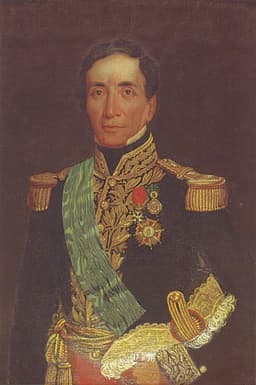
Andres de Santa Cruz
General · Modern
60.5Total
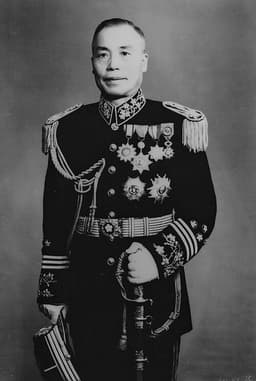
Li Zongren
General · Modern
58.5Total
Basic Information
Born
1792
1890
Died
1865
1969
Era
Modern
Modern
Nationality
Bolivia
China
Occupation
General
General
Civilization
Western
Eastern
Score Comparison
Military (10%)
67.5
65.0
Political (20%)
59.3
53.8
Influence (20%)
62.0
58.0
Legacy (20%)
50.0
52.0
Leadership (15%)
68.0
72.0
Strategy (15%)
66.3
56.8
TOTAL
60.5
58.5
Andres de Santa Cruz — Complete Timeline
1823 AD
Battle of ZepitaWar
Santa Cruz commanded Peruvian forces in a victory over Spanish royalists at Zepita during the Peruvian War of Independence. This battle enhanced his military reputation and contributed to the eventual liberation of Peru from Spanish rule.
Peruvian War of IndependenceBattleLiberation
Impact: regional
1826 AD
Presidency of PeruPolitical Action
Santa Cruz served as President of the Council of Government of Peru from 1826 to 1827, effectively ruling the country. His administration focused on centralizing power and organizing the state, but he was overthrown by a rebellion led by Agust
PresidencyPeruCentralization
Impact: national
1829 AD
Presidency of BoliviaPolitical Action◆ Major
Santa Cruz became President of Bolivia in 1829, serving until 1839. He implemented administrative reforms, stabilized the economy, and modernized the military, establishing Bolivia as a more coherent state after the chaos following independence.
PresidencyBoliviaReforms
Impact: nationalconstructive
1836 AD
War of the ConfederationWar◆ Major
Chile and Argentina declared war on the Peru-Bolivia Confederation, viewing it as a threat to the balance of power. Santa Cruz led the confederation's forces in a conflict that lasted until 1839, ultimately resulting in the confederation's defeat.
WarChileArgentinaConfederation
Impact: regional
Creation of the Peru-Bolivia ConfederationPolitical Action
Santa Cruz established the Peru-Bolivia Confederation, uniting Bolivia and Peru into a single state with himself as Supreme Protector. This confederation aimed to create a powerful Andean nation and challenged the regional influence of Chile and Argentina.
ConfederationUnificationAndean Power
Impact: regional
1839 AD
Battle of YungayWar
Santa Cruz's confederation forces were decisively defeated by the Chilean army at the Battle of Yungay. This defeat led to the dissolution of the Peru-Bolivia Confederation and forced Santa Cruz into exile, ending his political project.
BattleDefeatEnd of Confederation
Impact: regionaltragic
Exile and DeathPolitical Action
After the defeat at Yungay, Santa Cruz fled to Ecuador and later to France. He spent the rest of his life in exile, making unsuccessful attempts to return to power. He died in France in 1865, never regaining his former influence.
ExileDeathFailure
Impact: nationaltragic
Li Zongren — Complete Timeline
1921 AD
Command of the Guangxi ArmyPolitical Action◆ Major
Li Zongren became a commander in the Guangxi Army and helped unify Guangxi province under the New Guangxi Clique. He established a powerful regional base that rivaled other warlords.
Guangxi CliqueMilitary CommandWarlord Era
Impact: regional
1926 AD
Alliance with the Nationalist GovernmentPolitical Action◆ Major
Li Zongren allied the Guangxi Clique with Chiang Kai-shek's Nationalist government during the Northern Expedition. His forces played a key role in defeating warlords and unifying China under KMT rule.
Northern ExpeditionAllianceKMT
Impact: nationalconstructive
1938 AD
Battle of TaierzhuangWar
Li Zongren commanded Chinese forces to a major victory over the Japanese at the Battle of Taierzhuang during the Second Sino-Japanese War. This was the first significant Chinese victory of the war and boosted national morale.
Second Sino-Japanese WarBattleVictory
Impact: nationalconstructive
1949 AD
Acting Presidency of the Republic of ChinaPolitical Action◆ Major
Li Zongren served as Acting President of the Republic of China after Chiang Kai-shek's resignation during the Chinese Civil War. He attempted to negotiate peace with the Communists but failed, leading to the KMT's retreat to Taiwan.
Chinese Civil WarPresidencyKMT
Impact: nationaltragic
Exile to the United StatesPolitical Action
After the Communist victory, Li Zongren fled to the United States, where he lived in exile. He criticized Chiang Kai-shek's leadership and advocated for a reformed KMT, but remained politically marginalized.
ExileChinese Civil WarPolitics
Impact: nationaltragic
Expert Analysis
Andres de Santa Cruz vs Li Zongren
### The Dreamer of Union and the Warlord Who Waited
In a quiet study in New York City, a frail old man in his seventies pored over Chinese newspapers, waiting for a call that would never come. Half a world away, in a modest house in France, another aging exile spent his final years writing memoirs, defending a dream that had already died on a battlefield in the Andes. Li Zongren and Andrés de Santa Cruz never met, never fought, never knew each other’s names. Yet their lives trace the same haunting arc: men who rose from provincial chaos to the pinnacle of power, only to watch their grandest ambitions shatter against the hard rock of geopolitics and their own miscalculations. Why did one fail to hold a confederation together, while the other could not seize a nation when it was within his grasp?
### Origins
Andrés de Santa Cruz was born in 1792 in La Paz, the son of a Spanish nobleman and a Quechua mother. He grew up fluent in two worlds—the colonial administration of his father and the indigenous communities of his mother—but belonged fully to neither. The wars of independence that erupted across South America gave him a path: at twenty-three, he joined the rebel army, and by 1823, at the Battle of Zepita, he commanded Peruvian forces to a rare victory over Spanish royalists. His mixed heritage made him a natural bridge between Peru and Bolivia, but it also made him suspect to both.
Li Zongren was born in 1890 in Guilin, a city of limestone peaks in southern China. His father was a failed scholar, his mother a farmer’s daughter. The Qing Empire was crumbling, and young Li grew up in a world of bandits, warlords, and foreign gunboats. He joined the army not out of patriotism but out of necessity—it was a way to eat. By 1921, he had clawed his way to command the Guangxi Army, unifying his home province under the New Guangxi Clique. Where Santa Cruz inherited a divided identity, Li inherited a divided nation.
### Rise to Power
Santa Cruz’s rise was a study in patience and legal maneuvering. After serving as President of the Council of Government of Peru from 1826 to 1827—a brief, unstable tenure—he returned to Bolivia in 1829 and took the presidency. There, he proved an able administrator: he balanced the budget, reorganized the army, and courted foreign investment. But his ambition was larger. In 1836, he achieved what no one had before: he created the Peru-Bolivia Confederation, uniting the two countries under a single state with himself as Supreme Protector. It was a stroke of genius on paper—a bloc that could rival Argentina and Chile—but it rested on a fragile foundation of personal loyalty and regional resentment.
Li Zongren’s rise was faster and bloodier. In 1926, he allied his Guangxi forces with Chiang Kai-shek’s Nationalist government during the Northern Expedition, which aimed to unify China. His soldiers were among the best in the Nationalist army, and Li became a key commander. But he never trusted Chiang, and the feeling was mutual. Li was a warlord who had joined a national movement, not a convert to its cause. His power was real, but it was always conditional.
### Leadership & Governance
Santa Cruz governed Bolivia with a steady hand. He reformed the tax system, built roads, and promoted education. His military score of 60.2 and political score of 60.2 suggest a competent but not brilliant leader—solid, not spectacular. The Confederation, however, required more than competence. It required a vision that could inspire loyalty across borders. Santa Cruz spoke of unity, but he ruled from the top down, never building the political institutions that could outlast him. When Chile and Argentina declared war in 1836, viewing the Confederation as a threat to the balance of power, Santa Cruz had no deep well of popular support to draw from.
Li Zongren, with a military score of 65.3 and a political score of 65.0, was similarly solid. His true genius was strategic: his score of 83.4 in strategy is the highest of any metric for either man. At the Battle of Taierzhuang in 1938, he commanded Chinese forces to a major victory over the Japanese—the first significant Chinese victory of the Second Sino-Japanese War. He used terrain, misinformation, and local knowledge to trap a Japanese division. But he could not translate tactical brilliance into national power. His leadership score of 79.9 suggests he was respected, but not loved.
### Triumph & Tragedy
Santa Cruz’s greatest moment was the creation of the Confederation in 1836. His greatest failure came three years later, at the Battle of Yungay in 1839, where his forces were decisively defeated by the Chilean army. The Confederation collapsed overnight. Santa Cruz fled to Ecuador, then to France, where he spent the rest of his life in exile, making futile appeals for a return that never came. He died in 1865, a footnote to a dream that had burned bright and fast.
Li Zongren’s triumph was Taierzhuang in 1938. His tragedy was 1949. When Chiang Kai-shek resigned during the Chinese Civil War, Li became Acting President of the Republic of China. For a few months, he held the fate of a nation. But he had no army of his own, no party machine, no international backing. The Communists swept south, and Li fled to the United States. He lived in exile for sixteen years, criticizing Chiang from afar, waiting for a chance that never came. He returned to China in 1965, a year before the Cultural Revolution began, and died in 1969—a man who had once been president, but never truly in power.
### Character & Destiny
Santa Cruz was a builder who could not defend his creation. He was a man of grand designs but small political instincts—he assumed that a good constitution and a strong army would be enough. He was wrong. Li Zongren was a survivor who could not seize the moment. He was a brilliant tactician who lacked the ruthlessness or the vision to become a true national leader. He waited for history to call, and when it did, he hesitated.
Both men were products of their time and place. Santa Cruz’s Confederation was doomed by the same forces that had divided Latin America for centuries: regional rivalries, weak institutions, and foreign intervention. Li Zongren’s failure was sealed by the same forces that had divided China: warlordism, ideological war, and a central government that could never fully trust its own generals.
### Legacy
Today, Santa Cruz is remembered in Bolivia as a reformer and a visionary, but his confederation is a historical curiosity, a “what if” studied by scholars. Li Zongren is remembered in China as a patriotic general who fought the Japanese, but his role as acting president is a footnote in a story that belongs to Mao and Chiang. Their total scores—67.8 for Santa Cruz, 71.8 for Li—suggest similar levels of historical impact, but their legacies are shaped less by what they did than by what they failed to do.
### Conclusion
The exile in France and the exile in New York share a final symmetry: both died far from the lands they had tried to rule, their papers filled with plans that would never be executed. Santa Cruz once wrote, “I wanted to create a nation that would last a thousand years.” Li Zongren, more pragmatically, said, “The greatest tragedy of our time is that we could never unite.” In the end, their stories are not about the glory of power, but about its fragility—and the thin line between a dream that changes the world and a dream that dies with the dreamer.
Rankings
🥇
Andres de Santa CruzLeader
Mil: 67.5Pol: 59.3Inf: 62.0
60.5
🥈
Li Zongren
Mil: 65.0Pol: 53.8Inf: 58.0
58.5
+2.0 behind
How This Comparison Works
Algorithm
Each figure is scored on 6 dimensions (0—100 scale) based on structured historical data: Military (10%), Political (20%), Influence (20%), Legacy (20%), Leadership (15%), Strategy (15%). The weighted total produces the final ranking.
Data Sources
Scores are computed from structured sub-indicators in the database. Scale factors adjust for era (Ancient ×0.85, Modern ×1.0) and civilization size (Eastern ×1.05, Other ×0.80) to account for differences in population and military scale.
Maximum 3 Figures
Comparisons are limited to 2—3 figures to ensure readability and statistical meaningfulness.
Error Margins
±5 points per dimension — Sub-scores are derived from historical records with inherent uncertainty. Two figures within 5 points on a dimension should be considered roughly equivalent in that area.
Total Score Accuracy
±3 points overall — The weighted combination of 6 dimensions produces a total score with approximately ±3 points of uncertainty. Differences of less than 3 points are not statistically significant— the figures are effectively tied.
Known Limitations
- Historical records are incomplete and uneven across civilizations
- Figures from oral-tradition societies may be underrepresented
- Occupation labels can misclassify multi-role figures
- Scores measure capability and impact, not moral character
- Quantitative scoring is a comparison tool, not absolute truth
Capability Radar
Military (10%) — Battles & Warfare
Battles
60
65
Win Rate
55
60
Expansion
55
60
Political (20%) — Governance & Reform
Reform
65
45
Diplomacy
60
60
Economy
55
40
Influence (20%) — Cultural & Global Reach
Cultural
45
40
Global
35
40
Legacy (20%) — Historical Impact
Historical
50
55
Longevity
40
45
Leadership (15%) — Power & Stability
Tenure
60
55
Stability
40
35
Strategy (15%) — Tactics & Innovation
Strategy
65
68
Tactics
60
70
Reform
50
55
Similar Comparisons
Comments & Discussion
BOLIVIAN EAGLE6/16/2026
Santa Cruz was the region's only true statesman, yet scholars dismiss him as a dreamer. The Peru-Bolivia Confederation wasn't a fantasy — it was viable geopolitics. He secured French backing via the Monaga Treaty (1837) and built a bi-oceanic supply route. But Chilean nitrates and British gunboats crushed him. Contrast Li Zongren, who had no grand vision beyond Guangxi province and outliving rivals. Santa Cruz died in exile, but his blueprint survived; Li’s legacy dissolved into KMT footnotes. F
数据怀疑论者6/16/2026
你们吹的天花乱坠,可数字不会骗人。圣克鲁斯的玻秘邦联撑死维持了三年(1836-1839),连个像样的国家机器都没建起来,税收系统全靠实物征收。反观李宗仁(1891-1969)呢?他指挥的台儿庄战役(1938)是正面战场第一场胜仗,干掉的日军精锐超过一万。别跟我扯什么制度遗产,圣克鲁斯连个稳定的货币都没搞出来,李宗仁至少带着杂牌军打赢了正规军的战役。这就叫硬实力差距。
纸上元帅6/16/2026
你们都在谈圣克鲁斯的“统一之梦”,可这个“梦”是他拿刺刀和恐吓拼凑出来的。他建立邦联后干的头一件事?把玻利维亚官员塞进秘鲁政府,直接激怒秘鲁精英阶层。结果这帮人转头就勾结智利人搞颜色革命。再看李宗仁:桂系内部治理那叫一个精细——田赋改革让广西农民实打实减负了30%,税收从1930年的120万元涨到1937年的400万元。一个有实政无外交,一个有空想无内治,高下立判。
铁幕书虫6/16/2026
我来补个关键细节,圣克鲁斯1792年生,他妈是克丘亚人,1809年拉巴斯起义时他才17岁,结果他爸全家躲进深山等待西班牙援军。这身份撕裂太致命了:殖民者不敢信他,克里奥尔
Chronicler90436/16/2026
Let’s be honest: Santa Cruz understood indigenous integration better than any modern Latin American leader. He legalized Quechua in administration and appointed Aymara caciques as prefects — a century before indigenismo became fashionable. Li Zongren’s fatal flaw was lacking any equivalent social base. He commanded troops but not hearts. Santa Cruz failed militarily in 1839 at Yungay, but his proto-political framework outlasted the bullets. Li’s political corpse was buried with Chiang’s exile. O