Loading...
Andres de Santa Cruz vs Hideki Tojo
Andres de Santa Cruz leads by 6.6 pts · 2 figures compared
…
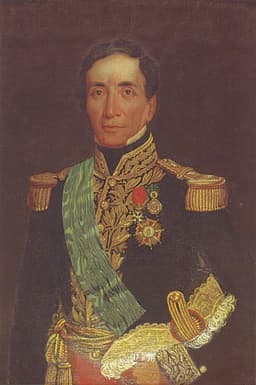
Andres de Santa Cruz
General · Modern
60.5Total
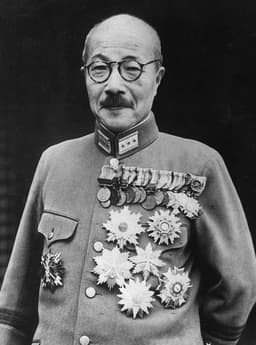
Hideki Tojo
General · Modern
53.9Total
Basic Information
Born
1792
1884
Died
1865
1948
Era
Modern
Modern
Nationality
Bolivia
Japan
Occupation
General
General
Civilization
Western
Eastern
Score Comparison
Military (10%)
67.5
70.0
Political (20%)
59.3
48.0
Influence (20%)
62.0
55.0
Legacy (20%)
50.0
50.0
Leadership (15%)
68.0
53.2
Strategy (15%)
66.3
55.0
TOTAL
60.5
53.9
Andres de Santa Cruz — Complete Timeline
1823 AD
Battle of ZepitaWar
Santa Cruz commanded Peruvian forces in a victory over Spanish royalists at Zepita during the Peruvian War of Independence. This battle enhanced his military reputation and contributed to the eventual liberation of Peru from Spanish rule.
Peruvian War of IndependenceBattleLiberation
Impact: regional
1826 AD
Presidency of PeruPolitical Action
Santa Cruz served as President of the Council of Government of Peru from 1826 to 1827, effectively ruling the country. His administration focused on centralizing power and organizing the state, but he was overthrown by a rebellion led by Agust
PresidencyPeruCentralization
Impact: national
1829 AD
Presidency of BoliviaPolitical Action◆ Major
Santa Cruz became President of Bolivia in 1829, serving until 1839. He implemented administrative reforms, stabilized the economy, and modernized the military, establishing Bolivia as a more coherent state after the chaos following independence.
PresidencyBoliviaReforms
Impact: nationalconstructive
1836 AD
War of the ConfederationWar◆ Major
Chile and Argentina declared war on the Peru-Bolivia Confederation, viewing it as a threat to the balance of power. Santa Cruz led the confederation's forces in a conflict that lasted until 1839, ultimately resulting in the confederation's defeat.
WarChileArgentinaConfederation
Impact: regional
Creation of the Peru-Bolivia ConfederationPolitical Action
Santa Cruz established the Peru-Bolivia Confederation, uniting Bolivia and Peru into a single state with himself as Supreme Protector. This confederation aimed to create a powerful Andean nation and challenged the regional influence of Chile and Argentina.
ConfederationUnificationAndean Power
Impact: regional
1839 AD
Battle of YungayWar
Santa Cruz's confederation forces were decisively defeated by the Chilean army at the Battle of Yungay. This defeat led to the dissolution of the Peru-Bolivia Confederation and forced Santa Cruz into exile, ending his political project.
BattleDefeatEnd of Confederation
Impact: regionaltragic
Exile and DeathPolitical Action
After the defeat at Yungay, Santa Cruz fled to Ecuador and later to France. He spent the rest of his life in exile, making unsuccessful attempts to return to power. He died in France in 1865, never regaining his former influence.
ExileDeathFailure
Impact: nationaltragic
Hideki Tojo — Complete Timeline
1941 AD
Attack on Pearl HarborWar
As Prime Minister, Hideki Tojo authorized the attack on the US naval base at Pearl Harbor, Hawaii. The surprise attack brought the United States into World War II. Tojo's decision was based on the belief that war with the US was inevitable due to resource embargoes and diplomatic failures.
World War IIPearl HarborUS-Japan War
Impact: globaldestructive
Appointment as Prime MinisterPolitical Action◆ Major
Hideki Tojo was appointed Prime Minister of Japan, replacing Fumimaro Konoe. He retained his position as Army Minister and later took on other portfolios, consolidating power. His appointment marked the ascendancy of the military faction in the Japanese government and the shift towards total war.
Prime MinisterMilitary GovernmentWorld War II
Impact: national
1942 AD
Fall of SingaporeWar◆ Major
Under Tojo's leadership, Japanese forces captured Singapore from the British in a swift campaign. The fall of Singapore was one of the worst British military defeats in history. It demonstrated Japanese military prowess and led to the occupation of a key strategic location in Southeast Asia.
World War IISingaporeJapanese Victory
Impact: global
1948 AD
Execution by the International Military Tribunal for the Far EastPolitical Action◆ Major
Hideki Tojo was found guilty of war crimes by the International Military Tribunal for the Far East and sentenced to death. He was executed by hanging on December 23, 1948. His trial and execution symbolized the Allied effort to hold Japanese leaders accountable for wartime atrocities.
War CrimesExecutionTokyo Trials
Impact: globaltragic
Expert Analysis
Hideki Tojo vs Andres de Santa Cruz
# The Architect and the Destroyer: Two Paths to Power in the Americas and Asia
In the winter of 1941, Hideki Tojo stood before the Imperial Diet in Tokyo and declared that Japan must “break through the iron wall” of Western domination. Half a world away and a century earlier, Andrés de Santa Cruz had stood in the presidential palace in Lima, dreaming of a different kind of breakthrough—a union of Peru and Bolivia that would stand as a bulwark against foreign interference. Both men were generals who became heads of state. Both sought to reshape their regions. But while one built a confederation that collapsed under the weight of its neighbors’ fear, the other unleashed a war that consumed his nation and ended with his execution. What drove these two men, born into different worlds, to such starkly different fates?
Origins
Hideki Tojo was born in 1884 into a military family in Tokyo, the son of a lieutenant general. His upbringing was steeped in the samurai ethos of duty, discipline, and sacrifice for the emperor. Japan’s rapid modernization after the Meiji Restoration had created a nation hungry for respect on the world stage, and Tojo absorbed this ambition like a sponge. He graduated from the Imperial Japanese Army Academy in 1905, just as Japan stunned the world by defeating Russia. For Tojo, war was not a tragedy but a tool—the sharpest instrument of national will.
Andrés de Santa Cruz, born in 1792 in La Paz, Bolivia, came from a different crucible. His father was a Spanish colonial official, his mother a Quechua noblewoman. This mixed heritage gave him a foot in two worlds—the European elite and the indigenous majority—and a lifelong conviction that unity across ethnic and political lines was possible. The wars of independence against Spain were raging when he came of age, and Santa Cruz joined the patriot forces, fighting for the liberation of Peru and Bolivia. His world was one of creation, not conquest: nations were being born, and he believed he could shape them.
Rise to Power
Tojo’s ascent was methodical and bureaucratic. He served as a military attaché in Germany, studied the efficiency of Nazi militarism, and rose through the ranks of the Kwantung Army in Manchuria. By 1937, he was chief of staff of that army, overseeing operations in China. His reputation as a hardliner grew—he believed that only decisive military force could secure Japan’s destiny. In October 1941, when Emperor Hirohito’s government was paralyzed by the choice between war and diplomacy, Tojo became Prime Minister. He was not just a general; he was the embodiment of the military’s takeover of civilian rule.
Santa Cruz’s path was more chaotic. After fighting in the Peruvian War of Independence, he served as President of the Council of Government of Peru in 1826, but his ambitions were larger. In 1829, he became President of Bolivia, where he proved an able administrator: he stabilized the currency, reformed the tax system, and built roads and schools. But his eyes were always on Peru. In 1836, he orchestrated the creation of the Peru-Bolivia Confederation, uniting the two countries under his leadership as Supreme Protector. It was a bold political experiment, born not from a single decisive moment but from years of careful negotiation and manipulation.
Leadership & Governance
Tojo governed through fear and control. As Prime Minister, he also held the posts of Army Minister and Home Minister, concentrating power that no Japanese civilian leader had ever possessed. He imposed strict censorship, suppressed dissent, and pushed through the attack on Pearl Harbor on December 7, 1941, believing that a surprise blow would cripple the United States and secure Japan’s dominance in the Pacific. His leadership style was rigid: he demanded absolute obedience and punished failure harshly. The fall of Singapore in February 1942, where Japanese forces captured 80,000 British troops, was his greatest military triumph—a lightning campaign that seemed to prove his strategy correct.
Santa Cruz governed through vision and compromise. He understood that the Peru-Bolivia Confederation needed legitimacy, not just force. He established a federal system, granted autonomy to regions, and promoted free trade between the two nations. His military record was more modest: at the Battle of Zepita in 1823, he had won a victory against Spanish royalists, but he was not a battlefield commander in the mold of Tojo. Instead, he used diplomacy and political maneuvering to hold his confederation together, balancing the interests of Peruvian elites, Bolivian landowners, and indigenous communities.
Triumph & Tragedy
Tojo’s triumph was the fall of Singapore, a victory that humiliated the British Empire and extended Japanese control across Southeast Asia. But it was a triumph built on sand. The attack on Pearl Harbor had awakened a sleeping giant. By 1944, Japan was losing ground, and Tojo’s rigid leadership crumbled. He resigned in July 1944 as American forces advanced on the Philippines. In 1948, he was hanged for war crimes by the International Military Tribunal for the Far East—a verdict that sealed his legacy as a symbol of militaristic aggression.
Santa Cruz’s triumph was the creation of the Confederation itself, a rare moment of unity in a fractured region. But Chile and Argentina saw the Confederation as a threat to the balance of power. War came in 1836, and at the Battle of Yungay on January 20, 1839, Chilean forces shattered Santa Cruz’s army. He fled into exile, first to Ecuador, then to France, where he died in 1865, a forgotten man in a foreign land.
Character & Destiny
Tojo was a man of iron will and narrow vision. He believed in the supremacy of military force and the infallibility of the Japanese spirit. His personality—rigid, authoritarian, and incapable of self-doubt—drove him to make decisions that led to national catastrophe. He once said, “Sometimes it is necessary to shut one’s eyes to the truth.” That refusal to see reality sealed his fate.
Santa Cruz was a man of grand ambition and fragile execution. He believed in the possibility of a unified Andean nation, a vision that was ahead of its time. But his personality—diplomatic, patient, but ultimately too trusting of his enemies’ goodwill—led him to underestimate the hostility of Chile and Argentina. He built a confederation that was a work of political art, but he could not defend it.
Legacy
Tojo’s legacy is one of destruction. In Japan, he is remembered as a wartime leader who led the country to ruin; outside Japan, he is a symbol of imperial aggression. His name appears in history books as a warning. Santa Cruz’s legacy is more ambiguous. In Bolivia, he is honored as a reformer who stabilized the nation; in Peru, he is seen as an ambitious meddler. The Peru-Bolivia Confederation is studied as a fascinating but failed experiment in Latin American integration—a dream that died at Yungay.
Conclusion
Tojo and Santa Cruz were both men of their time, shaped by the forces of nationalism and war. Tojo’s Japan was a rising industrial power hungry for empire; Santa Cruz’s Andes were a fractured region struggling to find its identity. One chose the sword, the other the treaty. One built a confederation, the other a war machine. Both ended in failure—one in exile, the other on the gallows. Their stories remind us that leadership is not just about power, but about the wisdom to know what can be built and what can only be destroyed. In the end, the architect and the destroyer both left ruins behind, but only one of them had ever tried to build something new.
Rankings
🥇
Andres de Santa CruzLeader
Mil: 67.5Pol: 59.3Inf: 62.0
60.5
🥈
Hideki Tojo
Mil: 70.0Pol: 48.0Inf: 55.0
53.9
+6.6 behind
How This Comparison Works
Algorithm
Each figure is scored on 6 dimensions (0—100 scale) based on structured historical data: Military (10%), Political (20%), Influence (20%), Legacy (20%), Leadership (15%), Strategy (15%). The weighted total produces the final ranking.
Data Sources
Scores are computed from structured sub-indicators in the database. Scale factors adjust for era (Ancient ×0.85, Modern ×1.0) and civilization size (Eastern ×1.05, Other ×0.80) to account for differences in population and military scale.
Maximum 3 Figures
Comparisons are limited to 2—3 figures to ensure readability and statistical meaningfulness.
Error Margins
±5 points per dimension — Sub-scores are derived from historical records with inherent uncertainty. Two figures within 5 points on a dimension should be considered roughly equivalent in that area.
Total Score Accuracy
±3 points overall — The weighted combination of 6 dimensions produces a total score with approximately ±3 points of uncertainty. Differences of less than 3 points are not statistically significant— the figures are effectively tied.
Known Limitations
- Historical records are incomplete and uneven across civilizations
- Figures from oral-tradition societies may be underrepresented
- Occupation labels can misclassify multi-role figures
- Scores measure capability and impact, not moral character
- Quantitative scoring is a comparison tool, not absolute truth
Capability Radar
Military (10%) — Battles & Warfare
Battles
60
65
Win Rate
55
40
Expansion
55
70
Political (20%) — Governance & Reform
Reform
65
30
Diplomacy
60
35
Economy
55
25
Influence (20%) — Cultural & Global Reach
Cultural
45
30
Global
35
55
Legacy (20%) — Historical Impact
Historical
50
55
Longevity
40
40
Leadership (15%) — Power & Stability
Tenure
60
60
Stability
40
20
Strategy (15%) — Tactics & Innovation
Strategy
65
50
Tactics
60
55
Reform
50
45
Similar Comparisons
Comments & Discussion
圣克鲁斯的矛头6/16/2026
数据是冰冷无情的:圣克鲁斯搞的秘鲁-玻利维亚邦联活了不到三年就崩了,GDP增长率基本来自挖银子,军队连智利一帮矿工都打不过。说他“建邦”不如说是画饼,一个靠土著民怨和白人精英勉强撑起来的纸牌屋。东条至少把日本带成了区域霸主,圣克鲁斯连南美小池塘都玩不转,吹他比东条好?别被“联邦主义者”的浪漫骗了,失败就是失败。
The Iron Will6/16/2026
Let’s cut the moral equivalency nonsense. Santa Cruz built a functional cross-border state that actually addressed indigenous rights and regional economies from 1836 to 1839. Tojo? He turned Japan into a war machine that starved its own civilians before Pearl Harbor—rice rationing started in 1940, not 1945. One man created a confederation that challenged elite interests; the other centralized power to feed his imperial fantasies. Santa Cruz lost to Chilean aggression, not incompetence. Tojo lost
大东亚共荣圈批斗者6/16/2026
我是历史系研究生,东条那套“共荣”本质是殖民剥削的遮羞布,日本在满洲搞的731部队和强征慰安妇是铁证。圣克鲁斯呢?他建的邦联确实短命,但他允许原住民参与地方议会,试图打破西班牙留下的种族隔离。别把两者并列——一个用现代化武器屠戮邻国,一个在19世纪就尝试多民族治理。论道德底线,东条连比较的资格都没有。
Pragmatic Strategist6/16/2026
You revisionists ignore the strategic context. Tojo inherited a Japan trapped by US oil embargoes and hostile alliances. His decision to strike Pearl Harbor was a calculated gamble to secure resources, not a madman’s whim. Santa Cruz had no such pressure—he voluntarily dismantled his confederation after losing one battle at Yungay. Tojo fought through four years of total war and only surrendered after atomic bombs. Santa Cruz fled to France like a coward. Different leagues entirely.
草鞋将军6/16/2026
老百姓眼里,东条是个穿草鞋啃冷饭团的战犯,圣克鲁斯是坐豪华轿子搞政变的军阀。据玻利维亚档案,圣克鲁斯在任期间贪污公款修自家庄园,还向英国贷款买军火打压政敌。东条虽坏,但他私生活简朴,战后也没卷款跑路。圣克鲁斯那套“联邦”梦,底层印第安人过得还不如殖民时代——土地被征用,税赋加重。论民生,这两个都是渣,但东条至少没当假清高的君子。