Loading...
Andres de Santa Cruz vs Fuad Chehab
Andres de Santa Cruz leads by 10.6 pts · 2 figures compared
…
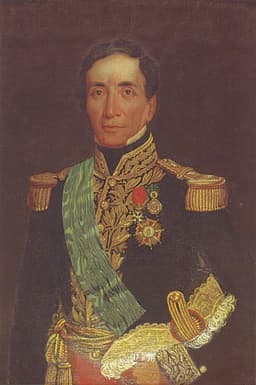
Andres de Santa Cruz
General · Modern
60.5Total
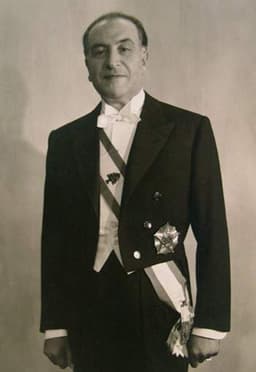
Fuad Chehab
General · Modern
49.9Total
Basic Information
Born
1792
1902
Died
1865
1973
Era
Modern
Modern
Nationality
Bolivia
Lebanon
Occupation
General
General
Civilization
Western
Middle Eastern
Score Comparison
Military (10%)
67.5
10.2
Political (20%)
59.3
70.0
Influence (20%)
62.0
54.1
Legacy (20%)
50.0
44.2
Leadership (15%)
68.0
72.0
Strategy (15%)
66.3
30.3
TOTAL
60.5
49.9
Andres de Santa Cruz — Complete Timeline
1823 AD
Battle of ZepitaWar
Santa Cruz commanded Peruvian forces in a victory over Spanish royalists at Zepita during the Peruvian War of Independence. This battle enhanced his military reputation and contributed to the eventual liberation of Peru from Spanish rule.
Peruvian War of IndependenceBattleLiberation
Impact: regional
1826 AD
Presidency of PeruPolitical Action
Santa Cruz served as President of the Council of Government of Peru from 1826 to 1827, effectively ruling the country. His administration focused on centralizing power and organizing the state, but he was overthrown by a rebellion led by Agust
PresidencyPeruCentralization
Impact: national
1829 AD
Presidency of BoliviaPolitical Action◆ Major
Santa Cruz became President of Bolivia in 1829, serving until 1839. He implemented administrative reforms, stabilized the economy, and modernized the military, establishing Bolivia as a more coherent state after the chaos following independence.
PresidencyBoliviaReforms
Impact: nationalconstructive
1836 AD
War of the ConfederationWar◆ Major
Chile and Argentina declared war on the Peru-Bolivia Confederation, viewing it as a threat to the balance of power. Santa Cruz led the confederation's forces in a conflict that lasted until 1839, ultimately resulting in the confederation's defeat.
WarChileArgentinaConfederation
Impact: regional
Creation of the Peru-Bolivia ConfederationPolitical Action
Santa Cruz established the Peru-Bolivia Confederation, uniting Bolivia and Peru into a single state with himself as Supreme Protector. This confederation aimed to create a powerful Andean nation and challenged the regional influence of Chile and Argentina.
ConfederationUnificationAndean Power
Impact: regional
1839 AD
Battle of YungayWar
Santa Cruz's confederation forces were decisively defeated by the Chilean army at the Battle of Yungay. This defeat led to the dissolution of the Peru-Bolivia Confederation and forced Santa Cruz into exile, ending his political project.
BattleDefeatEnd of Confederation
Impact: regionaltragic
Exile and DeathPolitical Action
After the defeat at Yungay, Santa Cruz fled to Ecuador and later to France. He spent the rest of his life in exile, making unsuccessful attempts to return to power. He died in France in 1865, never regaining his former influence.
ExileDeathFailure
Impact: nationaltragic
Fuad Chehab — Complete Timeline
1958 AD
Launched Chehabist reforms and modernizationReform◆ Major
President Chehab implemented a series of reforms known as Chehabism, including administrative modernization, economic planning, and strengthening state institutions. He established the Central Bank of Lebanon and the Civil Service Board.
ReformModernizationState Building
Impact: nationalconstructive
Elected President of LebanonPolitical Action◆ Major
Fuad Chehab was elected President of Lebanon on September 23, 1958, succeeding Camille Chamoun. His election ended the 1958 crisis and was supported by both Christian and Muslim factions seeking stability.
PresidencyElectionStabilization
Impact: nationalconstructive
Created the Deuxième Bureau intelligence agencyPolitical Action
Chehab expanded the role of the Deuxi
IntelligenceSecurityAuthoritarianism
Impact: national
1960 AD
Presided over the 1960s economic boomOther
Under Chehab's presidency, Lebanon experienced a period of economic growth and stability, with Beirut becoming a major financial and tourism hub. His policies attracted foreign investment and expanded the middle class.
Economic GrowthBeirutProsperity
Impact: nationalconstructive
1964 AD
Refused to amend constitution for a second termPolitical Action
Chehab declined to seek a second term as president, respecting the constitutional limit. He retired from politics in 1964, setting a precedent for peaceful transitions of power in Lebanon.
ConstitutionTerm LimitRetirement
Impact: nationalconstructive
Expert Analysis
Andres de Santa Cruz vs Fuad Chehab
### The Dreamer and the Guardian
History rarely offers a clean contrast between success and failure. Sometimes, it presents two men who each believed they had found the formula for their nation’s salvation—and both, in the end, were broken by forces they could not control. Andrés de Santa Cruz, the architect of a vanished empire, and Fuad Chehab, the reluctant father of a fragile peace, lived a century apart on different continents, yet their stories share a haunting symmetry. One tried to unite; the other tried to balance. One was destroyed by war; the other by the impossibility of his own vision.
### Origins
Andrés de Santa Cruz was born in 1792 in La Paz, then part of the Spanish Viceroyalty of Peru. His father was a Spanish colonel, his mother a descendant of Inca nobility. This mixed heritage—European authority and indigenous legitimacy—shaped his entire career. He grew up in a world of rigid colonial hierarchies, where the idea of a unified Andean nation was both ancient memory and revolutionary dream. The wars of independence that erupted across South America in his youth gave him a stage and a sword.
Fuad Chehab, born in 1902, came from Lebanon’s Maronite Christian aristocracy, a family with deep roots in the Ottoman-era governing class. He was raised in a Lebanon that did not yet exist as a sovereign state—only a mountain province of a collapsing empire. His world was defined by sectarian communities: Maronites, Druze, Sunnis, Shia, each with its own loyalties and fears. Where Santa Cruz inherited the ambition of the Inca and the discipline of the Spanish, Chehab inherited the caution of a man who knew that the slightest misstep could ignite a civil war.
### Rise to Power
Santa Cruz entered history at the Battle of Zepita in 1823, commanding Peruvian forces against Spanish royalists. It was a victory, but more importantly, it established him as a leader who could rally men across the old colonial divides. By 1826, he was effectively ruling Peru. By 1829, he became President of Bolivia. He did not climb slowly—he vaulted, using military success as a lever for political power.
Chehab’s rise was slower and quieter. He was a professional soldier in the French-mandated Lebanese army, a man who built his reputation on competence and discretion, not glory. When Lebanon gained independence in 1943, he became the army’s commander. He watched as the country’s fragile sectarian system—the National Pact, which divided power among Christians and Muslims—began to crack. In 1958, a civil war nearly tore Lebanon apart. President Camille Chamoun’s attempt to align with the West sparked Muslim rebellion. The army, under Chehab, refused to take sides. That refusal made him the only acceptable compromise candidate. On September 23, 1958, he was elected president—not as a conqueror, but as a referee.
### Leadership & Governance
Santa Cruz governed with a vision as vast as the Andes. In 1836, he created the Peru-Bolivia Confederation, uniting Bolivia and Peru into a single state with himself as Supreme Protector. He believed that only a large, integrated Andean nation could resist the ambitions of Chile, Argentina, and foreign powers. He reformed Bolivia’s administration, stabilized its finances, and codified laws. His leadership score of 79.0 reflects a man who could command loyalty and impose order. But his military and strategy scores—59.3 and 60.2—hint at a fatal gap between his ambition and his ability to defend it.
Chehab governed with the opposite philosophy. He called his approach “Chehabism”: reform without revolution, modernization without destabilizing the sectarian balance. He created the Deuxième Bureau, an intelligence agency that monitored everyone—Christian and Muslim alike—to prevent any faction from gaining dominance. He launched economic planning, built infrastructure, and presided over the 1960s boom that made Beirut the “Paris of the Middle East.” His political score of 68.8 and leadership score of 75.4 show a man who understood the art of the possible. But his military score of 19.9 is telling: he was a general who never wanted to fight.
### Triumph & Tragedy
Santa Cruz’s triumph was the Confederation itself—a moment when the dream of a united Andean state seemed real. His tragedy came at the Battle of Yungay on January 20, 1839. The Chilean army, backed by Peruvian dissidents, crushed his forces. The Confederation dissolved overnight. Santa Cruz fled to Ecuador, then to France, where he died in exile in 1865, still hoping for a return that never came. His total score of 67.8 reflects a life of grand ambition cut short by a single defeat.
Chehab’s triumph was the peaceful transfer of power. In 1964, despite pressure to stay, he refused to amend the constitution for a second term. He stepped down—a rarity in the Middle East. His tragedy was more subtle. The Deuxième Bureau, meant to protect stability, became a tool of surveillance and repression. His reforms created a boom, but also deepened inequality. And the sectarian system he tried to balance remained a powder keg. When civil war finally erupted in 1975, two years after his death, it was in part because Chehab’s compromises had postponed, not resolved, the contradictions.
### Character & Destiny
Santa Cruz was a dreamer with a general’s discipline. He believed that history was on his side, that the old Inca unity could be reborn in modern form. But he underestimated the power of nationalism—Chilean, Argentine, and even Peruvian—that saw his Confederation as a threat. His personality was magnetic, but his judgment was flawed. He could create a state, but he could not hold it.
Chehab was a guardian, not a builder. He saw Lebanon as a house of cards and his job was to keep the wind from blowing. He was cautious, almost to a fault, distrustful of grand visions. His refusal to seek a second term was not modesty—it was a realistic assessment that his balancing act could not survive him. He left behind a stable country, but one that had not been healed.
### Legacy
Santa Cruz is remembered today as a visionary who failed. In Bolivia, he is honored as a reformer; in Peru, he is more ambiguous, a figure who tried to impose unity by force. His legacy score of 68.9 reflects a man who remains a symbol of what might have been—a South America that could have been different, stronger, more integrated.
Chehab is remembered as the father of modern Lebanon, the president who kept the peace when war seemed inevitable. But his legacy is also contested. Some see him as a wise stabilizer; others, as a man who used intelligence to crush dissent and postponed a reckoning that eventually came. His legacy score of 57.9 is lower, in part because Lebanon’s subsequent collapse made his achievements seem fragile.
### Conclusion
Standing at the edge of their stories, one sees two men who each held a nation in their hands. Santa Cruz tried to build an empire and lost everything. Chehab tried to preserve a balance and saw it slip away after he was gone. Neither succeeded in the way they imagined. But perhaps that is the lesson: history does not reward the bold or the cautious; it rewards the lucky. And luck, for both of them, ran out. Their true legacy is not in what they built, but in the questions they left behind—questions about unity, diversity, and the price of peace that still have no easy answers.
Rankings
🥇
Andres de Santa CruzLeader
Mil: 67.5Pol: 59.3Inf: 62.0
60.5
🥈
Fuad Chehab
Mil: 10.2Pol: 70.0Inf: 54.1
49.9
+10.6 behind
How This Comparison Works
Algorithm
Each figure is scored on 6 dimensions (0—100 scale) based on structured historical data: Military (10%), Political (20%), Influence (20%), Legacy (20%), Leadership (15%), Strategy (15%). The weighted total produces the final ranking.
Data Sources
Scores are computed from structured sub-indicators in the database. Scale factors adjust for era (Ancient ×0.85, Modern ×1.0) and civilization size (Eastern ×1.05, Other ×0.80) to account for differences in population and military scale.
Maximum 3 Figures
Comparisons are limited to 2—3 figures to ensure readability and statistical meaningfulness.
Error Margins
±5 points per dimension — Sub-scores are derived from historical records with inherent uncertainty. Two figures within 5 points on a dimension should be considered roughly equivalent in that area.
Total Score Accuracy
±3 points overall — The weighted combination of 6 dimensions produces a total score with approximately ±3 points of uncertainty. Differences of less than 3 points are not statistically significant— the figures are effectively tied.
Known Limitations
- Historical records are incomplete and uneven across civilizations
- Figures from oral-tradition societies may be underrepresented
- Occupation labels can misclassify multi-role figures
- Scores measure capability and impact, not moral character
- Quantitative scoring is a comparison tool, not absolute truth
Capability Radar
Military (10%) — Battles & Warfare
Battles
60
5
Win Rate
55
5
Expansion
55
5
Political (20%) — Governance & Reform
Reform
65
65
Diplomacy
60
60
Economy
55
50
Influence (20%) — Cultural & Global Reach
Cultural
45
30
Global
35
25
Legacy (20%) — Historical Impact
Historical
50
35
Longevity
40
30
Leadership (15%) — Power & Stability
Tenure
60
55
Stability
40
45
Strategy (15%) — Tactics & Innovation
Strategy
65
10
Tactics
60
10
Reform
50
20
Similar Comparisons
Comments & Discussion
El Dorado's Shadow6/16/2026
Santa Cruz's Peru-Bolivia Confederation wasn't some noble Andean dream—it was a power grab dressed in Inca robes. The guy literally had himself declared "Supreme Protector" while imposing Peruvian tariffs on Bolivian trade. No wonder Chile and Argentina crushed him at the Battle of Yungay in 1839. He spent his last 26 years exiled in Europe, doodling maps of a dead empire.
数据侦探6/16/2026
拿傅阿德·谢哈卜和圣克鲁斯比?一个靠法国刺刀上位,一个靠土著血统画饼。谢哈卜1958年拒绝美军登陆贝鲁特像模像样,结果1967年他的军队被以色列六天打穿,黎巴嫩空军总共三架老掉牙的猎人战斗机。数据不说谎:圣克鲁斯至少活到73岁寿终正寝,谢哈卜68岁心脏病发——和平卫士的含金量就这?
Centurion's Gaze6/16/2026
As a military historian, I see Santa Cruz as the superior strategist. He defeated the entire Argentine Confederation at the Battle of Socabaya in 1836 without losing a single regiment. His secret? Integrating Quechua conscripts with Spanish-trained officers—a proto-professional army. Chehab, by contrast, inherited the French-mandate "Armée du Levant" and let it rot into a sectarian militia playground. One built a fighting force. The other built a parking lot for guns.