Loading...
Andres de Santa Cruz vs Duan Qirui
Andres de Santa Cruz leads by 7.4 pts · 2 figures compared
…
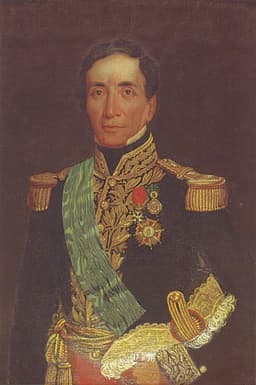
Andres de Santa Cruz
General · Modern
60.5Total
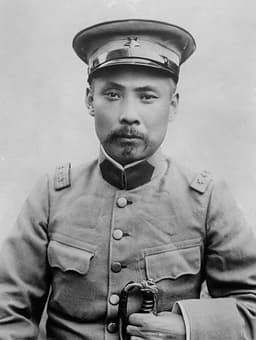
Duan Qirui
General · Modern
53.1Total
Basic Information
Born
1792
1865
Died
1865
1936
Era
Modern
Modern
Nationality
Bolivia
China
Occupation
General
General
Civilization
Western
Eastern
Score Comparison
Military (10%)
67.5
47.5
Political (20%)
59.3
53.8
Influence (20%)
62.0
53.3
Legacy (20%)
50.0
47.5
Leadership (15%)
68.0
62.0
Strategy (15%)
66.3
58.0
TOTAL
60.5
53.1
Andres de Santa Cruz — Complete Timeline
1823 AD
Battle of ZepitaWar
Santa Cruz commanded Peruvian forces in a victory over Spanish royalists at Zepita during the Peruvian War of Independence. This battle enhanced his military reputation and contributed to the eventual liberation of Peru from Spanish rule.
Peruvian War of IndependenceBattleLiberation
Impact: regional
1826 AD
Presidency of PeruPolitical Action
Santa Cruz served as President of the Council of Government of Peru from 1826 to 1827, effectively ruling the country. His administration focused on centralizing power and organizing the state, but he was overthrown by a rebellion led by Agust
PresidencyPeruCentralization
Impact: national
1829 AD
Presidency of BoliviaPolitical Action◆ Major
Santa Cruz became President of Bolivia in 1829, serving until 1839. He implemented administrative reforms, stabilized the economy, and modernized the military, establishing Bolivia as a more coherent state after the chaos following independence.
PresidencyBoliviaReforms
Impact: nationalconstructive
1836 AD
War of the ConfederationWar◆ Major
Chile and Argentina declared war on the Peru-Bolivia Confederation, viewing it as a threat to the balance of power. Santa Cruz led the confederation's forces in a conflict that lasted until 1839, ultimately resulting in the confederation's defeat.
WarChileArgentinaConfederation
Impact: regional
Creation of the Peru-Bolivia ConfederationPolitical Action
Santa Cruz established the Peru-Bolivia Confederation, uniting Bolivia and Peru into a single state with himself as Supreme Protector. This confederation aimed to create a powerful Andean nation and challenged the regional influence of Chile and Argentina.
ConfederationUnificationAndean Power
Impact: regional
1839 AD
Battle of YungayWar
Santa Cruz's confederation forces were decisively defeated by the Chilean army at the Battle of Yungay. This defeat led to the dissolution of the Peru-Bolivia Confederation and forced Santa Cruz into exile, ending his political project.
BattleDefeatEnd of Confederation
Impact: regionaltragic
Exile and DeathPolitical Action
After the defeat at Yungay, Santa Cruz fled to Ecuador and later to France. He spent the rest of his life in exile, making unsuccessful attempts to return to power. He died in France in 1865, never regaining his former influence.
ExileDeathFailure
Impact: nationaltragic
Duan Qirui — Complete Timeline
1919 AD
Resignation as Premier after the May Fourth MovementPolitical Action◆ Major
Duan Qirui resigned as Premier of the Republic of China in 1919 following the May Fourth Movement. The movement protested the weak response of the Chinese government to the Treaty of Versailles. Duan's government was blamed for failing to protect Chinese interests, leading to his resignation.
ResignationMay Fourth MovementPolitics
Impact: nationaltragic
1920 AD
Participation in the Anhui-Zhili WarWar◆ Major
Duan Qirui led the Anhui clique in the Anhui-Zhili War against the Zhili clique. The war was a major conflict in the Warlord Era. Duan's forces were defeated, leading to his resignation as Premier and the decline of the Anhui clique's power.
Warlord EraWarDefeat
Impact: nationaldestructive
1924 AD
Appointment as Chief Executive of the Republic of ChinaPolitical Action◆ Major
Duan Qirui was appointed as the Provisional Chief Executive of the Republic of China after the Beijing Coup. He headed a provisional government that attempted to unify the country but faced opposition from various warlords. His tenure was marked by political instability and military conflicts.
Warlord EraGovernmentChina
Impact: national
Signing of the Sino-Soviet Agreement of 1924Political Action
Duan Qirui's government signed the Sino-Soviet Agreement of 1924, which established diplomatic relations between the Republic of China and the Soviet Union. The agreement recognized Outer Mongolia as part of China but allowed Soviet influence. It was controversial and criticized by some Chinese nationalists.
DiplomacySoviet UnionTreaty
Impact: national
Expert Analysis
Andres de Santa Cruz vs Duan Qirui
# The Dream That Could Not Hold
On a spring morning in 1919, Beijing’s students poured into the streets, their voices rising against a government that had sold Shandong to Japan. Andres de Santa Cruz, half a world away and decades earlier, had once ridden through the Andes with a different kind of dream—a vision of a unified Peru-Bolivia Confederation that would restore the glory of the Inca Empire. Both men were generals who would shape their nations’ destinies. Both would see their grandest ambitions shattered. But why did one fall to a student protest, while the other fell to a foreign army?
Origins
Duan Qirui was born in 1865, the son of a minor official in Anhui province. The China of his youth was a crumbling empire, humiliated by foreign powers and torn by internal rebellion. He studied at the Tianjin Military Academy, absorbing Prussian-style discipline and a conviction that only a strong army could save China. His world was one of warlords, secret societies, and shifting loyalties—a chessboard where every move was a gamble.
Andres de Santa Cruz was born in 1792 in La Paz, Bolivia, to a Spanish father and an indigenous Quechua mother. He grew up in the shadow of the Andes, where the scars of Spanish conquest still bled. His mixed heritage gave him a unique perspective: he understood both the colonizer and the colonized. The wars of independence that swept Latin America in his youth offered a chance to forge something new—a nation that could unite the continent’s fractured peoples.
Both men emerged from eras of chaos, but their starting points were radically different. Duan inherited a civilization in decline, while Santa Cruz inherited a continent in rebirth.
Rise to Power
Duan’s path was forged in the Beiyang Army, the most modern military force in late Qing China. He proved himself a capable organizer and a loyal subordinate to Yuan Shikai, the man who would briefly become emperor. When Yuan died in 1916, Duan seized his chance. As premier, he controlled Beijing and commanded the Anhui clique, one of the most powerful warlord factions. His rise was a product of patronage and ruthlessness—a man who understood that in warlord China, power flowed from the barrel of a gun.
Santa Cruz’s rise was more romantic, but no less bloody. He fought alongside Simon Bolivar and Jose de San Martin, the liberators of South America. At the Battle of Zepita in 1823, he defeated Spanish royalists and earned a reputation as a brilliant tactician. By 1826, he was president of Peru; by 1829, president of Bolivia. His ascent was fueled by revolutionary ideals and the chaos of nation-building. He dreamed of a confederation that would unite the two countries he had governed.
Leadership & Governance
Duan ruled through patronage and fear. As chief executive from 1924, he attempted to stabilize China by convening a “Good Government Conference” and negotiating with the Soviet Union—signing the Sino-Soviet Agreement of 1924 that established diplomatic relations. But his governance was hollow. He could not control the warlords who paid him lip service, nor could he address the grievances of a rising nationalist movement. His military strategy was sound—he won battles against the Zhili clique—but his political wisdom was shallow. He believed force could solve problems that required legitimacy.
Santa Cruz governed with a different vision. He implemented administrative reforms in Bolivia that stabilized the economy, reformed the tax system, and promoted education. He respected indigenous communities, even reinstating some Inca-era governance structures. His creation of the Peru-Bolivia Confederation in 1836 was a masterstroke of political imagination—a state that would balance the power of Argentina and Chile. But his military strategy faltered. The War of the Confederation that followed was a disaster. Chile and Argentina saw his dream as a threat, and Santa Cruz could not match their naval power or their determination.
Triumph & Tragedy
Duan’s greatest moment was also his undoing. The May Fourth Movement of 1919 was a protest against the Treaty of Versailles, which awarded German concessions in Shandong to Japan. Duan, as premier, had secretly agreed to the terms. When students marched, he ordered a crackdown. The backlash was ferocious. He resigned that same year, his reputation in tatters. His tragedy was that he never understood that China’s future belonged not to warlords, but to the masses.
Santa Cruz’s triumph was the Confederation itself—a shining moment of unity that lasted just three years. But at the Battle of Yungay in 1839, his forces were crushed by the Chilean army. He fled to Ecuador, then to France, where he died in exile in 1865. His tragedy was that his dream was too big for his time. The nations of South America were not ready to surrender their sovereignty.
Character & Destiny
Duan was pragmatic, cynical, and ultimately hollow. He fought for power, not for a cause. His leadership score of 80.4 reflects a man who could command armies but not inspire nations. His strategy score of 81.1 hints at military brilliance wasted on a broken system.
Santa Cruz was visionary, idealistic, and ultimately doomed. He fought for a dream that could not survive the jealousy of neighbors. His leadership score of 79.0 is nearly identical to Duan’s, but his strategy score of 59.3 reveals a fatal weakness: he could imagine a new world but could not defend it.
Legacy
Duan Qirui is remembered as a footnote—a warlord who failed to see the tide of history. His total score of 71.8 places him as a minor figure in China’s long story. The May Fourth Movement, which he tried to crush, became the birth of modern Chinese nationalism.
Andres de Santa Cruz is remembered as a visionary—a man who almost united the Andes. His legacy score of 68.9 is slightly lower, but his influence score of 76.2 suggests a lasting impact. Bolivia and Peru still debate whether his confederation could have worked.
Conclusion
In the end, both men were prisoners of their times. Duan Qirui could not escape the logic of warlord politics, where loyalty was bought and sold. Andres de Santa Cruz could not escape the logic of nationalism, where borders were sacred. One fell to a student protest; the other to a foreign army. Their dreams—one of control, one of unity—crumbled not because they were unworthy, but because history had already chosen a different path. The lesson is sobering: even the most powerful generals cannot command the future.
Rankings
🥇
Andres de Santa CruzLeader
Mil: 67.5Pol: 59.3Inf: 62.0
60.5
🥈
Duan Qirui
Mil: 47.5Pol: 53.8Inf: 53.3
53.1
+7.4 behind
How This Comparison Works
Algorithm
Each figure is scored on 6 dimensions (0—100 scale) based on structured historical data: Military (10%), Political (20%), Influence (20%), Legacy (20%), Leadership (15%), Strategy (15%). The weighted total produces the final ranking.
Data Sources
Scores are computed from structured sub-indicators in the database. Scale factors adjust for era (Ancient ×0.85, Modern ×1.0) and civilization size (Eastern ×1.05, Other ×0.80) to account for differences in population and military scale.
Maximum 3 Figures
Comparisons are limited to 2—3 figures to ensure readability and statistical meaningfulness.
Error Margins
±5 points per dimension — Sub-scores are derived from historical records with inherent uncertainty. Two figures within 5 points on a dimension should be considered roughly equivalent in that area.
Total Score Accuracy
±3 points overall — The weighted combination of 6 dimensions produces a total score with approximately ±3 points of uncertainty. Differences of less than 3 points are not statistically significant— the figures are effectively tied.
Known Limitations
- Historical records are incomplete and uneven across civilizations
- Figures from oral-tradition societies may be underrepresented
- Occupation labels can misclassify multi-role figures
- Scores measure capability and impact, not moral character
- Quantitative scoring is a comparison tool, not absolute truth
Capability Radar
Military (10%) — Battles & Warfare
Battles
60
55
Win Rate
55
50
Expansion
55
40
Political (20%) — Governance & Reform
Reform
65
55
Diplomacy
60
50
Economy
55
40
Influence (20%) — Cultural & Global Reach
Cultural
45
30
Global
35
20
Legacy (20%) — Historical Impact
Historical
50
45
Longevity
40
30
Leadership (15%) — Power & Stability
Tenure
60
60
Stability
40
30
Strategy (15%) — Tactics & Innovation
Strategy
65
65
Tactics
60
60
Reform
50
70
Similar Comparisons
Comments & Discussion
**Big Data General**6/16/2026
Both men failed, but the scale of their failures differs. Duan Qirui faced 3,000 student protesters—hardly an existential threat if he'd been competent. Instead of consolidating his Beiyang Army's loyalty, he let a few hundred intellectuals topple his government. Santa Cruz at least forced Chile into a costly war (War of the Confederation, 1836-39) before losing. Duan's collapse wasn't from foreign invasion but from his own empty promises. Weak leadership, regardless of era, always gets exposed.
**安第斯预言家**6/16/2026
圣克鲁斯完胜段祺瑞,原因很简单:前者试图恢复印加帝国的荣光,是有根脉的民族愿景;后者只是北洋军阀内斗的产物,连“统一”的口号都是抄袭袁世凯的。圣克鲁斯在1836年建立的秘鲁-玻利维亚邦联,至少有过短暂的经济增长和贸易开放,而段祺瑞的北洋政府除了向日本借款和镇压学生,什么都没留下。圣克鲁斯败给智利军队,是异族入侵;段祺瑞被一群学生赶下台,是民心尽失。
**Revisionist Scalpel**6/16/2026
The comparison itself is flawed. Santa Cruz was a half-Quechua general trying to unite indigenous and creole elites under a federalist dream—a genuinely revolutionary project. Duan was a military dictator who sold railway rights to Japan (1918 Nishihara Loans) to fund his civil war against fellow warlords. One built a provisional capital in Tacna to oversee his federation; the other ran Beijing like a personal fiefdom. These aren't two dreamers—one is a statesman who failed, the other a warlord
**铁血史家**6/16/2026
军事层面,圣克鲁斯完败于智利海军,但段祺瑞的“边防军”其实更差劲——1920年直皖战争中,他的主力部队因为克扣军饷而溃散,三天内就被吴佩孚击败。圣克鲁斯至少组织了三次远征(1835-1838),显示其战略规划能力。段祺瑞的军事遗产只有“北洋炮兵”的噱头,实际战斗力为零。两位将军都试图用武力统一,但圣克鲁斯死于流亡途中的疾病,段祺瑞则死于天津租界的麻将桌上——难怪历史记住的是前者的理想,而非后者的失败。
**Classics Contrarian**6/16/2026
Forget the nationalist framing; neither man understood political legitimacy. Santa Cruz thought a federation could work in a continent fractured by geography—the Andes literally split his confederation in two. Duan believed Prussian-style discipline could override China's regional warlordism. Both ignored Tacitus: "They make a desert and call it peace." Santa Cruz's