Loading...
Andres de Santa Cruz vs Deodoro da Fonseca
Andres de Santa Cruz leads by 11.7 pts · 2 figures compared
…
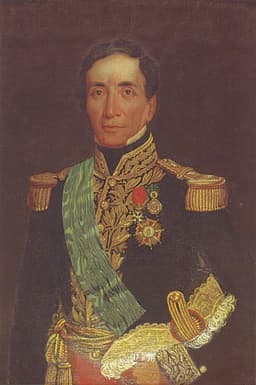
Andres de Santa Cruz
General · Modern
60.5Total
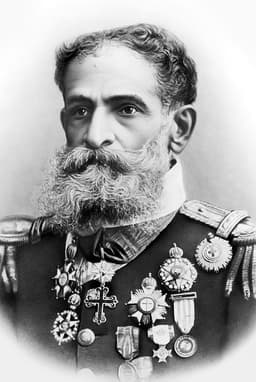
Deodoro da Fonseca
General · Modern
48.8Total
Basic Information
Born
1792
1827
Died
1865
1892
Era
Modern
Modern
Nationality
Bolivia
Brazil
Occupation
General
General
Civilization
Western
Western
Score Comparison
Military (10%)
67.5
50.0
Political (20%)
59.3
45.1
Influence (20%)
62.0
54.1
Legacy (20%)
50.0
44.2
Leadership (15%)
68.0
57.6
Strategy (15%)
66.3
38.6
TOTAL
60.5
48.8
Andres de Santa Cruz — Complete Timeline
1823 AD
Battle of ZepitaWar
Santa Cruz commanded Peruvian forces in a victory over Spanish royalists at Zepita during the Peruvian War of Independence. This battle enhanced his military reputation and contributed to the eventual liberation of Peru from Spanish rule.
Peruvian War of IndependenceBattleLiberation
Impact: regional
1826 AD
Presidency of PeruPolitical Action
Santa Cruz served as President of the Council of Government of Peru from 1826 to 1827, effectively ruling the country. His administration focused on centralizing power and organizing the state, but he was overthrown by a rebellion led by Agust
PresidencyPeruCentralization
Impact: national
1829 AD
Presidency of BoliviaPolitical Action◆ Major
Santa Cruz became President of Bolivia in 1829, serving until 1839. He implemented administrative reforms, stabilized the economy, and modernized the military, establishing Bolivia as a more coherent state after the chaos following independence.
PresidencyBoliviaReforms
Impact: nationalconstructive
1836 AD
War of the ConfederationWar◆ Major
Chile and Argentina declared war on the Peru-Bolivia Confederation, viewing it as a threat to the balance of power. Santa Cruz led the confederation's forces in a conflict that lasted until 1839, ultimately resulting in the confederation's defeat.
WarChileArgentinaConfederation
Impact: regional
Creation of the Peru-Bolivia ConfederationPolitical Action
Santa Cruz established the Peru-Bolivia Confederation, uniting Bolivia and Peru into a single state with himself as Supreme Protector. This confederation aimed to create a powerful Andean nation and challenged the regional influence of Chile and Argentina.
ConfederationUnificationAndean Power
Impact: regional
1839 AD
Battle of YungayWar
Santa Cruz's confederation forces were decisively defeated by the Chilean army at the Battle of Yungay. This defeat led to the dissolution of the Peru-Bolivia Confederation and forced Santa Cruz into exile, ending his political project.
BattleDefeatEnd of Confederation
Impact: regionaltragic
Exile and DeathPolitical Action
After the defeat at Yungay, Santa Cruz fled to Ecuador and later to France. He spent the rest of his life in exile, making unsuccessful attempts to return to power. He died in France in 1865, never regaining his former influence.
ExileDeathFailure
Impact: nationaltragic
Deodoro da Fonseca — Complete Timeline
1889 AD
Proclamation of the Brazilian RepublicPolitical Action
Deodoro da Fonseca led a military coup that overthrew Emperor Pedro II on November 15, 1889. He proclaimed the Republic of the United States of Brazil, ending 67 years of imperial rule.
CoupRepublic
Impact: globalprogressive
1891 AD
Election as First President of BrazilPolitical Action◆ Major
Deodoro da Fonseca was elected the first President of Brazil by the Constituent Congress on February 25, 1891. He took office under the new republican constitution, but his rule was brief and authoritarian.
ElectionPresidency
Impact: national
Dissolution of the National CongressPolitical Action◆ Major
Facing political opposition, Deodoro da Fonseca dissolved the National Congress on November 3, 1891, and declared a state of siege. This authoritarian act triggered a naval revolt and his eventual resignation.
AuthoritarianismPolitical Crisis
Impact: nationaldestructive
Resignation from the PresidencyPolitical Action◆ Major
Deodoro da Fonseca resigned the presidency on November 23, 1891, after a naval rebellion threatened his government. He handed power to Vice President Floriano Peixoto, ending his 9-month rule.
ResignationPolitical Crisis
Impact: nationaltragic
Expert Analysis
Deodoro da Fonseca vs Andres de Santa Cruz
### The Confederation and the Coup: Two Generals Who Shaped a Continent
In the high, thin air of the Andes, Andrés de Santa Cruz once dreamed of a great, unified nation that would restore the glory of the Inca Empire. In the steamy, tropical heat of Rio de Janeiro, Deodoro da Fonseca, a man of few words and a booming cannon, ended a monarchy with a single, decisive shout. Both were generals. Both became presidents. Yet their stories—one of a visionary who built a confederation and lost it, the other of a reluctant revolutionary who founded a republic and abandoned it—diverged as sharply as the landscapes they commanded. What drove these two men of the sword to such different fates?
### Origins
Andrés de Santa Cruz was born in 1792 in La Paz, Bolivia, a child of the colonial elite. His father was a Spanish officer, his mother a descendant of Inca royalty. This mestizo heritage—both conqueror and conquered—shaped his entire worldview. From an early age, he saw the fractured, war-torn continent not as a collection of new nations, but as a broken whole that could be mended. He was educated in the classics of European warfare but carried within him the memory of a lost indigenous empire. His era was one of chaos: the Spanish Empire was collapsing, and every caudillo with an army believed he could forge a new order.
Deodoro da Fonseca, born in 1827 in Alagoas, Brazil, came from a military family of Portuguese descent. Brazil was an empire, not a collection of warring republics. The Emperor Pedro II was a stable, respected figure. Deodoro grew up in a world where the army was a tool of the state, not a maker of states. He was a career soldier, a man of action rather than ideas. His era was one of slow, simmering tension: the monarchy was stable, but the army felt neglected, the planters wanted more power, and the abolition of slavery in 1888 had alienated the old elite. Deodoro was not a revolutionary by temperament; he was a loyalist who became a rebel out of frustration.
### Rise to Power
Santa Cruz rose through the crucible of war. In 1823, at the Battle of Zepita, he commanded Peruvian forces in a victory over Spanish royalists, earning a reputation as a capable and courageous commander. But his true genius was political. In 1826, he briefly served as President of the Council of Government of Peru, effectively ruling the country. Yet he was not content with a single nation. In 1829, he became President of Bolivia, where he began a decade of ambitious reforms: stabilizing the economy, modernizing the administration, and building a professional army. His great gamble came in 1836, when he created the Peru-Bolivia Confederation, uniting the two countries under his rule as "Supreme Protector."
Deodoro’s path was far more accidental. He was a respected general, but not a political thinker. The tipping point came in 1889, when a conspiracy of republican officers and civilian intellectuals convinced him that the Emperor had betrayed the army. On November 15, 1889, Deodoro led a bloodless coup, proclaiming the Brazilian Republic. He did not want power; he wanted respect for the military. Yet once the monarchy fell, he was thrust into the presidency, a role he neither sought nor understood. He was elected the first President of Brazil on February 25, 1891.
### Leadership & Governance
Santa Cruz was a visionary administrator. As President of Bolivia, he balanced budgets, built roads, and promoted education. His grand project, the Peru-Bolivia Confederation, was a sophisticated attempt to create a counterweight to the larger powers of Argentina and Chile. He governed with a steady hand, seeking to integrate two nations through shared institutions and a common defense. But his vision was also his blindness: he underestimated the fierce nationalism of Chile, which saw the Confederation as a mortal threat. His military strategy was sound but not brilliant—his scores in strategy (59.3) and military (60.2) reflect a competent commander, not a genius.
Deodoro, by contrast, was a disaster as a civilian leader. His military score (35.9) is low because he was never a battlefield commander; his political score (77.9) reflects his role in founding the republic, not his governance. He had no taste for negotiation or compromise. When the Constituent Congress resisted his heavy-handed style, he dissolved it on November 3, 1891, declaring a state of siege. It was the act of a general, not a statesman. The navy rebelled, and within weeks, Deodoro was forced to resign on November 23, 1891, his presidency lasting less than a year.
### Triumph & Tragedy
Santa Cruz’s greatest triumph was the creation of the Confederation itself—a bold, imaginative stroke that briefly made him the most powerful man in South America. His greatest tragedy came on January 20, 1839, at the Battle of Yungay in Peru. His forces were decisively crushed by the Chilean army. The Confederation dissolved overnight. Santa Cruz fled to Ecuador, then to France, where he spent the rest of his life in exile, a ghost of a lost empire.
Deodoro’s triumph was the Proclamation of the Republic—a single, decisive moment that ended a 67-year monarchy without a drop of blood. His tragedy was the failure of that republic. He could not adapt to the messy, democratic world he had created. His legacy is the republic itself, but his personal story is one of a man who broke an old order and could not build a new one.
### Character & Destiny
Santa Cruz was a dreamer with a plan. His mixed heritage gave him a unique perspective, but also a fatal overconfidence. He believed that a grand vision could overcome the raw power of nationalism and geography. Deodoro was a pragmatist without a purpose. He acted out of loyalty to his institution, not a political ideology. When the monarchy fell, he had no blueprint for what came next. Santa Cruz’s character was the engine of his rise and fall; Deodoro’s was the brake.
### Legacy
Santa Cruz is remembered as a visionary who nearly succeeded. In Bolivia, he is a national hero; in Peru and Chile, a cautionary tale. His legacy score of 68.9 reflects a man who shaped the political map of South America, even in failure. Deodoro is remembered as the founder of the Brazilian Republic, but his name is often overshadowed by the more stable leaders who followed. His legacy score of 60.6 is that of a transitional figure—necessary, but not beloved.
### Conclusion
Two generals, two nations, two paths. Santa Cruz tried to build a new world and was destroyed by the old one. Deodoro tore down an old world and could not inhabit the new one. One died in exile, dreaming of what might have been. The other died in his homeland, a relic of a revolution he never fully understood. Their stories remind us that the sword can open doors, but only the mind can build the rooms beyond.
Rankings
🥇
Andres de Santa CruzLeader
Mil: 67.5Pol: 59.3Inf: 62.0
60.5
🥈
Deodoro da Fonseca
Mil: 50.0Pol: 45.1Inf: 54.1
48.8
+11.7 behind
How This Comparison Works
Algorithm
Each figure is scored on 6 dimensions (0—100 scale) based on structured historical data: Military (10%), Political (20%), Influence (20%), Legacy (20%), Leadership (15%), Strategy (15%). The weighted total produces the final ranking.
Data Sources
Scores are computed from structured sub-indicators in the database. Scale factors adjust for era (Ancient ×0.85, Modern ×1.0) and civilization size (Eastern ×1.05, Other ×0.80) to account for differences in population and military scale.
Maximum 3 Figures
Comparisons are limited to 2—3 figures to ensure readability and statistical meaningfulness.
Error Margins
±5 points per dimension — Sub-scores are derived from historical records with inherent uncertainty. Two figures within 5 points on a dimension should be considered roughly equivalent in that area.
Total Score Accuracy
±3 points overall — The weighted combination of 6 dimensions produces a total score with approximately ±3 points of uncertainty. Differences of less than 3 points are not statistically significant— the figures are effectively tied.
Known Limitations
- Historical records are incomplete and uneven across civilizations
- Figures from oral-tradition societies may be underrepresented
- Occupation labels can misclassify multi-role figures
- Scores measure capability and impact, not moral character
- Quantitative scoring is a comparison tool, not absolute truth
Capability Radar
Military (10%) — Battles & Warfare
Battles
60
20
Win Rate
55
25
Expansion
55
10
Political (20%) — Governance & Reform
Reform
65
40
Diplomacy
60
25
Economy
55
15
Influence (20%) — Cultural & Global Reach
Cultural
45
20
Global
35
15
Legacy (20%) — Historical Impact
Historical
50
35
Longevity
40
20
Leadership (15%) — Power & Stability
Tenure
60
30
Stability
40
10
Strategy (15%) — Tactics & Innovation
Strategy
65
25
Tactics
60
20
Reform
50
15
Similar Comparisons
Comments & Discussion
铁幕史笔6/16/2026
作为历史数据党,我必须指出:圣克鲁斯统治下的秘鲁-玻利维亚邦联,人口不足250万,GDP勉强达到巴西帝国的20%。德奥多罗手里握着整个南美最完整的国家机器——统一货币、稳定军队、相对和平的边境。这不是什么“两个天才的悲剧对决”,这是资源差异决定结局。圣克鲁斯是巧妇难为无米之炊,德奥多罗是富二代败家子。
CANON KING6/16/2026
Santa Cruz was the real deal—a soldier-statesman who understood that nationalism alone couldn’t stabilize the Andes. His Peru-Bolivia Confederation wasn’t some romantic Inca fantasy; it was a pragmatic customs union that boosted trade and secured borders. Deodoro’s “coup” was just a temperamental general shouting “Viva a República!” because the emperor fired his friend. One built an actual multiethnic federation; the other stumbled into a republic he barely knew how to run.
火药将军6/16/2026
拿德奥多罗跟圣克鲁斯比?笑话。圣克鲁斯是正经的战略家,搞过统一关税,修过路,编过法典。德奥多罗呢?第一枪打完了就跑,财政乱成一锅粥,海军哗变他连手都抬不起来。一个真敢治国,一个只会喊口号。别拿学院派那套“两国不同”来洗地——失败就是失败。
NADA NOVA6/16/2026
Revisionist take: Santa Cruz wasn’t defeated by Chile, Argentina, or the Peruvian exiles—he was defeated by his own hubris. The Confederation was always a fragile quilt of regional loyalties and coerced alliances. Deodoro, for all his mediocrity, understood something Santa Cruz didn’t: when you topple a regime, you need the landowners and merchants on your side, not just the bayonets. Santa Cruz ignored the elites; Deodoro pandered to them. That’s why Brazil’s republic, however chaotic, survived
JAGUAR OF THE ANDES6/16/2026
Listen, I respect Deodoro as a founding father, but he was a weathervane. He proclaimed the republic, then resigned because he couldn’t handle Congress. Santa Cruz had a spine forged in the altiplano. He personally commanded campaigns, negotiated with foreign powers, and drafted a constitution that recognized indigenous governance. Deodoro was a transitional figure; Santa Cruz was a transformative one. One stamped out a monarchy; the other tried to resurrect an empire—and almost pulled it off.