Loading...
Andres de Santa Cruz vs Colin Powell
Andres de Santa Cruz leads by 2.0 pts · 2 figures compared
…
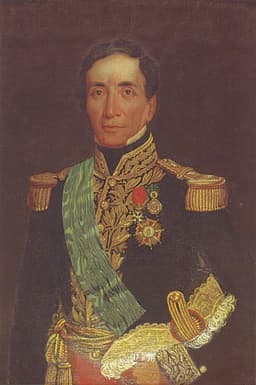
Andres de Santa Cruz
General · Modern
60.5Total

Colin Powell
General · Modern
58.5Total
Basic Information
Born
1792
1937
Died
1865
—
Era
Modern
Modern
Nationality
Bolivia
United States
Occupation
General
General
Civilization
Western
Western
Score Comparison
Military (10%)
67.5
25.0
Political (20%)
59.3
68.0
Influence (20%)
62.0
68.0
Legacy (20%)
50.0
52.0
Leadership (15%)
68.0
72.0
Strategy (15%)
66.3
50.0
TOTAL
60.5
58.5
Andres de Santa Cruz — Complete Timeline
1823 AD
Battle of ZepitaWar
Santa Cruz commanded Peruvian forces in a victory over Spanish royalists at Zepita during the Peruvian War of Independence. This battle enhanced his military reputation and contributed to the eventual liberation of Peru from Spanish rule.
Peruvian War of IndependenceBattleLiberation
Impact: regional
1826 AD
Presidency of PeruPolitical Action
Santa Cruz served as President of the Council of Government of Peru from 1826 to 1827, effectively ruling the country. His administration focused on centralizing power and organizing the state, but he was overthrown by a rebellion led by Agust
PresidencyPeruCentralization
Impact: national
1829 AD
Presidency of BoliviaPolitical Action◆ Major
Santa Cruz became President of Bolivia in 1829, serving until 1839. He implemented administrative reforms, stabilized the economy, and modernized the military, establishing Bolivia as a more coherent state after the chaos following independence.
PresidencyBoliviaReforms
Impact: nationalconstructive
1836 AD
War of the ConfederationWar◆ Major
Chile and Argentina declared war on the Peru-Bolivia Confederation, viewing it as a threat to the balance of power. Santa Cruz led the confederation's forces in a conflict that lasted until 1839, ultimately resulting in the confederation's defeat.
WarChileArgentinaConfederation
Impact: regional
Creation of the Peru-Bolivia ConfederationPolitical Action
Santa Cruz established the Peru-Bolivia Confederation, uniting Bolivia and Peru into a single state with himself as Supreme Protector. This confederation aimed to create a powerful Andean nation and challenged the regional influence of Chile and Argentina.
ConfederationUnificationAndean Power
Impact: regional
1839 AD
Battle of YungayWar
Santa Cruz's confederation forces were decisively defeated by the Chilean army at the Battle of Yungay. This defeat led to the dissolution of the Peru-Bolivia Confederation and forced Santa Cruz into exile, ending his political project.
BattleDefeatEnd of Confederation
Impact: regionaltragic
Exile and DeathPolitical Action
After the defeat at Yungay, Santa Cruz fled to Ecuador and later to France. He spent the rest of his life in exile, making unsuccessful attempts to return to power. He died in France in 1865, never regaining his former influence.
ExileDeathFailure
Impact: nationaltragic
Colin Powell — Complete Timeline
1987 AD
Appointed National Security AdvisorPolitical Action◆ Major
Powell was appointed National Security Advisor by President Ronald Reagan in November 1987, serving until January 1989. He coordinated foreign policy and national security matters, including arms control negotiations with the Soviet Union and the Iran-Iraq War, becoming the first African American in this role.
National SecurityReagan AdministrationForeign Policy
Impact: global
1989 AD
Became Chairman of the Joint Chiefs of StaffOther◆ Major
On October 1, 1989, Powell became the 12th Chairman of the Joint Chiefs of Staff, the first African American to hold the position. He oversaw U.S. military operations during the invasion of Panama (1989) and the Gulf War (1990-1991), becoming a highly visible public figure.
Military LeadershipGulf WarFirst African American
Impact: global
1990 AD
Developed the Powell DoctrineOther◆ Major
During the Gulf War planning, Powell articulated the Powell Doctrine, which stated that U.S. military force should only be used as a last resort, with overwhelming force, clear objectives, and an exit strategy. This doctrine influenced U.S. military interventions for the next decade.
Military DoctrineGulf WarStrategic Thinking
Impact: global
2001 AD
Appointed Secretary of StatePolitical Action◆ Major
On January 20, 2001, Powell was confirmed as the 65th U.S. Secretary of State under President George W. Bush, becoming the first African American to hold the office. He advocated for diplomacy and multilateralism, but his influence waned after the September 11 attacks.
DiplomacyBush AdministrationFirst African American
Impact: global
2003 AD
Presented Iraq WMD Case to the UN Security CouncilOther◆ Major
On February 5, 2003, Powell addressed the UN Security Council, presenting evidence that Iraq possessed weapons of mass destruction. The intelligence later proved to be inaccurate, damaging Powell's reputation and becoming a major controversy that he later called a 'blot' on his record.
Iraq WarUN SpeechControversy
Impact: globaldestructive
2004 AD
Resigned as Secretary of StateOther◆ Major
Powell resigned as Secretary of State on November 15, 2004, after President Bush's re-election. His departure was widely seen as a result of policy disagreements with Vice President Cheney and Secretary of Defense Rumsfeld, particularly over the conduct of the Iraq War.
ResignationIraq WarBush Administration
Impact: national
Expert Analysis
Andres de Santa Cruz vs Colin Powell
# The Dreamer and the Pragmatist
On a cold April morning in 1839, Andrés de Santa Cruz watched his grand vision collapse amid the thunder of cannon and the screams of dying men at Yungay, Peru. The Peru-Bolivia Confederation, the most ambitious political experiment in South American history, was bleeding out on the battlefield. Half a world away and a century later, another general would stand in a Pentagon briefing room in 2003, holding a vial of white powder before the United Nations, his reputation hanging on the credibility of intelligence that would later prove tragically false. Both men were builders of grand designs, yet one ended in exile, the other in a complex legacy of service and controversy. What separates the visionary who reaches too far from the institutionalist who navigates too carefully?
Origins
Andrés de Santa Cruz was born in 1792 in La Paz, Bolivia, into a world of colonial hierarchies and simmering revolutionary fervor. His father was a Spanish officer, his mother an indigenous noblewoman from Inca lineage. This mixed heritage gave him a foot in two worlds—the European military tradition and the Andean indigenous past—but full acceptance in neither. He grew up watching the Spanish Empire crumble and the new republics fight for their identities, a chaos that would shape his belief that only unity could bring stability.
Colin Powell was born in 1937 in Harlem, New York, to Jamaican immigrant parents. His world was one of racial segregation, limited opportunities, and the quiet dignity of working-class striving. Where Santa Cruz inherited a fractured colonial legacy, Powell inherited the slow, grinding struggle of the American civil rights movement. He joined the ROTC at City College not out of military ambition but because it offered structure and a path forward. His origins taught him to navigate institutions, not to build them from scratch.
Rise to Power
Santa Cruz’s rise was forged in the crucible of the Peruvian War of Independence. At the Battle of Zepita in 1823, he commanded Peruvian forces to a victory over Spanish royalists, proving himself a capable general. But his true genius lay in politics. By 1826, he served as President of the Council of Government of Peru, effectively ruling the country. Then, in 1829, he became President of Bolivia. He stabilized the economy, reformed the administration, and consolidated power with a steady hand. Yet he was not content with one nation.
Powell’s ascent was slower, more deliberate. He served two tours in Vietnam, where he witnessed the tragic costs of unclear objectives and political micromanagement. Unlike Santa Cruz’s dramatic battlefield commands, Powell’s military brilliance was organizational—he understood how to move armies, manage bureaucracies, and build consensus. He became the first African American National Security Advisor in 1987 and, in 1989, the first African American Chairman of the Joint Chiefs of Staff. His path was one of breaking barriers within an existing system, not creating a new one.
Leadership & Governance
Santa Cruz governed as a visionary reformer. In Bolivia, he introduced a new civil code, streamlined taxation, improved infrastructure, and promoted education. But his masterpiece was the Peru-Bolivia Confederation, established in 1836. He believed that uniting the two nations would create a powerful Andean state capable of resisting foreign influence and achieving lasting prosperity. As Supreme Protector, he tried to balance the interests of different regions, but his governance was top-down, authoritarian in its confidence that he alone knew the right path.
Powell’s leadership was defined by the Powell Doctrine, which he articulated after the Vietnam War: military force should be used only as a last resort, with overwhelming strength, clear objectives, and an exit strategy. He was a strategist of restraint. As Chairman of the Joint Chiefs, he managed the Gulf War with precision, building a global coalition and executing a campaign that achieved its limited goals. But his later role as Secretary of State under President George W. Bush tested his principles. He argued for caution before the Iraq War but ultimately presented the case for invasion, a decision that would haunt him.
Triumph & Tragedy
Santa Cruz’s greatest triumph was the Confederation itself—a bold, unprecedented union that briefly made him the most powerful man in South America. His tragedy came at the Battle of Yungay in 1839, where Chilean forces, fearing the Confederation’s power, decisively defeated his army. The Confederation collapsed, and Santa Cruz fled into exile, first to Ecuador, then to France, where he died in 1865, a man whose dream was too large for his time.
Powell’s triumph was the Gulf War of 1991, a textbook example of the Powell Doctrine in action: clear goals, massive force, and a swift victory. His tragedy was the Iraq War. In February 2003, he stood before the United Nations and presented evidence of weapons of mass destruction that did not exist. Whether he was misled or complicit, the moment shattered his reputation for integrity. He later called it a “blot” on his record, a stain that no amount of service could fully erase.
Character & Destiny
Santa Cruz was a dreamer with the soul of a builder. He saw history as something to be shaped, not endured. His mixed heritage gave him a unique perspective on Andean unity, but it also left him isolated—trusted by neither the Spanish elites nor the indigenous masses. His ambition was his strength and his downfall. He believed that if he could just create the right structure, peace and prosperity would follow. He underestimated the power of fear in his neighbors.
Powell was a pragmatist and an institutionalist. He rose by mastering the systems he served—the military, the State Department, the corridors of Washington. His character was defined by discipline, loyalty, and a careful avoidance of ideological extremes. But that same loyalty led him to defend policies he privately doubted. Where Santa Cruz died in exile, his dream shattered, Powell died in 2021 as a respected, if complicated, figure. Yet both men were ultimately undone by the gap between their vision and the messy reality of politics.
Legacy
Santa Cruz is remembered in Bolivia and Peru as a visionary who nearly succeeded. His Confederation is studied as a “what if” of South American history—a path not taken. Statues stand in La Paz, and historians debate whether he was a unifier or a dictator. His legacy is one of bold imagination, tempered by failure.
Powell’s legacy is more ambiguous. He broke racial barriers and gave the world a doctrine of military restraint that shaped American strategy for decades. But the Iraq War speech stains his record, a reminder that even the most careful navigator can lose his way. He is remembered as a man of dignity and competence who made a catastrophic error of judgment.
Conclusion
Two generals, two continents, two centuries. Santa Cruz built a nation and lost it; Powell served a nation and lost his credibility. One dreamed too big, the other perhaps not big enough. Their stories remind us that leadership is not just about vision or caution, but about the tragic space between what we intend and what we achieve. In the end, both men faced the same cruel truth: history judges not only our triumphs but our failures, and it forgives neither.
Rankings
🥇
Andres de Santa CruzLeader
Mil: 67.5Pol: 59.3Inf: 62.0
60.5
🥈
Colin Powell
Mil: 25.0Pol: 68.0Inf: 68.0
58.5
+2.0 behind
How This Comparison Works
Algorithm
Each figure is scored on 6 dimensions (0—100 scale) based on structured historical data: Military (10%), Political (20%), Influence (20%), Legacy (20%), Leadership (15%), Strategy (15%). The weighted total produces the final ranking.
Data Sources
Scores are computed from structured sub-indicators in the database. Scale factors adjust for era (Ancient ×0.85, Modern ×1.0) and civilization size (Eastern ×1.05, Other ×0.80) to account for differences in population and military scale.
Maximum 3 Figures
Comparisons are limited to 2—3 figures to ensure readability and statistical meaningfulness.
Error Margins
±5 points per dimension — Sub-scores are derived from historical records with inherent uncertainty. Two figures within 5 points on a dimension should be considered roughly equivalent in that area.
Total Score Accuracy
±3 points overall — The weighted combination of 6 dimensions produces a total score with approximately ±3 points of uncertainty. Differences of less than 3 points are not statistically significant— the figures are effectively tied.
Known Limitations
- Historical records are incomplete and uneven across civilizations
- Figures from oral-tradition societies may be underrepresented
- Occupation labels can misclassify multi-role figures
- Scores measure capability and impact, not moral character
- Quantitative scoring is a comparison tool, not absolute truth
Capability Radar
Military (10%) — Battles & Warfare
Battles
60
35
Win Rate
55
40
Expansion
55
20
Political (20%) — Governance & Reform
Reform
65
40
Diplomacy
60
70
Economy
55
30
Influence (20%) — Cultural & Global Reach
Cultural
45
55
Global
35
65
Legacy (20%) — Historical Impact
Historical
50
60
Longevity
40
45
Leadership (15%) — Power & Stability
Tenure
60
65
Stability
40
55
Strategy (15%) — Tactics & Innovation
Strategy
65
55
Tactics
60
45
Reform
50
60
Similar Comparisons
Comments & Discussion
El Yankesaurio6/16/2026
Santa Cruz died believing in indigenous-led federalism – that’s far more radical than anything Powell ever dreamed. Powell was a master of working within systems that marginalized people like him. Santa Cruz actually tried to restructure society. The Peru-Bolivia Confederation was flawed, but at least it was visionary. Powell's Powell Doctrine was just risk management dressed up as moral philosophy. Give me the dreamer over the bureaucrat every time.
数据拆解家6/16/2026
Powell的PPT比Santa Cruz的整个战争计划都完美,但事实核查为零。Santa Cruz至少敢打,输在战场上;Powell捏着那管洗衣粉就敢让全世界开战。你们说Powell是“务实”,我看就是高级文秘——把别人的坏主意包装得像个战略。Santa Cruz是在真刀真枪里输的,Powell是在数据房里输的,两者的专业度根本不在一个量级。
Vivus Magister6/16/2026
Look beyond the romanticism: Santa Cruz’s Confederation was a demographic nightmare. Forcing the coastal elites of Peru under a highland Aymara-Quechua power base? That’s not vision – that’s political suicide. Powell understood institutional friction. He knew that even righteous ideas need a Pentagon bureaucracy to survive. Santa Cruz blundered into Yungay because he never understood the class and ethnic terrain. That’s not a dreamer; that’s a brilliant tactician who forgot strategy.
粉笔与剑6/16/2026
我查过旧档案:Santa Cruz维持了三年稳定海关收入、土著社区自治、废除殖民遗产的强制劳役。Powell呢?参与伊朗门、捏造伊拉克证据、支持政变。Santa Cruz的“破碎的梦想”养活了印第安人,Powell的“完美体制”毁了中东。别用“复杂遗产”洗白,Santa Cruz是失败的好人,Powell是成功的坏工具。历史该还给那些实在的改革者。
Plan B Historian6/16/2026
They keep saying Santa Cruz “reached too far.” Bull. He had a working trans-Andean trade route, a functioning dual-state structure, and indigenous support. What he lacked was Peruvian coastal elites funding Chilean mercenaries. Powell had the entire US war machine and still couldn’t sell intelligence without doctoring it. “Institutionalist” is just a polite word for someone who knows the system is rigged and still chooses to play its games. Santa Cruz tried to rewrite the game.