Loading...
Andres de Santa Cruz vs Cesare Borgia
Andres de Santa Cruz leads by 0.3 pts · 2 figures compared
…
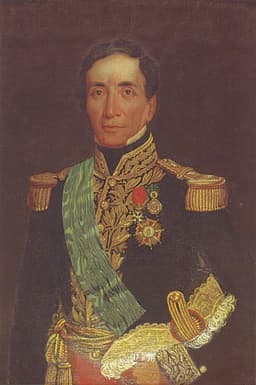
Andres de Santa Cruz
General · Modern
60.5Total
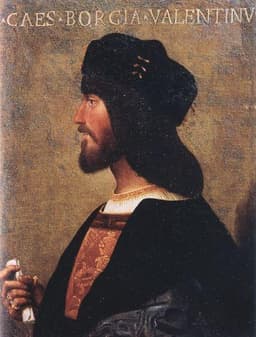
Cesare Borgia
General · Medieval
60.2Total
Basic Information
Born
1792
1475
Died
1865
1507
Era
Modern
Medieval
Nationality
Bolivia
Italy
Occupation
General
General
Civilization
Western
Western
Score Comparison
Military (10%)
67.5
67.5
Political (20%)
59.3
68.0
Influence (20%)
62.0
68.0
Legacy (20%)
50.0
40.0
Leadership (15%)
68.0
64.0
Strategy (15%)
66.3
66.3
TOTAL
60.5
60.2
Andres de Santa Cruz — Complete Timeline
1823 AD
Battle of ZepitaWar
Santa Cruz commanded Peruvian forces in a victory over Spanish royalists at Zepita during the Peruvian War of Independence. This battle enhanced his military reputation and contributed to the eventual liberation of Peru from Spanish rule.
Peruvian War of IndependenceBattleLiberation
Impact: regional
1826 AD
Presidency of PeruPolitical Action
Santa Cruz served as President of the Council of Government of Peru from 1826 to 1827, effectively ruling the country. His administration focused on centralizing power and organizing the state, but he was overthrown by a rebellion led by Agust
PresidencyPeruCentralization
Impact: national
1829 AD
Presidency of BoliviaPolitical Action◆ Major
Santa Cruz became President of Bolivia in 1829, serving until 1839. He implemented administrative reforms, stabilized the economy, and modernized the military, establishing Bolivia as a more coherent state after the chaos following independence.
PresidencyBoliviaReforms
Impact: nationalconstructive
1836 AD
War of the ConfederationWar◆ Major
Chile and Argentina declared war on the Peru-Bolivia Confederation, viewing it as a threat to the balance of power. Santa Cruz led the confederation's forces in a conflict that lasted until 1839, ultimately resulting in the confederation's defeat.
WarChileArgentinaConfederation
Impact: regional
Creation of the Peru-Bolivia ConfederationPolitical Action
Santa Cruz established the Peru-Bolivia Confederation, uniting Bolivia and Peru into a single state with himself as Supreme Protector. This confederation aimed to create a powerful Andean nation and challenged the regional influence of Chile and Argentina.
ConfederationUnificationAndean Power
Impact: regional
1839 AD
Battle of YungayWar
Santa Cruz's confederation forces were decisively defeated by the Chilean army at the Battle of Yungay. This defeat led to the dissolution of the Peru-Bolivia Confederation and forced Santa Cruz into exile, ending his political project.
BattleDefeatEnd of Confederation
Impact: regionaltragic
Exile and DeathPolitical Action
After the defeat at Yungay, Santa Cruz fled to Ecuador and later to France. He spent the rest of his life in exile, making unsuccessful attempts to return to power. He died in France in 1865, never regaining his former influence.
ExileDeathFailure
Impact: nationaltragic
Cesare Borgia — Complete Timeline
1493 AD
Appointment as CardinalPolitical Action◆ Major
Cesare Borgia was appointed cardinal by his father, Pope Alexander VI. This position gave him significant power within the Church and access to papal resources. He used his cardinalate to advance his family's political interests in Italy.
CardinalNepotismPapacy
Impact: regional
1498 AD
Resignation from the CardinalatePolitical Action◆ Major
Cesare Borgia resigned as cardinal to pursue a military and political career. He became the first person to voluntarily leave the College of Cardinals. This move allowed him to focus on conquering territories in the Romagna region of Italy.
ResignationMilitaryRomagna
Impact: regional
1499 AD
Conquest of the RomagnaWar◆ Major
Cesare Borgia, with French support, launched a campaign to conquer the cities of the Romagna. He captured Imola, Forl
ConquestRomagnaMachiavelli
Impact: regional
1503 AD
Fall from PowerPolitical Action
After the death of Pope Alexander VI, Cesare Borgia lost his political support. He was captured by his enemies and imprisoned in Spain. His territories in Italy quickly collapsed. This sudden fall demonstrated the fragility of his power base.
FallImprisonmentCollapse
Impact: regionaltragic
1507 AD
Death in BattleWar
Cesare Borgia was killed in a skirmish near Viana, Navarre, while serving as a mercenary captain. His death ended any chance of restoring his former power. He died at age 31, having failed to regain his Italian territories.
DeathMercenaryNavarre
tragic
Expert Analysis
Andres de Santa Cruz vs Cesare Borgia
The Prince and the President: Two Visions of Power in the Americas
On a dusty battlefield in northern Peru in January 1839, Andrés de Santa Cruz watched his grand experiment collapse. The Peru-Bolivia Confederation, a union he had nurtured for three years, shattered under Chilean cannon fire at Yungay. Three centuries earlier and an ocean away, another man had watched his own empire of ambition crumble: Cesare Borgia, dying in a minor skirmish in Navarre, his name already becoming synonymous with treachery and brilliance. Both men reached for supreme power in fractured lands. One became the model for Machiavelli’s immortal treatise on ruthless statecraft; the other became a footnote in the tragic history of Latin American unity. Why did one inspire a political bible while the other inspired only a failed confederation?
Origins
Cesare Borgia was born into the most scandalous family of Renaissance Italy. His father, Rodrigo Borgia, became Pope Alexander VI in 1492, transforming the papacy into a family business. Cesare was made a cardinal at eighteen, a position that brought immense wealth and influence but no spiritual calling. The Borgias were Spaniards who had clawed their way to the top of Italian society, and they governed with a calculus of poison and patronage that made them legends of infamy. Cesare grew up in a world where the rules were unwritten but absolute: loyalty was a currency, and betrayal was a strategy.
Andrés de Santa Cruz was born in 1792 in La Paz, Bolivia, into a different kind of hybrid world. His father was Spanish, his mother an indigenous Aymara noblewoman. He grew up speaking Spanish and Quechua, straddling two civilizations that had been at war for three centuries. The Spanish Empire was crumbling, and the air of the Andes was thick with revolutionary pamphlets. Santa Cruz was educated in the rigid hierarchies of colonial administration, but he also witnessed the simmering resentments of a population that had been conquered but never fully subdued.
Rise to Power
Borgia’s rise was a study in audacity. In 1498, he did what no cardinal had ever done: he resigned his sacred office to become a secular warlord. His father gave him French troops, a papal dispensation, and a title—Duke of Valentinois. With these tools, Borgia launched a lightning campaign into the Romagna, a region of central Italy that was a patchwork of petty tyrants and squabbling city-states. He captured Imola and Forlì in 1499, then moved on to Pesaro, Rimini, and Faenza. His method was simple: conquer quickly, govern ruthlessly, and eliminate rivals without hesitation. He appointed his most trusted lieutenant, Ramiro d’Orco, to pacify the region with terror, then executed d’Orco himself to win public approval—a move Machiavelli would later call “cruelty well used.”
Santa Cruz rose through a different kind of chaos. He fought for the Spanish royalists during the early wars of independence, then switched sides and joined the patriot cause. By 1823, he commanded Peruvian forces at the Battle of Zepita, a rare victory against the Spanish in a war marked by defeats. He became president of Peru in 1826, but his rule was brief and unstable. It was in Bolivia, his homeland, that he found his footing. Elected president in 1829, he spent seven years modernizing the country: reforming the tax system, building roads, centralizing the bureaucracy, and reducing the power of local caudillos. Bolivia, the poorest and most isolated of the new republics, began to function for the first time.
Leadership & Governance
Borgia governed like a Renaissance surgeon: precise, cold, and effective. He understood that power in Italy was personal, not institutional. He forged alliances with the French king, manipulated the College of Cardinals, and crushed the Orsini and Colonna families who had terrorized the Papal States for generations. His military strategy was aggressive and adaptive—he used artillery to batter down castle walls and diplomacy to isolate his enemies. But his political wisdom had a fatal flaw: it depended entirely on his father’s survival. Borgia never built institutions that could outlast his family’s support.
Santa Cruz governed like a nineteenth-century reformer. He believed that unity could overcome the fragmentation left by Spanish colonialism. The Peru-Bolivia Confederation, created in 1836, was his masterpiece: a single state with three regions—North Peru, South Peru, and Bolivia—each with its own government but all under his supreme authority. He codified laws, standardized tariffs, and promoted trade across the Andes. His military strategy was defensive and cautious; he preferred negotiation to battle. But his political wisdom had a different flaw: he underestimated the power of nationalism. Chile and Argentina saw his confederation as a threat to the balance of power, and they attacked with ferocity.
Triumph & Tragedy
Borgia’s greatest moment was also his last triumph. In 1502, at the height of his power, he controlled most of central Italy. His court at Urbino was a center of art and intrigue. Machiavelli, sent as a Florentine envoy, watched him with fascination. Then, in 1503, Pope Alexander VI died—probably of malaria, though poison was whispered. Borgia was sick at the same time, and while he recovered, his father’s death unraveled everything. His enemies rose, his armies melted away, and his allies abandoned him. He was captured, imprisoned, and eventually escaped to Navarre, where he died in a meaningless skirmish at thirty-one.
Santa Cruz’s tragedy was slower and more public. The War of the Confederation lasted three years. At first, he held his own, repelling Chilean invasions and negotiating with Argentina. But at Yungay in 1839, his army broke. The confederation dissolved overnight. Santa Cruz fled to Ecuador, then to France, where he spent the rest of his life writing memoirs and hoping for a return that never came. He died in 1865, a forgotten exile in Paris.
Character & Destiny
Borgia was a gambler who played for the highest stakes. His personality was a blend of charm and cruelty, ambition and impatience. He trusted no one and was trusted by no one. His downfall came not from a strategic error but from a structural one: he built a kingdom on the shifting sand of dynastic politics. When his father died, the foundation vanished.
Santa Cruz was a builder, not a destroyer. He had the patience to reform a country but not the ruthlessness to hold a confederation together. His personality was cautious, diplomatic, and proud. He believed that institutions could overcome history, but he could not overcome the fierce nationalism of Chile or the regional jealousies of Peru. His downfall came from overreach—a vision too large for the resources and loyalties available.
Legacy
Cesare Borgia’s legacy is paradoxically immense. He failed in his own lifetime, but Machiavelli’s *The Prince* immortalized him as the archetype of the cunning ruler. His name became a byword for political amorality, and his methods—deception, violence, manipulation—became a template for realpolitik. His influence score of 67 reflects this strange immortality: a failure who shaped how the world thinks about power.
Andrés de Santa Cruz is remembered in Bolivia as a great reformer and in Peru as a would-be conqueror. His legacy score of 69 is higher than Borgia’s, but his influence is narrower. He is a hero to Bolivian nationalists and a cautionary tale to advocates of Latin American unity. His confederation was a dream that came too early, in a continent too divided to sustain it.
Conclusion
Both men reached for the same prize: a unified state in a fractured land. Borgia tried to forge Italy through terror and family loyalty; Santa Cruz tried to forge the Andes through law and federalism. One became a symbol of cold calculation; the other, a symbol of lost hope. Their fates remind us that power is not just about strategy or will—it is about timing, about the structures that outlast the leader, and about the deep currents of history that no single hand can steer. Borgia died young, but his ghost haunts political theory. Santa Cruz died old, but his dream died young. In the end, perhaps the most dangerous thing a leader can do is to be born into a world that is not yet ready for his vision.
Rankings
🥇
Andres de Santa CruzLeader
Mil: 67.5Pol: 59.3Inf: 62.0
60.5
🥈
Cesare Borgia
Mil: 67.5Pol: 68.0Inf: 68.0
60.2
+0.3 behind
How This Comparison Works
Algorithm
Each figure is scored on 6 dimensions (0—100 scale) based on structured historical data: Military (10%), Political (20%), Influence (20%), Legacy (20%), Leadership (15%), Strategy (15%). The weighted total produces the final ranking.
Data Sources
Scores are computed from structured sub-indicators in the database. Scale factors adjust for era (Ancient ×0.85, Modern ×1.0) and civilization size (Eastern ×1.05, Other ×0.80) to account for differences in population and military scale.
Maximum 3 Figures
Comparisons are limited to 2—3 figures to ensure readability and statistical meaningfulness.
Error Margins
±5 points per dimension — Sub-scores are derived from historical records with inherent uncertainty. Two figures within 5 points on a dimension should be considered roughly equivalent in that area.
Total Score Accuracy
±3 points overall — The weighted combination of 6 dimensions produces a total score with approximately ±3 points of uncertainty. Differences of less than 3 points are not statistically significant— the figures are effectively tied.
Known Limitations
- Historical records are incomplete and uneven across civilizations
- Figures from oral-tradition societies may be underrepresented
- Occupation labels can misclassify multi-role figures
- Scores measure capability and impact, not moral character
- Quantitative scoring is a comparison tool, not absolute truth
Capability Radar
Military (10%) — Battles & Warfare
Battles
60
55
Win Rate
55
60
Expansion
55
55
Political (20%) — Governance & Reform
Reform
65
40
Diplomacy
60
55
Economy
55
35
Influence (20%) — Cultural & Global Reach
Cultural
45
55
Global
35
60
Legacy (20%) — Historical Impact
Historical
50
70
Longevity
40
65
Leadership (15%) — Power & Stability
Tenure
60
45
Stability
40
30
Strategy (15%) — Tactics & Innovation
Strategy
65
60
Tactics
60
65
Reform
50
50
Similar Comparisons
Comments & Discussion
MachiavelliStan6/16/2026
Borgia didn't just inspire Machiavelli—he *was* the template. Santa Cruz tried to be a prince but lacked the one thing Cesare mastered: the art of controlled terror. Borgia killed his own brother-in-law and crushed the Orsini faction methodically. Santa Cruz? He tried the Confederation by negotiation, not sword. Machiavelli literally wrote about how Cesare's cruelty kept the Romagna peaceful. Santa Cruz's "kindness" got his union dismantled by Chile in two years. Facts.
HistoryRerun6/16/2026
圣克鲁斯就是个高配版的包不同——只会喊“我大秘鲁玻利维亚要统一”,结果呢?1839年云盖一仗,智利人两发炮弹就把他那纸糊的邦联打碎了。博尔贾再坏,人家至少懂政治是门杀人艺术:他爹是教皇,他自己能一夜之间吊死里米尼总督。圣克鲁斯呢?他的军事扩张全靠前殖民官僚那套纸上谈兵,连个自己的军队都捏不牢。统一?笑话。
DataSkeptic6/16/2026
The comparison is lopsided. Borgia’s "fall" was a 2-year decline after his father died—he still had allies like the French king. Santa Cruz lost everything in a single battle after *three years* of stability. Borgia’s confederation (the Romagna) held for 4 years because he crushed local lords; Santa Cruz’s Peru-Bolivia try lasted 3 because he *negotiated* with them. One man’s failure was a collapse of patronage networks; the other’s was a collapse of pure military force. Different metrics, diffe
ClassicsScholar6/16/2026
博尔贾是《君主论》的活样本——马基雅维利在他身上看到了“狮子的凶猛和狐狸的狡猾”。但圣克鲁斯呢?他读的可能是“独立宣言”而不是《君主论》。1836年他建立邦联时,竟天真地以为玻利维亚和秘鲁的精英会为了“拉丁美洲命运”放弃地方利益。结果秘鲁北部贵族一转身就投了智利。博尔贾从不用道德感化敌人,只有匕首和毒药。圣克鲁斯的失败,是政治理想主义对现实政治的完败。
RevisionistCritic6/16/2026
别把博尔贾神化了。他靠的不过是教皇爸爸的钱和瑞士雇佣兵,一旦亚历山大六世死了,他立刻被赶出意大利。圣克鲁斯才是真苦命:他要在西班牙殖民废墟上,用印加帝国的影子、玻利瓦尔的理想、还有一堆不听话的caudillo拼出一个国家。博尔贾的“帝国”是家族信托基金,圣克鲁斯的邦联是凑穷