Loading...
Andres de Santa Cruz vs Bipin Rawat
Andres de Santa Cruz leads by 5.5 pts · 2 figures compared
…
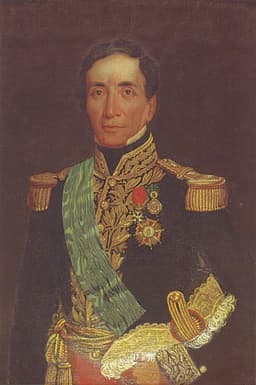
Andres de Santa Cruz
General · Modern
60.5Total
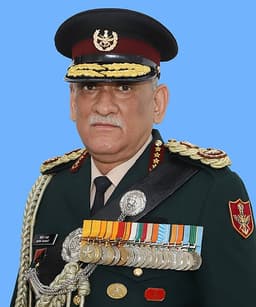
Bipin Rawat
General · Modern
55.0Total
Basic Information
Born
1792
1958
Died
1865
—
Era
Modern
Modern
Nationality
Bolivia
India
Occupation
General
General
Civilization
Western
Indian
Score Comparison
Military (10%)
67.5
40.0
Political (20%)
59.3
68.0
Influence (20%)
62.0
59.0
Legacy (20%)
50.0
45.0
Leadership (15%)
68.0
62.0
Strategy (15%)
66.3
55.0
TOTAL
60.5
55.0
Andres de Santa Cruz — Complete Timeline
1823 AD
Battle of ZepitaWar
Santa Cruz commanded Peruvian forces in a victory over Spanish royalists at Zepita during the Peruvian War of Independence. This battle enhanced his military reputation and contributed to the eventual liberation of Peru from Spanish rule.
Peruvian War of IndependenceBattleLiberation
Impact: regional
1826 AD
Presidency of PeruPolitical Action
Santa Cruz served as President of the Council of Government of Peru from 1826 to 1827, effectively ruling the country. His administration focused on centralizing power and organizing the state, but he was overthrown by a rebellion led by Agust
PresidencyPeruCentralization
Impact: national
1829 AD
Presidency of BoliviaPolitical Action◆ Major
Santa Cruz became President of Bolivia in 1829, serving until 1839. He implemented administrative reforms, stabilized the economy, and modernized the military, establishing Bolivia as a more coherent state after the chaos following independence.
PresidencyBoliviaReforms
Impact: nationalconstructive
1836 AD
War of the ConfederationWar◆ Major
Chile and Argentina declared war on the Peru-Bolivia Confederation, viewing it as a threat to the balance of power. Santa Cruz led the confederation's forces in a conflict that lasted until 1839, ultimately resulting in the confederation's defeat.
WarChileArgentinaConfederation
Impact: regional
Creation of the Peru-Bolivia ConfederationPolitical Action
Santa Cruz established the Peru-Bolivia Confederation, uniting Bolivia and Peru into a single state with himself as Supreme Protector. This confederation aimed to create a powerful Andean nation and challenged the regional influence of Chile and Argentina.
ConfederationUnificationAndean Power
Impact: regional
1839 AD
Battle of YungayWar
Santa Cruz's confederation forces were decisively defeated by the Chilean army at the Battle of Yungay. This defeat led to the dissolution of the Peru-Bolivia Confederation and forced Santa Cruz into exile, ending his political project.
BattleDefeatEnd of Confederation
Impact: regionaltragic
Exile and DeathPolitical Action
After the defeat at Yungay, Santa Cruz fled to Ecuador and later to France. He spent the rest of his life in exile, making unsuccessful attempts to return to power. He died in France in 1865, never regaining his former influence.
ExileDeathFailure
Impact: nationaltragic
Bipin Rawat — Complete Timeline
2016 AD
Led Counter-Insurgency Operations in KashmirWar
As Army Chief, Rawat oversaw intensified counter-insurgency operations in Kashmir following the 2016 unrest. He advocated for a tough approach against militants, leading to increased military presence.
KashmirCounter-insurgencyMilitary Operations
Impact: regional
Served as Chief of Army StaffPolitical Action◆ Major
Rawat was appointed Chief of Army Staff in 2016. He oversaw operations in Jammu and Kashmir, including the 2016 surgical strikes across the Line of Control, and focused on counter-insurgency.
Army ChiefSurgical StrikesCounter-insurgency
Impact: national
2019 AD
Appointed First Chief of Defence Staff of IndiaPolitical Action
General Bipin Rawat was appointed as India's first Chief of Defence Staff (CDS), a new position created to integrate the three armed services. He was tasked with improving jointness and military efficiency.
CDSMilitary ReformIntegration
Impact: nationalconstructive
2021 AD
Died in Helicopter CrashOther◆ Major
General Rawat, his wife, and 11 others died in a helicopter crash in Tamil Nadu. The crash occurred while he was traveling to a military event, and an inquiry attributed it to weather and pilot error.
DeathAccidentHelicopter Crash
Impact: nationaltragic
Expert Analysis
Andres de Santa Cruz vs Bipin Rawat
### The Dreamer and the Integrator: Two Generals Who Shaped Nations
On a December morning in 2021, a helicopter carrying India’s first Chief of Defence Staff, General Bipin Rawat, spiraled out of control over the Nilgiri hills and crashed into a mountainside, killing everyone on board. The tragedy shocked a nation that had come to see Rawat as the architect of a new, unified military command. A century and a half earlier, another general, Andrés de Santa Cruz, had watched his own grand vision crumble on the field of Yungay, high in the Peruvian Andes, before fleeing into a long, bitter exile. Both men were builders of confederations—one of armies, the other of nations. Both rose from turbulent times to the pinnacle of power. Why did one end in a state funeral and the other in obscurity? The answer lies not in luck, but in the very different worlds they sought to command.
### Origins
Andrés de Santa Cruz was born in 1792 in La Paz, then part of the Viceroyalty of the Río de la Plata. His father was a Spanish colonial official, his mother a Quechua noblewoman. This mixed heritage—European and indigenous—gave him a foot in two worlds, but it also left him an outsider to the pure-blooded elites who dominated South American politics. The continent was convulsing in the wars of independence, and Santa Cruz, like many ambitious criollos, joined the patriot forces under Simón Bolívar. He was a product of the chaos that followed the collapse of the Spanish Empire, a time when borders were fluid and a man with a sword and a plan could redraw maps.
Bipin Rawat, born in 1958 in a small town in Uttarakhand, India, came from a very different tradition. His father was an army officer, and the military was his birthright. India had been an independent nation for a decade when Rawat was born, a stable democracy with a professional, apolitical army. He grew up in the shadow of the 1965 and 1971 wars, but also in a system where the military served the civilian government, not the ambitions of a single man. His world was one of established hierarchies, not revolutionary upheaval.
### Rise to Power
Santa Cruz’s path to power was forged in battle. At the Battle of Zepita in 1823, he commanded Peruvian forces in a victory over Spanish royalists, earning a reputation as a capable commander. But his real talent was political. By 1826, he had maneuvered himself into the presidency of Peru’s governing council, a short-lived tenure that ended with his exile. Undeterred, he returned to Bolivia and in 1829 became its president. Here, he proved a masterful administrator, stabilizing the economy, reforming the legal code, and building roads. His ambition, however, was not limited to one country.
Rawat’s rise was slower, more institutional. He spent decades in the Indian Army, commanding troops in counter-insurgency operations in Kashmir and along the disputed border with China. His reputation grew for his blunt, no-nonsense style and his willingness to speak his mind. In 2016, he was appointed Chief of Army Staff, just as the government was adopting a more assertive posture toward Pakistan. He oversaw the “surgical strikes” across the Line of Control, operations that were both military and political statements. Then, in 2019, Prime Minister Modi created the post of Chief of Defence Staff specifically for him—a move that gave Rawat unprecedented authority to integrate the army, navy, and air force.
### Leadership & Governance
Santa Cruz’s greatest achievement was also his most audacious: the Peru-Bolivia Confederation, created in 1836. He united two fractious republics under a single state, with himself as Supreme Protector. He believed that only a large, powerful confederation could resist the ambitions of Chile and Argentina. He was a visionary, but his vision was brittle. He ruled through a mix of patronage and force, never building the popular legitimacy needed to sustain his creation. His military strategy was cautious, relying on defensive positions and hoping to outlast his enemies.
Rawat’s leadership was the opposite: aggressive, modernizing, and deeply embedded in a functioning state. As CDS, he did not create a new country but a new command structure. He pushed for jointness among the services, streamlining procurement and strategy. He was a reformer within a system, not a revolutionary against it. His military scores—a modest 45.8 in raw combat—reflect that his genius was organizational, not tactical. He was a manager of war, not a warrior.
### Triumph & Tragedy
Santa Cruz’s triumph was the Confederation itself, a moment when the map of South America seemed to bend to his will. But his tragedy was Yungay. In January 1839, the Chilean army, smaller but more cohesive, smashed his forces in a decisive battle. The Confederation dissolved overnight. Santa Cruz fled to Ecuador, then to France, where he died in 1865, a forgotten figure in a foreign land. His total score of 67.8 reflects a man of high influence and leadership but whose military and political foundations were ultimately too weak.
Rawat’s triumph was the creation of the CDS post itself—a reform that had been debated for decades. His tragedy was not defeat but death. The helicopter crash in 2021 cut short a career that was still in its ascent. His legacy is incomplete, a story with a missing last chapter. Yet his influence score of 73.1 is higher than Santa Cruz’s, because he died at the height of his power, his vision still alive in the institutions he shaped.
### Character & Destiny
Santa Cruz was a dreamer, a man who believed he could build a nation out of the rubble of empire. But he was also a pragmatist who never fully trusted his own people. He relied on foreign advisors and personal loyalty, not democratic consent. When his army failed, his state collapsed. Rawat was a builder of structures, not states. He operated within a democracy that was stable and a military that was professional. His character—direct, sometimes abrasive—served him well in a system that valued decisiveness. But it also made him enemies. Destiny gave Santa Cruz a battlefield defeat; it gave Rawat a sudden, shocking end.
### Legacy
Today, Santa Cruz is remembered mostly in Bolivia, where he is honored as a reformer but also blamed for the Confederation’s collapse. In Peru, he is a footnote. His legacy is one of ambition outstripping reality. Rawat’s legacy is still being written. The CDS system he pioneered is now a permanent part of India’s defense architecture. He is remembered as a patriot who died in service, his vision for a unified military still guiding policy. One man’s dream died on a battlefield; the other’s died in a crash. But only one of them built a foundation that could survive his own fall.
### Conclusion
Standing at the edge of the Andes, where Santa Cruz once imagined a new nation, and looking out over the Indian Ocean, where Rawat’s integrated fleet now sails, one sees the difference between a man who tried to create a country and a man who tried to perfect one. Santa Cruz was a product of a world without rules; Rawat, a product of a world with too many. Both were integrators, but one integrated armies, the other integrated peoples. In the end, the fate of their visions depended not on their brilliance, but on the soil in which they planted their dreams. Santa Cruz’s Confederation was a castle built on sand; Rawat’s reforms were a bridge built on bedrock. The difference is not just in the men, but in the worlds they inherited.
Rankings
🥇
Andres de Santa CruzLeader
Mil: 67.5Pol: 59.3Inf: 62.0
60.5
🥈
Bipin Rawat
Mil: 40.0Pol: 68.0Inf: 59.0
55.0
+5.5 behind
How This Comparison Works
Algorithm
Each figure is scored on 6 dimensions (0—100 scale) based on structured historical data: Military (10%), Political (20%), Influence (20%), Legacy (20%), Leadership (15%), Strategy (15%). The weighted total produces the final ranking.
Data Sources
Scores are computed from structured sub-indicators in the database. Scale factors adjust for era (Ancient ×0.85, Modern ×1.0) and civilization size (Eastern ×1.05, Other ×0.80) to account for differences in population and military scale.
Maximum 3 Figures
Comparisons are limited to 2—3 figures to ensure readability and statistical meaningfulness.
Error Margins
±5 points per dimension — Sub-scores are derived from historical records with inherent uncertainty. Two figures within 5 points on a dimension should be considered roughly equivalent in that area.
Total Score Accuracy
±3 points overall — The weighted combination of 6 dimensions produces a total score with approximately ±3 points of uncertainty. Differences of less than 3 points are not statistically significant— the figures are effectively tied.
Known Limitations
- Historical records are incomplete and uneven across civilizations
- Figures from oral-tradition societies may be underrepresented
- Occupation labels can misclassify multi-role figures
- Scores measure capability and impact, not moral character
- Quantitative scoring is a comparison tool, not absolute truth
Capability Radar
Military (10%) — Battles & Warfare
Battles
60
45
Win Rate
55
50
Expansion
55
30
Political (20%) — Governance & Reform
Reform
65
55
Diplomacy
60
50
Economy
55
30
Influence (20%) — Cultural & Global Reach
Cultural
45
35
Global
35
30
Legacy (20%) — Historical Impact
Historical
50
40
Longevity
40
20
Leadership (15%) — Power & Stability
Tenure
60
40
Stability
40
45
Strategy (15%) — Tactics & Innovation
Strategy
65
65
Tactics
60
60
Reform
50
75
Similar Comparisons
Comments & Discussion
No comments yet. Be the first to share your thoughts!