Loading...
Andres de Santa Cruz vs Francisco Morazan
Andres de Santa Cruz leads by 2.5 pts · 2 figures compared
…
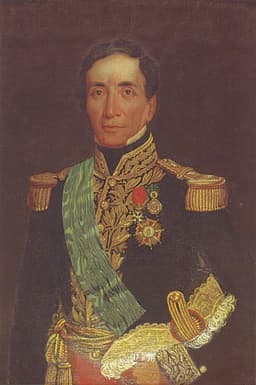
Andres de Santa Cruz
General · Modern
60.5Total
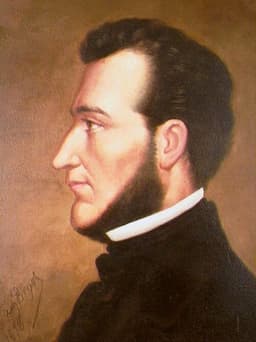
Francisco Morazan
General · Modern
58.0Total
Basic Information
Born
1792
1792
Died
1865
1842
Era
Modern
Modern
Nationality
Bolivia
Honduras
Occupation
General
General
Civilization
Western
Western
Score Comparison
Military (10%)
67.5
52.5
Political (20%)
59.3
60.0
Influence (20%)
62.0
62.0
Legacy (20%)
50.0
50.0
Leadership (15%)
68.0
68.0
Strategy (15%)
66.3
55.0
TOTAL
60.5
58.0
Andres de Santa Cruz — Complete Timeline
1823 AD
Battle of ZepitaWar
Santa Cruz commanded Peruvian forces in a victory over Spanish royalists at Zepita during the Peruvian War of Independence. This battle enhanced his military reputation and contributed to the eventual liberation of Peru from Spanish rule.
Peruvian War of IndependenceBattleLiberation
Impact: regional
1826 AD
Presidency of PeruPolitical Action
Santa Cruz served as President of the Council of Government of Peru from 1826 to 1827, effectively ruling the country. His administration focused on centralizing power and organizing the state, but he was overthrown by a rebellion led by Agust
PresidencyPeruCentralization
Impact: national
1829 AD
Presidency of BoliviaPolitical Action◆ Major
Santa Cruz became President of Bolivia in 1829, serving until 1839. He implemented administrative reforms, stabilized the economy, and modernized the military, establishing Bolivia as a more coherent state after the chaos following independence.
PresidencyBoliviaReforms
Impact: nationalconstructive
1836 AD
War of the ConfederationWar◆ Major
Chile and Argentina declared war on the Peru-Bolivia Confederation, viewing it as a threat to the balance of power. Santa Cruz led the confederation's forces in a conflict that lasted until 1839, ultimately resulting in the confederation's defeat.
WarChileArgentinaConfederation
Impact: regional
Creation of the Peru-Bolivia ConfederationPolitical Action
Santa Cruz established the Peru-Bolivia Confederation, uniting Bolivia and Peru into a single state with himself as Supreme Protector. This confederation aimed to create a powerful Andean nation and challenged the regional influence of Chile and Argentina.
ConfederationUnificationAndean Power
Impact: regional
1839 AD
Battle of YungayWar
Santa Cruz's confederation forces were decisively defeated by the Chilean army at the Battle of Yungay. This defeat led to the dissolution of the Peru-Bolivia Confederation and forced Santa Cruz into exile, ending his political project.
BattleDefeatEnd of Confederation
Impact: regionaltragic
Exile and DeathPolitical Action
After the defeat at Yungay, Santa Cruz fled to Ecuador and later to France. He spent the rest of his life in exile, making unsuccessful attempts to return to power. He died in France in 1865, never regaining his former influence.
ExileDeathFailure
Impact: nationaltragic
Francisco Morazan — Complete Timeline
1824 AD
Abolition of slavery in Central AmericaReform◆ Major
As a key leader in the liberal movement, Moraz
AbolitionSlaveryLiberal Reform
Impact: regionalprogressive
1827 AD
Battle of La TrinidadWar◆ Major
Morazán led a liberal army to victory against conservative forces at La Trinidad, Honduras. This battle was a key turning point in the Central American civil war, allowing Morazán to consolidate power and eventually become president of the federation.
BattleLiberal VictoryCivil War
Impact: regional
1830 AD
Presidency of the Federal Republic of Central AmericaPolitical Action
Morazán was elected president of the Federal Republic of Central America, a union of Guatemala, El Salvador, Honduras, Nicaragua, and Costa Rica. He pursued liberal reforms including separation of church and state, free trade, and land reform, facing opposition from conservatives.
Federal RepublicLiberal ReformsCentral America
Impact: regionalconstructive
1842 AD
Execution by firing squadPolitical Action
After a failed attempt to restore the Federal Republic, Moraz
ExecutionEnd of FederationLiberal Defeat
Impact: regionaltragic
Expert Analysis
Francisco Morazan vs Andres de Santa Cruz
### The Dream That Died Twice: Andrés de Santa Cruz and Francisco Morazán
In the spring of 1839, two men, born in the same year on different edges of the Spanish American world, faced the ruin of their grandest ambitions. On a dusty battlefield in Peru, Andrés de Santa Cruz watched his Peru-Bolivia Confederation shatter under Chilean cannon fire at Yungay. Three years later and a thousand miles north, Francisco Morazán stood before a firing squad in San José, Costa Rica, his dream of a united Central America ending in a volley of musketry. Both had tried to forge nations from fragments; both had failed. But why did their paths, so similar in origin, diverge so sharply in outcome? The answer lies not in their dreams, but in the soil from which they grew.
### Origins
Santa Cruz and Morazán were both children of the twilight of Spanish rule, born in 1792 into a world of rigid colonial hierarchies. Santa Cruz was a *mestizo* from La Paz, Bolivia, the illegitimate son of a Spanish colonel and an indigenous noblewoman. He carried within him the blood of two conquered worlds, a living symbol of the racial fault lines that would fracture the new republics. Morazán, by contrast, was a *criollo* from Tegucigalpa, Honduras, born into a family of modest but pure European descent. His father ran a small trading business, and young Francisco grew up not in the shadow of viceregal courts, but among the practical realities of commerce and rural life. Santa Cruz learned early that power flowed through lineage and military patronage; Morazán learned that power could be seized by ideas and will.
### Rise to Power
Santa Cruz rose through the ranks of the Spanish royalist army before switching sides to the patriots in 1820—a pragmatic decision common among ambitious officers. His victory at Zepita in 1823, commanding Peruvian forces against the last Spanish holdouts, cemented his reputation as a capable commander. By 1826, he was effectively ruling Peru, and by 1829, he had become president of Bolivia. His path was one of careful maneuvering, alliances with regional strongmen, and a keen eye for the main chance.
Morazán’s rise was more volatile. He began as a local official in Honduras, but the collapse of the first Central American federation in the 1820s thrust him into a brutal civil war between liberals and conservatives. His victory at La Trinidad in 1827 was not a set-piece battle like Zepita, but a desperate gamble by a provincial militia leader. It propelled him to the presidency of the Federal Republic of Central America in 1830. Where Santa Cruz inherited positions, Morazán had to conquer them.
### Leadership & Governance
As rulers, the two men revealed their deepest differences. Santa Cruz governed Bolivia with the precision of a colonial administrator. He stabilized the currency, reformed the tax system, and codified laws. The Peru-Bolivia Confederation he created in 1836 was not a democratic union, but a bureaucratic super-state, with Santa Cruz as “Supreme Protector.” He believed in order from the top down, a vision that suited the fractured Andean geography but alienated the very elites he needed to co-opt.
Morazán governed as a revolutionary. He abolished slavery in Central America in 1824, guaranteed freedom of the press, and promoted secular education. His Federal Republic was a liberal experiment, born from the Enlightenment belief that men could be remade by laws. But his reforms—attacking church privileges, confiscating conservative estates—turned the clergy and landed gentry into implacable enemies. Santa Cruz tried to build a state by accommodating power; Morazán tried to build a state by breaking it.
### Triumph & Tragedy
Santa Cruz’s greatest moment was the creation of the Confederation itself. For three years, he presided over a vast territory that controlled the Pacific coast from Panama to the Atacama Desert. It was a geopolitical masterstroke that threatened Chile and Argentina, who saw it as a rival too large to tolerate. His tragedy was that he failed to see that his confederation was a house of cards. The Battle of Yungay in 1839 was less a military defeat than a collapse of will: Peruvian officers deserted, Bolivian troops lost heart, and Santa Cruz fled into exile, never to return.
Morazán’s triumph was the sheer audacity of his vision. For a decade, he held together a federation of five fractious states through sheer personal charisma and military skill. His tragedy was that he could not hold it. By 1839, the federation had shattered into warring republics. Morazán’s final campaign, a desperate attempt to reclaim power from Costa Rica, ended with his capture. “I die with the satisfaction of having served my country,” he told his executioners, “and of having labored to establish liberty and equality.”
### Character & Destiny
Santa Cruz was a pragmatist, a man who calculated odds. He survived exile in France for decades, writing memoirs and dreaming of a return that never came. Morazán was a romantic, a man who burned bright. He chose death over surrender, a martyr’s end that he knew would outlast his enemies. One died in bed, the other before a firing squad. Their destinies were carved by their characters: Santa Cruz’s caution spared his life but cost him his legacy; Morazán’s passion cost his life but ensured his memory.
### Legacy
Today, Santa Cruz is a footnote—a brilliant administrator who built a state that vanished with a single battle. His name graces a Bolivian department, but his confederation is a historical curiosity. Morazán is a hero. His face adorns currency, his name echoes in streets and schools across Central America. He failed, but his failure was noble; he lost, but his ideals outlived him. The difference is that Santa Cruz built for himself, while Morazán built for a future he would never see.
### Conclusion
Standing at the end of their stories, one is struck by a haunting symmetry. Both men tried to unite what history had torn apart. Both were defeated by the very forces they sought to control: localism, envy, and the raw power of neighboring states. Yet Morazán’s dream, though dead, became a seed; Santa Cruz’s dream, though grand, became a ghost. The lesson is not that idealism triumphs over pragmatism, but that in the crucible of Latin America, only the dream that is willing to die for itself can ever truly live.
Rankings
🥇
Andres de Santa CruzLeader
Mil: 67.5Pol: 59.3Inf: 62.0
60.5
🥈
Francisco Morazan
Mil: 52.5Pol: 60.0Inf: 62.0
58.0
+2.5 behind
How This Comparison Works
Algorithm
Each figure is scored on 6 dimensions (0—100 scale) based on structured historical data: Military (10%), Political (20%), Influence (20%), Legacy (20%), Leadership (15%), Strategy (15%). The weighted total produces the final ranking.
Data Sources
Scores are computed from structured sub-indicators in the database. Scale factors adjust for era (Ancient ×0.85, Modern ×1.0) and civilization size (Eastern ×1.05, Other ×0.80) to account for differences in population and military scale.
Maximum 3 Figures
Comparisons are limited to 2—3 figures to ensure readability and statistical meaningfulness.
Error Margins
±5 points per dimension — Sub-scores are derived from historical records with inherent uncertainty. Two figures within 5 points on a dimension should be considered roughly equivalent in that area.
Total Score Accuracy
±3 points overall — The weighted combination of 6 dimensions produces a total score with approximately ±3 points of uncertainty. Differences of less than 3 points are not statistically significant— the figures are effectively tied.
Known Limitations
- Historical records are incomplete and uneven across civilizations
- Figures from oral-tradition societies may be underrepresented
- Occupation labels can misclassify multi-role figures
- Scores measure capability and impact, not moral character
- Quantitative scoring is a comparison tool, not absolute truth
Capability Radar
Military (10%) — Battles & Warfare
Battles
60
55
Win Rate
55
60
Expansion
55
40
Political (20%) — Governance & Reform
Reform
65
70
Diplomacy
60
45
Economy
55
50
Influence (20%) — Cultural & Global Reach
Cultural
45
45
Global
35
35
Legacy (20%) — Historical Impact
Historical
50
50
Longevity
40
40
Leadership (15%) — Power & Stability
Tenure
60
55
Stability
40
30
Strategy (15%) — Tactics & Innovation
Strategy
65
55
Tactics
60
50
Reform
50
45
Similar Comparisons
Comments & Discussion
Yungay's Ghost6/16/2026
As a military historian, I've always found Santa Cruz's tactical decisions at Yungay baffling. He had the strategic high ground and numerical parity, yet he let General Bulnes bait him into fragmenting his forces in a narrow valley. Pure Napoleonic arrogance—he assumed his veterans would crush the Chileans like they had the Argentines. Morazán, by contrast, was hopelessly outnumbered at San José but still nearly won through sheer grit. Santa Cruz lost to tactics, Morazán to geography. One failur
数字之眼6/16/2026
数据上看,圣克鲁斯的玻利维亚-秘鲁邦联人口超过200万,是中美联邦的三倍,财政收入更是指数级碾压。然而大邦联只撑了三年,小联邦却顽强存活了十五年。这说明什么?规模不等于稳定。圣克鲁斯输在过度集权——他将利马和拉巴斯强行捏合,却无视两地精英的世仇。莫拉桑虽然资源匮乏,至少理解联邦需要地方自治的弹性。不是谁更强大,而是谁更愚蠢。
Classics of the South6/16/2026
Reading Plutarch's *Parallel Lives* immediately comes to mind: Santa Cruz is the ambitious Caesar, Morazán the doomed Cato. Santa Cruz built a cross-Andean state with clear Roman-style administrative reforms—standardized coinage, centralized taxation, a national postal system. He was building an empire of law. Morazán, meanwhile, had no such grand infrastructure; his union was held together by personal charisma and liberal decrees. When Santa Cruz fell, his institutions crumbled; when Morazán di
历史的祛魅者6/16/2026
所谓“两位统一者”的叙事完全是一派胡言。圣克鲁斯根本不是什么大陆梦想家,他只是西班牙殖民总督体制的盗版者——他建立的邦联实质上恢复了上秘鲁对沿海港口的封建控制,与波旁改革前的旧制度毫无二致。莫拉桑更是个矛盾体:他一边高喊自由,一边在1834年解散萨尔瓦多议会,活脱脱的独裁者嘴脸。两人都是披着联邦外衣的霸权主义者,区别仅在于圣克鲁斯更有钱,莫拉桑更幸运地死得早。
The Ironist of History6/16/2026
The cruelest joke: both men embodied the exact fault line they tried to erase. Santa Cruz, the indigenous-blooded leader, built a state that relied on white Peruvian elites to function. Morazán, the purebred criollo, championed indigenous land rights and education reform. Each betrayed their own identity in pursuit of a synthetic nation. Santa Cruz wanted to be an Inca emperor for white merchants; Morazán wanted