Loading...
Andres de Santa Cruz vs Bayinnaung
Bayinnaung leads by 8.1 pts · 2 figures compared
…
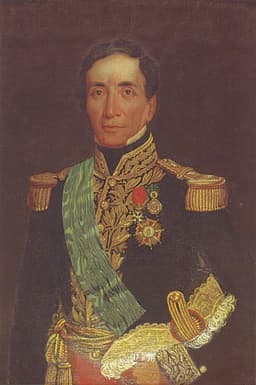
Andres de Santa Cruz
General · Modern
60.5Total
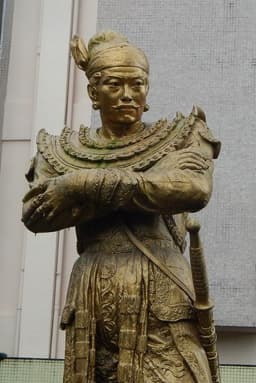
Bayinnaung
Emperor · Modern
68.6Total
Basic Information
Born
1792
1516
Died
1865
1581
Era
Modern
Modern
Nationality
Bolivia
Myanmar
Occupation
General
Emperor
Civilization
Western
Eastern
Score Comparison
Military (10%)
67.5
77.1
Political (20%)
59.3
82.0
Influence (20%)
62.0
65.0
Legacy (20%)
50.0
55.0
Leadership (15%)
68.0
74.0
Strategy (15%)
66.3
75.0
TOTAL
60.5
68.6
Andres de Santa Cruz — Complete Timeline
1823 AD
Battle of ZepitaWar
Santa Cruz commanded Peruvian forces in a victory over Spanish royalists at Zepita during the Peruvian War of Independence. This battle enhanced his military reputation and contributed to the eventual liberation of Peru from Spanish rule.
Peruvian War of IndependenceBattleLiberation
Impact: regional
1826 AD
Presidency of PeruPolitical Action
Santa Cruz served as President of the Council of Government of Peru from 1826 to 1827, effectively ruling the country. His administration focused on centralizing power and organizing the state, but he was overthrown by a rebellion led by Agust
PresidencyPeruCentralization
Impact: national
1829 AD
Presidency of BoliviaPolitical Action◆ Major
Santa Cruz became President of Bolivia in 1829, serving until 1839. He implemented administrative reforms, stabilized the economy, and modernized the military, establishing Bolivia as a more coherent state after the chaos following independence.
PresidencyBoliviaReforms
Impact: nationalconstructive
1836 AD
War of the ConfederationWar◆ Major
Chile and Argentina declared war on the Peru-Bolivia Confederation, viewing it as a threat to the balance of power. Santa Cruz led the confederation's forces in a conflict that lasted until 1839, ultimately resulting in the confederation's defeat.
WarChileArgentinaConfederation
Impact: regional
Creation of the Peru-Bolivia ConfederationPolitical Action
Santa Cruz established the Peru-Bolivia Confederation, uniting Bolivia and Peru into a single state with himself as Supreme Protector. This confederation aimed to create a powerful Andean nation and challenged the regional influence of Chile and Argentina.
ConfederationUnificationAndean Power
Impact: regional
1839 AD
Battle of YungayWar
Santa Cruz's confederation forces were decisively defeated by the Chilean army at the Battle of Yungay. This defeat led to the dissolution of the Peru-Bolivia Confederation and forced Santa Cruz into exile, ending his political project.
BattleDefeatEnd of Confederation
Impact: regionaltragic
Exile and DeathPolitical Action
After the defeat at Yungay, Santa Cruz fled to Ecuador and later to France. He spent the rest of his life in exile, making unsuccessful attempts to return to power. He died in France in 1865, never regaining his former influence.
ExileDeathFailure
Impact: nationaltragic
Bayinnaung — Complete Timeline
1550 AD
Establishment of the Toungoo EmpirePolitical Action
King Bayinnaung ascended the throne and began a series of military campaigns that created the largest empire in Southeast Asian history. At its peak, the Toungoo empire covered modern Myanmar, Thailand, Laos, and parts of China and India.
Toungoo EmpireSoutheast AsiaImperial Expansion
Impact: regionalconstructive
1557 AD
Conquest of the Shan StatesWar◆ Major
King Bayinnaung conquered the Shan States, bringing them under Toungoo control. This expansion added significant territory and resources to the Burmese empire.
Shan StatesToungoo ExpansionBurmese Empire
Impact: regional
1569 AD
Capture of AyutthayaWar
King Bayinnaung's forces captured the Siamese capital of Ayutthaya after a long siege. He installed a vassal king and made Siam a tributary state of the Toungoo empire.
Burmese-Siamese WarAyutthayaToungoo Empire
Impact: regional
1570 AD
Administrative ReformsReform◆ Major
King Bayinnaung implemented administrative reforms to govern his vast empire, including the appointment of governors and the standardization of laws and taxes. These reforms helped maintain control over conquered territories.
GovernanceAdministrationToungoo Empire
Impact: regionalconstructive
1574 AD
Conquest of Lan XangWar◆ Major
King Bayinnaung conquered the Lao kingdom of Lan Xang (modern Laos), bringing it under Toungoo control. This further expanded the Burmese empire to its greatest territorial extent.
Lan XangToungoo ExpansionLaos
Impact: regional
Expert Analysis
Andres de Santa Cruz vs Bayinnaung
### The Empire and the Confederation
In the humid heat of a Southeast Asian summer, a king stood before the shattered gates of Ayutthaya in 1569, his war elephants trumpeting victory over the ruins of Siam’s ancient capital. Three centuries later, on a cold Andean morning in 1839, a general watched his army scatter across the field of Yungay, the dream of a united Peru and Bolivia dissolving into dust. Bayinnaung of the Toungoo dynasty and Andrés de Santa Cruz of Bolivia both sought to forge vast, stable states from fractured lands. One succeeded in building the largest empire Southeast Asia had ever seen; the other saw his grand confederation collapse in a single battle. What drove these two men—separated by time, culture, and circumstance—to such different fates?
### Origins
Bayinnaung was born in 1516, in a small village near Toungoo, a minor kingdom in what is now Myanmar. His father was a village headman, but his mother claimed kinship with the royal line. The boy grew up in the shadow of war: the Shan states raided from the north, the Mon kingdoms threatened from the south, and the great Burmese kingdom of Ava had already crumbled. This was a world of constant conflict, where survival demanded ruthlessness and ambition. By contrast, Andrés de Santa Cruz entered life in 1792 in La Paz, Bolivia, the son of a Spanish nobleman and a Quechua mother. He was a *mestizo* in a society that prized pure Spanish blood, yet his mixed heritage gave him a unique perspective—he understood both the colonial elite and the indigenous majority. Where Bayinnaung’s world was one of warring kingdoms and shifting alliances, Santa Cruz’s was defined by the collapse of Spanish rule and the birth of new nations. The Burmese prince learned to fight; the Bolivian general learned to navigate politics.
### Rise to Power
Bayinnaung’s path to power was forged in blood. He served as a commander under his brother-in-law, King Tabinshwehti, and when Tabinshwehti was assassinated in 1550, the kingdom nearly fractured. Bayinnaung seized the throne, crushed rival claimants, and immediately launched campaigns to reunify Burma. His rise was a story of military conquest: by 1557, he had subdued the Shan States, adding vast territories to his domain. Santa Cruz’s ascent was more political. He fought in the Peruvian War of Independence, commanding a victory at Zepita in 1823, but his real talent lay in statecraft. He served as President of Peru’s council in 1826, then became President of Bolivia in 1829. Where Bayinnaung conquered with swords, Santa Cruz built his power through alliances, decrees, and careful administration.
### Leadership & Governance
Bayinnaung ruled as a warrior-king. His military campaigns were relentless: after taking the Shan States, he turned south, capturing Ayutthaya in 1569 after a long siege, and then conquered Lan Xang in 1574. His empire stretched from Manipur to Cambodia, the largest in Southeast Asian history. But conquest was only half the story. Bayinnaung implemented administrative reforms in 1570, appointing governors and establishing a system of tribute that held his vast domain together. He was a pragmatist, installing vassal kings in conquered territories rather than ruling directly. Santa Cruz’s governance was more visionary—and more fragile. As President of Bolivia, he stabilized the economy, reformed the tax system, and promoted education. In 1836, he created the Peru-Bolivia Confederation, uniting three states under his supreme protection. He believed a larger, unified state could resist Chile and Argentina, and he tried to balance regional interests with a centralized government. But his confederation was a house of cards, built on personal loyalty and fragile treaties.
### Triumph & Tragedy
Bayinnaung’s greatest triumph was the sheer scale of his empire. By 1580, he ruled from the Bay of Bengal to the Mekong River, and his capital at Pegu became a center of trade and culture. Yet his tragedy was that this empire was unsustainable. He spent his final years suppressing rebellions, and after his death in 1581, the Toungoo Empire quickly fragmented. His conquests were too vast, his administrative system too dependent on his personal authority. Santa Cruz’s triumph was the Confederation itself—a bold experiment in unification that briefly made him the most powerful man in the Andes. But his tragedy came at Yungay in 1839, where a smaller Chilean army routed his forces. The defeat was total: the Confederation dissolved, Santa Cruz fled to Ecuador, and then to France, where he died in exile in 1865, still dreaming of what might have been.
### Character & Destiny
Bayinnaung was a man of iron will and strategic vision. He was known as “the Conqueror of the Ten Directions,” a title that reflected both his ambition and his ruthlessness. He was also a devout Buddhist, building pagodas and sponsoring scriptures, but he never hesitated to destroy a city that resisted. His personality drove him to expand until there was nothing left to conquer—and that very drive ensured his empire would collapse without him. Santa Cruz, by contrast, was a diplomat and reformer. He believed in institutions and laws, not just armies. But his character was also his weakness: he trusted too much in treaties and not enough in the loyalty of his subordinates. When Chile attacked, his allies wavered, and his generals failed him. Where Bayinnaung’s destiny was shaped by the limits of empire, Santa Cruz’s was shaped by the fragility of a confederation built on paper.
### Legacy
Bayinnaung is remembered in Myanmar as a national hero, the king who united the country and created a golden age. His military campaigns are still studied, and his administrative reforms influenced later Burmese rulers. But his legacy is also a cautionary tale: the largest empire in Southeast Asia was also the shortest-lived. Santa Cruz’s legacy is more mixed. In Bolivia, he is honored as a capable president who brought stability and progress. In Peru, he is seen as an ambitious interloper. The Confederation he created is remembered as a noble failure, a dream of Andean unity that was crushed by Chilean power and internal division. Both men left behind monuments—Bayinnaung’s pagodas, Santa Cruz’s reforms—but also warnings about the limits of ambition.
### Conclusion
Standing at opposite ends of the early modern world, Bayinnaung and Santa Cruz faced the same fundamental challenge: how to build a lasting state from a patchwork of peoples and regions. Bayinnaung chose conquest, and his empire died with him. Santa Cruz chose confederation, and his union shattered in a single battle. Their stories remind us that the great builders of history are often prisoners of their own creations. The larger the empire, the harder it falls. The more fragile the alliance, the quicker it breaks. And in the end, the most powerful force in history is not the will of a king or the vision of a general, but the simple, stubborn weight of geography, culture, and time.
Rankings
🥇
BayinnaungLeader
Mil: 77.1Pol: 82.0Inf: 65.0
68.6
🥈
Andres de Santa Cruz
Mil: 67.5Pol: 59.3Inf: 62.0
60.5
+8.1 behind
How This Comparison Works
Algorithm
Each figure is scored on 6 dimensions (0—100 scale) based on structured historical data: Military (10%), Political (20%), Influence (20%), Legacy (20%), Leadership (15%), Strategy (15%). The weighted total produces the final ranking.
Data Sources
Scores are computed from structured sub-indicators in the database. Scale factors adjust for era (Ancient ×0.85, Modern ×1.0) and civilization size (Eastern ×1.05, Other ×0.80) to account for differences in population and military scale.
Maximum 3 Figures
Comparisons are limited to 2—3 figures to ensure readability and statistical meaningfulness.
Error Margins
±5 points per dimension — Sub-scores are derived from historical records with inherent uncertainty. Two figures within 5 points on a dimension should be considered roughly equivalent in that area.
Total Score Accuracy
±3 points overall — The weighted combination of 6 dimensions produces a total score with approximately ±3 points of uncertainty. Differences of less than 3 points are not statistically significant— the figures are effectively tied.
Known Limitations
- Historical records are incomplete and uneven across civilizations
- Figures from oral-tradition societies may be underrepresented
- Occupation labels can misclassify multi-role figures
- Scores measure capability and impact, not moral character
- Quantitative scoring is a comparison tool, not absolute truth
Capability Radar
Military (10%) — Battles & Warfare
Battles
60
85
Win Rate
55
90
Expansion
55
92
Political (20%) — Governance & Reform
Reform
65
70
Diplomacy
60
78
Economy
55
72
Influence (20%) — Cultural & Global Reach
Cultural
45
70
Global
35
55
Legacy (20%) — Historical Impact
Historical
50
75
Longevity
40
60
Leadership (15%) — Power & Stability
Tenure
60
85
Stability
40
65
Strategy (15%) — Tactics & Innovation
Strategy
65
88
Tactics
60
80
Reform
50
75
Similar Comparisons
Comments & Discussion
Tower of Elephants6/16/2026
Bayinnaung wasn’t just lucky; he mastered logistics in a way Santa Cruz never did. The Toungoo king moved 50,000 elephants across monsoon jungles to siege Ayutthaya—that’s an animal per square mile, with feed and water to match. Santa Cruz’s Confederation fell at Yungay because he couldn’t supply his troops over the Andes, leaving them starving. Logistics win empires, not dreams of unity.
战象之王6/16/2026
Bayinnaung的帝国建立在血腥的宗教统一上,强迫傣族称臣改信佛教,把寺庙烧成灰。Santa Cruz至少尝试用经济联盟让秘鲁和玻利维亚平等,失败在对抗智利版的“殖民主义”。Bayinnaung是征服狂人,Santa Cruz是理想主义者被现实碾压。选后者,哪怕他输得惨。
Data Detox6/16/2026
Santa Cruz’s Confederation of Peru and Bolivia had a 1.5 to 1 GDP advantage over Chile at Yungay, yet he still lost. Bayinnaung conquered a 700,000 square mile empire—maybe the largest in 16th-century Asia—with zero economic planning, just brute force. Statistics show Santa Cruz had the resources, but his leadership was a spreadsheet failure: all theory, no execution. Give me Bayinnaung’s instinct over a banker’s roadmap.
历史解码师6/16/2026
Santa Cruz的失败不是命运的玩笑,而是战略盲点。Bayinnaung用佛教寺院体系统一缅甸,每个省设僧王稳定地方;Santa Cruz却忽视高原土著权益,强迫征税导致内部叛乱。Yungay之战前,玻利维亚军队里一半是游击偏门。帝国不是贴纸拼图,必须是文化骨架,Santa Cruz只画了财务蓝图,没建地基。
Revisionist Flamethrower6/16/2026
Glorify Bayinnaung if you want, but his “empire” was a paper tiger within a generation—his son Nanda Bayin lost Siam and got executed by 1599. Santa Cruz’s Confederation died with him, but his economic policies like a unified tariff zone inspired later Andean integration. Fine, Bayinnaung won battles, but Santa Cruz planted seeds for modern Bolivia. I’ll take the visionary over the elephant herder.
山海狂人6/16/2026
你们都说Bayinnaung成功,可他屠城Ayutthaya用了四万人,把泰国北部变成废墟,结果缅甸国库耗尽,子孙无福享受。Santa Cruz至少用外交和商业拉拢过智利和阿根廷,差点建成长三角。历史写胜者即美,但输家Santa Cruz的《秘鲁-玻利维亚基础法》比Bayinnaung的屠杀更值得纪念。个人偏好:失败者的蓝图比胜利者的尸体