Loading...
Andres de Santa Cruz vs Antonio Lopez de Santa Anna
Andres de Santa Cruz leads by 1.6 pts · 2 figures compared
…
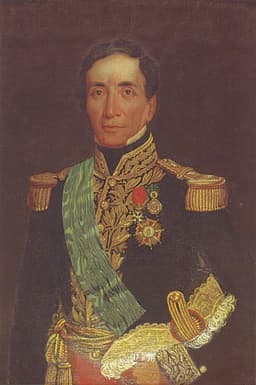
Andres de Santa Cruz
General · Modern
60.5Total
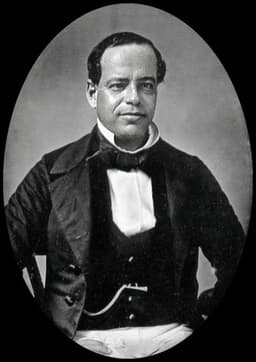
Antonio Lopez de Santa Anna
General · Modern
58.9Total
Basic Information
Born
1792
1794
Died
1865
1876
Era
Modern
Modern
Nationality
Bolivia
Mexico
Occupation
General
General
Civilization
Western
Western
Score Comparison
Military (10%)
67.5
70.0
Political (20%)
59.3
46.6
Influence (20%)
62.0
56.7
Legacy (20%)
50.0
58.0
Leadership (15%)
68.0
68.0
Strategy (15%)
66.3
60.0
TOTAL
60.5
58.9
Andres de Santa Cruz — Complete Timeline
1823 AD
Battle of ZepitaWar
Santa Cruz commanded Peruvian forces in a victory over Spanish royalists at Zepita during the Peruvian War of Independence. This battle enhanced his military reputation and contributed to the eventual liberation of Peru from Spanish rule.
Peruvian War of IndependenceBattleLiberation
Impact: regional
1826 AD
Presidency of PeruPolitical Action
Santa Cruz served as President of the Council of Government of Peru from 1826 to 1827, effectively ruling the country. His administration focused on centralizing power and organizing the state, but he was overthrown by a rebellion led by Agust
PresidencyPeruCentralization
Impact: national
1829 AD
Presidency of BoliviaPolitical Action◆ Major
Santa Cruz became President of Bolivia in 1829, serving until 1839. He implemented administrative reforms, stabilized the economy, and modernized the military, establishing Bolivia as a more coherent state after the chaos following independence.
PresidencyBoliviaReforms
Impact: nationalconstructive
1836 AD
War of the ConfederationWar◆ Major
Chile and Argentina declared war on the Peru-Bolivia Confederation, viewing it as a threat to the balance of power. Santa Cruz led the confederation's forces in a conflict that lasted until 1839, ultimately resulting in the confederation's defeat.
WarChileArgentinaConfederation
Impact: regional
Creation of the Peru-Bolivia ConfederationPolitical Action
Santa Cruz established the Peru-Bolivia Confederation, uniting Bolivia and Peru into a single state with himself as Supreme Protector. This confederation aimed to create a powerful Andean nation and challenged the regional influence of Chile and Argentina.
ConfederationUnificationAndean Power
Impact: regional
1839 AD
Battle of YungayWar
Santa Cruz's confederation forces were decisively defeated by the Chilean army at the Battle of Yungay. This defeat led to the dissolution of the Peru-Bolivia Confederation and forced Santa Cruz into exile, ending his political project.
BattleDefeatEnd of Confederation
Impact: regionaltragic
Exile and DeathPolitical Action
After the defeat at Yungay, Santa Cruz fled to Ecuador and later to France. He spent the rest of his life in exile, making unsuccessful attempts to return to power. He died in France in 1865, never regaining his former influence.
ExileDeathFailure
Impact: nationaltragic
Antonio Lopez de Santa Anna — Complete Timeline
1823 AD
Led the Plan of Casa Mata rebellionPolitical Action
Santa Anna, then a general, issued the Plan of Casa Mata on February 1, 1823, calling for the overthrow of Emperor Agust
RebellionOverthrowRepublic
Impact: nationalconstructive
1829 AD
Defended Mexico at the Battle of TampicoWar◆ Major
Santa Anna commanded Mexican forces that defeated a Spanish invasion force at Tampico on September 11, 1829. The victory ended Spain's last attempt to reconquer Mexico and made Santa Anna a national hero. He was hailed as the 'Hero of Tampico' and used this fame to advance politically.
VictorySpanish InvasionNational Hero
Impact: nationalconstructive
1833 AD
Became President of Mexico for the first timePolitical Action◆ Major
Santa Anna was elected President of Mexico in 1833. He quickly delegated power to Vice President Valent
PresidencyPolitical InstabilityPower
Impact: national
1836 AD
Commanded at the Siege of the AlamoWar◆ Major
Santa Anna personally led the Mexican army in the siege of the Alamo mission in San Antonio, Texas. After a 13-day siege, Mexican forces stormed the fort on March 6, 1836, killing all 180-250 Texan defenders. The battle became a symbol of Texan resistance and a rallying cry for independence.
BattleTexas RevolutionAlamo
Impact: regionaldestructive
Defeated and captured at the Battle of San JacintoWar
Santa Anna's army was surprised and routed by Texan forces under Sam Houston at the Battle of San Jacinto on April 21, 1836. Santa Anna was captured the next day. He was forced to sign the Treaties of Velasco, recognizing Texan independence, though Mexico later repudiated them.
DefeatCaptureTexas Independence
Impact: regionaltragic
1847 AD
Lost the Mexican-American WarWar
Santa Anna returned from exile to command Mexican forces during the Mexican-American War. Despite initial efforts, his army was defeated at the Battle of Cerro Gordo and later at the Battle of Chapultepec. US forces captured Mexico City on September 14, 1847, leading to the Treaty of Guadalupe Hidalgo and massive territorial losses.
Mexican-American WarDefeatTerritorial Loss
Impact: globaltragic
1853 AD
Sold La Mesilla to the United StatesPolitical Action◆ Major
During his final presidency, Santa Anna agreed to the Gadsden Purchase, selling 29,670 square miles of territory (La Mesilla) to the United States for $10 million. The sale was widely condemned in Mexico as a betrayal. This act further damaged his reputation and led to his overthrow.
Territorial CessionGadsden PurchaseBetrayal
Impact: nationaldestructive
1855 AD
Overthrown and exiled for the final timePolitical Action◆ Major
The Plan of Ayutla, led by Juan
OverthrowExileEnd of Career
Impact: nationaltragic
Expert Analysis
Andres de Santa Cruz vs Antonio Lopez de Santa Anna
# The Two Santas: How Two Men Named Santa Shaped the Destiny of South America
On a dusty battlefield in Peru, in the year 1823, two young generals fought on the same side against Spanish royalists. One was Antonio López de Santa Anna, a dashing Mexican officer who had already survived a wound that nearly took his leg. The other was Andrés de Santa Cruz, a Bolivian commander of indigenous and Spanish blood who would soon dream of an empire that united two nations. They never met again, but their parallel paths—one toward glory and ruin, the other toward vision and defeat—tell a story about the difference between ambition and statesmanship, between seizing power and building something that lasts.
Origins
Santa Anna was born in 1794 in Jalapa, Mexico, the son of a middle-class Spanish colonial official. He grew up in a world where the Spanish Empire was crumbling and opportunity beckoned for those bold enough to seize it. He joined the army at fifteen, and by his twenties, he had already switched sides from royalist to revolutionary, sensing which way the wind was blowing. His era was one of chaos—Mexico’s first decades of independence were a whirlwind of coups, constitutions, and foreign invasions. Santa Anna learned early that loyalty was a commodity to be traded.
Andrés de Santa Cruz, born two years earlier in 1792 in La Paz, Bolivia, came from a different world. His father was a Spanish military officer, his mother a descendant of Inca nobility. He grew up bilingual in Spanish and Quechua, fluent in two civilizations. Where Santa Anna saw Mexico as a prize to be won, Santa Cruz saw the Andes as a landscape to be united. His era, too, was one of revolution, but the wars of independence in South America had a different character: they were fought by armies that marched across entire continents, led by men like Simón Bolívar who dreamed of grand federations.
Rise to Power
Santa Anna’s path was a study in opportunism. In 1823, he issued the Plan of Casa Mata, a rebellion that toppled Emperor Agustín de Iturbide. He was twenty-nine. Six years later, in 1829, he became a national hero by defeating a Spanish invasion at the Battle of Tampico, a victory that earned him the title “Hero of Tampico.” He parlayed this fame into the presidency in 1833, but he was never much interested in governing. He handed power to his vice president and retired to his hacienda, waiting for the inevitable crisis that would bring him back.
Santa Cruz rose differently. He fought through the ranks of the independence armies, commanding Peruvian forces at the Battle of Zepita in 1823. He served as president of Peru’s council of government from 1826 to 1827, then became president of Bolivia in 1829. Where Santa Anna’s career was a series of dramatic entrances and exits, Santa Cruz’s was a slow, patient climb. He spent a decade governing Bolivia before attempting his grand project.
Leadership & Governance
As a ruler, Santa Anna was a master of political theater but a disaster at administration. He governed through charisma and fear, changing constitutions to suit his needs, and delegating the boring work of running a country to others. His military strategy was bold but reckless—at the Alamo in 1836, he ordered a frontal assault that cost hundreds of Mexican lives, then divided his army and was captured at San Jacinto weeks later. He signed away Texas while a prisoner. He sold the Mesilla Valley to the United States in 1853 for $10 million, a transaction that still haunts Mexican memory.
Santa Cruz governed as a reformer. He stabilized Bolivia’s economy, modernized its bureaucracy, and promoted education. His military strategy was cautious and diplomatic—he preferred to win through alliances and treaties. The Peru-Bolivia Confederation, created in 1836, was a masterpiece of political imagination: a single state uniting two nations, with Santa Cruz as Supreme Protector. He believed that only through unity could the Andean republics resist the ambitions of Chile and Argentina.
Triumph & Tragedy
Santa Anna’s greatest triumph was Tampico, where he defeated a Spanish invasion and cemented his reputation as a defender of Mexico. His greatest tragedy was the Mexican-American War of 1847, when he returned from exile to command an army that was outnumbered, outgunned, and outgeneraled. He lost Mexico City, lost half his country’s territory, and lost whatever remained of his honor. He went into exile, returned, was overthrown again, and finally died in poverty in 1876, nearly forgotten.
Santa Cruz’s triumph was the Confederation itself—a peaceful union that lasted three years and promised stability for the Andes. His tragedy was the Battle of Yungay in 1839, where Chilean forces crushed his army and ended his dream. He fled to Ecuador, then France, and died in exile in 1865. Unlike Santa Anna, he never tried to return.
Character & Destiny
The difference between these two men was not in their ambition, which was equal, but in their character. Santa Anna was a survivor, a man who reinvented himself eleven times as president, who changed sides, who sold territory, who abandoned his troops. He was brilliant at reading the moment but blind to the future. “A hundred years to come,” he once said, “my people will not be fit for liberty.” He was wrong about his people, but right about himself.
Santa Cruz was a builder. He believed in institutions, in laws, in the possibility of a united Andean civilization. His failure was not a failure of vision but of timing—Chile and Argentina were too strong, the forces of nationalism too powerful. He was, in many ways, a man born too late for his dream.
Legacy
Santa Anna’s legacy in Mexico is one of betrayal. He is remembered as the man who lost Texas, who sold the north, who led the nation into disaster. His name is synonymous with corruption and failure. His military score of 66.3 and political score of 81.1 reflect a man who could win power but never wield it wisely.
Santa Cruz is remembered differently. In Bolivia, he is a founding father, the president who brought stability and reform. In Peru, he is more controversial—a unifier who was also a conqueror. His legacy score of 68.9 reflects a man who almost succeeded, whose vision outlasted his defeat. The Peru-Bolivia Confederation remains a tantalizing “what if” of Latin American history.
Conclusion
Two generals, two Santas, two fates. One lived for himself and died forgotten; the other lived for an idea and died remembered. The difference between them is the difference between the man who seizes the moment and the man who builds for the ages. Santa Anna’s story is a warning about the seduction of power; Santa Cruz’s is a reminder that even failed dreams can shape a continent. In the end, history judges not by how many times you rise, but by what you try to build when you get there.
Rankings
🥇
Andres de Santa CruzLeader
Mil: 67.5Pol: 59.3Inf: 62.0
60.5
🥈
Antonio Lopez de Santa Anna
Mil: 70.0Pol: 46.6Inf: 56.7
58.9
+1.6 behind
How This Comparison Works
Algorithm
Each figure is scored on 6 dimensions (0—100 scale) based on structured historical data: Military (10%), Political (20%), Influence (20%), Legacy (20%), Leadership (15%), Strategy (15%). The weighted total produces the final ranking.
Data Sources
Scores are computed from structured sub-indicators in the database. Scale factors adjust for era (Ancient ×0.85, Modern ×1.0) and civilization size (Eastern ×1.05, Other ×0.80) to account for differences in population and military scale.
Maximum 3 Figures
Comparisons are limited to 2—3 figures to ensure readability and statistical meaningfulness.
Error Margins
±5 points per dimension — Sub-scores are derived from historical records with inherent uncertainty. Two figures within 5 points on a dimension should be considered roughly equivalent in that area.
Total Score Accuracy
±3 points overall — The weighted combination of 6 dimensions produces a total score with approximately ±3 points of uncertainty. Differences of less than 3 points are not statistically significant— the figures are effectively tied.
Known Limitations
- Historical records are incomplete and uneven across civilizations
- Figures from oral-tradition societies may be underrepresented
- Occupation labels can misclassify multi-role figures
- Scores measure capability and impact, not moral character
- Quantitative scoring is a comparison tool, not absolute truth
Capability Radar
Military (10%) — Battles & Warfare
Battles
60
65
Win Rate
55
40
Expansion
55
50
Political (20%) — Governance & Reform
Reform
65
20
Diplomacy
60
35
Economy
55
15
Influence (20%) — Cultural & Global Reach
Cultural
45
55
Global
35
50
Legacy (20%) — Historical Impact
Historical
50
60
Longevity
40
55
Leadership (15%) — Power & Stability
Tenure
60
75
Stability
40
10
Strategy (15%) — Tactics & Innovation
Strategy
65
45
Tactics
60
60
Reform
50
30
Similar Comparisons
Comments & Discussion
No comments yet. Be the first to share your thoughts!